Separation Of Church And Snake?

Last month, Jamie Coots, the pastor of a snake-handling church in Kentucky featured in the reality show Snake Salvation, died from a snake bite that occurred during a worship service. (He refused medical treatment for the bite.) Michael Sean Winters considers the questions snake-handling raises about what religious liberty really means, connecting it to pending court cases over the ACA’s contraception mandate:

The law is a complicated thing. … I readily confess that my opposition to the mandate, based on the institutional integrity of our Catholic schools and hospitals, must wrestle with the institutional integrity of Pastor Coots’ church to believe the Bible commands snake-handling. The nettlesome of the issues, however, is itself a sign of moral seriousness. The morally serious person is not the zealot for whom all moral calculations are easy. The morally serious person is she who recognizes the difficulties, the qualifications, the nuances, as well as the moral law.

Peter Lawler hesitates to draw any grand lessons about religious liberty from the issue of snake-handling Christians:

When I teach constitutional law, I treat snake-handling as a gray area when it comes to religious liberty under our Constitution. The limit to that liberty is the rights of others, beginning with the right to self-preservation.

The faith of the snake handler encourages behavior which is needlessly personally destructive and so a crazy violation of the law of nature according to our founding philosopher John Locke. A church with roused up men handling snakes could hardly be called a safe space. But handling is, after all, voluntarily chosen and (at least almost always) hurts no one but the handler himself. So some states are permissive—and others repressive—when it comes to snaking handling as a religious practice.

I’m not sure what we can learn about [snake] handling that can illuminate our present controversies over religious liberty. Well, maybe that’s the point. Our historical answer has been to be reluctant to apply high principle to tough cases, but to err on the side of accommodating the practice of good people whose lives are completed by faith. The Yoder decision that exempted the Amish from valid secular policy concerning compulsory education neglected principle on behalf of prudence. What’s the harm? And, of course, there’s plenty of good in giving the Amish the space they need to live their faith as they understand it. The Amish are in many ways are models of responsible, self-reliant American life.

The snake handlers could never win a similar victory in our courts. They’re much less fashionable. Who’s less fashionable, in fact? But can’t we say that the snake-handling churches do more good than harm for particular persons? Lives really are transformed in the direction of responsible citizenship by genuine faith. It’s easier, in some ways, to side with the snake handlers than the Amish. After all, they seem to require nothing of their believers in or outside of church but faith, and they do nothing that affects the rights of those who don’t share their belief. For me, our great history of religious accommodation means erring on the side of our singular diversity of churches as organized bodies of thought and action. So my state of Georgia is correct in letting the church be, without making a big deal out of it.

(Video: Clip from Snake Salvation)

Spiritual Amidst The Secular

Ross Douthat grapples (NYT) with the way living in modern, secular societies impacts our capacity to have and interpret spiritual experiences. To think through the matter, he draws on the philosopher Charles Taylor’s understanding of a “buffered self“, which presumes a clear distinction “between inner and outer, what is in the ‘mind’ and what is out there in the world”:

To the extent that the buffered self is a reading imposed on numinous experience after the fact, secularism looks weaker (relatively speaking), because no matter how much the intellectual assumptions of the day tilt in its favor, it’s still just one possible interpretation among many: On a societal level, its strength depends on the same mix of prejudice, knowledge, fashion and reason as any other world-picture, and for the individual there’s always the possibility that a mystical experience could come along … that simply overwhelms the ramparts thrown up to keep alternative interpretations at bay.

But if the advance of the secular world-picture actually changes the nature of numinous experience itself, by making it impossible to fully experience what Taylor calls “enchantment” in the way that people in pre-secular contexts did and do, then the buffered self is a much more literal reality, and secularism is self-reinforcing in a much more profound way. It doesn’t just close intellectual doors, it closes perceptual doors as well.

Dreher explains why Douthat’s academic-leaning post really matters:

As Douthat intuits, this is all actually a much bigger deal than you might think, because it speaks directly to related fundamental questions: What is the nature of reality? and How can we know?

There are other questions, of course.

Are there some things that can only be perceived by a religious mind, in the sense that adjusting the focus on a lens helps us to see things we couldn’t see before? How can we tell the difference between a madman and a visionary? How can we discern between someone who sees manifestations of God, and someone who sees manifestations of demons, but thinks they are of God? Or are they all the same? …

The most important sociological question Douthat raises is about the future of faith. If it is the case that individuals and cultures can lose the ability to perceive the numinous, then it follows that the religious sense can die, as a matter of sociobiological evolution. That is, having lost the ability to perceive spiritual reality, it will not be possible under normal circumstances to regain it, because it will literally not make sense.

Damon Linker finds the whole discussion a bit overwrought, arguing that “none of this is incompatible with individuals continuing to have divine experiences — which many millions of modern people clearly do”:

Historical epochs or eras don’t have homogeneous essences, making them either enchanted or disenchanted. Lots of people in the modern West are thoroughly secular in orientation, but many more aren’t. Just visit a Pentecostal church service on a Sunday morning. Or ask a Mormon for testimony of her personal revelations. Or pray with the congregants of an African Methodist Episcopal church. Or talk to an ultra-orthodox rabbi. Or peek into an orthodox Catholic Church during Easter Vigil Mass. Or read anthropologist T.M. Luhrmann’s important book about evangelical piety. Our shared social world is enchanted for some and disenchanted for others. And America’s thriving culture of conversion shows that many people can and do readily move from one camp into the other.

When Nonmonogamy Was The Norm

Jessica Gross captions the above TED talk:

Christopher Ryan, the co-author of Sex at Dawn with Cacilda Jethá, takes a deeper look at the standard narrative of human sexual evolution we’ve long upheld: men provide women with goods and services in exchange for women’s sexual fidelity. According to this model, Ryan points out, the war between the sexes is built into our DNA.

But based on their research, Ryan and Jethá have quite a few bones to pick with this narrative. Ryan explains that our sexual patterns are an outgrowth of agricultural models—which accounts for only about five percent of human history. For the other 95 percent, human sexuality was “a way of establishing and maintaining the complex flexible social systems, networks, that our ancestors were very good at.” In hunter-gatherer societies, there were overlapping sexual relationships between members of a community—a more fluid system than the Victorian model we’re wedded to today. In fact, several contemporary societies around the world argue against the sexual myth we’ve built up, too.

Watch Chris in our Ask Anything video series here. Read the Dish debate over Sex at Dawn here.

Unsexy Sexting

Maureen O’Connor is ambivalent about it:

Even as sexting colonizes our phones, the activity hasn’t exactly taken over our libidos: a study of American college students recently found that 55 percent of women and 48 percent of men have engaged in “consensual but unwanted sexting,” i.e., sexting when they’re not that into it. That sounds pretty bleak: Why contort yourself posing butt selfies in the bathroom if it doesn’t turn you on? …

Of course, sex has always been something of a performance. But as amateur porn floods into our lives – and our lives flood into amateur porn – the difference between earnest pleasure and enthusiastic fakery is increasingly difficult to discern. It’s tempting to think that in performing the “consensual but unwanted” things we believe to be sexy, we are preventing ourselves from engaging in the truly sexy – behaving like thwarted teenagers instead of adults who actually have sex.

But sexual diversions don’t need to be measured by how closely they approximate coitus; innuendo can be enjoyable on its own, the same way hot photos are fun to look at even when masturbation is, like, the furthest thing from our minds. If I hadn’t been sexting that night at my kitchen counter, I might have been watching TV or killing time on the Internet. That sexting session wasn’t an inferior version of sex; it was a superior version of Candy Crush.

Sexual Do’s And Donuts

Amanda Hess traces the amusing history of Cosmo‘s “most infamous sex tip,” which first appeared in the magazine in 2003, along with 98 other “Fresh, Frisky Tips [That] Will Thrill Every Inch of Your Guy”:

The pastry made its appearance in tip No. 30, spoken from the mouth of an apocryphal anonymous boyfriend: “My girlfriend gets a glazed donut and sticks my penis dish_donut through the hole. She nibbles around it, stopping to suck me every once in a while. The sugar beads from her mouth tingle on my tip.” Soon, tip No. 30 ascended in the public consciousness to become known as the most infamous Cosmo sex advice of all time—even stupider than the one where you take a sip of hot water into your mouth, introduce a penis, and gargle. Tom Wolfe skewered the doughnut line in his 2004 novel I Am Charlotte Simmonsand Maureen Dowd used it as evidence that feminism is stalling in her book Are Men Necessary?. If a real person actually admitted to executing the move, it was performance art in the service of mocking the magazine. In “I Tried Cosmo’s Weirdest Sex Tips So You Don’t Have To,” Anna Pulley advises against choosing a chocolate glaze: “It looks like shit. Actual, literal shit.”

Hess puts the donut advice in the context of an info-deprived audience:

When [former editor Kate] White took the reins at Cosmo in 1998, young women had few outlets for reading about sex outside of the Starr Report.

Crowding around a Cosmopolitan beat sneaking to the family desktop that moved at dial-up speed. Helen Gurley Brown, who ran Cosmo from 1965 to 1997, had made a “bold, gusty, irreverent magazine,” White says. But only when White took over did the magazine actually get “very candid” about just what a fun, fearless female does when she hops into bed. “This was a time when young people were clamoring for information, and they couldn’t get it from their friends,” White says. “We gave them permission to enjoy having sex.” For all its ludicrousness, Cosmopolitan presented a vision of limitless sexual experimentation, no shame. Cosmo wasn’t just a magazine that would tell you to put a doughnut on a penis—it would also put it on the cover, then reprint it in three books. And women bought the magazine, even if they didn’t really buy the tip: When White left Cosmo in 2012, she’d grown its audience by 700,000 to rival Helen Gurley Brown’s peak circulation of 3 million.

Update from a reader, who points to a video where “Amy Schumer plays a Cosmo-type editor brainstorming sex tips with her colleagues – mandatory viewing on the subject”:

(Photo by Rob Boudon)

How To Make Dates And Influence Algorithms

Logan Hill talked to four of the most popular New Yorkers on OKCupid.  Among them is James, “the living embodiment of his OKCupid handle, MyTiesAreSkinny,” who shares his strategy for maximizing dating success:

“You ready for the secret?” James asks me. “Not to blow your mind, but it’s disgusting …” He picks up his phone. “So, every couple days, I will do this,” he says. He opens the Tinder app, but before I can see the first woman’s face, he swipes right: interested. If the woman he likes also swipes right, he has an official match. In short: He never swipes left (not interested).

“I will say yes to every single person,” James says. And he never follows up with someone who hasn’t already confirmed her interest. On ­OKCupid,­ he does the same thing: He gives everyone five stars (and if someone gives him four or fives stars in return, the site will notify him of a match). By doing so, he exposes himself to less risk, an appealing upside to James, who’s had two difficult breakups. He’s since had thousands of matches—so many that he’s had to refine his strategy.

When he messages women on ­OKCupid­, it’s time-consuming:

He reads the profile and tailors each email with personal details. On Tinder, he basically tweaks the same message. “The last person I matched with was Allison,” he says. If he were to send a message to Allison on a Sunday, Monday, or Tuesday, it would read: Hey there Miss Allison. What kind of trouble did you get into this weekend? :) “That’s exactly what I do, every fucking time,” he says, laughing. For Wednesday: Hey there Miss Allison. What sort of trouble are you getting into this week? :) Thursday or Friday: What kind of trouble are you getting into this weekend? :) And if it’s Saturday: What kind of trouble have you been getting into? :)

Depending on how the Tinder chat evolves, he tries to move the conversation to text and then to a real date. “There’s a tyranny of choice,” he says. “I feel kind of gross saying that out loud, because I don’t want to objectify people. But you just kind of have to.”

Previous Dish on online dating here and here.

A Short Story For Saturday

James Franco reads Amie Barrodale’s short story, “William Wei,” first published in the Summer 2011 Paris Review:

The opening paragraph:

I once brought a girl home because I liked her shoes. That was the only thing I noticed about her. I live in a really small apartment. A lot of my clothes end up piled on my mattress or draped over the open door of the microwave. I guess the girl with the pink high heels woke up in the middle of the night and didn’t remember where she was. She went out naked in the hall and closed the door behind her. She said that she had asked me, and I told her that was the way to the bathroom, to go out the front door. I don’t remember doing that. I remember I woke up with the cops in my house, asking me if I knew this girl. I said of course, she was the girl with the pink high heels. They thought that was really funny. After that, I didn’t drink for about five months. I was mostly celibate, except for my upstairs neighbor, until she moved away. She was this Indian girl. She liked to do it from behind, in this one position. That was the only thing she wanted to do. The other things were boring, she said. When I went to the shower, she got up on all fours to masturbate.

Keep reading here. Check out our previous SSFSs here.

Face Of The Day

dish_FOTDsun2

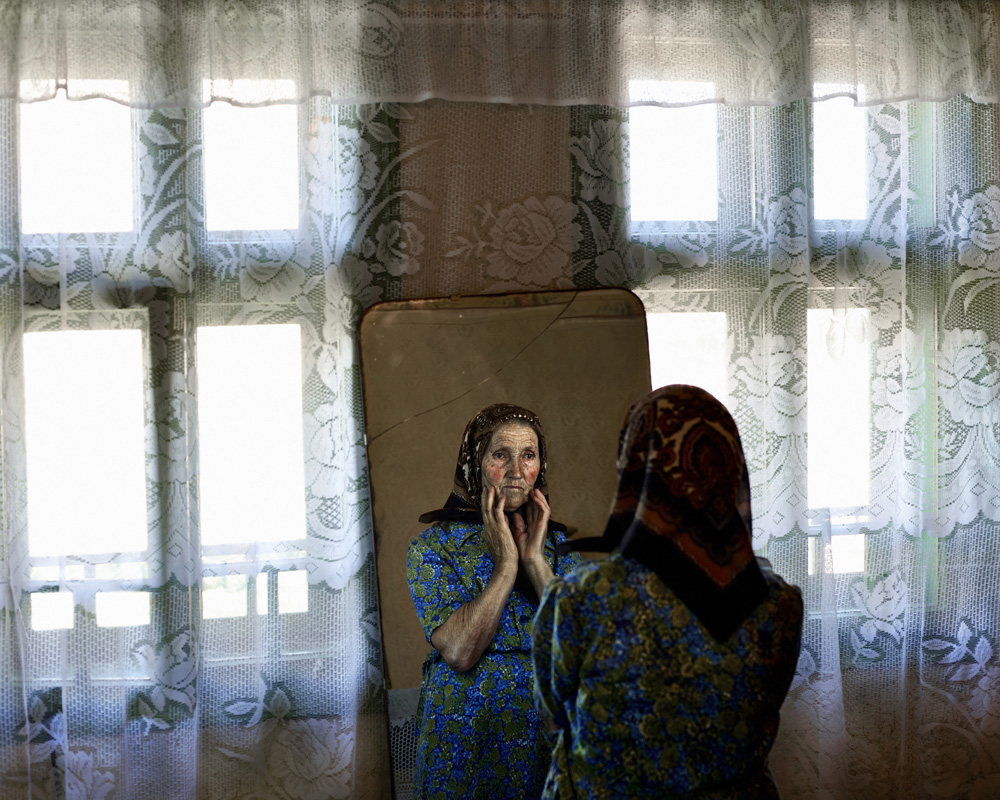
For his series Notes for an Epilogue, Tamas Dezso captured scenes of post-Soviet Romania:

[T]here is a documentary element to the photos, which chronicles a way of life that is fast disappearing. The communist-era factories and structures being salvaged for scrap will eventually vanish. Entire villages, like Geamana in the fifth slide, have already been abandoned entirely. The cultures in the area are also disappearing…. It may seem rural Romania’s transition into post-soviet life is taking an inordinately long time, but Dezso says the region operates at a different pace than many westerners are used to. This is another imperative behind his effort to capture the essence of what’s being lost — these are cultures and traditions that have lasted a very long time, and now stand to disappear in the equivalent blink of an eye.

(Photo by Tamas Dezso)

The Moral Fiber Of Fiction

Paula M.L. Moya explores the connection between literature and morality:

Because works of literary fiction engage our emotions and challenge our perceptions, they both reflect on and help shape what we consider to be moral in the first place. Importantly, this can be the case as much for the author as for the reader.

Consider Toni Morrison’s Sula.

In a 1985 interview conducted by Bessie Jones, Morrison formulated the question that motivated the novel Sula: “If you say you are somebody’s friend as in Sula, now what does that mean? What are the lines that you do not step across?” Elsewhere in that same interview, Morrison explains that she views writing as a way of testing out the moral fiber of her characters in order to see how they respond to difficult situations: “Well, I think my goal is to see really and truly of what these people are made, and I put them in situations of great duress and pain, you know, I ‘call their hand.’ And, then when I see them in life threatening circumstances or see their hands called, then I know who they are.” Moreover, because Morrison regards writing as a process of moral and epistemic investigation, she does not write about ordinary, everyday people or events. Instead, she plumbs the hard cases—the situations where “something really terrible happens.” She explains: “that’s the way I find out what is heroic. That’s the way I know why such people survive, who went under, who didn’t, what the civilization was, because quiet as its kept much of our business, our existence here, has been grotesque.” The process of writing a novel can be mode of inquiry in which the “answer” surprises even the author.