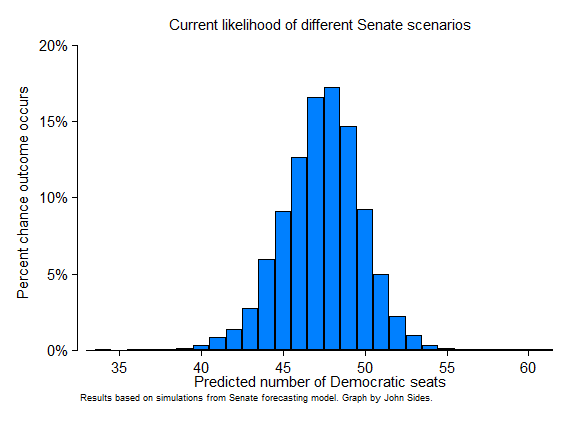
John Sides updates his forecasting model:
One key piece of information is whether candidates have held an elective office before and, if so, which one. Unsurprisingly, political science research has long shown that candidates who have held elective office and higher levels of office tend to do better on Election Day. They usually run better campaigns and make fewer mistakes, if only because they’ve done it before. As we have begun to incorporate candidate experience into the model, our initial sense is this: Republicans may have a far better chance of winning control of the Senate than we or other analysts previously thought. Here is a preliminary estimate: The GOP could have as much as a 4 in 5 chance of controlling the chamber.
Harry Enten looks at the generic ballot, which also suggests a rough election for Democrats:
In the closing days of the 2012 election, Democrats led the generic congressional ballot by an average of 3.2 percentage points among registered voters, according to the final five polls that released registered voter numbers (CBS/New York Times, CNN/ORC, Gallup,United Technologies/National Journal and YouGov/Economist). The generic ballot is a standard polling question that typically pits a generic Democrat against a generic Republican in a race for Congress. It’s one of the best indicators of the national political environment. Over the past month, the Democratic advantage among registered voters on the generic ballot is down to 0.5 points. That’s a gain of 2.7 points for Republicans.
Kilgore considers the Democrats’ turnout efforts:
The X-factor is whether the social-media-focused, voter-to-voter motivational techniques deployed by the Obama campaign to such good effect in 2012 are replicable in a midterm. In the old days, for Democrats especially, GOTV centered on “knock-and-drag”—flooding heavily pro-Democratic areas with labor-intensive campaign contacts, especially immediately prior to or on Election Day. That is not so easy with geographically dispersed young voters (other than on college campuses), and with the spread of early voting. And that’s why the new GOTV techniques—less limited in time and place—are so important.
 The Dish