Peter Matthiessen, the writer and naturalist, died of leukemia on Saturday at the age of 86. Jeff Himmelman profiled Matthiessen in a piece published just days before his death (NYT):
Though Matthiessen is not as well known as some other names of his generation, you would be hard-pressed to find a greater life in American letters over the last half-century. He is the only writer ever to win the National Book Award for nonfiction and fiction, but it’s not just the writing: Born into the East Coast establishment, Matthiessen ran from it, and in the running became a novelist, a C.I.A. agent, a founder of The Paris Review, author of more than 30 books, a naturalist, an activist and a master in one of the most respected lineages in Zen. As early as 1978, he was already being referred to, in a review in The New York Times, as a “throwback,” because he has always seemed to be of a different, earlier era, with universal, spiritual and essentially timeless concerns.
David L. Ulin distills Mattiessen’s work to “five essential reads” and reviews his final novel, In Paradise, which came out Tuesday:
In many ways, it’s a fitting coda to his career, the story of a meditation retreat at Auschwitz, based on an experience the author had in 1996. On the one hand, that seems antithetical: “In this empty place,” he writes, “… what was left to be illuminated? What could the witness of warm, well-fed visitors possibly signify? How could such ‘witness’ matter, and to whom? No one was listening.” At the same time, where better to look for some sort of human essence than in a landscape that embodies us at our worst?
This is the key message of Matthiessen’s life and writing — that we are intricate, thorny, inconsistent, that the lines between good and bad blur within us, that we are capable of anything. The only choice is to remain conscious, to engage with openness.
Matthiessen gave one of his final interviews to Alec Michaud in February, expressing his philosophy of writing:
Do you think a novel should be about a Big Important Subject?
I think all novels should challenge the establishment — it’s our duty to speak for those who can’t speak for themselves. But if you expect your readership to pay attention, it’s our duty to write as well as we can and to eliminate extra adjectives, adverbs. I keep finding out I’m not one of the so-called top fiction writers and I guess that’s certainly true in terms of public acceptance. But take At Play in the Field of the Lord and Far Tortuga and Shadow Country — not this new book, because I don’t think that’s in the same class as those other books — I’ll put those novels up against just about anybody’s three novels. They take risks, and the risks are interesting, I think. You stick your neck out. It’s no fun to write something you have down to a formula.
Alex Caring-Lobel remembers Matthiessen as a Zen priest:
His Zen training heavily influenced a number of his works, such as Far Tortuga (1975) and The Snow Leopard (1978), but the relationship between Matthiessen’s Zen practice and writing was somewhat ambivalent. He never tried explicitly for dharma insight in his writing, and he began working on Far Tortuga, the novel most impressed, he said, by his Zen practice, before ever sitting zazen. The protagonist of his new novel, In Paradise, which takes place at a “bearing witness” meditation retreat at Auschwitz, is quick to deride what Matthiessen’s root teacher called “the stink of Zen”—self-conscious spirituality and its pretensions.
Malcolm Jones pays tribute as well:
Matthiessen’s generation is almost gone. He was one of the last. But while the dreams and ambitions that drove most of those writers—to write the Great American Novel, to live life on a large and even glamorous scale—now seem old-fashioned, even quaint, Matthiessen endures. His fascination with nature and with the unknowability of reality—and the necessity of articulating that mystery—comes without expiration dates. He taught several generations about the beauty of the wild and how to find a place in it. And generations from now novelists will still be learning from him. In wisely sidestepping the hubristic folly of trying to sum up his own time, he achieved a sort of timelessness.
The New Yorker has assembled a collection of his travel writing here. Matthiessen’s 1999 Paris Review interview, in which he explains why he identifies more as a writer of fiction than nonfiction, is here. Listen to Terry Gross’s 1989 interview with the author here.
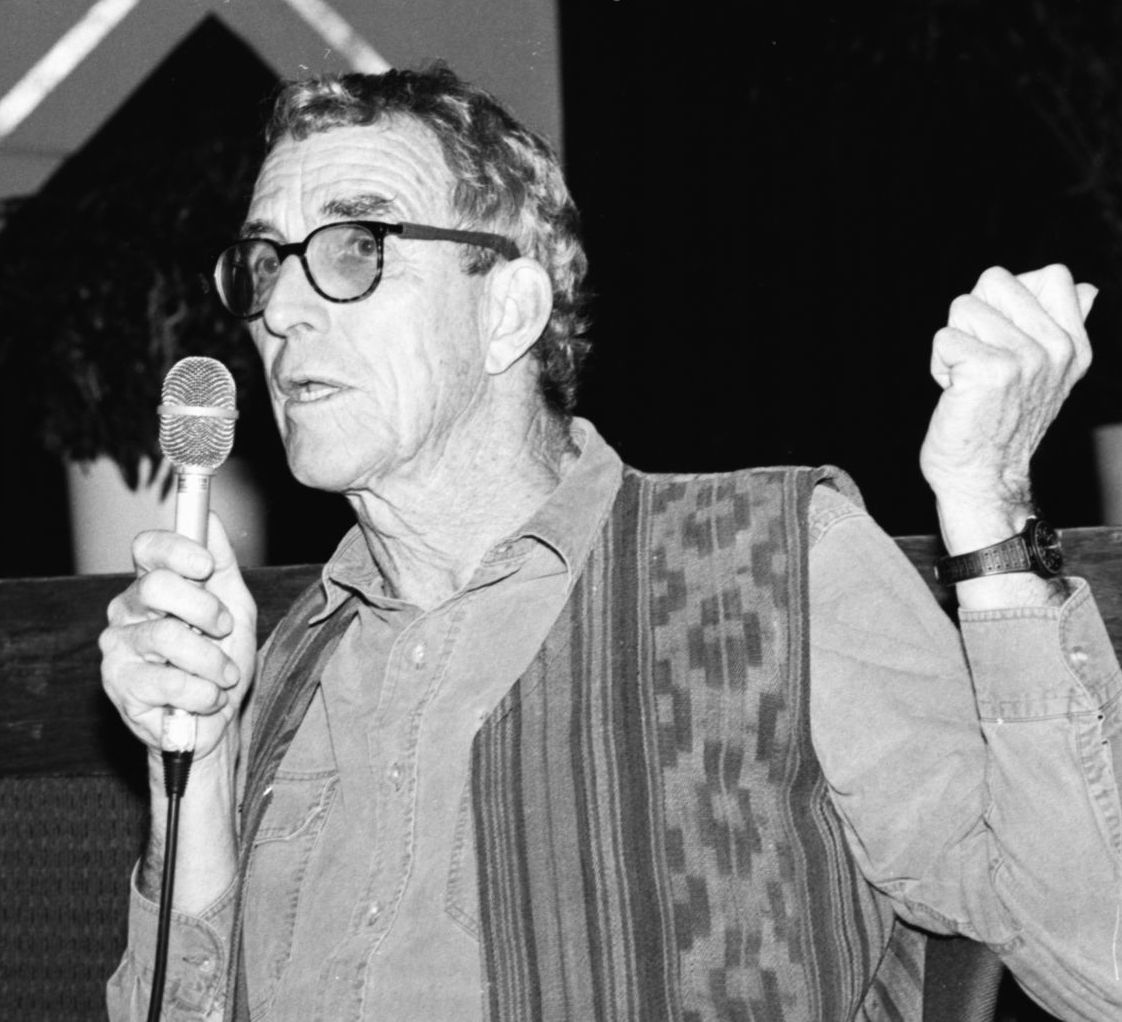
(Photo of Peter Matthiessen, Miami Book Fair International, 1991 via Wikipedia)
 The Dish