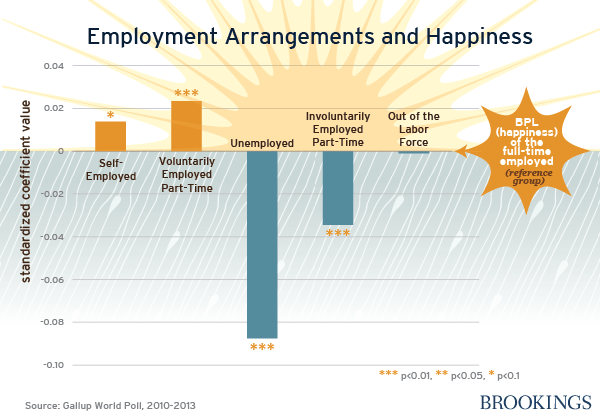
Leonid Bershidsky highlights new research showing that people who work later in life tend to be happier:
In a recent paper, [Brookings fellow Carol] Graham explored the relationship between well-being and late-life work. She found that there are “well-being benefits to voluntary part-time employment as well as to remaining in the workforce beyond retirement age.” These results are especially pronounced in countries where part-time work is the norm and people work past retirement age out of choice rather than necessity. … In the end, older people are happier, and feel healthier, when they are active and feel needed.
Graham, who provides the above chart, considers the ideal work arrangement:
Of course, not everyone has the luxury of choosing to work part-time, and many of those workers who choose to work beyond the retirement age do so precisely because they like their work.
Still, our findings provide some food for thought. Perhaps we can imagine a future where over-burdened middle- aged workers with children have more flexibility to work part-time, with late-life workers taking up some of the slack. The latter would help ease the burdens posed by fiscally unsustainable pension systems.
Looking at Graham’s country-by-country findings, Christopher Ingraham focuses on the study’s major outlier – Russia:
In most countries, the happiness curve bottoms out somewhere around middle age — 47 in the United States and 41 in Britain, for instance. This usually happens long before the average person is expected to die, with one major exception: Russia. In Russia the curve doesn’t bottom out until age 91. Essentially, life under Putin is one continuous downward spiral into despair.
Graham explains it bluntly: “What’s going on in Russia is deep unhappiness.” In the Organization for Economic Cooperation and Development’s Better Life Index, for instance, Russians rated their general life satisfaction a 3.0 out of 10. Three-quarters of Russians are “struggling” or “suffering,” with only 25 percent “thriving,” according to their responses to a 2012 Gallup survey. Contrast these figures with the United States, where life satisfaction is a robust 7.6 and nearly 60 percent are thriving.
 The Dish