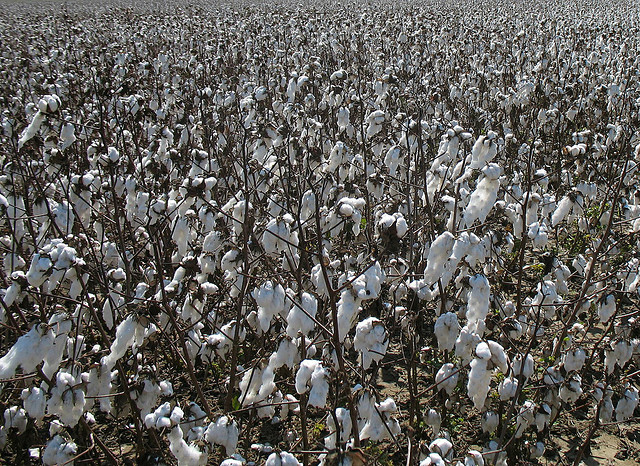
High Cotton author Gerard Helferich visited farms in Mississippi to examine “the forces that have exiled cotton from its historic homeland and to ponder what its loss means for farmers, for others in the industry, and for the rest of us”:
In the end, what is gained and what is lost by the Delta’s shift away from cotton? It’s clear that if Mississippi farmers never harvested another boll, the world would still have plenty of the fiber to meet its needs. The region’s residents may miss the sight of cotton nodding in the fields and the evocative scent of fresh-picked lint. Those whose livelihood depends on the crop, such as brokers and gin workers, have already suffered from cotton’s retreat. The local economy has been pinched, as cotton’s greater capital investment and higher employment needs have drained away. … Excluding [Quito Gin owner David] Grossman, every farmer I spoke with believes that he is better off for diversifying his crops. In fact, as I’ve talked to growers large and small over the past few months, I’ve heard very little nostalgia for cotton.
Yet “even as the creation of the finished product disappeared from the US economy,” observes Matthew MacFarland, “demand for American cotton in the global textile sector has only grown: Exports’ share of domestic cotton production has expanded from 32 percent in 1948 to 74 percent in 2012.” He examines the bottom line as the product moves to cheaper labor markets:
Enter Bangladesh, a country whose garment exports have skyrocketed from a mere $6.4 million in 1983 to $21.5 billion in 2012. Bangladesh’s ready-made garment (RMG) industry has been the sole force behind the country’s rapid industrialization, shifting its economy away from agriculture and toward manufacturing and drawing a rural population into the churning city of Dhaka. … The Bangladesh RMG industry gets most of its cotton from India and Uzbekistan, countries that trail the US in terms of sheer cotton exports but whose proximity makes for cheaper and easier trade. But while the likelihood of an American farmer’s cotton ending up in Bangladesh is low, a piece of clothing made in a Bangladeshi factory has a one in four chance of ending up in the US and a 50 percent chance of ending up in the European Union. In other words, on the supply side, American cotton and Dhaka factories are cousins several steps removed. In terms of demand, the relationship between Western retailers—and consumers—and the RMG industry is more directly causal. Including the Pacific Ocean, 8,500 miles lie between Yazoo City and Dhaka—but that distance vanishes between here and any local mall.
Previous Dish on the costs of clothing here, here, and here.
(Photo of “September in the Delta” in Leflore County, Mississippi, 2006, by Natalie Maynor)
 The Dish