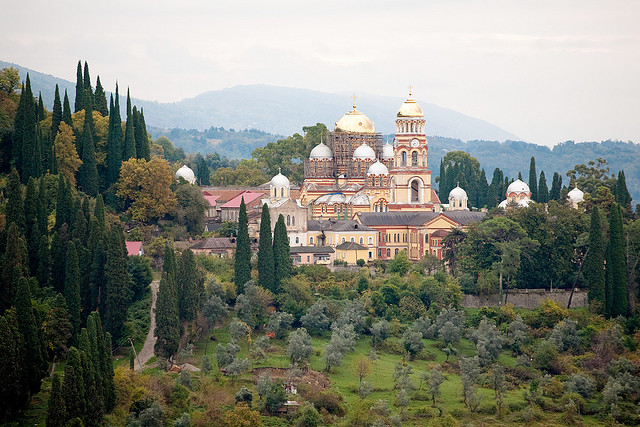
Tom Whipple finds himself making repeat visits to Mount Athos, home to 1,400 monks who tend the “vestal fire” of the Orthodox church:
Athos is a place where a bearded octogenarian who has not seen a woman in 60 years can venerate the bones of a two-millennia-dead saint, then pull out a mobile phone to speak to his abbot. Where a pilgrim with a wooden staff in one hand can have a digital camera in the other. And where, in the dim light of dawn matins, I can look on a church interior that would be instantly recognisable to a pilgrim from five centuries ago. …
To understand Athos you have to accept it is magic. Not in the sense that the supernatural actually occurs: at least, not so far as I am concerned. But here people really believe in magic. Every monastery, even the lowliest, has its “miracle icons”. In one there is an ancient painting of the Virgin, saved from the iconoclasm of early Orthodoxy, that reputedly screamed out in pain when the monastery was set on fire. Still blackened from the ordeal, she receives medallions and offerings from people who want her help.
Reflecting on a recent visit, he wonders what calls him to Athos:
Of one thing I am sure: my motives have nothing to do with spirituality, except in the very loosest sense. Why, then, do the monks let me come?
They are not stupid; they know that not all pilgrims are as pious as they pretend to be. But providing hospitality to guests is their calling. Besides, they would say that God knows why I am here better than I do. Other places are pretty, other places are unusual, yet like many I keep returning.
On my last night, I go to the shower. I drop my towel on the way to the cubicle. I bend to pick it up, and when I return there is a monk standing in front of me. “Do think”, he says, “about the true religion.”
Maybe I will, someday. But at the time I remember what a pilgrim called Marcellus told me the last time I was here, over the dregs of a bottle of ouzo. He too was a regular, but not especially holy, visitor. He, however, knew why he came: “We have lion reserves, elephant reserves, monkey reserves,” he said. “Why not monk reserves? Why not let monks live in their natural habitat, an endangered species preserved for the world?” He smiled, pleased with the analogy, and poured another glass.
(Photo of monastery at Athos by Svetlana Grechkina)
 The Dish