Book Club: Can Christianity Survive Modernity? Ctd

All of these readers seem to answer “yes” to the above question:

I was raised a Christian in a tiny, Midwestern town where everyone went to either the Catholic church or the Protestant church. I was surrounded by unquestioning believers until I left for college. I had lost how-jesus-became-godmy faith in my early teens and it stayed lost for the next 40 years or so. But I now consider myself a Christian, with all the attendant doubts and questions. I credit books like Ehrman’s and groups like the Jesus Seminar for my change of heart.

Why? Because their research and scholarship affirmed the actual existence of Jesus and his horrific death. Up until then, Jesus was just a mythical being, like Zeus or Thor. I felt I finally had something solid to stand on, and so I started my faith journey.

I didn’t mind the messiness and contradictions in the gospel accounts at all. It makes it feel more authentic and vivid to me, like I was witnessing all those men and women trying to make sense of something new and strange. I would have been extremely skeptical if the New Testament had been a smooth and seamless account, because I can’t imagine actual humans responding to such wild events in a smooth and seamless way. I mean, it must have been so weird, y’know?

Another is on the same wavelength:

The problem comes when a screwdriver is used to drive a nail into the wall. Logic as we know it is not at the core of religion. This is not a diss; religion is akin to non-Euclidean geometry, or to quantum physics. It goes by a different creed, ethos, set of “rules” – whatever.

bookclub-beagle-trEhrman’s textual analysis is great, and I’ve loved his books. To see his scholarship as weakening Christianity, however, is to sell religion short. The story of Christ is a portal, a doorway to enter religious life. Its literal truth or untruth is of little to no interest. People who insist on the inerrant truth of this or that need to watch Rashomon a few times, take mushrooms, and chill out. The Gospels are full of Jesus telling parables; get the hint?

Another:

I am a practicing Catholic who attends Mass almost every Sunday, prays every day and even prays the Liturgy of the Hours as often as my hectic schedule allows. I love the Catholic Church despite having some great misgivings about some of its priorities and teachings, especially in the areas of sexuality. I concluded long ago from reading Ehrman, Geza Vermes and others, that the New Testament is almost an historical novel, with many (but by no means all) of the words of Christ having been made up by the authors of the Gospels. Since I believe that the fall of man in Genesis cannot be true, I cannot believe that Christ died and was resurrected as a sacrifice to expiate original sin.

So why am I a Catholic?

You wrote: “But since the scholarship is pretty much indisputable, it seems to me that it is not Christianity that should be abandoned in the wake of these historical revelations, but a false understanding of what the Gospels and Letters actually are.” This sums up why I still consider myself a Catholic. As Ehrman lays out in his book, the beliefs of the early Church evolved as the theologians and philosophers tried to figure out who and what Jesus was. They couldn’t know, because even people who knew, loved and followed Christ apparently didn’t fully understand him. All the Church fathers had were the writings of others and oral traditions. What they achieved was a tour de force of logic and intellect as they refined their understanding of Christ.

Is this refined understanding accurate? Of course not, and neither is Ehrman’s, but it is the best we can do as mere humans. A Church that at least proclaims the hope and love exemplified by Jesus is my home.

Interestingly, Ehrman has written elsewhere that he is agnostic not because of where his scholarship has led him, but because of the issue of theodicy.

In Ehrman’s words:

About nine or ten years ago I came to realize that I simply no longer believed the Christian message. A ehrman_bart_12_020large part of my movement away from the faith was driven by my concern for suffering. … We live in a world in which a child dies every five seconds of starvation. Every five seconds. Every minute there are twenty-five people who die because they do not have clean water to drink. Every hour 700 people die of malaria. Where is God in all this? We live in a world in which earthquakes in the Himalayas kill 50,000 people and leave 3 million without shelter in the face of oncoming winter. We live in a world where a hurricane destroys New Orleans. Where a tsunami kills 300,000 people in one fell swoop. Where millions of children are born with horrible birth defects. And where is God? To say that he eventually will make right all that is wrong seems to me, now, to be pure wishful thinking.

Another reader:

“Does this book effectively debunk Christianity’s core claims in modernity … or does it point to a new way of understanding and believing them?” I have wrestled with this same question after reading Reza Aslan’s book, Zealot. What his book and Ehrman’s book point towards is that Christianity as we know is a Romanized version that is far removed from the actual lives and times of Jesus of Nazareth. But for me, both books gave me a stronger faith in Jesus. This may be because I have always been quite liberal in my interpretation of Christianity. For me, follow the Golden Rule, help the least fortunate amongst us, and trust in the teaching of Jesus have always been the central tenants of my faith.

I am often told that to be Christian you have to believe in the Resurrection. You have to believe that Jesus died on the Cross for our sins and was resurrected to sit by God. Both of these books ultimately arrive at this point as well. Is one a Christian if they do not believe in the Resurrection? If there is no Resurrection, is there Christianity?

This is a question I have grappled with and continue to grapple with at this time. However, I think the answer to both questions is that the Resurrection does not have to be literal, as is true of other parts of the Bible. Why would it diminish the faith if Christianity/the Resurrection were interpreted to be that Jesus taught us how to live a better life, temper our sins, have a relationship with God, and died for these teachings and went to Heaven as the Son of God, as all of us will as the son and daughters of God? This would only diminish the faith in so far as it would not appeal to 3rd and 4th century Roman authorities and fulfill a literal interpretation of the Messiah prophecies.

I don’t know about you, but the former provides me a stronger faith for living in the 21st century and is more accurately backed up by historical research. This is why I say both of these books should give us comfort as Christians living in the 21st century, as we can embrace a historical Jesus that is divorced from the politics of the creation of the religion that is named after him. As Aslan writes, this is a Jesus worth believing in and following towards a relationship with God.

Another:

Let me start by saying that I am at least a non-theist and very probably what almost anyone would describe as an atheist.  I also have a Jewish background and very strongly identify with the Jewish community.

So does Ehrman “debunk Christianity’s core claims…”?  Absolutely not.  What he does do is make it clear that these Gospels were written by human beings who had very human motivations, and not all of those motivations were directly related to pure belief in Jesus.  They had political motivations, personal feelings, and all the limitations of humans – not to mention very little or no understanding of the physical world that our science has begun to give us in the past 300 or so years.

It is of course possible that the core claims of Christianity are not true, but just because the gospels were written by flawed human beings doesn’t make them so.  It is certainly possible that the understanding of Jesus evolved along exactly the lines that Ehrman describes and slowly and gradually approached the current “truth” – or maybe even that the understanding of that truth can evolve further.  It is possible that the followers of Jesus simply did not or could not grasp the full truth immediately and that it took them centuries to get there.

On the other hand, it is very difficult to distinguish this process from another process – the development of a false religion over hundreds of years as its doctrine grew.  How can we tell the difference between a true religion in which theology developed and a false religion that added layer after layer of false theology?  I don’t think we can from examining the historical record of how the theology grew.

So Ehrman neither debunks nor proves Christianity, but I think he does make believers face the fact that the Gospels were written by humans (with all that implies) and theology is rarely completely static and fixed.  There I think he does a great service to Christians, if they will allow it.

Another atheist reader:

Your question of whether Christianity can survive modernism grabbed me.  It is a serious question whether any Church can survive, without another schism, the conflict between fundamentalists and “modernists” we see being played out in the world.  Pope Francis may have found the answer – de-emphasize the doctrinal elements of the faith and emphasize the compassion in the rituals and good works inspired by the faith.  A wonderful balancing act, in which I wish him all the best.

(Please email any responses to bookclub@andrewsullivan.com rather than the main account. Read the whole Book Club thread on How Jesus Became God here.)
Humanists In The Foxhole

Adelle M. Banks reports that the military will now allow serving members to identify as humanists:

More than two years after first making his request, Army Maj. Ray Bradley can now be known as exactly what he is: a humanist in the U.S. military.

“I’m able to self-identity the belief system that governs my life, and I’ve never been able to do that before,” said Bradley, who is stationed at Fort Bragg in North Carolina and works on supporting readiness of the Army Reserve’s medical staff. Lt. Col. Sunset R. Belinsky, an Army spokeswoman, said Tuesday (April 22) that the “preference code for humanist” became effective April 12 for all members of the Army. …

The change comes against a backdrop of persistent claims from atheists and other nonbelievers that the military is dominated by a Christian culture that is often hostile to unbelief. In recent years, activists from the broad spectrum of freethinking organizations have demanded equal treatment as the tradition-bound military grapples with the growth of the spiritual-but-not-religious population.

Jason Torpy explains the importance of the decision:

For many atheists in the military, identifying as a humanist is a positive expression of their values. The unintended consequence of religion vs. non-religion debate results in only two options: belief in a god (usually the Christian one) or belief in nothing. Humanists believe in many things—reason, compassion, empathy, and service for others, as exemplified by Humanist Society Celebrants or charitable organizations like Foundation Beyond Belief.

In addition, recognizing “Humanist” as an answer to the religious preference question is a step toward recognizing humanist chaplains in the military. Religious service members have long enjoyed the benefit of talking privately with a chaplain, and humanists should be afforded the same access to a leader who is training in counseling and understanding of humanist and non-religious viewpoints. Many major religious and non-religious leaders are in full support of a humanist chaplain in the military, even when the House of Representatives rejected the idea.

Our previous coverage of humanist chaplains is here and here.

A Poem For Sunday

13088747563_3394ddb557_b

“Not a Raven” by Nina Cassian:

A bird—very close to me,
a kind of relative,
showed me a hidden spring
in the woods.
I tasted it,
and suddenly leaves covered my body.
Two squirrels
jumped on my shoulders.
The spring itself
engulfed my legs
like a transparent weed.

We stayed like this
till evening fell.

Then the bird announced to me
my youth had come to an end.

(From Continuum: Poems © 2008 by Nina Cassian. Used by permission of W.W.Norton & Company. Photo by Martin Fisch)

A Double-Barreled Canonization

Today Pope Francis declares Popes John XXIII and John Paul II to be saints, the first double papal canonization in Church history. To give Dish readers added context about the event, Byliner has unlocked The Secret World of Saints by Bill Donahue (not the insufferable one from the Catholic League). It’s an in-depth look at the canonization process, which John Paul II streamlined:

When he became pope in 1978, John Paul II was keenly aware that the saint-making process was malleable. A playwright in his early days, he also recognized the theater inherent in sainthood, and he saw that, by minting new saints, he could endear the Church to its growing flock in Africa, Asia, and South America. And so, in 1983, he simply changed the rules. He did away with the devil’s advocate—suddenly there was no longer an official naysayer hovering over each sainthood cause. He also reduced the number of miracles needed for sainthood. For centuries, four miracles had been required of non-martyrs. John Paul cut that number to two.

In his twenty-six-year papacy, John Paul canonized 482 people—more than had been named during the preceding five centuries. He beseeched local dioceses to recommend saintly candidates so that Catholics everywhere might feel that they live amid exemplars of holiness. He specialized in mass canonizations (among them, the 120 Martyr Saints of China, canonized in one fell swoop in 2000) and in sanctifying people of color—for instance, Josephine Bakhita, a Sudanese-born slave.

Both of these popes also benefited from exceptions to the established path to sainthood, especially John Paul II, whose canonization only nine years after his death sets a modern record:

John Paul’s record sprint to sainthood started during his 2005 funeral Mass, when chants of “Santo Subito” or “Sainthood Now” erupted from the crowd. Bowing to the calls, Pope Benedict XVI waived the typical five-year waiting period before a saintly investigation can begin and allowed the process to start just weeks after his death.

The rest of the process followed the rules: John Paul was beatified in 2011 after the Vatican certified that a French nun suffering from Parkinson’s disease was miraculously healed after she prayed to him. A Costa Rican woman whose inoperable brain aneurism purportedly disappeared after she prayed to John Paul was the second miracle needed for canonization. …

John XXIII was beatified in 2000 after the Vatican certified that the healing of an Italian nun suffering from a gastric hemorrhage was miraculous. Pope Francis, very much a spiritual son of John, waived the Vatican rule requiring a second miracle so that John could be canonized alongside John Paul.

When asked what these two popes were known for, Rachel Zoll explains their divergent reputations – but also notices the shrewd politics behind Pope Francis canonizing them together, which she describes as “balancing the ticket”:

One is Pope John XXIII who served from 1958 to 1963 and he’s known for his modernizing reforms of the church, bringing it out into the modern world. And the other is Pope John Paul II, who served from 1978 to 2005 when he died. And he’s known for, obviously a lot of things, but he also helped uphold orthodoxy and doctrine, and was seen in a way as putting some control around, or course corrections around, the reforms that John Paul XXIII had put in place.

There’s a left-right divide in the church and it is very wide. And by bringing these two men together for canonization at the same time, he’s saying a lot of different things. He’s saying one isn’t–there not at odds with each other, that they’re more on a continuum of how they led the church and also, that there’s room for everybody. This is a big message of his pontificate, that he wants all people of different views to be welcome in the church.

George Weigel makes a similar observation, but in the context of the Second Vatican Council, which began at John XXIII’s prompting:

Pope Francis’s bold decisions to canonize Blessed John XXIII without the normal post-beatification miracle, and to link Good Pope John’s canonization ceremony to that of Blessed John Paul II, just may help reorient Catholic thinking about modern Catholic history. For what Francis is suggesting, I think, is that John XXIII and John Paul II are the twin bookends of the Second Vatican Council—and thus should be canonized together.

Zooming out, Michael Lipka and Tim Townsend remind us that a pope becoming a saint is “a rarity in modern times”:

Roughly 30% of all popes are saints. Starting with St. Peter, traditionally regarded as the first leader of the church after Christ’s death, 52 of the first 55 popes became saints during Catholicism’s first 500 years. In the last 1,000 years, just seven popes have been made saints, including the two being canonized on Sunday.

You can purchase The Secret World of Saints as a Kindle Single here.

Mary Magdalene, Disciple?

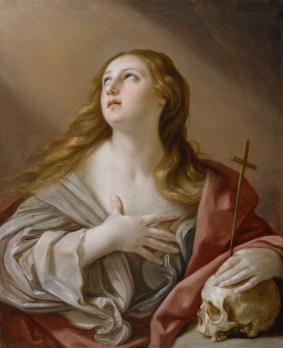
Ann Turner rejects the claim that Mary was a prostitute and describes her – the only woman in the New Testament whose full name is used – as “a model of what a true disciple looks like”:

[A]ttempts to move Mary to the background of the Passion Narratives and to erase her as a vital and Guido_Reni_-_The_Penitent_Magdalene_-_Walters_372631loving witness to Jesus began well before the fifth century. It began with the writer of Luke, in Acts, where Peter and Paul are given center stage as those who preach to the Gentiles, as those who witness to the risen Christ — ignoring that it is Mary Magdalene, called the Apostle to the Apostles, who first sees the risen Christ in the garden, according to both the Gospels of Matthew and John. In Luke, when Mary and two other women return breathless and excited to say they have seen the Lord, the male disciples think their words are “like nonsense” (Luke 24:11). Is the author of Acts responsible for this erasure of The Magdalene, as she sometimes is called, or is it part of a wider effort to discredit her authority and put Peter at the head of the new church?

In the sixth century, Pope Gregory the Great tried to undermine Mary Magdalene’s reputation by connecting her story to the story of the prostitute that precedes her story in the Gospel of Luke. But this is a later misinterpretation. Luke is clear that Mary was the woman healed by Jesus when he expelled seven demons from her. And Mary responded by contributing to Jesus’ ministry and following him. Luke says she was a woman of means, like some other women who followed Jesus. They were not just followers in the passive sense — they were disciples.

(Image of The Penitent Magdalene by Guido Reni, circa 1635, via Wikimedia Commons)

Turning The Nones Toward Faith, Ctd

Damon Linker claimed last week that possibly “the most daunting obstacle to getting the nones to treat traditional religion as a viable option is the sense that it simplifies the manifest complexity of the world.” Millman quibbles:

I do think that pluralism poses a fundamental challenge to traditional religion. But it’s not the pluralism of modes of knowledge that poses a challenge, but the pluralism of identity. It’s not that traditional religion can’t “handle” natural selection, or psychopharmacology, or biblical source-criticism; it’s certainly not that it can’t explain the evil of the Holocaust. It’s that traditional religion – Abrahamic religion, anyway – demands that you identify yourself definitively as an adherent. It demands an unequivocal commitment. And contemporary young people, according to all the evidence, are very wary of making commitments like in any walk of life: in love, in work, or in terms of religious identity.

Picking up on similar themes, David Session offers advice to millennials facing this pluralistic world, claiming that “whatever earnestness and work ethic millennials may have, they face seemingly endless indistinguishable choices, and respond with defeated detachment—indecision.” What they should do:

All we have to do is start living different ways, a little at a time. Start committing to people, places, things. Say yes to your friend’s party Saturday night, and go anyway even when something better comes up. Join an organization that fights for an issue you care about, and keep going even when the meetings are long, boring, and seem pointless. Fight for someone below you, anyone: immigrants, minorities, the homeless, the incarcerated, whoever; you’ll realize you had more in common with them than you thought. Commit to a person or people; stay in the same city with them, live with them, marry them. Join a union, especially if you’re the only member under 50; if there isn’t one where you work, start one. If you can find one that hasn’t retreated into spiritual apoliticism or reactionary traditionalism, I don’t even care if you take up a religion.

The point is to build human ties, add little by little to your network of solidarity, make it thicker and stronger. It won’t be enough, but it’ll be a start.

Book Club: Occam’s Razor And The Gospels

[Re-posted from earlier today. The whole Book Club thread on How Jesus Became God is here. Please email any responses to bookclub@andrewsullivan.com rather than the main account.]

A reader turns the conversation toward something I wrote:

You clearly do not believe in Occam’s Razor. You write that “Jesus was not the only first-century who was deemed to have a virgin birth, martyrdom and resurrection. In fact, these were quite common tropes in the Greek and Roman world at the time.” Next paragraph: “And in that astonishing vision of a Jesus fully alive after death, so much that had mystified his disciples in Jesus’ life and teachings suddenly became clear. This man truly was God.”

So you’re acknowledging that there were a fairly large number of Jesuses bookclub-beagle-trrunning around Judea at the time, all making similar claims.  But in the next breath you declare your certainty that the one you worship really was the Son of God (whatever that means) and the rest were phonies.

So which explanation is simpler, and infinitely more probable: (1) you are right, the universe is ruled by an immortal, all-powerful entity that shares attributes with some creatures living for an ungraspable brief period of time on one tiny planet among a countless number of other planets in an infinitely large universe, and who had a son that was identical to these isolated creatures, and decided to sacrifice his son to pay for the follies of these creatures, or (2) the Christian myths of the resurrected man/god, which had been around for a long time before your cult figure was born, for a variety of historical reasons, became centralized in this one figure?  The question answers itself.

Andrew, I’m sorry, but you have to see why most Christians must put on the blinders and believe in rote dogma. The whole mess otherwise falls apart so, so rapidly.

Another reader:

I’m always confused when I’ve read you write things like “Even through [the Gospels] obvious literal imperfections, a deeper perfection shines.”

I don’t really know if you mean that the Gospels don’t actually need to be literally true AT ALL – that it’s really just their deep metaphorical, spiritual meaning that matters – or if you still believe that in some how-jesus-became-godareas they do have to refer to literal truths.

If it’s the first, then I could agree with that view of the Gospels – spiritual truth can be conveyed by all sorts of texts that are not literally true. But if it’s the second, then I wonder how Ehrman’s book doesn’t create a core doubt in you or in Christianity in general. Because it seems to me that it pushes the answer to the question of whether or not modernity and Christianity can co-exist towards “no”.

For example, Christians believe that Jesus was resurrected in the flesh. But we’ve learned that Jesus and the apostles lived in a world where virgin births were not unique to Jesus, and neither were people who were half-god and half-human. So I imagine that resurrection stories also existed outside of Jesus’ story. (And maybe that’s answered in a later part of the book than I’m currently in!)

A glance at the biblical record:

Nine individuals in scripture are clearly presented in the Bible as being raised from the dead. Of these miraculous resurrections, three occur in the Old Testament. At least three individuals were raised from the dead by Jesus. Both Peter and Paul raised a person from the dead and most importantly of all, Jesus himself was resurrected. In addition, an untold number of saints were resurrected at Jesus’ crucifixion (Matthew 27:52-53). Also, it is incredibly possible that Paul himself was resurrected after he was stoned and left for dead (Acts 14:19-20).

The reader continues:

If so, why is Jesus’ resurrection any more special than any other resurrection from a different tradition? If we believe Jesus’ story, shouldn’t we believe the others’ stories? Other people in other religions had equally strong faith. And if we don’t believe the other stories, why believe Jesus’? Couldn’t the apostles have been hallucinating, under some form of mass delusion? What makes Jesus’ story so special that you must believe it is true when others aren’t?

For me, Ehrman’s book bolsters the argument that the answer is that it’s not special. It shows that the Gospels are, as you say, messy, inaccurate, internally conflicted, human. They took from and paralleled other traditions of the time. Like many other religious stories, the story of Jesus is a universal spiritual quest filtered through the particular individual, cultural and historical conditions in which it existed. It’s not really special in the way that I think Christianity requires.  So, without that specialness, how DOES Christianity survive?

Another wants clarification:

“Does this book effectively debunk Christianity’s core claims in modernity … or does it point to a new way of understanding and believing them?” Of course the answer to your question depends on what exactly the “core claims” of Christianity are.

If the core claim is that Christ is the Son, co-equal with the Father for all eternity – or similar “high” Christological claims – I do think this book and books like it erect additional barriers to that belief, by shedding light on how they came to be formulated and exposing the gulf between them and the beliefs of the earliest Christians.  It’s very hard to believe that powerful men with very specific interests, writing hundreds of years after Jesus, would have more accurately grasped his nature then men and women closer to his own station, who had learned of him from his own disciples and others that knew him.

If the core claim of Christianity, on the other hand, is that Christ was in some sense God – for example, that Christ represented the extent to which a fully human life could be infused with the power and purpose of God – and that, furthermore, the manner in which he was God allowed him to conquer death and sin, the book does not impact this belief much one way or the other.

The challenge for every Christian is to understand how Jesus, fully human, was nonetheless God; and thereby to understand how we, fully human, can participate in God’s kingdom.  A critical, historical reading of the gospels is an aid in this effort, not an impediment.  If anything, the high Christologies of later years are the impediment, obscuring as they do the real, full extent of Jesus’ humanity, and thus relieving from us the burden of Christ’s greatest challenge to us – to live like him, and through doing so, to act out God’s kingdom in our own lives.

Update: My response to these arguments here.

Tumblr Of The Day

204677448dw

The delightful I Write For SkyMall:

This particular product comes from a severe miscommunication between SkyMall and our Chinese manufacturers, but we’re making the best of it! Because at SkyMall, we know that nothing better accompanies a declaration of love than an entirely unrelated statement of fact.

So let the loved one in your life know just how strongly and literally you feel about them by gifting them the I Love You Stone. If they ever come to doubt you, just tell them, “But it’s on that stone. Spoken out loud.”

I suggest you gift this product in an undecorated box inscribed with the word ‘GIFT’. As you hand off the present, tell your recipient, “This is a gift.” After they open it, as they tearily thank you for the warm and heartfelt gesture, hug them. And as you hold them close, cherish the moment by whispering ever so softly in their ear: “I am hugging you.”

Update from a reader:

You may also enjoy these satirical, occasionally cosmic reviews of SkyMall products.

Breaking Into The Black Market

dish_weed

Roy Klabin talked to “Viktor” – a marijuana distributor who makes an estimated $24,000 to $32,000 per month – about the underground drug economy:

Having a trusted third party transport the weed is the least risky way to get it into the marketplace. “Because you have somebody coming to you, on your terms, paying cash. Boom. Immediately, in one deal, all your illegal weed has just turned into cash. Farmers are eager to offload in bulk, so as buyers we entice them by offering to buy the biggest quantities. The more bulk you buy, the more leeway you have with price.” According to Viktor, it’s a buyer’s market. “There are plenty of people making weed. In California and Colorado, they got more weed than they know what to do with.”

In order to become a broker, Viktor explained, you have to get an in with a farmer—which is no small feat. “It’s easier to befriend distributors than farmers. If you’re a farmer, you’re protecting everything about yourself. Even if you were going to have a visitor, you’re going to black bag their head all the way up. You don’t want them knowing how to get there, remembering anything about where you’re at. If the wrong person finds out about your million-dollar pot farm, they’re going to come up there and kill you. There’s no witnesses, because it’s in the middle of nowhere.”

Meanwhile, Matt Honan investigates the high-tech future of growing and selling pot:

Start with indoor farms, which are massively energy-intensive. Their high-pressure sodium lights, which themselves require large amounts of electricity, can send temperatures soaring. Yet marijuana plants need to stay cool and dry. Traditionally, growers have handled this dilemma by using electricity-gulping HVAC compressors. Colorado company Surna saw opportunity here. It has introduced an energy-efficient climate-control system that uses chilled water. The system pipes a circuit of cooling water through the grow and can even extract water directly from the indoor air to regulate humidity. “This plant is from Afghanistan. It wants to be on a windy hill in semi-arid conditions,” says Surna CEO Tom Bollich. “That’s one thing we can do that traditional HVAC can’t—we can give you 40 percent humidity and 75 degrees.” If Bollich’s name is familiar, it could be that you know him from his previous gig: CTO of Zynga. “I moved on from that, did several startups and moved around, and started looking into the cannabis industry,” he says. “It was the next gold rush, honestly.”

(Photo by Miguel Peixe)

Chart Of The Day

Curse Words

Mona Chalabi looks at childhood profanity:

study published last year in the American Journal of Psychology collected “data about the emergence of adult like swearing in children.” … The study found that, overall, boys had a slightly larger repertoire of bad words than girls (95 compared to 80). But that repertoire varied by age. By age 3 or 4, girls were using 40 taboo words while boys were using 34; but among 7- and 8-year-olds, boys were using 45, and the number of bad words girls were using slipped down to 25.