Adding Penury To Injury

Harold Pollack explains how Medicaid forces millions of people with disabilities to live in poverty in order to remain eligible:

With important variations across the states, most recipients are forbidden from having more than two or three thousand dollars in the bank. You can generally keep your house or your car. That’s pretty much it. You can’t have that emergency fund on hand in case the muffler or the furnace breaks.

And what about the stuff Medicaid doesn’t cover? It’s nice to get your teeth cleaned or just to buy a Big Mac every once in awhile. Because of such means-testing, that new mother is forbidden from setting any money aside for her child’s education. That food services worker living with intellectual disabilities can’t save up for a nice vacation. …

These requirements seem especially strange in the wake of health reform. If you’re on Medicaid because you had a spinal cord injury, you face punishing limitations on your allowable financial assets. If you qualify for Medicaid on the basis of low-income, you don’t face the same limitations. There’s no real justification for this inconsistency. Its one virtue may be that it could prove politically generative, in promoting beneficial reforms. It’s hard to believe that the disability community or the American public will long tolerate this discrepancy.

The 2013 Achieving a Better Life Experience (ABLE) Act, which is on the legislative agenda again this year, is intended to mitigate this catch-22.

What Do Rahm Emmanuel And Chad Griffin Have In Common?

They’re both very adept at manufacturing reality.

We discover today that CNN’s documentary series on Chicago under Rahm was coordinated in ways big and small with the mayor’s office. And – surprise! – it turned into a major propaganda coup for the ambitious Democrat. What you see is how a public figure can effectively get the media to burnish his image by leveraging access. This access-journalism in a very competitive climate can become propaganda very easily griffinetal– and is a win-win for both parties. The media entity gets a high profile product which it can use for ratings and ad money; the politician gets the kind of coverage no ad campaign could ever deliver. The only loser is the viewer.
And the more you see the Becker book’s roll-out continue, you see how brilliantly Chad Griffin has leveraged access-journalism as well – with a special Hollywood twist.  Griffin, after all, is a product of Hollywood – a former agent and prodigious fundraiser. And so I’ve come to think that it’s best to see the Becker book and the coming HBO documentary as ways to manufacture a Hollywood-ready story that begins in 2008 and ends in 2013. That’s what Becker’s book is really about. It reads like a screenplay, packed full of emotional subplots, and quirky characters. In interviews, she has even referred to real people, like Dustin Lance Black, as “characters” in her story. In the big positive front page review in the New York Times (that’s two NYT cover-pieces on this book) Linda Hirshman sees the book and the HBO documentary for what they are:

Perry was more than a lawsuit; it was a Hollywood production. Griffin’s outfit, Americans for Equal Rights, was started by professional P.R. consultants — Griffin and his business partner, Kristina Schake — at lunch with the Hollywood actor, director and producer Rob Reiner. AFER was always about changing the culture; it even had its own writer and producer, Dustin Lance Black and Bruce Cohen, from the acclaimed gay-themed biopic “Milk.”

My sources tell me that the HBO documentary that Griffin also gave exclusive access to is as breathless, as fawning and as narrowly focused as Becker’s book. The entire movement for marriage equality is distilled into a five-year courtroom drama for perfect dramatic effect. Hirshman notes who the star of that future movie will be:

Supreme Court civil rights landmarks have an irresistible narrative arc. First, the protagonists are oppressed; in the marriage equality story, the protagonist who started the revolution was “a handsome, bespectacled 35-year old political consultant named Chad Griffin,” and he had spent most of his life “haunted by the fear that if he told anyone he was gay, his friends and everything he dreamed for his future would evaporate.”

“The protagonist who started the revolution.” Now, Hirshman is very well aware that this is a massive distortion, and she correctly notes that the Perry case was a failure and trivial compared with the Windsor case and that the book doesn’t just ignore the work of the real pioneers, like Evan Wolfson or Mary Bonauto, but actually sleights them in order to puff up Griffin’s role. But when even Hirshman finds herself echoing the tropes that Becker has used, you see how the truth in the end will not matter.

Griffin knows that for most people who have no grip on the history of  the movement, this five-year movie narrative will be it.

Critics can complain or devastate the claims of the book, but that will not matter. For the millions who see the HBO movie, and for those who absorb the Becker book, the entire movement will have begun in 2008 and Griffin will be Rosa Parks. It’s win-win. Becker gets a big advance for exclusive access; the exclusive access keeps other journalists away from the subject; the New York Times gets big spreads for its star reporter; Griffin manufactures a Hollywood reality in which marriage equality is only achieved because of his courage; HRC coopts the entire narrative by hiring Griffin; and Olson and Boies get to portray themselves as the central lawyers in the movement. It does not matter that the Perry case failed; it does not matter that the bulk of the progress came outside the contours of this narrow, failed case, and in the decades before. What matters is an easy cinematic narrative that obliterates reality in favor of propaganda.

And it will, I think, work. Check out Entertainment Weekly’s conclusion:

Forcing the Spring stands as … the definitive account of the battle for same-sex marriage rights.

Not one account; “the definitive account.” Not an account of one ultimately unsuccessful case, decided on a technicality, but “of the battle for same-sex marriage rights.” Then check out the promotional materials for Olson and Boies’ forthcoming book – and the p.r. campaign becomes clearer still:

As allies and not foes, they tell the fascinating story of the five-year struggle to win the right for gays to marry, from Proposition 8’s adoption by voters in 2008, to its defeat before the highest court in the land in Hollingsworth v. Perry in 2013. Boies and Olson guide readers through the legal framing of the case, making crystal clear the constitutional principles of due process and equal protection in support of marriage equality while explaining, with intricacy, the basic human truths they set out to prove when the duo put state-sanctioned discrimination on trial.

Redeeming the Dream offers readers an authoritative, dramatic, and up-close account of the most important civil rights issue — fought and won — since Brown v. Board of Education and Loving v. Virginia.

So Perry is now Brown v. Board of Education? Even though it failed? Even though another case succeeded? Even if there has been no definitive federal ruling from the Supreme Court yet? And notice the framing here as well: “the five-year struggle for the right for gays to marry.” That’s the “reality” that Griffin has successfully manufactured through the fawning screenplay of Jo Becker. The decades before – and the countless people, public and private, famous and unknown – are wiped from history. They don’t work so well as a movie, after all.

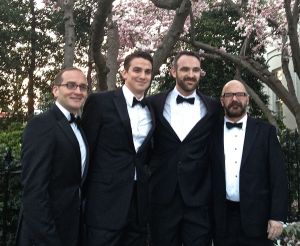
(Photo: Griffin and yours truly, with our spouses, in a happier time, at the White House state dinner for David Cameron, May 14, 2012.)
Oregon Fails Obamacare

Sarah Kliff explains why the Beaver State is shutting down its health exchange:

Oregon’s exchange has, since the get-go, had a pretty terrible run. Because of technological problems, the state couldn’t process online applications for months. Instead, it had to hire 400 temporary workers to process the flood of paper applications used as an alternative. And even by the end of open enrollment — and after spending $200 million in federal funds — Cover Oregon was the only exchange in the country where people couldn’t self-enroll in a health plan in a single sitting.

Oregon’s exchange didn’t have one single-point of authority, a state-issued review concluded in March. The project involved multiple agencies, who sometimes had different and conflicting goals. And Oregon did not set any penalties for when its main contractor, Oracle, missed deadlines.

This raises a number of policy questions, as Jason Millman points out:

Despite its technical problems, Cover Oregon has enrolled about 64,000 in private health plans since October, and enrollment has been extended until the end of the month. When the next enrollment period opens Nov. 15, will those Oregon customers have to go through the enrollment process all over again? That’s not clear, Cover Oregon technology chief Alex Pettit said Thursday. He’s scheduled to meet with federal health officials Monday and Tuesday to iron out further details.

Suderman’s lays into the state government for its incompetence:

Cover Oregon didn’t come through it at all. There were delays, and then more delays. The exchange never successfully went online. No one ever signed up for private coverage through the system. Reports surfaced showing that independent consultants had warned for years that the ambitious project was likely doomed. The warnings were ignored.

In March, Gov. Kitzhaber accepted the resignation of Cover Oregon’s acting director Bruce Goldberg, who supervised the exchange-building process, and requested that the exchange’s board remove Chief Operating Office Triz DelaRosa and CIO Aaron Karjala. It was a $300 million disaster—a model for the nation that turned out to be a total failure.

Josh Archambault predicts that several other state exchanges will fail eventually:

[A] recent hearing in DC highlighted how many of the states still lack a plan to sustain operations in the coming years. All claimed to not require additional federal funding, but even the executive director of the California exchange had to push back on independent assessments that they would be unable to sustain in future years. Hawaii was of special note, given that they don’t have any concrete plans for how to finance themselves yet.

The Obama Administration has started to show malleability in how long states have to spend establishment funds, Rhode Island being the first example of this. But those funds will eventually run out, and a GOP-run Congress is unlikely to provide a blank check to keep them running.

Putting Mental Illness In A Black Box

Esther Breger criticizes ABC’s new medical drama “Black Box,” about a neuroscientist with bipolar disorder, for perpetuating the trend of treating TV heroes’ mental illnesses as superpowers:

Catherine, the medical director of a fancy neurological center known as the Cube, is apparently amazing at her job, and “Black Box” doesn’t hesitate to draw a connection between her genius and her illness: “Catherine has an insight into her patients that no one else has, allowing her to communicate with them on a different level,” according to ABC’s press notes. She’s fabulously empathetic and intuitive, somehow able to see what all the other doctors miss (though her cases should be familiar to anyone who reads Oliver Sacks’s essays). That’s because, the show keeps reminding us, mental illness goes along with greatness. …

The show’s particular absurdities are all its own, but “Black Box” is part of a long line of fictions that treat psychological disorders as a professional asset.

On TNT’s “Perception,” which will soon air a third season, Eric McCormack plays a schizophrenic neuroscience professor who moonlights as an FBI consultant, solving murders with the help of witnesses he hallucinates. “Mind Games,” which lasted five episodes this spring before getting the axe, starred Steve Zahn as a bipolar genius who used to teach psychology and now runs a “problem-solving” business. Benedict Cumberbatch’s Sherlock Holmes coolly calls himself a “high-functioning sociopath,” but Sherlock fans have been offering competing psychological profiles for Arthur Conan Doyle’s character for decades. “Homeland,” at its best, complicated this dynamic, but Claire Danes’s Carrie Mathison was still gifted with a perception that her saner C.I.A. colleagues lacked. She was a superhero, until she was a lovesick lackey.

Because it’s so painfully clumsy and thoughtlessly constructed, “Black Box” distills what’s unsettling in the rest of these shows into something wholly unpleasant.

Alan Sepinwall also pans the show:

Describing the show makes it sound like the sort of thing Jack Donaghy might have scheduled on the “30 Rock” version of NBC: Kelly Reilly plays Catherine Black, a brilliant neurologist who’s known as “the Marco Polo of the brain,” and who has somehow kept secret from all her friends, colleagues, and even her long-term boyfriend Will (David Ajala) that she is bipolar, and subject to abrupt, extreme mood swings from manic to depressive. Her name is Black, she tells us that people in her field call the brain a black box, and she is an expert at curing everyone’s neurological difficulties except her own! And she frequently refuses to take her medication because she fears becoming dull or, worse, “normal,” which leads her to sleep around, perch on hotel balcony railings while drunk and frequently dance to free-form jazz compositions that only she can hear.

In other words, it’s combining what’s become the most annoying aspect of “Homeland” with the most formulaic parts of “House”(*) with that tired old saw that Fienberg has dubbed the Vocational Irony Narrative.

Capital For Conservatives

Gobry argues that conservatives ought to agree with Piketty’s proposal to shift the tax burden from income to wealth:

To be a conservative is to want a vibrant, innovative economy. All else equal, presumably, in order to have such an innovative economy, you want to have risk-taking and risk-bearing capital. The problem with the global economy isn’t, per se, that the rich have a lot of money. It’s that the rich have a lot of money and, instead of investing it in rocket ships to the moon and dotcom ventures, almost all of them are instead investing it in government bonds and ultra-safe corporate bonds. With inflation at zero and no wealth tax, investing at 2% for no risk is very attractive. If there is inflation and/or a wealth tax, suddenly you have to seek it out bigger investments.

Looked at it very broadly, the conservative “diagnosis” would say something like this: for the broad middle class, what we usually think of as the components of “the good life”, i.e. housing, a job, affordable healthcare, higher education, and so on, are growing increasingly expensive–and in large part this is because of bad government regulation. This is also true of access to capital. As Piketty says, all else equal, we want to increase wealth mobility and access to capital.

Noting that Americans see Piketty as more left-wing than he sees himself, Yglesias points out that he actually wants to cut most Americans’ taxes:

Piketty’s big point about the United States is that we actually do engage in substantial wealth taxation in this country. We call it property taxes, and they’re primarily paid to state and local governments.

Total receipts amount to about 3 percent of national income. The burden of the tax falls largely on middle-class families, for whom a home is likely to be far and away the most valuable asset that they own. Rich people, of course, own expensive houses (sometimes two or three of them) but also accumulate considerable wealth in the stock market and elsewhere where, unlike homeowners’ equity, it can evade taxation.

Piketty also observes that the current property tax system is curiously innocent of the significance of debt. A homeowner is taxed on the face-value of his house, whether he owns it outright or owes more to the bank than the house is worth. “If you own a house worth $500,000 but you have a mortgage of $490,000 then your net wealth is $10,000,” he explains. “So in my system you would owe no tax.”

But Scott Sumner thinks we should measure inequality not by income or wealth, but rather by consumption:

[T]here are plenty of billionaires who splurge on things like 500-foot yachts. Now we are getting somewhere! The labor and materials that went into constructing that yacht could have produced 10,000 cars for average people. That sort of inequality is real. That’s what we (should) mean by “economic inequality.” That’s the way all of us economists were taught, but 99% of us seem to have forgotten what we learned about consumption. Consumption is what you should tax. Of course when we tried to do that a bunch of Democratic politicians who have apparently never heard of Bastiat said the luxury tax was a bad idea because it cost jobs in the yacht making industry. (I’m not joking.) Nor are they willing to cut back on intellectual property protections for companies like Disney.

Capital in the Twenty-First Century is available here.

Is HRC Hosting Jo Becker Tomorrow?

I ask because of this – now deleted – calendar from Penguin, Becker’s publisher, which we stumbled upon three days ago:

Screen Shot 2014-04-25 at 1.04.49 PMWe called the HRC building and press office and, after several attempts, we could not get an answer. They told us that the only event planned this weekend is private and they cannot give us any details about it. Blogger Will Kohler tried to get an answer too and tells the Dish that the HRC spokesman wouldn’t deny or confirm a Becker event. But HRC rents the space out and would presumably get reimbursed for hosting an event. So this is a genuine question for HRC members: is HRC honoring a book that trashes everyone else in the marriage equality movement?

We can’t get an answer from them, which is par for the course. But maybe you can: press@hrc.org. Be nice.

Update: we’re not the only ones getting the run-around. From Metro Weekly’s Justin Snow:

Update: A reader writes:

What about Becker also being hosted at Gibson Dunn, Ted Olson’s law-firm, for a private event on April 28 (as shown in your screenshot)? Even more inside access.

Indeed. An author who is hosted at book signings and events by the “characters” she fawns over in her book is crossing an ethical line. Another one. And, yes, I think, given the refusal of HRC to confirm or deny that the Becker event is canceled tomorrow, we can assume that it’s a party for Becker, and a thank you for the public relations job she has done for the organization. It’s all win-win-win. Except for the truth.

One last update: Because HRC would not respond to requests for clarification, Chris Johnson asked Becker herself at her DC book-signing at Politics and Prose if HRC was hosting her on Saturday:

Quote For The Day

“I’m not surprised. I’ve been discriminated against for 70 years, and they might as well discriminate against me in death as well as life,” – Madelynn Taylor, a US Navy veteran who won’t be allowed to have her ashes interred with her dead wife’s ashes because of a provision in the Idaho Constitution.

Will Obamacare Help Democrats?

Senate ACA

Sam Stein and Sabrina Siddiqui examined the websites “for 186 House Democrats up for reelection (we didn’t count those who’ve announced retirements), as well as 20 Democrats running for Senate (including three current House members and a few clear frontrunners who don’t currently hold federal office)”:

The results tell the story of a party still skeptical of the law’s political benefits, but overwhelmingly committed to upholding President Barack Obama’s signature piece of legislation. House Democrats are far more excited about Obamacare, with many members overstating the critical role they played in its passage. Senate Democrats seem more inclined to whitewash the entire bill from the public’s memory — the majority of Senate candidates avoid mentioning Obamacare at all. Only three candidates among the 206 whose websites we checked had an overtly anti-Obamacare message — and even those three don’t advocate repealing the law outright.

Josh Green expects Democrats to benefit from Obamacare in the long run:

I think the health-care law will still prove to be a net plus for Democrats in many races—a few this fall, and many more in future elections. The reason why is easier to understand if you flip the issue around and look at it from the Republican side.

Conservative orthodoxy still holds that Obamacare is a socialist abomination, and this requires Republican candidates to continue to advocate its repeal. It’s true that the law’s repeal is a strong motivator for Republican voters, and that does carry electoral advantages. But in practice, repealing Obamacare would entail dissolving popular state plans such as [Kentucky’s health care exchange] Kynect. Voters are bound to notice and make the connection.

Kentucky’s Democratic governor, Steve Beshear, on Tuesday declared the law an “indisputable success” and said 413,000 Kentuckians had gained private or Medicaid coverage through Kynect. As the Washington Post’s Greg Sargent notes, Beshear has a 56-29 approval rating. But Senator Mitch McConnell, the Kentucky Republican running for reelection, remains wedded to the notion of repeal. Now, Democrats in the state are going after him for wanting to abolish not Obamacare, but Kynect.

Jonathan Bernstein’s view:

If you ask people whether government should “do more” or “do less” on health care, the liberal argument is going to come out on top with everyone except a small group of seriously ideological conservatives.

Making Obamacare the central issue in health care tends to obscure that Democratic advantage. That may be why Republicans would want to continue to keep the debate going. It also appears that Obamacare motivates Republican voters, for now at least. I’ve always believed this is arbitrary. Republican voters will always be motivated by whatever issue that Republican politicians, opinion leaders, and party-aligned media choose to emphasize. If the focus switched to Common Core, for example, Republican voters would follow. It’s difficult to see them moving away from Obamacare anytime soon, however, given their investment.

Cillizza, on the other hand, argues that Obamacare is still a problem for Democrats:

Republicans HATE the law. Democrats like it.  That’s why, in Louisiana, almost six in ten registered voters said that they would not vote for a candidate who did not share their views on the law. While some of that number is surely Democrats who wouldn’t vote for a candidate who was against Obamacare, all of the other data out there about the law suggests that the energy on the issue is with the folks adamantly opposed to it.

Given that, the gap between those saying they wouldn’t vote for a candidate who disagreed with them on the Affordable Care Act and those who said they would is another way to gauge intensity around the law. And while the 30-point gap between “wouldn’t vote” and “would” is widest in Louisiana, it’s still quite large in North Carolina (18 points) and Arkansas (17 points). In Kentucky, where the state-run insurance exchange is working as well as any in the country, there appears to be less political heat around the law, with those who wouldn’t vote for a candidate who shared their  view on the ACA running only seven points ahead of those who said they could vote for a candidate who disagreed with their view.

The Right’s Blindness To Race

Beutler was not shocked by Bundy’s racist remarks:

It’s hard to put this delicately, but a tax-protesting, government-rejecting, gun-toting white rancher from the Old West is fairly liable to say and believe some pretty uncouth things, including about race. I didn’t know Bundy was a racist until Thursday, but I was utterly unsurprised by the revelation. I doubt many liberals were terribly shocked either.

His explanation for why “many, many conservatives—even conservatives with presidential ambition—were caught completely flatfooted”:

When certain conservatives object to liberal characterizations of the American right, and when they bristle at suggestions that conservative policies draw some of their political vitality from unreconstructed racists, or resentful white voters, or anything other than ideologically pure freedom fighters, they aren’t playacting. At some point, to those conservatives, willful blindness to the political power of white conservative populism became unwillful. As far as they were concerned, anyone arguing that welfare-state opposition (or tenth-amendment fetishism or any other conservative hobbyhorses) derived any political support from racist whites was trafficking in racial McCarthyism. Perhaps at some point they had assumed a defensive crouch to protect themselves and their tribe from an uncomfortable reality, but eventually they grew comfortable in it.

Relatedly, Barro finds that Bundy’s big-government grievances resonate most strongly among whites:

The rush to stand with Mr. Bundy against the Bureau of Land Management is the latest incarnation of conservative antigovernment messaging. And nonwhites are not interested, because a gut-level aversion to the government is almost exclusively a white phenomenon. A 2011 National Journal poll found that 42 percent of white respondents agreed with the statement, “Government is not the solution to our problems; government is the problem.” Just 17 percent of blacks, 16 percent of Asians and 25 percent of Hispanics agreed.

And Weigel explains why Bundy’s downfall matters:

Bundy had the potential to become a galvanizing figure for a cause that’s hard to get people excited about. For a very long time, conservatives have been campaigning to take back federal lands, give them to the states, and let businesses or farms—or whatever—develop them. Having spent many hours inside the air-conditioned ballrooms of conservative conferences like AFP’s “Defending the American Dream Summit,” I’ve seen presentations about the government’s choke-hold on usable land. Other reporters, who’ve tracked legislation in Western states, have watched Arizona and Utah pass bills demanding the feds turn over tens of millions of acres to the states.

The problem, as Jessica Goad and Tom Kenworthy noted, was that Western voters didn’t care.* By at least a 2–1 margin in a recent Colorado College State of the Rockies survey, they did not think “having too much public land” was a problem. Enter Cliven Bundy. His years-long battle with the feds came to a head last month, and conservatives from Arizona Rep. Paul Gosar to Kentucky Sen. Rand Paul to likely next governor of Texas Greg Abbott rallied to him.