Thank Uncle Sam For Your iPad

Jeff Madrick praises Mariana Mazzucato’s The Entrepreneurial State: Debunking Public vs. Private Sector Myths for going “well beyond the oft-told story about how the Internet was originally developed at the US Department of Defense”:

For example, she shows in detail that, while Steve Jobs brilliantly imagined and designed attractive new commercial products, almost all the scientific research on which the iPod, iPhone, and iPad were based was done by government-backed scientists and engineers in Europe and America. The touch-screen technology, specifically, now so common to Apple products, was based on research done at government-funded labs in Europe and the US in the 1960s and 1970s. Similarly, [economist Robert] Gordon called the National Institutes of Health a useful government “backstop” to the apparently far more important work done by pharmaceutical companies. But Mazzucato cites research to show that the NIH was responsible for some 75 percent of the major original breakthroughs known as new molecular entities between 1993 and 2004.

An Ancient Political Curse

Rose Eveleth suggests that the “curse” of the Unlucky Mummy – blamed in Britain for a variety of disasters in the late 19th and early 20th century, including the sinking of the Titanic – reflected  sublimated anxieties about colonialism:

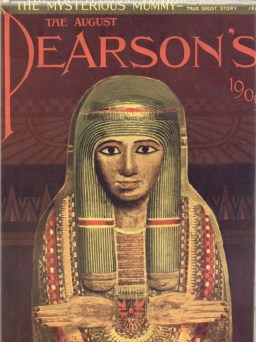
As it happens, the Unlucky Mummy arrived in England during the perfect curse-making storm. … At Pearson's_Magazine_1909_with_Unlucky_Mummythe time, Britain was occupying Egypt. It had invaded the Middle Eastern country in 1882, bombarding Alexandria for 10 and a half hours from the sea in an attack that was largely one sided – the British didn’t lose a single boat. The fires that followed destroyed much of the city and two days later the British army entered Alexandria and took on Egyptian forces in a handful of skirmishes, the most notable being the battle at Tel-el-Kebir. Because the Egyptian land was flat and open, the British decided to attack at night. After an hour of fighting, the Egyptians fled. The British military stayed in Egypt in a variety of capacities until 1922.

While the occupation of Egypt was a military success, it was met with trepidation back home.

Should a European power intervene in the goings on of a Middle Eastern country? The British said they were there to help depose a tyrannical rule, but the British people weren’t sure that was their government’s job in the first place. But while the occupation troubled many, some didn’t want to outwardly express their anxieties. So they turned to objects that represented the country in question: Egyptian artifacts. “You can’t talk about how difficult it is to occupy another country because that’s unpatriotic,” says Roger Luckhurst, a professor of literature at Birkbeck College, University of London, who details the Unlucky Mummy’s journey through myth and reality in his 2012 book, The Mummy’s Curse. “This is a narrative that lets you talk about it in another way.” The idea that objects from Egypt like the mummy board would exact revenge was a way to express anxiety without actually talking about war.

(Photo of a 1909 Pearson’s cover featuring the story of the Unlucky Mummy via Wikimedia Commons)

Ukraine’s Religious Battle Lines

Anna Nemtsova discovers that the conflict has engendered a schism of sorts within the Orthodox church:

Throughout Ukraine, where 11,000 Orthodox churches serving over 10 million believers answer to the Moscow Patriarchate, priests prayed for peace without a “fascist” and “neo-Nazi” government, as they call the new authorities in Kiev, but also without war and victims. Yet the leaders of the church hierarchy are drawing their own battle lines in a country divided not only by language and ethnicity, but by the nationalist leanings of the religious patriarchs.

In Kiev, at the height of protests that brought down Yanukovych, Orthodox priests passed through the crowd blessing the demonstrators, and on Easter Sunday there, Patriarch Filaret made a blunt political speech. He described Russia as “evil” and prayed, “Lord, help us resurrect Ukraine.”

In Moscow, Patriarch Kirill addressed an audience that included Russian President Vladimir Putin. Kirill prayed “that peace be restored in the minds and hearts of our brothers and sisters in blood and faith and that the lost ties and cooperation which we all need so much also be restored”—which would sound benign if Putin’s political technicians were not working so hard to shatter peace in Ukraine so the Kremlin can restore “lost ties and cooperation” by invading and annexing the Russian-speaking parts of the country should Putin deem it necessary.

The Best Of The Dish Today

I spent the day monitoring the latest p.r. push by the Human Rights Campaign (i.e. the Becker book on the marriage equality movement), and absorbing the debates among the earliest Christians about how exactly they came to believe that Jesus was God. The fruits of Dishness, I guess.

On the Obama front, has anyone noticed that the latest surveys from Gallup and Rasmussen show his approval rating climbing back up quite sharply?

On the ex-sherpas front, I can’t help bit think of this classic Onion piece on the douchebags who want to climb Everest or sail around the world alone.

On the HRC front, another one of them pops up on HuffPo to defend their record on marriage. Steve Fisher insists that HRC was front and center under Elizabeth Birch in the 1990s. How?

To build a movement of Americans on the side of LGBT equality, she led the creation of a slick logo built on a carefully calibrated hrcfashion.jpgmessage about equality … With the logo as a calling card, HRC built a membership base of hundreds of thousands who have been called upon to lobby, take action and help move the bar in their home states, neighborhoods and workplaces … She and her team created the Corporate Equality Index, a mammoth project that annually graded (and thus coaxed) corporations on their LGBT employment policies.

Logos!

Look: I’m not denying that these were decent initiatives and helped us all in the long run. But logos aren’t arguments. And on marriage, in the early and critical years, HRC said close to nothing and refused repeatedly to do anything. When some of us begged them to spend money on Hawaii’s marriage breakthrough, we were told to go raise the money ourselves. Pity all the donors had been told by HRC not to bother. For that matter, try and find a speech given by Birch in those years making the case for marriage equality. Try and find a clip of an HRC official on television making that case. Good luck.

As for Fisher, take a look at this NYT story from December 2004, reporting that HRC had decided even at that late date to drop marriage equality as an issue. And who in that piece is quoted backing this surrender? Steve Fisher!

Some gay rights activists, including the leadership of the Human Rights Campaign, said they believed that aggressively pursuing same-sex marriage only played into the hand of Republicans and religious conservatives, who skillfully used the issue this fall to energize their voters. Steven Fisher, the campaign’s communications director, said the group’s emphasis in coming months would be on communicating the struggles of gays in their families, workplaces, churches and synagogues … He also said the group would adopt a selective and incremental approach to winning rights rather than reaching for the gold ring of marriage right away.

You can spin but you can’t hide.

Today, we covered American oligarchy and Iraqi “democracy.” We took a look at responses – here and here – to Thomas Piketty’s new book on inequality. And we wondered what Chris Christie has been smoking lately. The Window View contest was a real, if romantic, teaser.

There’s still time to join this month’s book club – just download the e-book version of How Jesus Became God here. This reader did:

I just want to point that even before the book discussion begins, you are already doing what Ehrman specifically warns us not to do; you are treating the book as if it addresses the question of whether or not Jesus was (or is) ACTUALLY God.

Over and over and over – until I was ready to throw up my hands and scream “YES, I get the point already” – Ehrman emphasizes that he is investigating what early Christians believed about Jesus. He repeats endlessly that historians cannot make judgments about theological truth, only about historical investigation.

And as others have pointed out, the ideas in the book are not controversial among biblical scholars – except among those like the authors of the “response” book, who begin their investigation with the conclusion already determined.

I know, I know. But stay tuned for a Christian response (mine) to the book  – and then our debate.

A post update you might have missed: a reader in tiny Latta, SC gives his perspective on the firing of the town’s lesbian police chief. You can leave your unfiltered comments at our Facebook page and @sullydish.

17 more of you became subscribers today. Join them here.

And see you in the morning.
Trying To Close Up Shop

https://twitter.com/iitsgabrielaa/statuses/443401160477519873

A bipartisan effort by Congresswomen Ileana Ros-Lehtinen and Lois Capps is trying to limit photoshopping in ads like the one above. DL Cade is skeptical:

These measures are being taken because, as the bill points out in its introduction, “The dissemination of unrealistic body standards has been linked to eating disorders … [and] has a particularly destructive health effect on children and teenagers.” Noble intentions, and we still don’t know how they will set about regulating Photoshop use in ads, but all of this begs a couple of questions. First, does Congress realize how prevalent Photoshopping really is in advertisements? And second, is there anybody on Capitol Hill that is truly qualified to set rules that regulate such use?

Katy Waldman is more critical:

In a world of limited time and resources, Photoshop seems like a strange drum for the Eating Disorders Coalition to beat. Diseases like anorexia and bulimia are largely understood now to be biological in origin, although cultural conditioning can definitely trip certain wires. There’s a lot of research linking media exposure to dieting and body dissatisfaction, but only a handful of studies directly implicate ads in eating disorders (and even those caution that the offending images likely triggered pre-existing drives). Given that the specific genetic causes of eating disorders remain so mysterious, and the treatment so hit-or-miss, lobbying money might be better spent on research than on making sure the thin, beautiful women who appear in magazines are naturally thin and beautiful.

Becker On Fresh Air

To Terry Gross’ immense credit, she had Jo Becker back on her radio show to defend the ridiculous premise and framing of her book, namely that the revolution of marriage equality began in 2008 with an epiphany by Chad Griffin. Gross tries repeatedly to get Becker to withdraw her idea that the “revolution” “began” in 2008. But Becker won’t. Money quote:

GROSS: So getting back to that first paragraph in your book, if you had it to do over again, would you have written this is how a revolution starts?

BECKER: I would.

GROSS: Because?

BECKER: Because I believe that this was a revolutionary step that they took, and not to say that it hadn’t been considered, but they were the ones that took the step.

But the case that actually made the difference federally was the Windsor case, argued by Roberta Kaplan, and not the case Becker has to hype because of her sources. And challenging Prop 8 was not a revolutionary step. It was risky, sure. But taking the issue to the federal courts had been part of the strategy for the previous twenty-five years. The idea that this was first dreamed up by Chad Griffin – after all of us had been clueless and cowardly beforehand – is absurd as well as insulting. She has no clue what she’s talking about.

Becker also describes 2008 as “a really, you know, dark moment in the gay rights movement.” Seriously?

In 2008, we had higher levels of national support for marriage equality than in any previous year – and close to double the support we had when the revolution actually began; we had won in California and Massachusetts; we were on the verge of winning in Connecticut, Iowa, Vermont, New Hampshire and DC. And we had elected Obama, who was about to end the HIV Travel ban, “Don’t Ask, Don’t Tell”, and remove the federal government from supporting DOMA. A terrible campaign in California (Griffin was right about that and I was too) lost us that state in a close race in the fall election. But momentum was clearly with us. Before the Perry decision, we had also won New York, Washington, Maine, Maryland, Delaware, and Minnesota. All those victories came through the more democratic process of state legislatures. Before the Perry ruling, we also had marriage equality in 13 countries – and a wave of others followed that had nothing to do with Olson or Boies or Griffin.

The book is an attempt by a tiny few to co-opt and claim credit for a movement they had previously had nothing to do with. No one with any knowledge of the movement has defended it. And, judging from her Fresh Air interview today, Becker can’t either.

Face Of The Day

The Duke And Duchess Of Cambridge Tour Australia And New Zealand - Day 16

An Aboriginal woman performs for Catherine, Duchess of Cambridge and Prince William, Duke of Cambridge, at the National Indigenous Training Academy in Ayers Rock, Australia on April 22, 2014. The royal couple are on a three-week tour of Australia and New Zealand, the first official trip overseas with their son, Prince George of Cambridge. By Scott Barbour/Getty Images.

Rescuing Kafka From “Kafkaesque”

In a review of Reiner Stach’s Kafka: The Decisive Years and Kafka: The Years of Insight, Cynthia Ozick rails against the term:

With its echo of “grotesque,” the ubiquitous term “Kafkaesque” has long been frozen into permanence, both in the dictionary and in the most commonplace vernacular. Comparative and allusive, it has by now escaped the body of work it is meant to evoke. To say that such-and-such a circumstance is “Kafkaesque” is to admit to the denigration of an imagination that has burned a hole in what we take to be modernism – even in what we take to be the ordinary fabric and intent of language. Nothing is like “The Hunger Artist.” Nothing is like “The Metamorphosis.”

Whoever utters “Kafkaesque” has neither fathomed nor intuited nor felt the impress of Kafka’s devisings. If there is one imperative that ought to accompany any biographical or critical approach, it is that Kafka is not to be mistaken for the Kafkaesque. The Kafkaesque is what Kafka presumably “stands for” – an unearned, even a usurping, explication. And from the very start, serious criticism has been overrun by the Kafkaesque, the lock that portends the key: homoeroticism for one maven, the father-son entanglement for another, the theological uncanny for yet another. Or else it is the slippery commotion of time; or of messianism; or of Thanatos as deliverance. The Kafkaesque, finally, is reductiveness posing as revelation.’

Update from a reader:

Can I please just say: POSEUR ALERT.

Ozick’s charges could be just as fairly leveled at pretty much any eponym: Orwellian, Shakespearean, Dickensian, Hobbesian, Darwinian, Marxist – even Calvinist or Lutheran. Encapsulating someone’s life’s work in a word is not meant to be all-encompassing; it’s a shorthand to refer to the main elements that made their work revolutionary.

I think it’s a straw man to presume that the term “Kafkaesque” subsumes the work of Kafka in any way. The word refers to a quality of modern society that Kafka captured so powerfully; it does not confine Kafka only to the word Kafkaesque. It seems almost reductive of her to impute that kind of intentional misunderstanding to anyone using the word.

Sitting in a deportation hearing without access to two-way translation while other people are deliberating incomprehensibly about your future? Absolutely Kafkaesque. Being told you don’t have standing to challenge government spying because the secrecy of the program makes it impossible to prove that you were indeed spied on? How is that not Kafkaesque?

Importantly, what term does Ozick propose to replace it? If it’s important enough to warrant a word, the word is important enough to need a good synonym if it’s put out of circulation.

Sherpas On Strike

4ac10d977

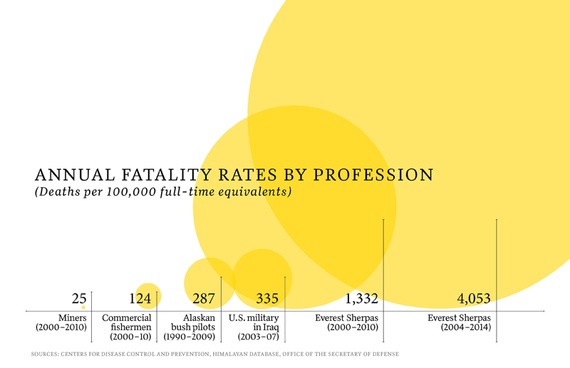
After threatening a work stoppage over unfair pay and grueling work conditions, the Nepalese mountaineers who clear the way for recreational climbers on Mount Everest have voted to leave the mountain and cancel the 2014 climbing season entirely out of respect for the 16 sherpas who died in an avalanche last Friday – the worst climbing accident in Everest’s history. Svati Kirsten Narula looks into how much more dangerous the mountain is for sherpas than for the climbers they serve:

There has always been a divide between Sherpas and Western summit-seekers, but these tensions have increased in recent years as Everest has become more accessible to unskilled-but-well-heeled climbers. The world’s tallest mountain has become much safer for the average Joe than ever before. For the people who live in its shadow, though, and must return to it again and again to earn a living, the risks haven’t declined in the same way. …

Western expedition leaders are acutely aware of this sobering reality [that being a Sherpa is more dangerous than being an American soldier during the Iraqi insurgency], and many have established funds for the families of fallen Sherpas. It’s difficult, though, to assuage the guilt of leaving the mountain with fewer people than you brought there. Melissa Arnot, the Eddie Bauer-sponsored American mountaineer who has summitted Everest five times, had a Sherpa die on an expedition of hers in 2010. Reflecting on this in 2013, she told Schaffer: “My passion created an industry that fosters people dying. It supports humans as disposable, as usable, and that is the hardest thing to come to terms with.”

Jon Krakauer, author of Into Thin Air: A Personal Account of the Mt. Everest Disasterelaborates on what makes the job so dangerous:

Sherpas aren’t provided with nearly as much bottled oxygen, because it is so expensive to buy and to stock on the upper mountain, and they tend to be much better acclimatized than Westerners. Sherpas are almost never given dexamethasone prophylactically, because they don’t have personal physicians in their villages who will prescribe the drug on request.

And perhaps most significant, sherpas do all the heavy lifting on Everest, literally and figuratively. The mostly foreign-owned guiding companies assign the most dangerous and physically demanding jobs to their sherpa staff, thereby mitigating the risk to their Western guides and members, whose backpacks seldom hold much more than a water bottle, a camera, an extra jacket, and lunch. The work sherpas are paid to do—carrying loads, installing the aluminum ladders, stringing and anchoring thousands of feet of rope—requires them to spend vastly more time on the most dangerous parts of the mountain, particularly in the Khumbu Icefall—the shattered, creaking, ever-shifting expanse of glacier that extends from just above base camp, at seventeen thousand six hundred feet, to the nineteen-thousand-five-hundred-foot elevation. The fact that members and Western guides now suck down a lot more bottled oxygen is wonderful for them, but it means the sherpas have to carry those additional oxygen bottles through the Icefall for the Westerners to use.

Although the sherpas say their decision to sit out the season is about mourning their colleagues, Bryce Covert examines the labor dispute:

Somewhere between 350 to 450 Sherpas work above Everest’s base camp during the season, which lasts two months. Despite the fact that climbers each pay a $10,000 peak fee to Nepal’s Ministry of Tourism and tens of thousands to commercial climbing guide companies, Sherpas usually get about $125 per climb for each legal load, although some take on more to earn more. They usually haul about $3,000 to $5,000 a season, although given that the average yearly salary in Nepal is about $700, many are drawn to the pay. But Western guides can make $50,000 to $100,000. …

The demands include an immediate payment of 40,000 rupees, or about $400, to the families of the victims, covering the costs of treatment for the injured, and a payment of 10 million rupees, or about $100,000, to those who won’t be able to continue working on the mountain due to their injuries. It also calls for allowing expedition teams to call off the season’s climbing and refusing to fix ropes and ladders this season, plus perks and salaries paid to the Sherpas if climbing is suspended. They have called for the creation of a relief fund through 30 percent of the royalties from issuing permits, something guides and Sherpas have called for for many years, as well as doubling their current life insurance policy payments from the current million rupees, or $10,000, to two million rupees, or $20,000.

Update from a reader:

Thanks for this curation of good reads. Here’s another gorgeous, intimate read from a young female Sherpa. It’s the point of view we too rarely see in Western media.