Party On, Tehran

3035293917_1d691ee4b7_o

Tehran Bureau takes a peek at the party culture lurking just below the surface in the Iranian capital’s more affluent districts:

For the wealthy and the well-connected, the boundaries of hedonism are limited only by the spatial confines of their villas or luxury apartments. Some outfit their homes with back-lit bars and DJ tables, transforming their homes into nightclubs at the flick of a light switch. There are strobe-lit discos where girls in bikinis spray guests with water guns, and embassy-district shindigs in which all counter space is taken up by imported alcohol. Then, there are parties based around film screenings, dance performances and concerts by underground bands, where members of the cultural scene gather to critique each other’s projects, sway to 1970s-style rock music or enjoy some Persian-tinged flamenco.

Most of the time, however, they are simple gatherings where friends and acquaintances gather in search of release from daily pressures. Nastaran, a 33-year-old translator, says throwing regular parties in her two-bedroom central Tehran apartment gives her something to look forward to as she goes through the weekday grind. “I get up after 6, splash some water on my face and head out into the traffic. In the evenings, if I’m lucky, I make it home by 8, eat dinner and go to bed. If I didn’t have this” – she says, raising up her glass of bootleg liquor – “what kind of life would I have?”

(Photo: Tehran skyline by Shahrokh Dabiri)

GROWing Pains, Ctd

Jay Newton-Small wonders why New Hampshire state representative Marilinda Garcia, a Latina who could be the GOP’s dream diversity candidate, isn’t getting much financial support for a Congressional run:

One of the challenges for female candidates on either side of the aisle is training them in raising money, generally a harder task for women than men at first. Emily’s List on the left holds regular training seminars around the country that are free to all perspective candidates. But the Susan B. Anthony List, which raises less than one-fifth of the money Emily’s List does, has not yet been able to launch such a program. “Do we wish that [Garcia] had more support? Do we wish that we had more money to give her to cross the finish line? Of course I do,” says Marjorie Dannenfelser, president of the Susan B. Anthony List. “I do wish the [National Republican Congressional Committee] would do more.”

Ostensibly, the NRCC is doing more. Last year, they launched a program called Project GROW to help female candidates. But Garcia, though she is a female Republican running for the House, has yet to get anything from the group.

Previous Dish on Project GROW here.

For The Love Of God

Ryan Jacobs flags a study that suggests people grow closer to God amidst relationship troubles:

In a new study published in Social Psychological and Personality Science, researchers recently tested how threats to romantic relationships affected people’s intimacy with God. The results suggest that the divine can act as a sort of rebound during moments of romantic desperation or trouble. The researchers exposed mostly religious subjects to psychological exercises that “threatened their romantic relationship” and then asked them about their connection to God. A control group just answered the God questions. Across three experiments, those in the experimental group reported stronger connections or a greater interest in God. The experiments also showed that those under the threatened relationship condition were “more willing to accommodate God’s transgression,” like not answering prayers. The researchers write that the results indicate that there is “considerable overlap between people’s divine and interpersonal relationships.”

But the study indicates a flip side:

[Researcher Kristin] Laurin’s team found that participants sought to enhance their relationship with God when under threat of romantic rejection – but only if they had high self-esteem. This fits with past work showing that people high in self-esteem seek social connection when their relationships are threatened. It’s a sobering finding, Laurin says: “We find that high self-esteem people, who already are the ones who take constructive steps to repair their relationships when they are under threat, have yet another resource they can turn to: their relationship with God,” she explains. “Low self-esteem people, who are the ones who retreat and protect themselves at the expense of the relationship when the relationship is under threat, don’t seem to be able to use this new resource either.”

Our Tentativeness Toward Future Tech

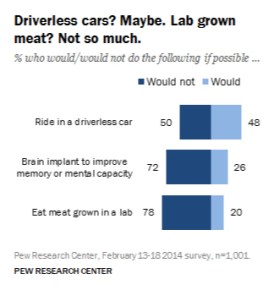
Last week, Pew released a study measuring American attitudes toward future technologies. While the majority of respondents expressed significant reservations about most of the tech, Emily Badger is glad that the driverless car was among the most accepted:

Transportation geeks generally love the idea of autonomous cars because they’ll make ownership unnecessary. When cars no longer need people to drive them, they can drive around all day, transporting one passenger after another after another — in a network PI_2014.04.16_TechFuture_driverless_cars-dish-cropthat might look a lot like personalized public transit. The resulting transportation system would be tremendously efficient. Cars wouldn’t spend the vast majority of their lives parked. We wouldn’t need to devote so much of our land to parking spots. We could get rid of the urban congestion that’s caused purely by people driving around looking for parking. …

Maybe you own a car because you need it, for mobility. But you own that car because you want it for some more intangible reason. In the future, however, the arrival of mass-market autonomous cars will force us to confront the difference between these two ideas. When you no longer need to own a car for mobility, will you still want one anyway for the love of cars, or for what they say about you, or for some other deeply personal reason?

Elsewhere in the study, 65% of respondents felt “it would be a change for the worse if lifelike robots become the primary caregivers for the elderly and people in poor health.” Waldman, on the other hand, welcomes the age of the robo-sponge-bathing:

Part of the reluctance people have may come from the associations we have with the word “robot,” and not just that they might rise up and exterminate us. When you hear the word, what do you think of? Something made of metal and plastic, probably. Not something with gentle hands that could, say, turn you over carefully and apply a soothing salve to your bedsores. But when they actually start designing caregiving robots, you can bet they’ll make sure to make them soft.

That industrial design will be one important part of gaining acceptance for helper robots. But more important will be the fact the need is so great, and they’ll be really, really handy. We already have a glaring need for caregivers for the sick and elderly, and as the Baby Boomers age, it will only increase. There are never going to be enough people to meet the need, unless half the American population is made up of nurses, orderlies, and home health aides taking care of the other half. And that of course would be prohibitively expensive. Robots will be pricey at first, but the price will drop over time, and Medicare will gladly pay a few grand for a bot that can do work that would end up costing tens of thousands of dollars a month if it were done by humans.

Adi Robertson parses more of the study:

Despite our categorical optimism about “technology,” it turns out that we’re sometimes more conservative about things that are actually on the horizon. 63 percent of Americans, for example, think that it would be a change for the worse if US airspace was opened to “personal and commercial drones.” 22 percent thought it would be a change for the better. … 66 percent think that it would be a bad thing if parents could alter a child’s DNA “to produce smarter, healthier, or more athletic offspring,” compared to 26 percent in support.

The most popular advance was a world where “most people wear implants or other devices that constantly show them information about the world around them,” which 53 percent thought would be a change for the worse and 37 percent thought would be an improvement.

Jason Koebler asked bioethicist Jonathan Moreno to explain all the anti-tech anxiety:

“I’m not impressed that this tells us very much how people will respond in a real case,” Moreno said. “If you go back and look at historical change, people were terrified of horse and carriages, they were shocked you could go 10 miles per hour on a train. But then, once you get them on it, we got very comfortable going from 10-40 miles an hour.” The point, Moreno said, is that people adjust to new tech very quickly. …

It’s not hard to think of more recent examples. At first, people were horrified that someone could reach them at any time on a cell phone—now, we can’t live without them. By generally trusting that “technology” as a whole is a force that’ll make people’s lives easier, the public doesn’t have to pick and choose which ones to throw their proverbial support behind. And, maybe it doesn’t even matter what people want—innovation is going to happen regardless.

The African Way To Bank

Noting the widespread use of mobile payments in Africa, Bright Continent author Dayo Olopade thinks through whether similar efforts could succeed in the US. She sees need for the technology because “the poorest 30 percent of Americans were, to use an industry term, underbanked—unable to access credit and financial services within their means”:

Exporting mobile money to the United States, however, entails a slew of challenges that its creators did not face in Africa.

Need drove the invention of M-Pesa and its counterparts, but regulatory ambiguity ensured it could scale. Even today, mobile-banking laws in Africa are evolving slower than the technology itself. One hazard, regulators believe, is that mobile payments can be used for money laundering. While much of this risk is diffused by ID cards, PINs, and caps on transfers, it was not until 2011 that Kenya legislated capital requirements for mobile banking, and only in 2013 did the government begin to tax mobile transfers. Other countries in Africa have been stricter about which entities can serve as mobile financial institutions, but since telecoms are not traditional banks, they fall into a regulatory gray area.

In the United States, however, banking laws are much less malleable, and any activity that smells like banking is subject to a significant burden of compliance with post-crash policies designed to protect consumers. Allowing telecoms or tech companies to act like banks may involve new legislation. Given this headache, mobile money in the U.S. might end up looking different than it does in Africa, perhaps involving partnerships among wireless carriers, hardware companies, and banks. But the bar has been set, and the West now finds itself in the unfamiliar position of looking to Africa for technological inspiration.

Dayo’s “Ask Anything” series is here.

A Spark Of Suffering

Parul Seghal considers Scottish novelist Muriel Spark’s distinctive take on human misfortune:

Spark was fascinated by suffering – and even tried writing a critical study of the Book of Job – but it was an active, robust kind of suffering that she liked, whereby hunger whetted one’s wits. Her women are not enamored of their anxiety, of their moods and wounds. If they’re poor and powerless, it’s in the way of a junkyard dog, with a restless, scavenging instinct, a loyalty to no one and breathtaking cunning. Spark simply seemed to find no romance in female abjection, the fashion for which Susan Sontag describes in Illness as Metaphor. “Sadness made one ‘interesting,’ ” Sontag writes. “The melancholy creature was a superior one: sensitive, creative, a being apart.” …

Compare that to these most Sparkian of sentiments: “He actually raped her, she was amazed”; “Filthy luck. I’m preggers. Come to the wedding.” Or, from Spark’s own description of her brief marriage to the much older and very violent Sydney Oswald Spark (she called him S.O.S.), who went insane: “He became a borderline case, and I didn’t like what I found on either side of the border.” Spark is being glib, of course, but in that glibness is a kind of laconic dignity and an instinct for privacy.

Forever Pop

Tom Junod finds that child stars no longer fade away like they did in past generations:

Today’s child stars tend to hang around because the values of child stardom have become the values of the culture at large. Music and television are turning into the equivalent of gymnastics and tennis: sports built entirely around the identification and training of prodigies. Bob Dylan was once considered a phenomenon because he recorded his first album at the age of 20; the Beatles were, among other things, the first boy band. But it’s worth asking what kind of music they would have made if Dylan first had served time as the wisecracking sidekick on a Nickelodeon show and the Beatles had been brought to market by Simon Cowell.

The answer is simple: They would have made music that entertained above all else.

Was Jesus God?

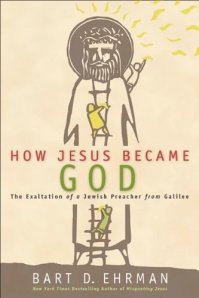
I’m in the home-stretch of the book, Bart Ehrman’s How Jesus Became God, the first selection for the Dish’s resurrected (!) Book Club. I know many readers are, as well. We’ll start the conversation this week – so hold your emails for a bit. I’m going to try and structure debate on the book into some clear, distinct questions, rather than trying to grapple with it all at once.

But as an appetite-whetter and encouragement to finish reading, here are some early reviews. First up, Fr. Robert Barron attacks the core of Ehrman’s thesis – that “explicit statements of Jesus’ divine identity can be found only in the later fourth Gospel of John, whereas the three Synoptic Gospels, earlier and thus presumably more historically reliable, do not feature such statements.” Barron calls this idea “nonsense”:

In Mark’s Gospel, Jesus addresses the crippled man who had been lowered through the roof of Peter’s house, saying, “My son, your sins are forgiven,” to which the bystanders respond, “Who does this man think he is?  Only God can forgive sins.” What is implied there is a Christology as high as anything in John’s Gospel.
how-jesus-became-godAnd affirmations of divinity on the lips of Jesus himself positively abound in the Synoptics.  When he says, in Matthew’s Gospel, “He who does not love me more than his mother or father is not worthy of me,” he is implying that he himself is the greatest possible good.  When in Luke’s Gospel, he says, “Heaven and earth will pass away, but my words will never pass away,” he is identifying himself with the very Word of God.  When he says in Matthew’s Gospel, in reference to himself, “But I tell you, something greater than the Temple is here,” he is affirming unambiguously that he is divine, since for first century Jews, only Yahweh himself would be greater than the Jerusalem Temple.

Perhaps most remarkably, when he says, almost as a tossed-off aside at the commencement of the Sermon on the Mount, “You have heard it said, but I say…” he is claiming superiority to the Torah, which was the highest possible authority for first century Jews.  But the only one superior to the Torah would be the author of the Torah, namely God himself.  Obviously examples such as these from the Synoptic authors could be multiplied indefinitely.  The point is that the sharp demarcation between the supposedly “high” Christology of John and the “low” Christology of the Synoptics, upon which the Ehrman thesis depends, is simply wrong-headed.

Another critic is Michael Bird, one of the contributors to How God Became Jesus: The Real Origins of Belief in Jesus’ Divine Nature – A Response to Bart D. Ehrman:

[W]hile Ehrman insists that there was a continuum between gods and humans in the ancient world, I contend that Jews and Christians held to a strict monotheism that delineated God from the rest of the created order. And when they mapped out where Jesus belonged on this ledger, he was clearly on the God-side – not semi-divine or quasi-divine, but identified with the God of creation and covenant.HGBJ-Cover

And whereas Ehrman thinks that Jesus was a prophet who proclaimed God’s judgment of this world, I argue that the historical Jesus saw himself as proclaiming and even embodying God’s kingship. Jesus believed that, in his own person, Israel’s God was becoming King, which is why Jesus spoke and acted with a sense of unmediated divine authority, why he identified himself with God’s activity in the world, why he believed that in his own person Israel’s God was returning to Zion as the prophets had promised, and why he outrageously claimed that he would sit on God’s own throne.

Meanwhile, Greg Carey criticizes the way some Christians have engaged the book, arguing that “it doesn’t help to dismiss Ehrman for being an agnostic, as if agnostics have nothing to teach Christians about the Bible, Jesus, or faith”:

[T]here is a live conversation among biblical scholars about how most Christians came to regard Jesus as divine. In other words, Ehrman’s book raises questions that should interest us all. This is not about liberals and secularists attacking the church. It’s an ongoing debate that crosses the usual party lines. …

Most Christians, however, have no idea that Ehrman’s book represents a genuine conversation among informed scholars. This is unfortunate. Nothing Ehrman is saying would surprise a biblical scholar at even the most conservative theological school. This knowledge gap constitutes a failure of educational ministry in the churches. We Christians should be learning to engage legitimate public conversations about Jesus, about the Bible, and about our faith. And we should attend to spiritual development that equips us to enter those conversations with humility and love.

I might as well state one core reason I picked this book. I strongly believe that Christians need to absorb all we can about the origins and debates over the texts that have come to form our faith. We should have nothing to be afraid of but the truth.

And the theological truth and the historical truth – while constructed in different terms and according to different criteria – must be compatible. No religion founded on untruths can or should survive. Which is why the meaning of the Incarnation and the Resurrection must be addressed squarely within the bounds of history and scripture properly understood – if we are to respect Christianity as a modern faith. This project, of course, is as challenging for a Christian as it is for a non-believer like Ehrman. And it’s worth remembering Ehrman’s reasons for being “obsessed” with Jesus, despite being an agnostic:

Without that declaration [of Jesus’ divinity], Jesus’ Jewish followers would have remained a small sect within Judaism. Probably a very small sect indeed. Converts would not have flocked to their cause — especially Gentile converts, any more than they flocked to the cause of the Pharisees or of John the Baptist.

If Gentiles had not started converting, eventually at an impressive rate, Christianity would not have grown exponentially over the next three hundred years. If Christianity had not been a sizable minority in the empire by the early 4th century, Constantine almost certainly would not have converted. If Constantine had not converted, the massive conversions in his wake would never have occurred. The Empire would not have become predominantly Christian. Theodosius would not have declared Christianity the state religion. Christianity would not have become the most powerful religious, cultural, social, political, and economic force in our form of civilization. We would not have had the Middle Ages, the Renaissance, the Reformation, or Modernity as we know it.

All of that history and culture hinges on the belief that Jesus is God.

So was he? That very question is what we’ll be debating this coming week.  Update from a reader:

Yay! I found myself bitter and cynical about this Easter. I was able to articulate it to my wife after freaking out about the volume of sugar and artificial dyes going into our young children: “Why do we celebrate the birth and death of Jesus, and not his actual accomplishments?”. To me, he represented a transformational shift in thinking about love and power that is at least as important as his divine status. Or maybe not? Both major holidays are all about worshiping Jesus’s divine status, rather than his deeds as a living man. Aren’t his teachings and example central to Christianity? How do our major holidays represent the core values demonstrated through Christ’s living, if at all? He did offer a bit more than his own claim to being the One True God, right? That’s what’s getting me down.

Anyway – I’m gonna load Ehrman’s book on my Kindle. I’m psyched you brought this up.

Sex In Transition

“I fucking hate my penis,” Molly at The Toast freely admits, reflecting on the “Before Times” of her sex life before beginning the process of sex reassignment surgery:

[A]t no point did sex ever come naturally or easy to me as a man, because I found it really hard to stay erect when with a woman. I sustained almost no pleasure from sex, and if my ex had been the kind of woman to watch Archer she’d have spent a lot of nights telling me I was pushing rope. The thing seemed to be a mystery to me. I was attracted to women (mostly), but it did not react to them in a way that was consistent with that attraction. I started to believe that at some point every other penis-owning humanoid had been given a manual on how to operate their dicks, but mine had been lost in the post. It made me feel like shit, every time it failed me – and it failed me a lot.

Over time me and my ex figured out tricks to make it work, but they were just that – tricks.

They all seemed to rely on telling stories, and my ex became really great at making up erotica on the spot while actively engaging in erotica. She’d tell a story about some dirty schoolgirl, or herself in a compromising situation, and looking back I can pretty clearly see what was going on and why they worked so well. The actual physicality of sex, the mechanical aspects, became static as she told the stories, and I was able to put myself not in the role of the male aggressor, but in the role of her, or the schoolgirl, or whatever. Anything but me. Anyone but a man. That’s what it took.

In quiet moments back then I would allow myself to hate my penis like I hate it now; imagining universes where I’d been born female or timelines where I’d come out of the closet years ago and had finished all the surgeries and hormones and everything else already. I knew what was going on, in my mind, but I did not want to give a voice to it, not then. It was easier to live a lie and go through a performance for the outside world while suffering immeasurable mental anguish than it was to be honest with myself.