The View From Your Obamacare: Small Business Owners

The thread continues:

I still cannot understand how the advocates of Obamacare have failed to use one of the strongest President Obama Visits Boston To Talk About Health Careconservative arguments for the program: the elimination of one of the principal roadblocks that innovative Americans face in starting their own businesses.

My wife is an instructive example.  She’s a medical writer who edits journal articles and consults on New Drug Applications for experimental new drugs.  She’s been the project lead for the approval of several new drugs that you’ve probably heard of.  When she went into business for herself at age 45, you couldn’t have named a better example of the can-do spirit that the GOP claims to support.

But she has high blood pressure and a child with autism.  Neither of these conditions has had any significant effect on our healthcare costs, but BOTH of them are considered pre-existing conditions. Without the healthcare coverage I have from my full-time job, she literally could not have obtained coverage at all.  This isn’t idle speculation on my part; I considered starting a full-time business of my own a few years ago but found that it was simply impossible to obtain insurance.

Why on earth isn’t there some Democrat somewhere shouting this pro-business message from the rooftops?

Several more readers share their stories:

I just read your piece on the meep meep that is Obamacare and I am surprised that I haven’t heard more about how it is helping small business owners like the two of us.

I left my job with benefits several years ago and started my own psychology practice, enabled in part by my wife’s insurance through her job at Duke. She was overworked and underpaid, but they provided us with good health insurance, so she stayed. At the beginning of this year, she was finally able to leave to start her own private practice. Now she is her own boss making more money and we are much happier all around. We chose to continue with her previous policy because it is slightly cheaper but could have easily gone on the marketplace and found a comparable policy. And we will in 18 months when COBRA runs out.

But the real boon had been to my employees (I am fortunate to have two wonderful colleagues who work with me). While the small business policies with only three employees were cost prohibitive, the individual policies are not. So they get good health coverage and an extra little bit in their checks each month that I contribute to cover some of their costs. It costs my company a little extra a month but I’m happy to pay it. They save about $400/month each on top of that. I’m in the process of hiring another well-qualified psychologist. She can afford to work for a small business because she can get affordable health coverage and I can provide a benefit to hire the best qualified candidate.

I can afford the types of employee retention policies that I have implemented because of Obamacare. My employees get good health coverage. And I can keep growing my business attracting the best clinicians from the likes of Duke and UNC. Best of all, our patients can also afford good coverage and will get good care. It’s a win-win all around.

If the Republicans really cared about small business owners, they would be supporting this law. Surely there are some left? I know the answer to that question and it’s unfortunate. Maybe in a couple election cycles the GOP will come wake up – if they’re still around.

Another:

My brother is 62 and the owner of a small garden center that employs about six people.  It’s a seasonal (April thru November) business that is subject to the whims of Maine’s weather.  Some years he can cover expenses and turn a small profit; other years it’s touch-and-go. As a result, he never felt like he could afford health insurance. Luckily, his health has been good and regular check-ups were paid for out-of-pocket. But a catastrophic injury or illness probably would have spelled bankruptcy, the end of his business, and the loss of those jobs.

ACA made it affordable for him to buy health insurance this spring. Now he is not at risk of losing his business because of injury or illness.  A small business, the kind that Republicans supposedly hold so dear, has been made just a little more secure and stable precisely because of Obamacare. Shouldn’t this be something the GOP is 100% behind?  Meep meep indeed.

A less straightforward story:

I run a small business with few dozen employees in California, Michigan and Washington. We cover 100% of employee health insurance premiums. We have always had robust plans with low deductibles. I did not think that we would be affected at all by ACA.

However, in December our insurance brokers called asking if we wanted to renew our group health insurance with the same provider for one more year at the same rate, or risk paying more when our insurance policy expired in June. There was a vague warning that under ACA our insurance rates may go up dramatically. But the catch was we wouldn’t be able to tell what the new rates/plans were until sometime in March. We had to make that decision to renew in December with incomplete information. I wasn’t entirely happy with our current insurance provider and wanted to shop around. I also didn’t really believe the hype that our rates were going to be rising, so I decided I’d rather shop around new plans when they became available.

It turns out the ACA did shake up the market for small group insurance. Anthem, our current provider, eliminated their low deductible plans for small businesses. The closest similar plan through them called for a 300% increase in deductibles. This came at an 8% savings to our company over the previous year. However, I didn’t think this savings at the expense the employees would do much for morale.

After viewing a large number of options, we decided to go with Blue Shield, which has a zero deductible plan with better coverage than our previous plan. The cost of the new plan is about 9% more than we were paying in the previous year. This increase was acceptable to me and is less than our insurance costs had increased in previous years for lower coverage.

I am happy with paying a little bit more for our new insurance. Our employees are happy to be paying a bit less. It is true, as the Republicans warned, that we didn’t have the opportunity to keep our previous insurance. But being forced to look at different vendors allowed us to buy something that was of better value. Overall, I think the ACA has been a net positive for this small business.

(Photo by Yoon S. Byun/The Boston Globe via Getty Images)

8 Million Sign-ups, Ctd

David Hogberg expects the ACA exchange enrollment number to be revised downward:

One factor that the CBO did not include was enrollees who leave the exchanges because their income enrollmentshrinks thereby qualifying them for Medicaid. The U.C. Berkeley Center for Labor Research and Education recently estimated that just under one-fifth of enrollees on Covered California would leave the exchange for Medicaid. Combined with people who left because they gained employer-based coverage, the Center found that Covered California would retain about 57.5 percent of current enrollees.

If that occurs across all exchanges, then the final enrollment number will be closer to 4.6 million. Of course, not every state is California (thank goodness), so the amount of churn due to Medicaid and employer-based coverage will vary across the nation.  Yet those factors will cause the eight million figure to be revised downward as the year goes on. Each time that happens in the coming months, the media will hark back to the President’s victory dance.  For a public that doesn’t much trust Obama on health care, each revision will likely erode that trust a little further.

Jaime Fuller also suggests that Democrats shouldn’t get too excited by the 8 million figure:

Despite the relatively sunny past month Obamacare supporters have had, it’s not clear that Republicans are misguided in basing their electoral futures against this one policy that has had a bit of a comeback. First, there is little correlation between a state’s approval of the Affordable Care Act and how many people signed up for health insurance in that state.

The latest polling on Affordable Care Act approval ratings were released on April 11 by Gallup. Kentucky residents have had an average Obamacare approval of 32 percent since 2010. However, the state was one of the biggest successes in signing up the uninsured. North Carolina also attracted many Obamacare sign-ups, yet average approval of the law is 38 percent. The law may continue to rack up successes, but they seem to be completely untethered to opinions of the law. This works to Republicans’ advantage.

And to further complicate things, Ezra explains how “Obamacare” doesn’t mean the same thing everywhere:

Obamacare isn’t an iPhone; it’s not a single, carefully tended experience controlled by a central authority. It’s more like the Android operating system. Obamacare powers hundreds of different health systems. Many of those systems are off to an incredible start. Others are struggling.

This is the problem with trying to say whether Obamacare is a success or a failure. The program will end up seeding many huge successes — and some painful failures. It depends on who you are, and where you live. … In California, for instance, there are 19 different regions, each with its own insurance options and prices.

Beutler is still optimistic about the ACA’s impact for Democrats this fall. Meanwhile, Drum runs through other ways to gauge the success of Obamacare:

I’d say a reduction in the uninsured of 25 million is a pretty good metric. If, by 2023, the number is substantially below that, it would be a big hit to the law’s success. Getting people covered, after all, has always been the law’s primary goal. What’s more, I’d be surprised if more states don’t expand Medicaid and get more aggressive about setting up their own exchanges by 2023. At some point, after all, Republican hysteria about Obamacare just has to burn out. (Doesn’t it?)

On health inflation, I think running below the post-WWII average is a pretty aggressive standard. That would require health care inflation of about 1 percent above overall inflation. If we manage to keep it to around 2 percent, I’d call that a reasonable result.

But my biggest issue is with the age-adjusted mortality rate. I know this is a widely popular metric to point to on both left and right, but I think it’s a terrible one. Obamacare exclusively affects those under 65, and mortality just isn’t that high in this age group. Reduced mortality is a tiny signal buried in a huge amount of noise, and I very much doubt that we’ll see any kind of clear inflection point over the next few years.

Vicarious Nostalgia

Amy Merrick sees the phenomenon on the rise in advertising:

Taco Bell’s target customers are Millennials, most of whom weren’t even born in the eighties. Microsoft and RadioShack want to reach younger shoppers, too. So does the nostalgic approach make sense in these cases?

According to [research by Erica Hepper, a psychologist at the University of Surrey], the other time nostalgia tends to peak is when people are in their late teens and early twenties. They’re facing a series of anxious life transitions, such as starting a career and moving out of their parents’ homes. Millennials, in particular, are facing a tough job market and crushing student loans. People can feel a vicarious nostalgia for an era they didn’t actually live through: witness the appeal of Renaissance fairs, or of steampunk subculture, with its quasi-Victorian costumes.

She also notes, “Millennials know more about the eighties than might be expected, partly because of all the TV reruns they watched as kids.”

Taking Control Of Your Biological Clock

Emma Rosenblum discusses the growing trend of professional women freezing their eggs in order to have children later in life, when they are more established in their careers and have more time to parent:

Imagine a world in which life isn’t dictated by a biological clock. If a 25-year-old banks her eggs and, at 35, is up for a huge promotion, she can go for it wholeheartedly without worrying about missing out on having a baby. She can also hold out for the man or woman of her dreams. Doctors hope that within the next 30 years the procedure will become a routine part of women’s health, and generous would-be grandparents will cover it as they would a first-mortgage down payment. “If you’re going to give your daughter a college graduation gift, what would you rather give her—a Honda or the chance to make a decision about when she’s ready to have a baby?” asks Dr. Geoffrey Sher, the medical director of the Sher Fertility Clinics, which has eight locations around the country and the Web address haveababy.com. And because it’s done before fertility issues arise, “the potential market for egg freezing is exponentially larger than that of in vitro fertilization,” he says.

Jessica Grose praises Rosenblum’s piece:

The reaction to the piece so far has largely been about the misleading coverline, which says “Freeze Your Eggs, Free Your Career.” “Solution to all of your problems, ladies,” Jezebel’s Erin Gloria Ryan tweeted this morning, “simply be rich enough to freeze your eggs.” But that’s really not what Rosenblum is arguing in the piece.

All of the women in her story wish they could have had kids earlier—it just wasn’t in the cards. And Rosenblum is careful to point out that freezing one’s eggs is a very expensive proposition: It can cost up to $12,000, not including storage fees. She also mentions two companies that are trying to democratize egg freezing, charging a $1,500 down payment and then $250 a month for the next 24 months, which Rosenblum describes as putting “eggs on layaway.” …

If we want more women to be able to have high-powered jobs and families, and if we want women to be able to raise children with partners, we should welcome this option. That egg-freezing technology has evolved and the practice has become less stigmatized is a very good thing.

Your Prius Was Made For Beijing Traffic

It turns out that hybrid vehicles’ fuel efficiency varies from country to country, due in part to “national driving styles”:

When the computer generated vehicles were “driven” according to the real world driving data, the hybrids generated fuel savings of 48 percent in India and up to 55 percent in China, compared with around 40 percent in the US. Why the discrepancy? At low speeds, such as found in many cities, the internal combustion engine is inefficient, and so in the hybrids the electric motor took over. Energy recovered through regenerative breaking – when the electric motor is allowed to run backwards as a generator when the car is slowing – was, as expected, the main reason why they hybrids were much more efficient.

The second most important factor surprised the researchers. “We forgot about the aggressiveness of the driving styles,” says [researcher Anand] Gopal. “Dense traffic and aggressive driving styles favor hybrids.” In India and China, driving involves a lot of accelerating and braking – which can both be done more efficiently with an electric drive train versus a petrol engine. Although a major road in Los Angeles or London may be a pain to get through at rush hour, it does not require the levels of hard, emergency, braking required in New Delhi, Gopal says. Drives that include more time in traffic jams and fewer motorways also generated greater benefits from hybrids.

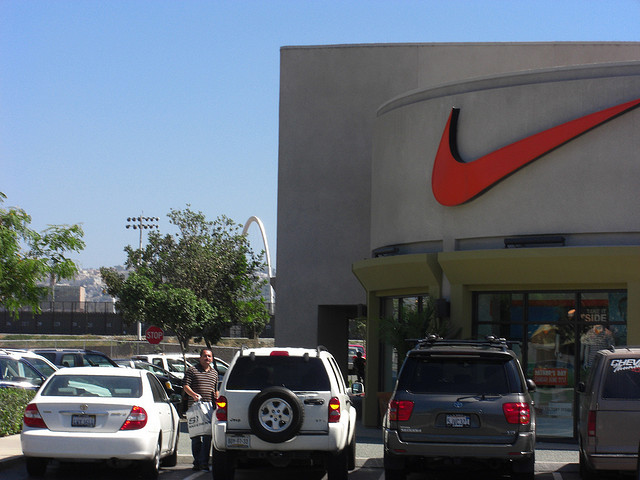
Why Swooshes Went Out Of Style

3657633460_5f389250c8_z

John McDuling suggests the decline of suburbia bears some of the blame:

Two themes being talked about in retail lately are the death of the mall, and the decline of logo-centric fashion. Both malls and (to some extent) the obsession with logos emerged in the first place due to the rise of the suburbs. Suburban developments were in many cases built around shopping malls, and  the homogeneity of the suburbs created a mentality that “resulted in group think and concentration of brand interest,” Piper Jaffray argues. This environment helped logo-centric brands like Abercrombie and Fitch prosper.

Normcore aside, that is no longer the case: branded clothes have been displaced by so-called fast fashion, designs that are basically straight from the catwalk, more sophisticated – like cities, if you will, in contrast to the suburban aesthetic of the logos. It’s far too early to describe the suburbs as dying, but a shift back to the cities is happening, and it looks like its already having an impact, on shopping malls and teen clothing retailers at least.

(Photo by Vivian Peng)

The Writer’s Better Half

Koa Beck explains why Vera Nabokov “remains a revered figure” – and often a source of envy – among writers:

Vera not only performed all the duties expected of a wife of her era—that is, being a free live-in cook, babysitter, laundress, and maid (albeit, she considered herself a “terrible housewife”)—but also acted as her husband’s round-the-clock editor, assistant, and secretary. In addition to teaching his classes on occasion (in which Nabokov openly referred to her as “my assistant”), Vera also famously saved Lolita, the work that would define her husband’s career, several times from incineration, according to Stacy Schiff ‘s Pulitzer Prize-winning 2000 biography, Vera (Mrs. Vladimir Nabokov). With Vera by his side, Nabokov published 18 novels between 1926 and 1974 (both in Russian and English). Through 1976, the year before his death, he also published 10 short story collections and nine poetry collections along with criticism, plays, uncollected short stories, and translations.

She goes on to describe other literary partnerships:

As Laura Miller recently pointed out in Salon, Virginia Woolf and Edna St. Vincent Millay each benefited greatly from truly anomalous marriages of their time, in which their respective husbands assumed a Vera-esque role. Millay’s husband, Eugen Boissevain, reportedly described himself as a feminist and “married the poet Edna St. Vincent Millay with the express purpose of providing her with a stable home life and relieving her of domestic tasks so she could write.” By the time Millay died, she had written six plays and more than a dozen books of poetry. While Leonard Woolf cared for Virginia during her bouts of mental illness, he also managed the household, tended to the garden, and co-founded the couple’s literary press.

But not all gifted writers are blessed with Veras (or Leonards or Eugens for that matter). At a promotional reading of Bark at Congregation Beth Elohim in Park Slope, Brooklyn, [Lorrie] Moore clarified to me—and a room’s worth of fans—that she absolutely does not have a Vera. “I do every little thing myself,” she said.

Previous Dish on the spouses of writers here.

The Best Of The Dish This Weekend

A beagle takes playing catch to a whole new level:

I took the girls out myself to the park today, which was jammed with picnickers, weekenders and stoners. Drum circle at one end, young Washingtonians sprawled out on the lawn at the other; some Latino soccer players kicking up dust in between; an occasional giant crown passing through from an Easter service; boyfriends balancing girlfriends in yoga poses; a rasta in a loin cloth; awkward prepsters swaying nervously; a child showing off her Easter gown; and the blossoms bursting out of the very branches:

photo

I’m not sure that’s the typical scene many think of when they think of Washington. But on a day like today – a true high holiday – it was really good to be home.

We pulled out some 4/20 stops today – this video is a classic – but focused more on the Easter side of things. One simple account of Easter’s meaning today; one surpassing meditation on its power and vitality; and a George Herbert poem to say what prose cannot.

How to write: advice from Doris Lessing. How to pray: Rosary-learning from Carolyn Browender. How men react to being cruised the way they cruise women; and a hauntingly beautiful portrait of a mother and daughter.

The most trafficked posts of the weekend were Map Of The Day, on where Americans don’t live; and my takedown of a new and surreal book on the marriage equality movement.

As of today, we have 28,395 subscribers. Join them here. Update from one:

I have been reading the Dish since I followed a link to it from a National Review Online article by Jonah 2014-04-17 15.32.44Goldberg. (You guys still friends I wonder?) My memory is little foggy on the point, but I remember donating 20 bucks to your site in your very first attempt to monetize it, before you went over to The Atlantic. So when you said you were going to start charging a subscription to your site, I decided to wait and see if you were really going to go through with it. It soon become apparent that this was real deal, but then I somehow just never got around to it. Anywho, I paid $50 – one year plus arrears for the last year-and-a-half of foot-dragging.

I keep coming back to this site for a number of reasons. First and foremost, I do not have time to browse the Internet the way I used to, so I rely on you and your staff to connect me to interesting content. (Through you I discovered, for example, Coursera, where I’ve taken a half-dozen of their online courses). Secondly, I love your honest and nuanced engagement with the issues, which is expressed in a clear and accessible every man’s style of writing. Finally, I enjoy the eclecticism of your posts, as well as your amusing little pet obsessions. (Speaking of which, I have a burning question. Do you really – now be honest with me – get turned on by a “smoking hot beard” in the same way that I do by a nice set of tits? Don’t bother answering, I know the answer already and it cracks me up!)

I am attaching a view from the window of my office in Sassari, Italy (island of Sardinia), where I own and run a private language school. I would be honored if you used it for one of your contests or in your regular posts.

Happy Easter to you and your family!

Happy Easter to all our readers. And see you in the morning.

Columbine: 15 Years Later

Dave Cullen, author of the best-selling book Columbine, addresses the lessons that much of the mainstream media haven’t yet learned from the tragedy:

Casey Chan puts the anniversary in a broader context:

History buffs might not know this already but it seems as if this week—April 14th to April 20th—might be the worst week in American history. Things like President Lincoln being assassinated, the Bay of Pigs invasion, the Columbine shooting, the Virginia Tech school shooting, the Oklahoma City bombing, the Boston Marathon bombing, etc. all happened during this week in history. Of course, if you look back far enough into history, you’re going to find something terrible for every day because, well, terrible things happen all the time. But you have to admit, this week just isn’t a good week for American history.

From an Esquire profile of Frank DeAngelis, the Columbine principal retiring this year after 35 years at the school:

Mr. D’s job of reconciling the past with the present and the future is a difficult one. Because, as the students will readily attest, people are uncommonly weird about Columbine. Tour buses stop to let their riders snap pictures during the school day. Visitors take selfies in front of the school’s sign. Travelers who’ve gotten lost looking for the memorial end up wandering around the parking lot. The memorial was built in 2007, in nearby Clement Park. It was set away from the school to deter tourists from bothering students, but that didn’t work. They keep coming. To them, the school itself is the monument.