The Wright Way To Read St. Paul

Probably_Valentin_de_Boulogne_-_Saint_Paul_Writing_His_Epistles_-_Google_Art_Project

In November, the Dish noted the publication of N.T. Wright’s 1700-page, groundbreaking exploration of St. Paul and the origins of Christianity, Paul and the Faithfulness of God. In a profile of the Anglican priest and scholar, Jason Byassee takes the measure of his intellectual ambitions:

Wright’s goal in his teaching and writing is to massively revise the way Christianity has been articulated for generations. Christian faith, for Wright, is not about going to heaven when you die. It is not about the triumph of grace over the law of the Old Testament. He says its key doctrine is not justification by grace alone, the cornerstone for the Protestant Reformers. The church has misread Paul so severely, it seems, that no one fully understood the gospel from the time of the apostle to the time a certain British scholar started reading Paul in Greek in graduate school.

“Apologist” and “revisionist” usually don’t fit on the same business card. A significant New Testament scholar told me of the time he first heard Wright speak. “He sounds like the voice of God,” he told a friend on the way out. Then he overheard someone else leaving the same lecture quip, “That guy thinks he’s the voice of God.”

He goes on to highlight Wright’s contributions to the “New Perspective on Paul” (NPP), described as “a relatively recent theological discussion about what Paul really taught about salvation”:

According to the NPP (a phrase coined by Wright), Paul was not worried about where believers’ souls would go after death. Christians of the late medieval period were worried about hell and felt they had to earn entry to heaven with works. This is the theology Martin Luther taught and wrote against, helping to ignite the Protestant Reformation.

But Jews of Paul’s time were nowhere near so individualistic, so obsessed with the next life, so unfamiliar with grace as were the late medieval Christians. Instead of teaching about souls being saved from hell, say the NPP scholars, Paul is centrally teaching about God’s faithfulness to Israel. He is showing that Yahweh is a God who keeps his promises, and so can be trusted to fulfill his promises in history. NPP scholars actually think the works commanded in the law are good gifts from God. Paul doesn’t say not to do them because you’ll go wrong and think you’re earning salvation. He says not to do them because the Messiah has come and the world is different now. All people can worship Israel’s God and should do so together without ethnic division.

Update from a reader:

I used to work at the Museum of Fine Arts in Houston, where Saint Paul Writing His Epistles is on view. The fascinating story behind the work is that there are several under paintings on the canvas, most visible to the naked eye if you look carefully at the writing desk. The head of Jesus, crowned with thorns (from an earlier painting), feels as though it is staring up at Paul while he composes. An x-ray of the painting reveals an earlier self-portrait, one of the artist at his easel.

While the artist most likely did this because he could not afford to buy more canvas, it sets up a nice metaphor for the conversation about Paul. There’s Paul, Jesus, and finally the individual layered over one another, leaving the rest of us to hash what it means. Here’s more from the MFAH website. It was always one of my favorites, and I miss visiting it in the gallery.

(Saint Paul Writing His Epistles, most likely by the 17th century French painter, Valentin de Boulogne, via Wikimedia Commons)

Bringing Joy To Life

In an interview, the poet Christian Wiman, whose work often grapples with doubt and death, turns his attention to joy:

I feel that there is a great deal of joy in my work of the past ten years, but I do get letters from people telling me to ditch the sackcloth and ashes, and I get tired of my own grimace in mirrors. Can one really just decide to be more joyful, though? One aspect of joy is the suspension of will—the obliteration of will, really—though probably there is an element of discipline in being prepared for joy, just as there is in being prepared for poetry. “Iridescent readiness,” W. S. Di Piero calls it. And there are these lines from Richard Wilbur:

Try to remember this: what you project
Is what you will perceive; what you perceive
With any passion, be it love or terror,
May take on whims and powers of its own.

The thing is, we are always going to feel God’s absence more than his presence. We are always going to feel the imprint and onslaught of necessity, which is the crucifixion, more than we feel the release and freedom of pure joy, which is the resurrection. The first we experience; the second, even when it emerges out of experience, we believe. In that tiny gap of grammar is an abyss of difference. Suffering we know and share intimately with Christ (it’s how we bear it). Faith and hope are always imaginative—that is to say, projective—acts: “Tomorrow I shall wake to welcome him.”

Previous Dish on Wiman here, here, here, here, here, and here.

Would You Notice Jesus?

Jeremy Polacek notes a new and disruptive sculptural incarnation of Jesus Christ:

Lying blanketed and forlorn on a [Davidson, North Carolina] bench, “Homeless Jesus” has inspired a conversation about homelessness in general, appropriate depictions of Christ and at least one call for his arrest. The life-size statue is the work of Canadian sculptor Timothy Schmalz who in his artist statement says he’s “devoted to creating artwork that glorifies Christ.” His “Homeless Jesus” is controversial for many reasons; most importantly because of the pose. The figure depicts Jesus as a man under a blanket, with only his exposed feet, wounded by crucifixation, to give away his identity — a starkly different image than the images Christ on the cross, Christ at the nativity or Chris the redeemer that we are used to seeing.

The idea seems to be catching on:

Davidson’s “Homeless Jesus” is the first “Jesus the Homeless” statue on display in the U.S., but more might be on the way. While not entirely a unanimous opinion (St. Michael’s Cathedral in Toronto and St. Patrick’s Cathedral in New York rejected installing the works largely due to cost), a number of religious officials and bodies have expressed interest and support for the work.

Long before it came to Davidson, Pope Francis was presented with a wooden model of the work, which he blessed and prayed over. Catholic Charities of Chicago intends to install the work later this year, while the Archdiocese of Washington, D.C., and the city of Rome have also discussed the possibly. If it so, it would appear on Via della Conciliazione, in sight of St. Peter’s Basilica.

Turning The Nones Toward Faith

Damon Linker argues that it won’t happen until religion “comes to grips with and responds creatively to the fact of pluralism”:

[P]erhaps the most daunting obstacle to getting the nones to treat traditional religion as a viable option is the sense that it simplifies the manifest complexity of the world. Yes, we long for a coherent account of the whole of things. But we don’t want that account to be a fairy tale. We want it to reflect and make sense of the world as it is, not as we childishly wish it to be.

The tendency toward oversimplification is a perennial temptation for all forms of human thinking, but it’s especially acute in matters of religion … There is a whole, and it can be grasped. But it is a complex whole. A pluralistic whole. A differentiated whole shot through with contradiction and paradox. This is something that modern men and women intuitively understand, even if they’ve never read a word of the great philosophical pluralists (Daniel Bell, Isaiah Berlin, and Michael Oakeshott), and even if they choose to devote their lives to fighting it in a futile and self-defeating embrace of fundamentalism.

Quote For Easter Sunday

Caravaggio_-_Cena_in_Emmaus

“We are not told that Jesus ‘survived death’; we are not told that the story of the empty tomb is a beautiful imaginative creation that offers inspiration to all sorts of people; we are not told that the message of Jesus lives on. We are told that God did something – that is, that this bit of the human record, the things that Peter and John and Mary Magdalene witnessed on Easter morning, is a moment when, to borrow an image from the 20th century Catholic writer Ronald Knox, the wall turns into a window. In this moment we see through to the ultimate energy behind and within all things. When the universe began, prompted by the will and act of God and maintained in being at every moment by the same will and action, God made it to be a universe in which on a particular Sunday morning in AD33 this will and action would come through the fabric of things and open up an unprecedented possibility – for Jesus and for all of us with him: the possibility of a human life together in which the pouring out of God’s Holy Spirit makes possible a degree of reconciled love between us that could not have been imagined.

It is that reconciled love, and the whole picture of human destiny that goes with it, that attracts those outside the household of faith and even persuades them that the presence of religion in the social order may not be either toxic or irrelevant after all. But for the Christian, the basic fact is that this compelling vision is there only because God raised Jesus. It is not an idea conceived by the spiritual genius of the apostles, those horribly familiar characters with all their blundering and mediocrity, so like us. It is, as the gospel reading insists, a shocking novelty, something done for and to us, not by us. How do we know that it is true? Not by some final knock-down would-be scientific proof, but by the way it works in us through the long story of a whole life and the longer story of the life of the community that believes it. We learn and assimilate its truth by the risk of living it; to those on the edge of it, looking respectfully and wistfully at what it might offer, we can only say, ‘you’ll learn nothing more by looking; at some point you have to decide whether you want to try to live with it and in it.’

And what’s the difference it makes?

If God exists and is active, if his will and action truly raised Jesus from the dead, then what we think and do and achieve as human beings is not the only thing that the world’s future depends on. We do all we can; we bring our best intelligence and energy to labour for reconciliation and for justice; but the future of reconciliation and justice doesn’t depend only on us. To say this doesn’t take away one jot of our responsibility or allow us to sit back; as Pascal said, we cannot sleep while Jesus is still in agony, and the continuing sufferings of the world are an image of that agony. But to believe that everything doesn’t depend on us delivers us from two potentially deadly temptations. We may be tempted to do something, anything, just because we can’t bear it if we aren’t making some visible difference; but to act for the sake of acting is futile or worse. Or we may be consumed with anxiety that we haven’t done enough, so consumed that we never have time to be ourselves, to give God thanks for his love and grace and beauty. We may present a face to the world that is so frantic with fear that we have left something undone that we make justice and reconciliation deeply unattractive. We never acquire the grace and freedom to give God thanks for the small moments of joy, the little triumphs of sense and kindness,” – Rowan Williams.

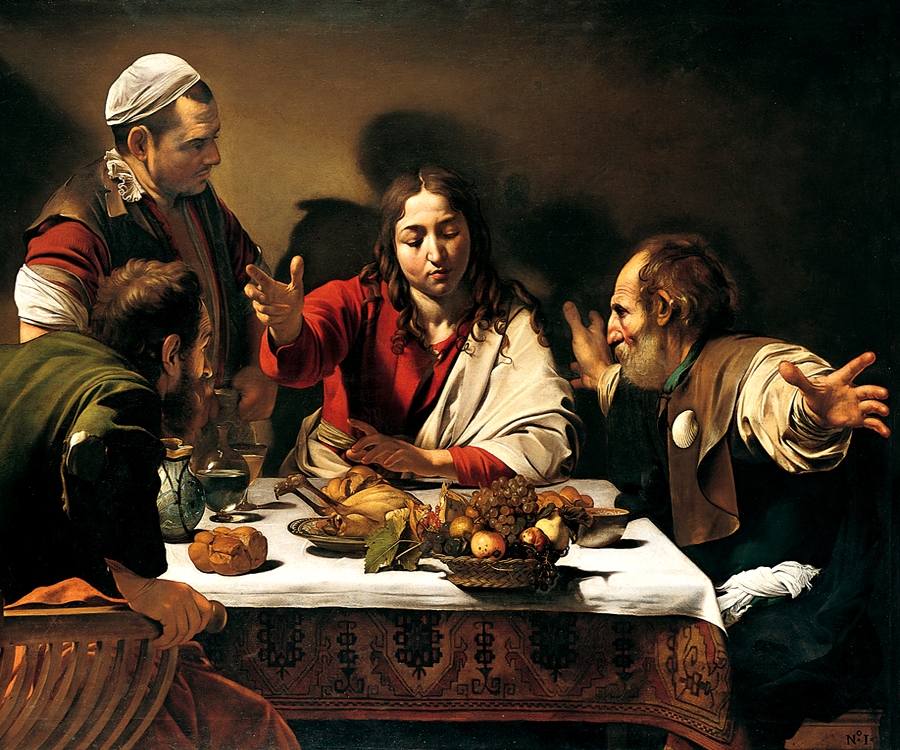
(Caravaggio’s Supper at Emmaus, 1601, via Wikimedia Commons)

Different Ways To Pray, Ctd

Last time we checked in on Carolyn Browender’s Lenten resolution to spend a week following the prayer practices of different faith traditions, she had tried Mormonism and Quakerism. She then turned to Roman Catholicism:

I borrowed a rosary from a friend and after some hunting around, found  a how-to pamphlet from the Knights of Columbus and a list of the different mysteries you’re supposed to mediate on when praying. I didn’t know the Hail Mary, Glory Be, Fatima Prayer or Hail Holy Queen, so my first attempt was clumsy. I kept alternating between the pamphlet for the prayers and the list of mysteries. My second attempt was a bit smoother and was done right before I went to sleep. At this point I’d memorized the Hail Mary and Glory Be, and found it much easier to relax and fall into a more contemplative state. While my mind would sometimes wander while contemplating the mysteries (I focused on the sorrowful ones), I did appreciate the physicality of fingering beads. This seems to be a theme for me this Lent: If there is some kind of ritual or movement I can perform my prayers are likely to be more focused.

Next up was Judaism, which proved a linguistic challenge:

After attempting to pray from a more traditional website, I opted to switch to an online community’s siddur for my afternoon and evening prayers. The former featured clunky translation and assumed more familiarity with certain prayers than I had. The latter, while easier to follow and with an more inclusive and poetic translation, seemed almost too short, which made it difficult to connect fully to the ritual. Granted, the brevity was my fault—I was praying alone, when the ideal way to pray would have been in a minyan. I also missed the melodies that prayers and psalms were sung to when I attended services. Music (singing in particular) is a useful spiritual tool for me, even when the words are in a language other than English, and its absence was definitely felt in this exercise.

I also struggled with timing. I did not even attempt the full morning prayer service, though I tried to say the Modeh Ani when I woke. I really like the idea of being thankful and grateful upon waking, but not being a morning person I found it difficult to be particularly genuine when reciting it.

Thankfully, the Shema came through for me a few times. I would recite this as part of the afternoon and evening prayers and again before I went to sleep. I found that singing this quietly before falling asleep centered and relaxed me. Its frank statement of faith in the oneness of God is also appealing—this is one of the few beliefs of mine that has been nearly constant through phases of skepticism and questioning.

A Poem For Saturday

18249097_cba2008bd5_o

“Jordan (II)” by George Herbert (1593-1633):

When first my lines of heav’nly joyes made mention,
Such was their lustre, they did so excell,
That I sought out quaint words, and trim invention;
My thoughts began to burnish, sprout, and swell,
Curling with metaphors a plain intention,
Decking the sense, as if it were to sell.

Thousands of notions in my brain did runne,
Off’ring their service, if I were not sped:
I often blotted what I had begunne;
This was not quick enough, and that was dead.
Nothing could seem too rich to clothe the sunne,
Much lesse those joyes which trample on his head.

As flames do work and winde, when they ascend,
So did I weave my self into the sense.
But while I bustled, I might heare a friend
Whisper, How wide is all this long pretence!
There is in love a sweetnesse readie penn’d:
Copie out onely that, and save expense.

(Photo by Mark Probst)

A Supremely Strange Short

Jonathan Crow calls Samuel Beckett’s only movie – titled, simply, Film – “enigmatic, bleakly funny and very, very odd”:

The 17-minute silent short is essentially a chase movie between the camera and the main character O  – as in object. Film opens with O cowering from the gaze of a couple he passes on the street. Meanwhile, the camera looms just behind his head. At his stark, typically Beckettesque flat, O covers the mirror, throws his cat and his chihuahua outside and even trashes a picture — the only piece of decoration in the flat — that seems to be staring back at him. Yet try as he might, O ultimately can’t quite evade being observed by the gaze of the camera. …

Ever since it came out, critics have been puzzling what Film is really about. Is it a statement on voyeurism in cinema? On human consciousness? On death? Beckett gave his take on the movie to the New Yorker: “It’s a movie about the perceiving eye, about the perceived and the perceiver — two aspects of the same man. The perceiver desires like mad to perceive and the perceived tries desperately to hide. Then, in the end, one wins.” Keaton himself defined the movie even more succinctly, “A man may keep away from everybody but he can’t get away from himself.”

Meanwhile, Tim Martin reviews Beckett’s recently published “lost” short story Echo’s Bones. He sees a young writer still struggling to cast off the burden of James Joyce’s influence:

The story’s plot is deliberately staccato and unhinged. [The character] Belacqua is cast up from the grave, “up and about in the dust of the world, back at his old games in the dim spot”, and finds himself sitting on a fence smoking cigars. He has a brief philosophical assignation over garlic and rum with a prostitute (sample dialogue: “Alas, Gnaeni, the pranic bleb, is far from being a mandrake. His leprechaun lets him out about this time every Sunday. They have no conduction”), before being kidnapped by the grotesque Lord Gall, an impotent golfing aristocrat of monstrous proportions who carries Belacqua on his shoulders up a tree, where he persuades him to impregnate his wife and meet his pet ostrich. … Several characters from the book’s earlier stories arise from the bay aboard a submarine, and watch him crossly from afar. The grave, once uncovered, is empty. “So it goes in the world,” the story concludes.

Perhaps Godot or Happy Days might appear similarly ridiculous in summary. But Beckett’s linguistic approach here stands in fascinating opposition to his subsequent progression towards what he called a “lessness” of language and object. Speaking to James Knowlson in 1989, he described his eventual realisation that Joyce “had gone as far as he could in the direction of knowing more… I realised that my own way was in impoverishment, in lack of knowing and in taking away.” That epiphany lay far in the future, but the sterile, spasmodic prose in “Echo’sBones” already shows him trying to pass his Joyce influence like a kidney stone.

The Politics Of Porn

dish_pornmap

Christopher Ingraham compares red and blue states’ porn-watching habits:

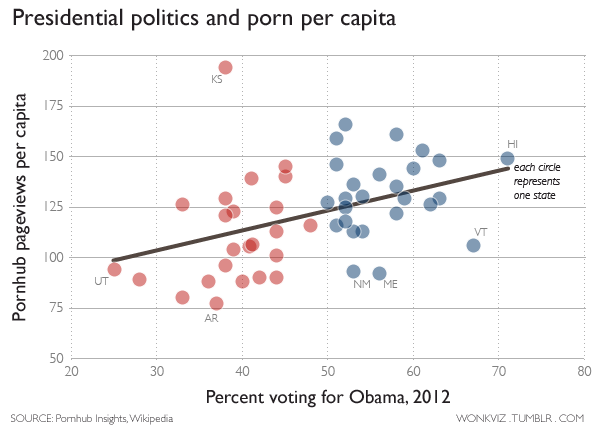
Blue states watch more porn. But what’s the matter with Kansas? According to Pornhub Insights, Kansas leads the nation in porn pageviews per capita at roughly 194. They don’t specify what interval this is over (monthly, weekly, etc), but the state-by-state comparison is nonetheless interesting.

Plotting Obama vote share in 2012 versus porn consumption, it looks like blue states consume more porn per capita than red ones. Aside from Kansas – a clear outlier – and Georgia, the remaining top ten per-capita porn consumers are all blue. Similarly, New Mexico and Maine are the only blue states in the bottom ten per-capita porn consumers.

Update from a reader:

Kansas is getting the credit for other people’s porn habits. This is due to one the the vagaries of IP-address based geolocation. When a geolocation service tries to figure out where, geographically, an IP address is located but does not have the date to specify at a less-than-national level, it returns the location of a spot in the very center of the country – which is a spot near Wichita, Kansas. Thus, Kansas numbers are inflated by all the IP addresses for which a more specific location could not be identified.

In other porn analysis, Calvin Hennick wonders why commenters on porn sites are, on the whole, more upbeat than those elsewhere on the Internet:

Take this sampling from XVideos, a site where I’ve spent hours, ahem, researching this phenomenon:

“Her booty is the best”

“11 out of 10! This one never gets old”

“great video”

“awesome. whats her name?”

“If Kendra was my sister, I’d fk her…is that weird?”

Okay, so maybe it’s not all healthy and constructive. But consider what’s here: straightforward, sincere expressions of appreciation, along with a simple request for more information (“whats her name?”). Now consider how rare those things are on the rest of the Web.

His theory:

Porn is primal. Everywhere else online – even places where we’re anonymous – we “keep our clothes on,” so to speak, unable to shed our egos. We think we’re right about everything, and it is very important to us that everyone else knows this. But when we watch porn, we’re not trying to impress anyone or prove anything to ourselves. We’re totally naked. And so, instead of critiquing the videos, or debating their merits until we hate a person we’ve never met, we allow ourselves to relax and wallow happily in our shared humanity.

The Pleasures Of Stoned Sex

Like Savage and Yoffe, Maureen O’Connor celebrates pot’s place in the bedroom:

Perhaps as powerful as the way weed makes users feel, is how it makes them act and interact.

Grinspoon explains, using psychedelic pioneer Timothy Leary’s emphasis on the impact of “set and setting” on drug trips: “The set means all the ideas, thoughts, experiences that you have with this particular drug, and the setting is the surroundings. For instance, are you afraid you’re going to have a knock on the door and the cops will come in? Those things influence the high. So part of the set in having a sexual experience is how the people feel about each other.” Grinspoon, whose first personal experience with weed involved passing the dutch with Carl Sagan, postulates that feelings of communion between weed-smoking partners can be more profound than mere sexual sensation. To the sober or weed-culture averse, this social side effect may be one of weed’s more irritating cultural legacies — earnest hippies hugging and musing about love and the spirit and really connecting, man. But for those who indulge in a romantic setting, the heightened earnestness can free them to interact in new, thrilling, and unapologetic ways.

Update from a reader:

I don’t exactly enjoy being high. If I’m looking for a way to unwind, I prefer the way a few beers makes me feel. Pot winds me up somewhat and makes me too introspective. But my wife and I do toke occasionally because the sex is so incredibly, impossibly, off-the-scales amazing.

The first time was such an epiphany I almost immediately started getting judgmental on my former self for wasting so many years by having sex sober. Nowadays we set aside a night every month or so for our daughter to spend the night at Grandmas so we can have a pot induced sex-a-thon.