A pop-culture sketchbook in motion:
Month: April 2014
The Putin Way Of War
Anne Applebaum outlines his innovative tactics, which she characterizes as “old-fashioned Sovietization plus slick modern media”:
Thirteen years ago, in the wake of 9/11, the United States suddenly had to readjust its thinking to asymmetric warfare, the kinds of battles that tiny groups of terrorists can fight against superior military powers. We relearned the tactics of counterinsurgency in Iraq.
But now Europe, the United States, and above all the Ukrainians need to learn to cope with masked warfare—the Russian term is maskirovka—which is designed to confuse not just opponents, but the opponents’ potential allies. As I’ve written, the West urgently needs to rethink its military, energy, and financial strategies toward Russia. But more specific new policies will also be needed to fight the masked invasions that may follow in Moldova or, in time, the Baltic states if this one succeeds.
Americans and Europeans should begin now to rethink the funding and the governance of our international broadcasters in order to counter the new war of words.
Kevin Rothrock points out how badly we are screwing up the information war:
The biggest fumble came this week, when the White House confirmed that CIA Director John Brennan traveled to Kiev last weekend. The Russian government and media have been loudly insisting that American spies orchestrated the overthrow of the Yanukovych government. And now it looked like Russian claims that the U.S. government was helping Kiev crack down on separatists in the Donbas region were true.
For its part, the State Department has been trying to reach out to Russian speakers on the Internet for years, but the crisis in Ukraine has highlighted just how clumsy those efforts are. Earlier this month, Russia’s Foreign Ministry went so far as to lampoon the U.S. embassy to Russia, which tweeted—to the amusement of many—a misspelled hashtag that was supposed to say “the isolation of Russia.” Russia’s diplomats warned the U.S. that it ought to learn how to spell a country’s name before spreading “spam” and offered their proofreading services to the State Department’s press office.
James Bruno compares the Russian and American approaches to diplomacy:
Russia has always taken diplomacy and its diplomats seriously. America, on the other hand, does not. Of this country’s 28 diplomatic missions in NATO capitals (of which 26 are either currently filled by an ambassador or have nominees waiting to be confirmed), 16 are, or will be, headed by political appointees; only one ambassador to a major NATO ally, Turkey, is a career diplomat. Fourteen ambassadors got their jobs in return for raising big money for President Obama’s election campaigns, or worked as his aides. A conservative estimate of personal and bundled donations by these fundraisers is $20 million (based on figures from the New York Times, Federal Election Commission and AllGov). The U.S. ambassador to Belgium, a former Microsoft executive, bundled more than $4.3 million.
By contrast, all but two of Moscow’s ambassadors to NATO capitals are career diplomats. And the two Russian equivalents of political appointees (in Latvia and Slovakia) have 6 and 17 years of diplomatic experience respectively. The total number of years of diplomatic experience of Russia’s 28 ambassadors to NATO nations is 960 years, averaging 34 years per incumbent.
Chart Of The Day

Kliff relays Gallup’s latest numbers:
The polling firm’s data shows states that set up their own exchanges and expanded Medicaid had their uninsured rate fall by 2.5 percent, compared to a 0.8 percent drop in states that have opted out of at least one of the health law programs. Separate federal data has shown that states expanding Medicaid have had faster growth in the public program than those that have opted not to participate. States that do not expand Medicaid essentially leave those in poverty in a coverage gap because they are too poor to qualify for the private insurance subsidies offered to people above the poverty line.
Cohn adds:
As readers of this space know, the Gallup results are very imprecise, enough that nobody should take specific figures too seriously. And these aggregate totals surely mask all sorts of variation among the states. But the overall pattern—a sharp divergence between the two groups of states—is almost certainly real. It’s also very tragic.
Drum piles on:
These numbers will change a bit over the next couple of months as things settle down and signups are complete, but the relative differences will almost certainly remain huge. Republican governors have been almost unanimously dedicated to sabotaging Obamacare and withholding health care from their own residents, and they’ve been successful. I hope they’re proud of themselves.
Douthat, meanwhile, lays down a marker:
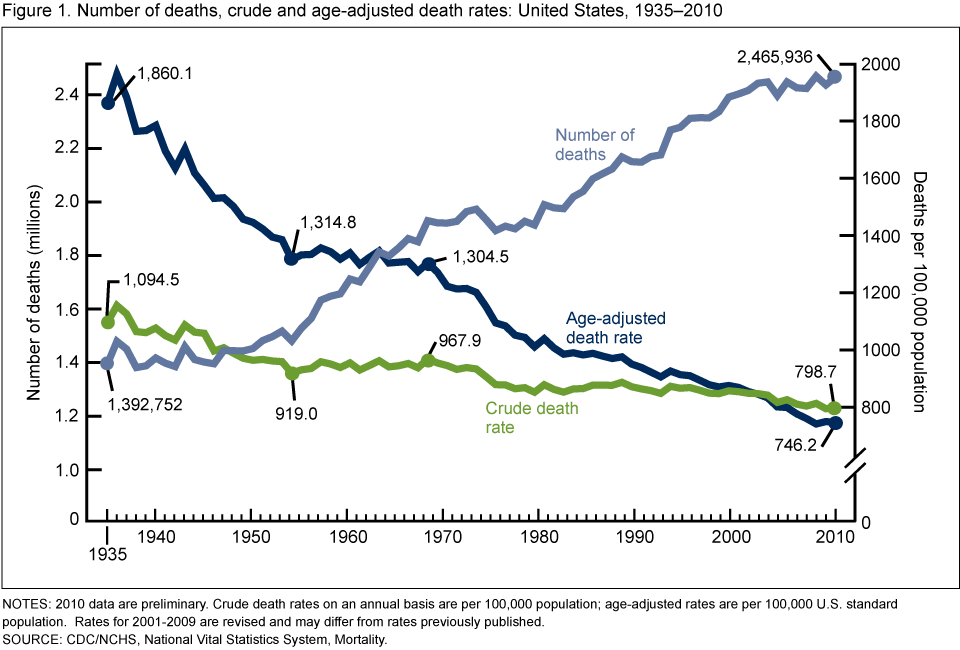
If, in 2023, the uninsured rate is where the C.B.O. currently projects or lower, health inflation’s five-year average is running below the post-World War II norm, and the trend in the age-adjusted mortality rate shows a positive alteration starting right about now, I will write a post (or send out a Singularity-wide transmission, maybe) entitled “I Was Wrong About Obamacare” — or, if he prefers, just “Ezra Klein Was Right.”
The Neocons And The Putin-Netanyahu Alliance
Michael Brendan Dougherty notes the many differences between Israel’s and Russia’s predicaments and foreign policies, but he also sees a deep neocon dilemma:
For some neoconservatives, Benjamin Netanyahu is the totem of “moral clarity” on the international scene. And yet, these same writers will say that Obama is being played for a fool over Crimea. If Obama is a fool for not opposing Putin strongly enough, what does that make of Bibi’s moral clarity? Bill Kristol worries that Obama is placating Russia, and has said that Obama’s “weakness” has invited Russia’s aggression in the Ukraine. What has Israel’s silence done? When Kristol says that America should be making Putin’s friends pay a price, surely he doesn’t mean Israel.
Here’s a thought experiment. Imagine if France or Britain or Germany had abstained in the UN vote on the annexation of Crimea, and robbed the US of international support. Do you think Bill Kristol would not have mentioned it? Of course not. We’d be reading the umpteenth Weekly Standard piece on the feckless appeasers and ninnies of Old Europe. But when Israel does the same thing … crickets. Or even, in fact, lionization of Netanyahu as a strong figure on the world stage – compared, of course, with president Obama. After a while you notice something about this faction: when they are engaged on obvious inconsistency, Israel – not America – is almost always the reason why. And they will always, in that instance and that instance alone, blame America first.
Dissents Of The Day
A reader quotes me:
Even as the truth now is that no one with undetectable virus can infect anyone, and no one on Truvada can get infected. Instead of embracing that, we shy from it.
This seems optimistic to me in a way that borders on foolish. Where did you learn this? I’d love to read the scientific papers or studies that come to that conclusion. My memory of articles I have read about
Truvada say that in the study group, it prevented infection at a percentage in the high 90s, which is pretty darn good. But that doesn’t mean “no one on Truvada can get infected.” I have no beef with anyone who wants to take it to reduce their risk, but you can’t make the claim that a very effective pharmaceutical can protect a person from infection in the same way that a physical latex barrier can. (I’ve never agreed with your hatred of condoms and side with Dan Savage: If condoms break without people noticing, they can’t make that much of a difference.)
Not to mention that saying a person with undetectable viral load cannot infect anyone also sounds irresponsible at best. From the CDC website: “However, sexual transmission of HIV from an infected partner who was on ART with a repeatedly undetectable plasma viral load has been documented.”
All that said, wider use of PrEP should be considered, but honesty and facts are called for in discussing its potential. I think if it were true that no one on Truvada could get infected, you’d see every public health department clamoring to offer it to high-risk populations.

We’ve covered this ground already. Here’s the key study on the impact of undetectable viral loads in preventing transmission. Money quote:
Statistical analysis shows that the maximum likely chance of transmission via anal sex from someone on successful HIV treatment was 1% a year for any anal sex and 4% for anal sex with ejaculation where the HIV-negative partner was receptive; but the true likelihood is probably much nearer to zero than this. When asked what the study tells us about the chance of someone with an undetectable viral load transmitting HIV, presenter Alison Rodger said: “Our best estimate is it’s zero.”
In over 40,000 unprotected sex acts, no negative partner was infected by a positive partner with undetectable viral loads. A key Truvada study found more than 90 percent effectiveness in preventing HIV infection even among those not fully compliant with the one-pill-a-day regimen. Another study showed that “participants could reduce their risk of HIV by 76 percent taking two doses per week, 96 percent by taking four doses per week, and 99 percent by taking seven doses per week.” 99 percent may not be 100 percent, but it’s pretty damn close. And it’s not that different from condom use in HIV prevention. Condoms are not 100 percent effective either; you need to use them correctly; they can break; and so on. Moreover, stopping sex and putting on a rubber in the heat of the moment may not be as easy as taking one pill a day outside the experience of sex.
Another reader is “horrified that you are using your influence to pass off opinion as science in regards to the prophylactic use of Truvada”:
I’m not an expert, a patient, an advocate, or a physician – I just work for the pharmaceutical industry and I sat through the FDA Advisory Committee hearing on Truvada PrEP in May 2012. I assure you that experts on that panel were concerned about Truvada and resistance – particularly when not taken as prescribed.
Furthermore, the claim that “maintaining a Truvada prescription requires a comprehensive HIV test every three months” is simply false. This is recommended by FDA, but there is no process in place to ensure that prescribers test patients every three months. We must depend upon physicians to follow these recommendations – and even the most conscientious prescriber might fill a prescription for the patient who is about to leave on vacation and needs a refill “just this once.” Contrast this to a drug like thalidomide, for which FDA requires the prescriber to submit a negative pregnancy test result before the drug is dispensed.
Finally, no one knows what side effects might result from long-term use of Truvada – or what will happen when the drug is not taken as recommended. The FDA approval was based on results seen in a small number of patients in carefully controlled clinical trials. Oftentimes it takes years after approval before dangerous side effects of drugs are discovered. This is particularly true for drugs taken long term.
Celebrate that Truvada is on the market. Celebrate that Truvada represents a major development in HIV-prevention, but please don’t pass off opinion and conjecture as scientific fact. You have so much influence, please be careful!
Here [pdf] is the FDA’s Risk Evaluation and Mitigation Strategy for Truvada for PrEP. It describes many of the concerns about Truvada. And here [pdf] is a transcript of the advisory committee hearing. It’s really long, but search this for “resistance” – and you’ll see that it was a major concern among the experts on the panel.
I’ve noted that resistance is a worry. But insurance companies won’t cover the drug outside the three-month protocol, require an HIV test to start it, can catch an HIV infection before it has a chance to mutate, and the small chance of resistance if the patient is not taking it regularly in those three months can be overcome by other HIV drugs in a different class than Truvada. As for side-effects, it is not true that we know nothing about it. Truvada has been around for quite a while. No drug is without side effects. But the side-effects of HIV are brutal and the side-effects of the full cocktail much more punishing to the body. The truth is: the risks of Truvada are minimal compared with the risk of HIV and the toll of the cocktail. No of course it isn’t fail-safe. But the actual risks of this are trivial, when you abandon the irrational fear and panic inherited from the past and look at the entire picture. Another reader:
In the past I have found your attitude toward HIV to be a little cavalier, to be honest. So when you talk about Truvada, I take it with a grain of salt. I am 29, of the generation that was a little child when the worst was happening and was basically taught to fear sex, condom or not, ESPECIALLY GAY SEX. This was of course on top of all the traditional moralizing against sex, coupled with “abstinence only” sex ed. To this day, even after learning the truths, I can’t have sex without the worry in the back of my mind of whether this will be it. I had resigned myself to it for the rest of my life.
So now I am hearing that that there’s a drug that could be almost the vaccine we have all been hoping for. The first thing that happens is massive amounts of moralizing (on both sides), judgement and a big heaping spoon of FUD [fear, uncertainty, doubt]. What I need are trusted, independent, verifiable facts. And right now, I don’t know who the fuck to believe.
So my question is: Where the hell are the doctors? Why aren’t we hearing from independent medical professionals? Where is the Surgeon General issuing a recommendation? The AMA? All I have to go on right now is figures from one side, figures from the other side, and all the screaming in between.
My attitude is not cavalier. It comes from two and a half decades of study and more than two decades with the virus. My attitude is based simply on taking seriously the value of intimate, gay sex as a human good, not a lamentable evil. And on trying to see the actual, practical ways we can deploy to reduce infection and transmission. From sero-sorting to Truvada, I’ve been thinking about this for a long time – in part out of a duty to my friends and lovers who died agonizing deaths. I don’t think they would want us infecting each other at the rates we are, or would regard this breakthrough as anything other than a Holy Grail of sorts. And don’t throw up your hands at arguments back and forth. I’ve offered the data and the facts. Check out the links I’ve provided and ask your doctor if it works for you.
What Does Bud Do To Young Brains? Ctd
Maia Szalavitz works to debunk the study we flagged yesterday:
The 20 marijuana-smoking participants, who took the drug at least once a week, were deliberately selected to be healthy. If they had any marijuana-related problems—or any psychiatric problems or other issues—they were excluded from participating.
Are you beginning to see what’s wrong? Although the pot-smoking participants showed brain differences in comparison to the controls who were also selected to be normal— both groups were normal! If the smokers had any marijuana-related problems or any type of impairment, they would not have been included in the first place. Therefore, the brain changes that the researchers found were—by definition—not associated with any cognitive, emotional, or mental problems or differences.
“I’m disappointed that scientists are still able to publish high profile papers that only look at neuroimaging without a behavioral endpoint,” says Carl Hart, an associate professor of psychology at Columbia University who was not associated with the research (Disclosure: he and I worked on a book project together). Hart compares the findings to brain differences found between the genders. “There are structural differences between men and women in certain areas,” he says, but they don’t predict differences in ability. “We don’t say this means women are impaired,” he adds.
German Lopez points out other limitations of the research:
[R]esearchers never analyzed if the detected differences persisted over time. Blood acknowledges the issue as one of the study’s limitations, but she cautions that it’s rare the brain fully reverses major changes. The study also didn’t identify whether marijuana caused the detected differences. It’s possible, for example, that people with different brain structures are more likely to use marijuana. But because the amount of marijuana use correlated with more variations in brain structure, Blood says she’s fairly confident the two factors are linked.
Pushing The Envelope, Ctd

A reader: “Oh how I wish someone in Finland would help us mail protest letters to Putin using those stamps.” Another:
A friend from Finland writes:
Now there are two online petitions going on in Finland. The first, of course, is for banning these stamps. The other is for making a lick-able version, instead of the self-adhesive.
Heh. Update from a reader:
For the sake of a brief laugh, or to show the degree to which the cultural shift towards equality has advanced in Western Europe: While reading through yesterday’s edition of Germany’s “Die Welt” newspaper (the most right/conservative quality paper in the mainstream media) I came across an article on the new Finnish stamps with the absolutely delightful title “Klebende Homoerotik zum Anlecken” – ‘”sticky homoeroticism fit to lick”.
Another:
Despite philately‘s nerdy conservative image, homosexuality has always had a place in the stamp world.
In the 1970s, a prominent collection that won numerous competitive exhibiting awards was called “Alternative Lifestyles”. No one imagined that so many earlier stamps commemorated homosexual men and women, and for most of us (remember, 1975) this was our first awareness of the gay world. It is a tribute to philately, I think, that in this era, such a collection won such widespread praise and won so many national awards. And there was a strong group of prominent homosexual stamp dealers in the 1980s (who also went by the name “gay Mafia”) largely concentrated in the more philatelically arcane “postal history” fields and who were very successful and who threw the best parties. More on the history of gays and philately can be found here.
Marijuana Is Good
As pot becomes fully legal in some parts of the country, we may soon be better able to discuss its many positive benefits for both the individual and society. At some point, the cannabis movement, like the marriage equality movement in the 1990s, will get out of the defensive crouch (leave us potheads alone!) and into the much more interesting area of the tangible goodness and benefits of “God’s plant.” So herewith a couple of buds in the wind. Dan Savage picks up on the awesome Emily Yoffe’s recent piece on weed and sex:
I didn’t start smoking pot until I was 34 years old. (I was far too busy in my teens memorizing the lyrics to Stephen Sondheim’s shows to bother with weed.) So I had been sexually active for nearly 20 years the first time I smoked pot. Stoned sex was a
revelation. For a guy like me—someone with their fair share of hang-ups, body image issues, and, yes, sexual inhibitions—pot was very freeing. It helped me to do something that I had never been able to do on my own: It turned off that voice in my head that said, “You’re not going to eat that, are you?”
So, yeah, get high and have sex. It’s amazing—or it can be. Individual results may vary, of course, but pot can make you silly, it can make you playful, and it can put you in the moment. And, yes, it can give you the munchies. But chips aren’t the only things a high person can munch on for hours.

Whoopi Goldberg is now a pot-columnist for Colorado’s The Cannabist. Her first piece is on the wonders of the vape pen in calming her glaucoma-induced headaches:
These pens are light, compact and portable. The vapor is inoffensive and subtle. And for me a lot of the new pot is too strong — and when I take edibles I rarely come out of the room. With the vape pen, you have more control over how much THC you ingest. If my headache is just starting, I know a short sip will take care of it. If the pressure inside my head is pounding, then two or three sips is a better prescription.
These glaucoma-induced headaches come on like freight trains — like, BOOM, my head starts hurting, my eyes start bugging, my whole body starts to tense up. But then I find her, and it relaxes everything and calms everything. It helps my head stop hurting, and with glaucoma your eyes ache, and she takes the ache out. It’s wonderful. The high is different, too. It feels like a gentle, warm breeze at the beach. It’s like someone undoing a vice grip, very slowly. It’s not overpowering — and I’m certainly not looking for that high high. I’m looking for relief.
The legalization in two states is not just about those two states. By providing places where recreational as well as medical pot can be enjoyed legally, it allows writers to emerge from the cannabis closet with no fear of legal consequences. I don’t think we’ve fully absorbed the consequences of this creative and intellectual liberation. And words and ideas that have long been suppressed in the mainstream can be very powerful things. Especially if they are, you know, true.
The View From Your Obamacare
Readers begin to share their stories:
Being left out of the official statistics are people like me who purchased new policies directly from insurance carriers. Pre-ACA, they would not have insured me for any amount of money due to a long list of pre-existing conditions. As of January 1, they can no longer ask me those questions. I do not qualify for any subsidies, so there was no need for me to purchase insurance through the exchange. Instead, I bought insurance without the government middleman, courtesy of the ACA.
Another:
I’m a 29-year-old woman and a self-employed writer. Before the ACA passed, I was rejected by every health insurer in California because I had an abnormal pap smear and was diagnosed with HPV, which can cause cervical cancer. I was shocked – not by the diagnosis, which is very common, but by the fact that I could not get any coverage (I am otherwise very fit and in perfect health). I am eternally grateful for Obamacare – not because of the cost (which at $181/mo for a $2000 deductible is much cheaper than the Freelancer’s Union insurance in had in NYC of $270/mo for a $10,000 deductible), but because it allows me to get health care at all.
What troubles me about the health politics of the Republican party is that they seek to dismantle both Obamacare and Planned Parenthood, thus rendering a woman in my position without any sort of affordable preventative care. And there are a lot of women in my position. HPV is not a rare disease. According to the CDC’s website:
About 79 million Americans are currently infected with HPV. About 14 million people become newly infected each year. HPV is so common that most sexually-active men and women will get at least one type of HPV at some point in their lives.
But many women, myself included, do not like to talk about these details in public. I paid attention to the way people reacted to Sandra Fluke, and I am not interested in engaging in a public conversation about my sexual choices (though if you must know, I’m heterosexual, monogamous, and am engaged to a man I have been dating for five years). This, I think, is one of the reasons we don’t hear an outpouring of good publicity for Obamacare: the people who benefit most from it (self-employed, with a pre-existing condition) are less inclined to talk about their success stories because the subject matter is often too sensitive for a public forum, or for a name to be attached to it.
Another shifts focus:
The law has been helping my family in one key way since just a few months after its passage in 2010: my 19-year-old-sister gets to stay on my mom’s plan. My dad died in late 2012. If Obamacare hadn’t given us this option, keeping my sister insured would be an all-hands-on-deck financial effort by myself, my mom and probably my little brother. It would be a huge drain on the incomes of my entire immediate family.
Now? She’s had coverage consistently since exceeding the age of 18 and apparently can continue to have coverage for another six years. In the meantime, she’s getting a degree and starting her first part-time jobs, so she’s probably on track to be pay for her own insurance by the time she is 26. In a world without ACA, she couldn’t have this college experience. She’d have to go to school part-time and work more. Obama is helping my family help my sister have the kind of college experience she deserves and I am tearing up just typing this to you.
Update from a reader:
As you know, I’m an advocate of Obamacare. However, I have to point out that your third reader is apparently either mistaken or doesn’t know about one huge change in the marketplace due to the ACA. Now this may differ from state to state, but here in CA, prior to 2010, children could stay on their parents ONLY IF they are full-time students. Only if she was a part-time student would she have had to carry her own insurance.
There is one huge change to the law that affects parents. Prior to 2014, here in CA, one child’s premiums paid for all children. So if you were Kate whatshername and had 8 children, you’d still only pay for one. I think this is what your reader meant by not having a “huge drain on the incomes on my entire immediate family.”
Starting in 2014, with all new ACA plans, a parent has to pay for up to three children’s premiums, as long as they are under 18. Any child over 18 will have their own premium. So, if a parent had six children, three under 18 and three over 18, that parent will have to pay six premiums along with the parents. If the scenario was five children under 18 and one over, that parent would have to pay for four children’s premiums.
So that third reader? She may be in for a huge surprise when the mom renews. It sounds like the mom had to pay for two premiums before, and now will be looking at three, four if the writer is under 26.
You know what surprises me? I haven’t read one story in the media about this change. And I think it’s because parents have known all along, that the old way was a very nice free ride.
Another provides some supplemental info on the subject:
This link has state-by-state laws on eligibility. Looks like 19 is the youngest a kid would no longer qualify for parents insurance. But there were lots of exceptions to that age depending on the state. Often a kid could remain on insurance longer if they were a student. Here is a key part of an issue brief (pdf) on the subject from 2010: “Young adults covered as dependents on their parents’ employer policies often lose eligibility for that coverage at age 19 or upon graduation from high school, particularly if they do not go on to college.” And here’s part of a useful Kaiser brief (pdf) from 2010:
Approximately 25 states have extended the age that young adults can remain on their parent’s health insurance plan, but policies regarding who is eligible for this coverage vary widely. Most of the states that have these policies in place extend coverage to young adults up to age 25, but some states extend dependent coverage to age 24 or 26 and New Jersey extends the dependent age to 30. Some states mandate that eligible young adults be unmarried, be students, or be living in the same state as their parent with private coverage. State requirements to extend coverage to dependents do not apply to insurance plans that are self-funded. The federal requirements in the health reform law are designed to apply to these self-funded plans, along with other private insurance plans.
The new federal health reform law will be applied to all states, including those who have already expanded dependent coverage to some young adults. Young adults in states with narrower eligibility criteria than the federal law will now be able to take advantage of the federal law. States that have broader eligibility for dependent coverage will be able to continue their current state policies, which will enable more young adults to qualify for dependent coverage in those states than would qualify under the federal law.
A Russian Reconquista
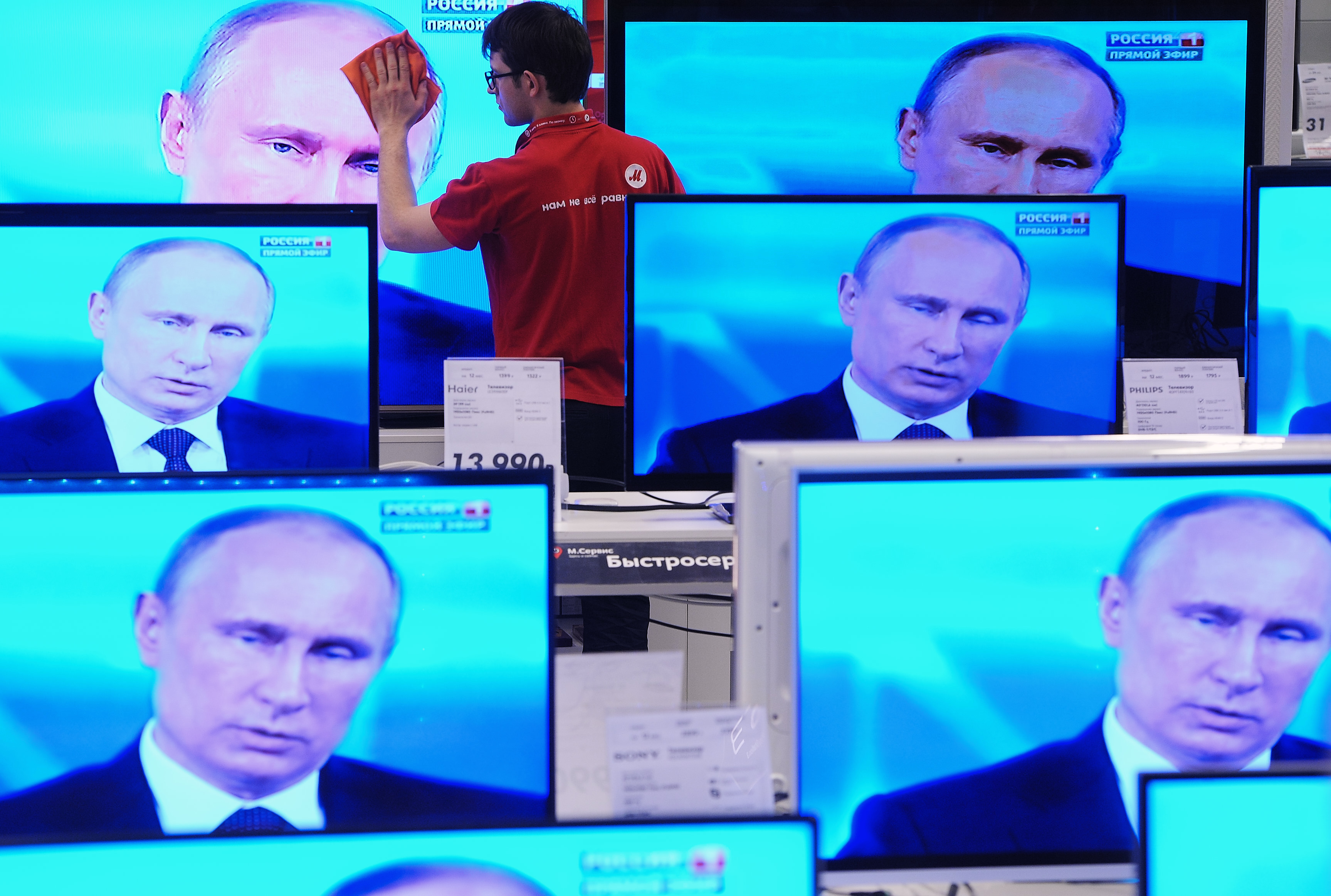
In case anyone doubted his intentions, here’s what Putin said on live TV today:
“The Federation Council granted the president the right to use military force in Ukraine,” he said, referring to the upper house of parliament. “I really hope that I do not have to exercise this right and that we are able to solve all today’s pressing issues via political and diplomatic means,” Putin said.
Putin referred to the region in question by its tsarist name “Novorossiya”, or “New Russia”, as it was referred to in the 19th century under tsarist rule, and suggested it was a historical mistake to hand it over to Ukraine.
He also admitted that Russian soldiers had been in Crimea prior to the referendum, though he still claims there are none in eastern Ukraine:
“Our servicemen stood behind the back of Crimea’s self-defence forces,” Putin said. “They acted politely, but resolutely and professionally. There was no other way to hold the referendum in an open, honest and honorable way and allow the people to express their opinion.”
But Julia Ioffe explains that the Russian invasion has already begun, and looks at some reasons why Ukraine isn’t really fighting back:
Who would do the shooting?
After the massacre on the Maidan in February, the new government in Kiev disbanded the Berkut, the Ukrainian special police who shot at protesters. Many were then publicly humiliated across Ukraine, having to apologize from city stages on their knees. This has created three problems. First, there are rumors that some of the former Berkut fighters, feeling betrayed and embittered—and unlikely to see this government as legitimate—fled to Russia, were outfitted by Moscow, and sent back to fight. Second, in disbanding Berkut, Kiev lost some of its best fighters, then ones that could potentially flush city buildings of special forces. Third, the move created uncertainty in the ranks of the rest of the Ukrainian police and armed forces: if they obey orders to fire now, will they be thrown under the bus later?
Jason Karaian highlights the dire financial situation of Ukraine’s military:
Today, the defense ministry trumpeted its 100-million-hryvnia ($8.9 million) fundraising drive, a big chunk of which came from mobile users donating 5 hryvnia at a time via a special text number. Meanwhile, the Finance Ministry also announced the issue of 1.1 billion hryvnia ($97 million) in war bonds to help finance the cash-strapped military. … On the ground, Ukraine’s military is badly outmatched by Russian forces. That was true even before Russia seized a number of ships in Crimea and, it was reported today, pro-Russian forces commandeered armored personnel carriers in eastern Ukraine. If the military escalation continues, it will take more than phone-in fundraisers and novelty bond issues for Ukraine to mount much of a defense.
Scarce resources are weakening the Ukrainian military in other ways, too. Reuters reported today on soldiers who claimed to have defected from Ukraine, citing a lack of resources and support from Kiev. “They haven’t fed us for three days on our base,” one said. “They’re feeding us here. Who do you think we are going to fight for?”
Anna Nemtsova has more on the defections:
[F]or now the Ukrainian military units ordered to put an end to the separatist movement in Donesk Oblast have refused to fight the protesters. Earlier on Wednesday outside Sloviansk, a crowd of pro-Russian demonstrators managed to convince a few dozen Ukrainian paratroopers from the same 25th Brigade to surrender. Ukrainian flags were taken off their four armored vehicles and locals presented with the flags of Russia and of the People’s Army of Donbas, the separatist militia. After switching sides, the soldiers drove to Lenin Square, where pro-Russian operatives have occupied the administration building since last week. Most of these militiamen claimed they were from Crimea; none of them spoke a word of Ukrainian. Still, they treated the surrendered Ukrainian paratroopers with courtesy and served them a nice meal inside the administration building.
The Ukrainian solders at Pchelkino Station were shocked when they heard that their colleagues had given up their weapons and their armored vehicles to pro-Russian protesters. But eventually they were convinced to do the same.
Eli Lake and Josh Rogin note the increasing possibility that Putin will make a move for Odessa:
Odessa is not only Ukraine’s most important remaining port for access to the Black Sea. It has also allegedly been a key avenue for Russian companies to export, sometimes with illicit or controversial purposes, goods overseas. Russian arms to the regime of Syrian President Bashar al Assad allegedly flowed through Odessa, for example. … The loss of Crimea and the Russian takeover of other waterways in Eastern Ukraine “puts even more pressure on Odessa as Ukraine’s last sea shipment lifeline, not just for the navy but for Ukrainian industry,” said Druckman. “There should be concern from the perspective of Ukraine losing access to the Black Sea.”
Gauging the exact level and nature of Russian interference inside Odessa is difficult. The Ukrainian domestic intelligence services claim to have arrested Russian intelligence officers there and pro-Russian militias in Odessa are organizing rallies daily.
(Photo: A shop assistant cleans a TV screen during Russian President Vladimir Putin’s nationally televised question-and-answer session in a shop in Moscow, Russia on April 17, 2014. By Dmitri Dukhanin/Kommersant via Getty Images)
 The Dish