Bringing A Checkbook To A Gun Fight

Michael Bloomberg plans (NYT) “to spend $50 million this year building a nationwide grass-roots network to motivate voters who feel strongly about curbing gun violence, an organization he hopes can eventually outmuscle the National Rifle Association.” Cillizza expects Bloomberg to become an NRA boogyman (as if he weren’t already):

The more groups opposed to gun control are able to cast the effort to pass measures that would tighten said laws as the efforts of a New York City billionaire bent on telling you how to live your life, the less effective the effort will be. Look at how badly Virginias reacted when Bloomberg ran stings in the Commonwealth in 2007 and when he made comments in 2012 about how so many guns used in New York City came from Virginia.  People don’t like others telling them how to handle their business — especially if that person is a billionaire New York City resident who wants to regulate things like sugar in soda.

Bouie weighs in on Bloomberg’s crusade:

Of course, money is money, and a $50 million investment to combat the NRA could prove effective, even with Bloomberg’s image. But there are problems there, as well.

The NRA’s power is as much a function of passion as it is resources. As the Times reports, the organization spends just $20 million annually on political activities. Its influence comes from its members, who are hypervigilant against any effort to curb gun rights. The enthusiasm gap between gun activists and gun-control advocates is huge. According to the Pew Research Center, 42 percent of those who favor gun rights have either contributed money to a pro-gun organization, contacted a public official to express an opinion on gun policy, expressed opinions on guns on social media, or signed a petition on gun policy. By contrast, only 25 percent of those who prioritize gun control have done the same.

Put another way, gun rights are crucial for those who support them in a way that isn’t true of people who oppose them. Bloomberg’s task is to heighten the political salience of gun control and turn that into action.

McGillis joins the conversation:

The overriding political aim of the Bloomberg’s new effort is to reshape the perceptions around the gun issue, to make more elected officials who might be inclined to support tougher gun laws rethink their assumption that the politically safe and expedient vote is to vote with the NRA. And the first real test for doing so, post-Manchin-Toomey, is the 2014 election. It’s an imperfect test, because it just so happens that none of the Republicans from purplish states who voted against Manchin-Toomey [the background-check bill] (Kelly Ayotte in New Hampshire, Jeff Flake in Arizona, Rob Portman in Ohio, Ron Johnson in Wisconsin, among others) are up this fall. That has left Bloomberg’s team in the awkward position of threatening only the Senate Democrats who voted against Manchin-Toomey and are up this fall, Mark Pryor in Arkansas and Mark Begich in Alaska. Immediately after Manchin-Toomey, the group ran a tough ad in Arkansas attacking Pryor for his vote, which drew a counter from Pryor and criticism from Washington Democrats who noted that Bloomberg was only helping raise the likelihood that Republicans would gain control of the Senate. …

The clearer and more crucial test for the new group will be making sure they provide adequate support to the Democratic senators who did vote for Manchin-Toomey despite being up for a tough reelection in strong gun-rights states—notably, Mary Landrieu in Louisiana and Kay Hagan in North Carolina.

John Aravosis passes along the video above from Bloomberg’s new group:

I’ve always said that I have two models, mentor-movements really, for my advocacy work: The NRA, and AIPAC. When I worked on the Hill, both groups knew how to sow fear in the halls of Congress.  It’s what other should aspire to.  It’s what gay rights advocacy, the ones on the ground, aspire to. And it’s what the anti-gun-violence movement should do as well.

This video is a good first step.
Jo Becker’s Troubling Travesty Of Gay History, Ctd

When your premise is that the marriage equality revolution began in 2008, that the movement was only then re-branded around the themes of family values and toleration, that the subject had been languishing in obscurity before the gay “Rosa Parks” came on the scene, there are a few things that will necessarily not compute.

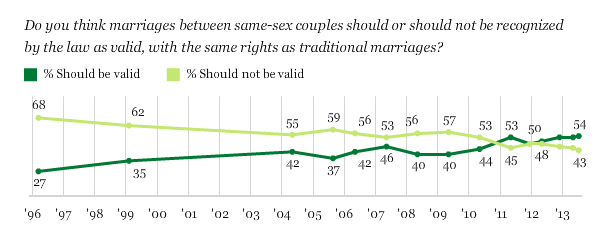
Look first of all at the polling on the question. No one can doubt that the actions of a handful of people in the highest regions of the Obama administration would never have happened without this long-sustained, widening and deepening support in the polls. Public persuasion and advocacy were absolutely indispensable to bringing the new majority about, and making cautious politicians capable of changing. So check out Gallup’s polling on the question over the last couple of decades:

Screen Shot 2014-04-17 at 11.11.17 AM

In 1996, support was at 27 percent. By 2007, it was at 46 percent. It has since peaked at 53 percent in 2011 and 54 percent now. What Becker is arguing is that increasing the support by 8 percent after that early momentum was the only period that matters. The increase of 15 percent before that – in a far less propitious environment – was irrelevant, and in fact, proof that until the key figure of Chad Griffin arrived, nothing was really happening. I’d love to know how Becker can make that argument with a straight face. Or whether on her book tour, she will be confronted with the sheer perversity of that judgment. I also think it’s incumbent on Griffin to say whether that is his view of the matter as well. It sure sounds like it from Becker’s book.

Then there are the following bizarre consequences of her insane history. Among the heroes of her book are Joe Biden and Ken Mehlman.  Now just think about that for a moment. Biden voted for the Defense of Marriage Act in 1996 – by far the most damaging moment in the movement’s history. As Isaac Chotiner notes, the book’s fellatial account of Biden’s own pro-gay goodness rests on stories of his past that reveal that he had no issues with gay couples – even as he voted to rid them of any rights by voting for DOMA! This grotesque hypocrisy is glossed over in favor of letting Becker’s source spin his own past uncritically. Ditto with Obama. He was obviously bullshitting on this subject for years. Chotiner:

As was the case with Biden, Obama wants credit for holding a position he knows is wrong. That position also shows a certain contempt for voters, as if they couldn’t figure out that Obama is being dishonest and, of course, supports gay marriage.

As for Mehlman, WTF? He ran the Bush 2004 campaign that used the marriage equality movement to turn out the Republican Christianist base and ensure Bush’s re-election. Without that issue, Bush may well not have won Ohio, and John Kerry would have been president. Now, I was delighted at Mehlman’s metamorphosis and have long believed that we should welcome all converts and hunt no heretics in this cause. I gave him a platform on the Dish I was so happy with his reversal.

But when he is credited as a critical hero of the movement and Evan Wolfson is damned as an obstructionist, you are seriously in an alternative universe. When he is the star, and the large universe of Republicans, conservatives and libertarians who backed marriage equality long, long before Mehlman’s Damascene moment are airbrushed out of history, you can see why this toxic distortion of history is so troubling. The idea that recommending a female interviewer for Obama’s revelation is more important than the decades of legal, educational and political organizing that took place in the teeth of Mehlman’s own brutal attack on gay couples … well, it beggars belief.

Geidner notes another way in which Olson and Boies and Griffin conducted themselves differently than other parts of the movement. They got paid to the tune of $6 million, while previous legal support for marriage equality was almost always done pro bono:

The $6.4 million price tag runs in contrast to many other legal fights mounted by the LGBT community. Much of such “impact litigation” is brought by nonprofit legal groups like Gay & Lesbian Advocates & Defenders, which brought the case that one of its lawyers, Mary Bonauto, argued and led to marriage equality in Massachusetts. Other such litigation is brought by nonprofit groups working with outside private lawyers working without payment for their services — called pro bono — like Lambda Legal and Jenner & Block’s Paul Smith, who argued the 2003 case, Lawrence v. Texas, that ruled sodomy laws across the country unconstitutional.

As for the extraordinary fundraising required, it took one lunch with David Geffen and one phone call to Steven Bing to raise half of it in a few days – support that Griffin has long downplayed in his presentation of the case.

To be honest, writing these posts makes me a little sick. For decades, this kind of nasty internal spat was avoided, because all of us in this fight believed that the cause was far more important than our own divisions and egos. Evan and I – who labored together pretty much alone for years – had serious political and ideological differences. He is a full-bore liberal; and I am a small-c conservative. On the road, we’d hash stuff out on trains and green rooms – and we had a deep disagreement over strategy, with my preferring a gradualist, federalist and political approach, while he backed a strategic, national, legal campaign. But we never aired this in public; we both thought the issue was much bigger than either of us. It turned out we were both half-right, and I’m proud of our discipline. To have made so much progress with so little acrimony only to have such unity side-swiped by such an egregious, ugly and unprecedented attempt to claim total credit is terribly demoralizing. We owe Olson and Boies and Griffin gratitude for continuing the fight. If only they would at some point return the compliment – instead of using a credulous, ignorant reporter to describe this movement as theirs and theirs alone.

Where The Males Have (Little) Vaginas And The Females Have (Big) Penises

I’m not sure what Thomas Aquinas – peace be upon him – would make of this latest revelation about “natural law”:

Researchers reporting in the Cell Press journal Current Biology on April 17 have discovered little-known cave insects with rather k0nt91liu3XXmP47novel sex lives. The Brazilian insects, which represent four distinct but related species in the genus Neotrogla, are the first example of an animal with sex-reversed genitalia. “Although sex-role reversal has been identified in several different animals, Neotrogla is the only example in which the intromittent organ is also reversed,” says Kazunori Yoshizawa from Hokkaido University in Japan.

During copulation, which lasts an impressive 40 to 70 hours, female insects insert an elaborate, penis-like organ into males’ much-reduced, vagina-like opening. The researchers speculate that the insects’ sex organs and sex-role reversal may have been driven over evolutionary time by the resource-poor cave environment in which the bugs live. Males of the genus provide females with nutritious seminal gifts in addition to sperm, making it advantageous for females to mate at a higher rate.

The more we learn about nature, the more the notion that the universe reflects a cosmic version of human heterosexuality gets discredited. Gender can be fluid in some species; in others, females have the testosterone; in this case, females have dicks. And rather elegant ones at that. We now know what Victorian scientists discovered but hid: that same-sex behavior is also endemic in the animal kingdom, unusual, but widespread. We know that some humans are born with indeterminate gender, that others have a gender that belies their external sex organs, that others still have no problem with their gender but are emotionally and sexually attracted to their own.

The reason why this matters is that the vast apparatus of “natural law” still permeates a huge amount of our thinking about human sexuality and emotion.

In the case of the Catholic Church, a crude and outdated version of natural law is integral to arguments about the “objective disorder” of homosexuals; among many evangelicals, gender diversity is regarded as something that needs to be beaten (sometimes literally) out of a child; reparative therapy is still lamentably used to terrorize the psyches of those born with a different nature. But almost all of this is based on something that has been exposed definitively as untrue. Natural law – far from insisting on a crude gender division in humanity and the universe – should actually help us to appreciate the moral neutrality of differing sexual and emotional identities. And at some point, if natural law endures as part of the Catholic imagination, it will have to be invoked in defense of the naturalness of the homosexual, the transgender, the intersex and all the other bewildering outcomes of our evolution.

Yes, I can see a future where Christianity is a prime defender of sexual minorities – because we simply represent the pied beauty of God’s actual creation. Will I live to see it? Almost certainly not.

(Photo: Current Biology, Yoshizawa et al.)

Quote For The Day

“White feminist Germaine Greer can speak at Brandeis because, in one of the more whimsical ideological evolutions even by dear old Germaine’s standards, Ms Greer feels that clitoridectomies add to the rich tapestry of ‘cultural identity’: ‘One man’s beautification is another man’s mutilation,’ as she puts it. But black feminist Hirsi Ali, who was on the receiving end of ‘one man’s mutilation’ and lives under death threats because she was boorish enough to complain about it, is too ‘hateful’ to be permitted to speak. In the internal contradictions of multiculturalism, Islam trumps all: race, gender, secularism, everything. So, in the interests of multiculti sensitivity, pampered upper-middle-class trusty-fundy children of entitlement are pronouncing a Somali refugee beyond the pale and signing up to Islamic strictures on the role of women,” – Mark Steyn.

Now you could argue that Hirsi Ali has also been invited to speak at Brandeis after the shabby withdrawal of an honorary degree. But Greer was not told she had to engage in a dialogue with her critics on the question of mutilating girls and women. She was given a platform denied to a victim of female genital mutilation. I don’t think it’s Islamophobic to note that glaring inconsistency.

The Cutting Truth

Kristina_Knipe_a10

In an essay on the experience and expression of female pain, Leslie Jamison considers cutting “an attempt to speak and an attempt to learn”:

There’s an online quiz titled “are you a real cutter or do you cut for fun?” full of statements to be agreed or disagreed with: I don’t really know what it feels [like] inside when you really have problems, I just love to be the centre of attention. Gradations sharpen inside the taboo: Some cut from pain, others for show. Hating on cutters—​or at least these cutter-​performers—​tries to draw a boundary between authentic and fabricated pain, as if we weren’t all some complicated mix of wounds we can’t let go of and wounds we can’t help, as if choice itself weren’t always some complicated mix of intrinsic character and agency. How much do we choose to feel anything?

She confesses:

I used to cut. It embarrasses me to admit now, because it feels less like a demonstration of some pain I’ve suffered and more like an admission that I’ve wanted to hurt. But I’m also irritated by my own embarrassment … I hurt myself to feel is the cutter’s cliché, but it’s also true. Bleeding is experiment and demonstration, excavation, interior turned out—​and the scar remains as residue, pain turned to proof.

(Photo by Kristina Knipe, from her self-harm series “I Don’t Know The Names of Flowers”)

Psychoanalyzing Putin

https://twitter.com/ninavanlan/status/456436984332832769

Joseph Burgo makes the case that the Russian president really does suffer from narcissistic personality disorder:

In exploring the past of prominent figures who seem to display features of narcissistic personality disorder, I have found that many of them were childhood bullies who may also have been bullied by others.

The bully is a special type of narcissist who offloads or projects his sense of defect into the victims he persecutes. I’m not a loser, you areI don’t feel vulnerable and afraid, you do. Though younger and smaller than many of them, Putin fought back against the courtyard thugs and became something of a bully himself. With an explosive temper and thin skin, Putin regularly took offense, instantly lashing out with violence. According to [Masha] Gessen, one childhood friend recalls that if anyone dared to insult Putin, he “would immediately jump on the guy, scratch him, bite him, rip his hair out by the clump—do anything at all never to allow anyone to humiliate him in any way.”

The bullying narcissist is in flight from himself. His entire personality expresses an ongoing, relentless battle to ward off unconscious shame and a sense of internal defect, which accounts for his inability to take criticism or tolerate the smallest of slights. To deny the unconscious sense of being small, defective, and vulnerable, he projects a self-image that conveys his superiority. He establishes his own power and prestige by humiliating other people and filling them with the shame he has disavowed. For the bully, social interaction is all about proving himself a winner by making other people feel that they are the losers.

Looking Back On Leaning Out, Ctd

A reader argues that our post was based on “a common misconception” about Lean In:

Sandberg doesn’t champion working over staying home. When she tells women to lean in, she’s not telling them to work: she’s saying that for as long as they choose to work, they shouldn’t have one foot already out the door because of what having a family might demand of them in the future. It’s a carpe diem message, and an argument against approaching your career with a defeatist attitude.

Another isn’t sure what attitude to take:

I’m so glad you’re talking about Lean In and hope that it ends up as a thread. I’m a 36-year-old woman acting as the executive at a small organization with a big budget. I love my work, my peers, the intellectual stimulation, my ability to call on my brain to perform backflips and contortions. But I tell you what: it doesn’t make me happy.

On the contrary, it makes me pretty miserable. Being “on” 24 hours a day, constantly fielding demands and needs from employees and contractors, pushing off needed vacation or personal time because I know work needs my presence, and feeling that I’m doing important work intellectually but not making a tangible difference in the life of another human on any given day.

I don’t have kids and I’m not sure they’re right for me and my partner, but I often find myself thinking I should have them because it’s one of the only socially acceptable ways to “lean out” for today’s talented working women. I’m hungry to see what happens if I unplug from the professional class and its expectations, but I’m terrified to do it out of fear that everyone will think I’m crazy and that if I find I actually prefer my field to whatever “softer” work I might do, there won’t be a pathway for me to reenter with the influence and earnings I currently have. And this sounds weird, but at least I’d be “in good company” if my offramp and reduced earnings involved kids, whereas I’d just be I dummy if I did it to myself in order to try to find some happiness.

Another circles back to the source of the thread:

With regard to the post about Alice Dreger “leaning out,” I think that, at best, she leaned sideways.  She may have left a tenured position at MSU, but she did so to work what sounds like close to full-time on the Intersex Society.  She now has an academic position at Northwestern and several different platforms for her writing.  She has flexibility, which is great, but I am not sure she should be held up as an example of people/women doing the opposite of Sheryl Sandberg.  And Dreger was able to do all of this because she is married to a doctor whose income can support her and their family as she pursues her “part-time” and “low-paying” positions.  She is pretty darn successful, whether she sees herself as having stepped off the treadmill or not.  I don’t imagine that people who don’t have the luxury of choosing to “cost their family money” would be particularly sympathetic.

Another is on the same page:

I read with interest Alice Dreger’s piece on “leaning out,” and think you left out her most important point: “Ironically, leaning out has given me a vastly more interesting career than I would have otherwise had.”

After reviewing her CV, I confess to feeling a shred of the same irritation toward Dreger that I felt in force toward Sheryl Sandberg. Both are superstars in their fields, and have gone far beyond what most of us will ever achieve professionally. I’m very much down with Dreger’s basic point of view – that’s about where I am too, and have negotiated a situation where I can be home most days when my only daughter gets off the bus. Like her, I also value the rewards inherent in having more time for other relationships and interests (which are certainly available to anyone, regardless of professional status). But most of us are not negotiating for earlier, more expensive flights to get home from national talk show appearances, able to negotiate for a part-time professorship, and getting published in the New York Times etc. – just as most career women are not and will never be in Sandberg’s stratosphere.

Please don’t get me wrong – for the most part, I find my life pretty fulfilling, vocationally and at home, and I certainly don’t begrudge Dreger or Sandberg their success and life satisfaction. They’ve earned every bit of it. But I can also see how women in more pedestrian situations might find not find their thoughts on the value of leaning in or out terribly applicable to their own lives.

Disaster Coverage Has Always Been A Disaster

Amber Frost has the archival news footage to prove it:

If you’re under the impression that tragic disasters used to be held in a respectable reverence in this country, please refer to the vintage bit of newstainment above, a 1937 Universal Studios newsreel on the Hindenburg explosion. From the Hollywood sturm und drang musical accompaniment to the announcer (who feels freshly picked from a radio soap opera) this little five-minute news reel is pure spectacle. There’s an explosion sound effect, studio-recorded screams and a police siren added, apparently to “recreate” the story. It’s at least as vulgar as anything on cable news today, and they didn’t even have the benefit of CNN’s holograms!

The question left unanswered at the end of the film: What caused the explosion? Scientists just last year settled on an answer:

Led by a British aeronautical engineer, Jem Stansfield, and based at the South West Research Institute in the US, the team blew up or set fire to scale models more than 24m long, in an attempt to rule out theories ranging from a bomb planted by a terrorist to explosive properties in the paint used to coat the Hindenburg.

Investigations after the disaster concluded that a spark had ignited leaking hydrogen gas, but could not agree on what caused the spark, or the leaking gas. Conspiracy theories took hold that the airship had been brought down by a bomb, or had been shot down from the ground. Through recreating different scenarios with mini-replicas, and studying archive footage of the disaster, along with eyewitness accounts, experts believe they have discovered what really happened.

… The airship had become charged with static as a result of an electrical storm. A broken wire or sticking gas valve leaked hydrogen into the ventilation shafts, and when ground crew members ran to take the landing ropes they effectively “earthed” the airship. The fire appeared on the tail of the airship, igniting the leaking hydrogen. “I think the most likely mechanism for providing the spark is electrostatic,” said Mr Stansfield.