Sex, Lies, and Text Messages

A new study reveals that people often lie while exchanging sexy texts with their significant others:

“Deception during sexting with committed relationship partners appears to be fairly common,” writes a research team led by Michelle Drouin of Indiana University-Purdue University Fort Wayne. Its study is published in the journal Computers in Human Behavior.

Of the 155 participants (average age just under 22), 109 reported they had sent a sexually explicit text message. Among that group, 48 percent admitted lying during sexting with a committed partner. Specifically, 20 percent said they had lied about either what they were wearing or what they were doing, while 28 percent had lied about both. Women were the more frequent liars, texting untruths far more often than men.

Katy Waldman compares these findings to our deceptions in real sex:

Of course, we all lie in person too—is a fake sext any different from a fake orgasm?

As a medium, sexting feels peculiarly suited to a more benign type of fabrication (also known as storytelling): It aims to construct a shared fantasy of togetherness with someone who is not physically present. “Wildly imaginative leaps are possible,” writes Maureen O’Connor in her excellent deep dive into the genre. The simulated “self of sexting can be markedly different from the self who actually has sex,” and isn’t that kind of the point.

O’Connor also notes that “55 percent of women and 48 percent of men have engaged in ‘consensual but unwanted sexting,’ i.e., sexting when they’re not that into it.” These could be the bored people who lie. However, at least for women, the statistics on ‘consensual but unwanted’ regular sex look the same: 55 percent of women have done it (compared to 26 percent of men). Since rote erotic acts seem pretty frequent, perhaps our lies do hint at disengagement from the person at the other end of the line, or on the other side of the bed. But in this case, as in so many others, the technology seems to be abetting a natural human impulse, not rewiring our brains.

The Dish has covered the sexting phenomenon extensively, most recently here and here.

When The Cover Is The Story

Jill Filipovic suggests that the Rolling Stone gaffe that has fact-checkers around the world snickering shows just how much magazine covers still matter:

Some of us still buy print magazines, but ever more of us are reading the articles on tablets or laptops instead. And the volume of accessible content online far exceeds that at your local newsstand or grocery store checkout. And yet, despite such an enormous quantity of high-quality, cover-worthy imagery, the photos on the covers we can actually hold in our hands are what become online content fodder.

That scarcity may actually be the point. There’s not a widely read website in Internet-town that keeps the same photo on the front page for more than a day, let alone a week or a month. Magazine real estate may be rendered more valuable by virtue of the fact that it’s more permanent – if you have a hard copy of a magazine you can store it away without the fear that you might go to read it one day and find an “Error: Page Unknown” message. And although fewer people may purchase a copy of Rolling Stone over the course of a month than click over to the homepage of a popular website, the eyes on a magazine cover may be more valuable than those on a quickly changing web page.

Even if you only look at magazine covers while waiting to check out at Walgreens or getting your nails done, your eyes are settling on a small handful of options, making each of them resonate more strongly than the hundreds of pictures in your 15 open browser tabs.

By the way, Julia Louis-Dreyfus set the record straight via Twitter:

What The Hell Just Happened In Nigeria?

The Nigerian terrorist group Boko Haram kidnapped some 100 teenage girls from a government school in the northeastern state of Borno on Monday. Zack Beauchamp expects the group to hold the girls for ransom:

“Their goal is almost certainly to ransom [the girls],” Daveed Gartenstein-Ross, a senior fellow at the Foundation of the Defense of Democracies who follows Boko Haram, told me. ”Otherwise, they have chosen a target that will make everybody hate them. Killing [100] schoolgirls would be a huge PR hit even for some of the rougher jihadist groups.”

Boko Haram has been known to kidnap for money. Since the group launched a full-on uprising against the Nigerian government in 2012, it has kidnapped a number of foreigners in order to raise funds to continue the struggle.

Nigerians in Borno province, which is both the location of the school and Boko Haram’s base of operations, aren’t as wealthy as the foreigners that the group might normally kidnap. But kidnappings aren’t always about money. “Ransom can be for any number of things, including ransoming for a prisoner exchange,” Gartenstein-Ross says. Nigeria has captured many Boko Haram fighters during the ongoing conflict. In response, the group has both attacked prisons and demanded prisoner releases as part of ransoms before.

Walter Russell Mead is more pessimistic:

Boko Haram, which is believed to have camps in the hilly forests surrounding Chibok near the border with Cameroon, have used kidnapped girls in the past as sex slaves and laborers. All of this happened the same day that a bomb blast, also blamed on the Islamist group, killed 75 people at a bus station outside the capital Abuja.

Despite a much touted government military offensive that was launched against the militants in October, the threat from Boko Haram is growing. Abuja, which in three weeks is set to host the World Economic Forum on Africa (called the “African Davos”), is hundreds of miles away from the state of Borno, where the kidnappings took place. That Boko Haram might be able to conduct two highly-coordinated attacks against Nigerian civilians on the same day, in two locations far apart, will not be any comfort to President Goodluck Jonathan and the people he is charged with protecting.

Meanwhile, John Campbell wishes American journalists would pay as much attention to the unrest in Nigeria as they do to the situation in Ukraine:

It takes horrific violence in the capital city, Abuja, to generate US coverage on Nigeria. In the US as in southern Nigeria, the carnage receives little to no attention – no matter how great it is – so long as it is far away in the northeast. The “Giant of Africa” and until recently Washington’s most important strategic partner in Africa and a major source of imported oil and gas, Nigeria is largely ignored by the U.S. media, beyond occasionally boosterish articles on the business pages that focus on the Lagos-Ibadan corridor and the country’s oil patch. While the New York Times and the Wall Street Journal are honorable exceptions and have previously broken stories of gross human rights violations by the government security forces U.S. media inattention to Nigeria seems short-sighted and unwise.

A Victory For Transgender Indians

Transgenders Welcome SC Verdict, Recognizing Transgenders As Third Gender

In a landmark ruling yesterday, India’s Supreme Court decided that transgender individuals need no longer identify themselves as “male” or “female” on official documents. The court also called for an expansion of rights:

Hijras are deprived of jobs, education and health care; turned away at hospitals, limited by the practice of male and female wards. India had taken steps to ensure their recognition when India’s Election Commission earlier allowed a third gender of “other” on voter registration forms for the national elections now taking place.

But the Supreme Court on Tuesday expressed concern over transgenders being harassed in society and said “it was the right of every human being to choose their gender.” It directed the government to bring them into the mainstream, ordering it to set aside quotas for jobs and education for transgender individuals, bringing them in line with the benefits already afforded other minority groups and lower castes. The court said hijras will be entitled to “all other rights,” including passports, voter cards and driving licenses.

Rama Lakshmi explains how to square this ruling with the decision the court handed down in December, reinstating a colonial-era law criminalizing homosexuality:

In many ways, expanding the rights to transgendered people is far easier than legalizing homosexuality in India. For centuries, eunuchs – called hijras in Hindi — were given a special place in Indian religious epics and parables.

“Granting rights to transgenders is more acceptable to our psyche because we find many transgender characters in our religious, cultural mythologies and literature. Some of our Hindu Gods were of third-gender, some Gods changed their gender seamlessly to perform specific roles and rituals,” said Rose Venkatesan, who transitioned from being a man to a woman four years ago and is a former television host and an independent filmmaker in the southern city of Chennai. “There are temples and annual religious festivals for the transgender community.”

But in modern times, the eunuch community has lived in closed and segregated communes, either feared or reviled by their neighbors. In cities, it is not uncommon for eunuchs to show up at wedding parties and celebrations of the birth of a child wearing vibrant clothing and singing and dancing, clapping their hands aggressively and demanding money in return for blessing.

(Photo: Transgender Indians express their happiness with victory signs after the Supreme Court verdict in which it granted recognition to transgender people as a third category of gender in New Delhi, India on April 15, 2014. By Raj K Raj/Hindustan Times via Getty Images)

Moore Award Nominee

“It seems the height of privilege blindness to schoolmarm gays about how to engage their aggressors when Friedersdorf, in point of fact, has no idea what omnipresent psychological torture feels like… I realize I’m coming down rather hard on an ally here, but as an ally, Friedersdorf and those like him need to recognize that their first responsibility is to listen, not to dictate,” – J Bryan Lowder, doubling down on his view that all opponents of marriage equality should shut up and be denied high-profile jobs and endorsing “a little retributive succor, when we can.”

I’d say there are two premises in there that are ludicrous over-reach. All gay people live in a world of “omnipresent psychological torture”? No straight person has any right to an incorrect opinion on this question, and deserve to be written out of the discourse. Unsurprisingly, Lowder then refers to our astonishing progress over the last couple of decades as a “recent miracle.” Miracle? It sure wasn’t that. It was the result of adhering to the norms of open debate, liberal argument in making our case – precisely the approach Lowder thinks is repellent.

Let’s just say that if we had followed Lowder’s illiberal advice, there would be no marriage equality in America and a hell of a lot more “omnipresent psychological torture.”

How Do Ukrainians Feel About All This?

Leonid Ragozin explains why many Ukrainians are disillusioned with both Kiev and Moscow:

Southeast Ukraine may be the world’s most difficult and unwelcoming environment for fomenting a genuine protest—stability tops the list of local values and priorities. Many local residents admire Putin for bringing that to Russia, but what he is now peddling in Ukraine is instability, and that’s a very tough sell. 

Russia’s efforts are getting increasingly counterproductive. In fact, Putin has become the single biggest force helping to patch up the split between Ukraine’s nationalist west and Russophone east. While the West and many Ukrainian politicians continue to alienate Ukrainian Russophones by treating them as if they are an unfortunate historical error, Putin did more than all of them combined to awake many in Ukraine’s east to the fact that their country, however imperfect, is a better place for a Russian speaker than Russia proper is. A recent poll show that a majority of people in Ukraine’s Russophone regions don’t support separation.

Akos Lada and Maria Snegovaya note that the divide between supporters and opponents of the Euromaidan revolution “is becoming more generational than regional”:

Younger (and better-educated) Ukrainians across all the regions of Ukraine are Western-oriented, support democracy and pro-Western development. As to their attitudes toward Euromaidan, the pattern is such that the older a person is, the more he or she supported the Viktor Yanukovich government and opposed the protesters[.] … Strikingly, the generational change would almost entirely eliminate any existing regional divide in Ukraine in about 10 years if Russia did not intervene – according to the estimates of Evgeny Golovaha, a Professor at the Institute of Sociology of NAS of Ukraine. This is similar to the pattern of convergence described by Alesina et al. in “Goodbye Lenin or not” for Western and Eastern Germany. Overall, Ukrainians are not only turning to the West but making a different civilizational choice, where democracy comes in a package with different political values.

Christian Caryl relays what people in Odessa, another strategically important Russophone city, are saying:

There are, undoubtedly, many Odessans who might welcome rule from Moscow. One hears little Ukrainian spoken on the streets; it’s estimated that about 90 percent of the 1 million people inhabitants of the city prefer to use Russian in their daily lives. Politically, though, Odessa is sharply divided between those who applaud annexation by Russia and those who remain loyal to the goals of the Euromaidan revolution that toppled the government of President Viktor Yanukovych. …

Yet despite the differences in opinion, it’s hard to find anyone in Odessa who welcomes the possibility that Russian forces might invade. “I’m afraid of war,” says Alina Savchenko, a 25-year-old teacher, who notes that her family has members in both Russia and Ukraine. “I live here. I don’t want to see any conflicts among my relatives.” She can think of little positive to say about the revolutionary government in Kiev, but says that she would prefer to see Ukrainians solve their own problems “without interference from the outside, whether it be from Europe or Russia.” Poll figures suggest that Savchenko speaks for the mainstream. Recent surveys in eastern Ukraine have found that even there only a tiny minority — from 4 to 4.7 percent — want to break away from the country.

The latest Dish on Ukraine here and here.

O’Malley’s March To 2016

Maryland Governor Martin O’Malley put his signature on the state’s marijuana decriminalization bill on Monday. Katie Zezima sees this as another example of O’Malley “tacking to the left and burnishing his liberal credentials“:

While other potential 2016 candidates on both sides of the aisle have voiced their support for decriminalizing small amounts of marijuana (we’re looking at you, Rand Paul), O’Malley is the first who has actually taken any action.

But Waldman doubts that the liberal agenda will decide the 2016 Democratic primary:

The problem is that the liberal scorecard may not be the basis for how primary voters usually make their decisions, especially Democrats.

It isn’t that ideology doesn’t matter, but it eventually gets overtaken by questions of character, electability, or things like the “theory of change” debate that animated the 2008 contest between Clinton, Barack Obama, and John Edwards, in which the most substantial disagreement was over how you go about enacting your agenda.

These days, Democrats are much more focused on an expansive and detailed liberal agenda than back in 2004. At the time, it was enough for Howard Dean to say that he’d take on George W. Bush without fear, and this allowed him to assume the role of liberal standard bearer, even though Dean’s record in Vermont wasn’t particularly leftist (he had been a member of the centrist Democratic Leadership Council and was given high marks by the NRA, among other things). His record mattered much less than the attitude he embodied.

And Jill Lawrence points out that O’Malley’s partisan record could also be a liability:

O’Malley is a polished and aggressive partisan, having honed his message as head of the Democratic Governors Association, as a party spokesman on TV, and on the circuit at Democratic dinners and campaign events across the country. If he runs, he will have a strong substantive case to put before primary voters. He’ll have more of a challenge convincing them he has what it takes to make headway in a less hospitable environment than Maryland. It’s not his only potential obstacle, but it could well be a top consideration for some voters, given the despair-inducing dysfunction of the last few years.

Tiptoeing Toward More Sanctions

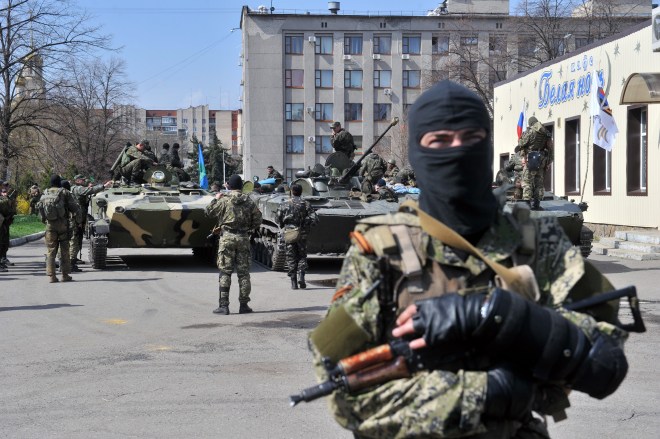
UKRAINE-RUSSIA-CRISIS-POLITICS-SLAVYANSK

Josh Rogin explains why the administration is taking so long to announce new sanctions on Russia in response to its provocations in Ukraine:

There is still some internal disagreement inside the Obama administration over whether to proceed with sanctions against broad sectors of the Russian economy or with more targeted sanctions against Russian politicians, oligarchs, and perhaps some of the institutions those politicians and oligarchs are connected to.  So far, the U.S. has sanctioned 31 Russian individuals and one Russian bank. U.S. officials believe the sanctions against Putin’s business associates have had some effect and could be expanded.

Stefan Wolff sticks up for the cautious approach:

[T]he incremental toughening-up of the West’s responses keeps the door open for diplomatic solutions and has not fallen into the trap of a tit-for-tat escalation, which is difficult to step back from and makes face-saving exits for both Russia and the West ever more difficult while being played out on the back of the people of Ukraine.

The talk of new sanctions gives at least a limited hope to the four-party talks in Geneva scheduled for Thursday, and were apparently the focus of a phone call between German Chancellor Angela Merkel and Putin on Tuesday night. The mere consideration of additional sanctions does not compel Russia to a response, and in fact may offer Moscow an incentive to participate. In turn, it leaves the US and EU with options, depending on the outcome of the talks, which could be as little as an agreement to meet again in the same format.

Insisting on the possibility of a diplomatic way forward, as the West and Russia both continue to do, may not be much at this stage, but it is better than the alternative of walking straight into a military confrontation between Russia and Ukraine.

But John Hudson and Shane Harris suspect that John Brennan’s surprise visit to Kiev points to something more:

The administration’s reluctance to militarize the conflict and impose harsher sanctions on Russia has angered hawks in Congress who are demanding more intelligence-sharing between Washington and Kiev as well as weapons transfers. “We ought to at least, for God’s sake, give them some light weapons with which to defend themselves,” Sen. John McCain (R-Ariz.) told Face the Nation on Sunday. “They won’t even share some intelligence with the Ukrainian government.”

Brennan’s visit appeared to raise the level of American involvement, even if not in the form of military aid. In the past few weeks, Ukraine has boasted of its success in rounding up Russian agents and provocateurs, particularly in the south of the country, where Russian forces are in control of Crimea, and in the east, where protesters believed to be working in coordination with Russian security forces have stormed Ukrainian government buildings. Former U.S. intelligence officials said that Ukraine has a generally credible and sophisticated domestic security service. But the sudden surge in arrests of suspected Russian agents signals a greater level of information-sharing from the Americans, former officials said.

Larison dumps on the idea of sending weapons to Ukraine:

I suppose it would make some Western interventionists happy that the U.S. was “doing something,” but I’m not sure who else would be encouraged by a decision that would be simultaneously provocative and useless. It would be provocative because it would deepen U.S. involvement in the conflict, and that would only encourage Russia to continue its agitation and incursions. It would be useless because the Ukrainian military is in no condition to fight. Even some of the advocates for sending arms to Ukraine have acknowledged the Ukrainian military’s lack of readiness and training. If U.S. shipments of arms encouraged Ukraine to try to fight a war that it couldn’t win, it would make things even worse and help give Russia a pretext for a larger military intervention.

Lastly, Ryan Avent fears that a more forceful response would carry the unacceptable risk of starting a major war:

There are a couple of actions that might alter Mr Putin’s payoff structure. One would be to make threats that are both credible and a real deterrent to Russia. If America promised to counter any further aggression by locking Russia out of the global financial system (as it did to Iran) that might work, given that the policy would mean relatively minor economic costs for NATO and enormous and immediate economic pain for Russia. Another option would be to put American soldiers in harm’s way, so that Russia could not invade NATO territory without directly harming American military personnel. Given that America could not help but respond forcefully to an attack on its own people, such a move might render the NATO guarantee toothy. Not toothless. So, basically, man the NATO-Russian border with American troops.

The problem in both of these cases is that—given that we’re not exactly clear on Mr Putin’s utility function and political constraints—there is some not-insignificant risk that either would make war more likely, and possibly much more likely.

(Photo: Armed pro-Russian men wearing military fatigues gather by Armoured Personnel Carriers (APC) as they stand guard outside the regional state building seized by pro-Russian separatists in the eastern Ukrainian city of Slavyansk on April 16, 2014. Ukraine’s Western-backed prime minister on April 16 accused Russia of erecting a new ‘Berlin Wall’ that threatened European security. ‘Today’s events… are starting to endanger Europe and the European Union. It is now clear that our Russian neighbours have decided to build a new Berlin Wall and return to the Cold War era,’ Arseniy Yatsenyuk told a government meeting. By Genya Savilov/AFP/Getty Images)