What Does Bud Do To Young Brains?

Jason Koebler highlights a study linking marijuana use to brain abnormalities in young people:

High-resolution MRI scans of the brains of adults between the ages of 18-25 who reported smoking weed at least once a week were structurally different than a control group: They showed greater grey matter density in the left amygdala, an area of the brain associated with addiction and showed alterations in the hypothalamus and subcallosal cortex. The study also notes that marijuana use “may be associated with a disruption of neural organization.” The more weed a person reported smoking, the more altered their brain appeared, according to the Northwestern University and Harvard Medical School study, which was published in the Journal of Neuroscience.

The finding already has the study’s authors calling for states to reconsider legalizing the drug. Hans Breiter, the lead author, said he’s “developed a severe worry about whether we should be allowing anybody under age 30 to use pot unless they have a terminal illness and need it for pain.”

Saundra Young gets the response of another researcher:

“This data certainly confirms what others have reported with regard to changes in brain structure,” [Dr. Staci Gruber, director of the Cognitive and Clinical Neuroimaging Core at McLean Hospital in Boston] said. “When we consider the findings of the [Jodi] Gilman … study with our own and other investigations of marijuana use, it’s clear that further investigation is warranted, specifically for individuals in emerging adulthood, as exposure during a period of developmental vulnerability may result in neurophysiologic changes which may have long-term implications.”

Gruber says we need to take a closer look at all pot users whether they smoke once or twice a week or four or time times a week.

And she had this advice for adolescents: “Don’t do it early–prior to age 16. That’s what our data suggests, that regular use of marijuana prior to age 16 is associated with greater difficulty of tasks requiring judgment, planning and inhibitory function as well as changes in brain function and white matter microstructure relative to those who start later.”

Meanwhile, Mitch Earleywine criticizes the methodology of a different study purporting to show neuropsychological deficits from pot use:

First, we have to keep other drug use in mind. Unfortunately, the marijuana group in this study got drunk more than 4 times as much in the last six months as the controls. Given what we know about binge drinking and neuropsychological functioning, it’s going to be hard to attribute any differences between these groups to the plant. It’s just as likely that any deficits stem from pounding beers. Studying cannabis users who aren’t so involved with alcohol would help address neuropsychological functioning much better.

Jo Becker’s Troubling Travesty Of Gay History

Journalist Jo Becker has a new book out on the marriage equality movement. The revolution began, it appears, in 2008. And its Rosa Parks was a man you would be forgiven for knowing nothing about, Chad Griffin. Here’s how the book begins – and I swear I’m not making this up:

This is how a revolution begins. It begins when someone grows tired of standing idly by, waiting for history’s arc to bend toward justice, and instead decides to give it a swift shove. It begins when a black seamstress named Rosa Parks refuses to give up her seat on a bus to a white man in the segregated South. And in this story, it begins with a handsome, bespectacled thirty-five-year-old political consultant named Chad Griffin, in a spacious suite at the Westin St. Francis hotel in San Francisco on election night 2008.

After that surreal opening, the book descends into more jaw-dropping distortion. For Becker, until the still-obscure Griffin came on the scene, the movement for marriage equality was a cause “that for years had largely languished in obscurity.” I really don’t know how to address that statement, because it is so wrong, so myopic and so ignorant it beggars belief that a respectable journalist could actually put it in print. Obscurity? Is Becker even aware of the history of this struggle at all? Throughout the 1990s, marriage equality had roiled the political landscape, dominated the national debate at times, re-framed and re-branded the entire gay movement, achieved intellectual heft, and key GAY MARRIAGElegal breakthroughs, such as the landmark Hawaii case that vaulted the entire subject from an idea to a reality. The man who actually started that revolution was Dan Foley, a straight man from the ACLU, who filed the key lawsuit. Foley does not make Becker’s index. Why would he? If the revolution only began in 2008, he is irrelevant. The courage and clarity it took to strike that first blow is nothing for Becker compared with that of two straight men, David Boies and Ted Olson, and one gay man, Chad Griffin, who swooped into the movement at the last moment and who were, not accidentally, Becker’s key sources for the entire tall tale.
The intellectual foundation of the movement is also non-existent in Becker’s book – before, wait for it!, Ken Mehlman and Ted Olson brought Republican credibility to the movement. Yes, that’s her claim. My own work – penning the first cover-story on the conservative case for marriage equality in 1989, a subsequent landmark re-imagining of the gay rights movement in 1993, and a best-selling book, Virtually Normal in 1995 – is entirely omitted from the book, along with the critical contributions from other conservatives and libertarians, from Jon Rauch and Bruce Bawer to John Corvino and Dale Carpenter. I suspect even Olson and Mehlman will reject Becker’s ludicrous thesis, if challenged on this point. But for Becker, all of this work contributed nothing but further obscurity. The astonishing achievement of turning what was once deemed a joke into a serious national cause and issue happened in the 1990s and then more emphatically after George W. Bush’s endorsement of the Federal Marriage Amendment in 2004. But for Becker, an obscure late-comer, Griffin, had a “unique ability” to leverage legal cases into a political rallying cry. This is so wrong and so contemptuous of the people who really did do that work I am at a loss for words.

More staggeringly, the critical, indispensable role of Evan Wolfson in pioneering this cause is actually treated with active contempt in the book. He is ludicrously portrayed by Becker as an obstacle to change, a remnant of a previous generation, a man who had led the marriage Senate Panel Holds Hearing on DOMAmovement nowhere. This is where the book becomes truly toxic and morally repellent. I’ve been a part of this movement for twenty-five years, either as an activist speaker/writer or as a close observer on this blog for the last decade and a half. What Becker writes about Evan and the movement is unconscionable, ignorant and profoundly wrong. Evan had the courage to create this movement, and empower it with legal rigor and strategy, when it was far, far less popular than it is now. Without him, quite simply, the movement would not exist for Griffin to now outrageously attempt to claim credit for. Yet this book sweeps Wolfson aside as an actual obstacle to progress because he was concerned that the Prop 8 case was a high-risk high-reward legal strategy that would not be the slam-dunk for national marriage equality that Boies and Olson believed it would be.
And here’s the thing: Evan was right about that. The Prop 8 case succeeded only in striking down California’s ban, and not changing the entire world, and it rested entirely on the legal and intellectual infrastructure Evan and I and others had been building for two decades. If Boies and Olson had been right, we would have federal marriage equality right now. But they weren’t and we don’t. Now I supported the case because I believed that it could add to the educational effort to expose the weakness of the arguments of those opposing equality – and – wh0 knows? – might even end marriage discrimination. But when I say “add”, I mean exactly that. Legal arguments take time to percolate up and about. And the Prop 8 case was deeply dependent on the cases that preceded it. It wasn’t a panacea, and was less potent than the Windsor case in changing America as a whole. So while I’m certainly no opponent of Boies and california-gay-marriage-supreme-court-map_580Olson, and was thrilled to have them on board,  it is simply bizarre to argue, as Becker does, that the marriage equality movement didn’t really exist until they and Griffin allegedly “re-branded” it.

Perhaps the most critical legal events in this long struggle took place in New England. Getting actual marriage equality in one state, Massachusetts – and then exporting it to an entire region – had always been our Holy Grail and was indispensable to our long-term success. There were many architects of that vision – but one stands out to anyone with any knowledge of the matter. That’s Mary Bonauto, the woman who won the right to marry in Vermont in 1997 (only to be foiled by the legislature), and who made marriage in Massachusetts happen. To quote Roberta Kaplan, who argued the Windsor case in front of the Supreme Court, “No gay person in this country would be married without Mary Bonauto.” Yet in Becker’s book, she too is shunted aside, and airbrushed out of history. In fact, any figure of any note apart from Boies and Olson and Griffin are excised in this book in Stalinist fashion as if they didn’t exist.

For me, then, the key question about this book is how on earth such a distorted and ahistorical and polemical attack on the architects of the marriage equality movement can have been written. Becker could have presented the material in this book merely as the experience of a few people who came very late to the movement – a small snapshot of the last few years through the eyes of a small group. But she doesn’t. She virtually-normalcredits them with the entire movement, and treats all those before as obstacles to it. That’s such a distortion you have to wonder how it came about.

The answer, I think, is access-journalism. It’s clear from the notes in the book that an overwhelming amount of the material comes from the sources she embedded herself with. Other figures with real knowledge of the movement barely get a phone call. (Wolfson got one peremptory one late in the day; I got none.) In other words, this is access-journalism at its most uncritical and naive worst. There is no indication that Becker has any clue about anything that happened before 2008, and every indication that thereafter, she simply parroted the spin of those she had access to. And so the book is best seen not as as act of journalism, but as a public relations campaign by Boies, Olson and Griffin to claim credit for and even co-opt a movement they had nothing to do with until very recently. It’s telling that the Human Rights Campaign – an organization that opposed aggressive efforts to pioneer marriage equality until the early 2000s – is now sending out emails touting Becker’s book for its preposterous hagiography of its executive director. Money quote about the NYT magazine excerpt:

[It] details HRC President Chad Griffin’s pivotal role in guiding the Obama administration to publicly endorse marriage equality during the 2012 election cycle, including a conversation he had with Vice President Biden just days before his famed interview with David Gregory on “Meet the Press.” …

Griffin helped found the American Foundation for Equal Rights, recruited the bipartisan legal dream team of Ted Olson and David Boies, and challenged the discriminatory Proposition 8 in federal court—racking up momentous legal victories for the marriage equality movement.

Sure, Griffin (because of his ability to raise money) had access to Biden and asked the right question. Good for him. But Biden could easily have ducked it and Obama had long since decided to come out for equality before the election anyway, so the only proximate effect of this insider access was to accelerate the process. Other influences on the president – a beloved high school teacher, his kids, his reading, for example – are disregarded in order to cast Griffin as the key figure. The creaking of the narrative machinery to present this turn of events is so grating and breathless it all but discredits itself. And a remarkable coda to this hagiography is the fact that Griffin and Boies and Olson are actually sponsoring the author’s book party! And why would they not? A book that is essentially a stenography of their self-regard is something they should celebrate. Whether the NYT feels the same way about one of their reporters having her sources throw her a party is another matter.

The trouble with this kind of embedded journalism is not that what it details is an inaccurate portrayal of the situation from the viewpoint of the characters it is championing. It is the rank failure to inquire into any other views of the matter and to be informed about the history of the movement. It is the lazy, uninformed decision to buy the self-serving narrative of a few, interested sources as the objective narrative of history. Then you have the sales job: a decision to hype the book by claiming that these characters’ late-coming contributions to the effort somehow rescued a movement that was stalled. And, yes, that is emphatically the argument of the book – not just that Griffin helped things along but that all those before him, including the heroes who pioneered this struggle, were irrelevant losers and laggards. Whatever else this is, it is not reporting in any balanced or fair meaning of the word.

And of course it also raises a core question about Griffin. This book obviously reflects his own view of himself as the Rosa Parks of this movement. And that marks him as an extreme outlier in it. One thing that has characterized the marriage equality movement from the get-go has been a collective decision to give credit widely and broadly for a movement that began in the grass roots and succeeded because of some key figures but also thanks to tens of thousands of people, gay and straight, who stood up for equality in places far less welcoming than executive suites in San Francisco. No single individual has decided to claim personal credit for all this until now – let alone smear, insult and write out of history the vast coalition that made this possible. I’ve long supported Griffin’s welcome attempt to shift HRC from apathy to action on marriage. But the idea that he can now be hailed as the uniquely indispensable figure and all his predecessors and critical allies mocked as irrelevant is grotesque. He is in that sense a harbinger of something genuinely new. He has decided to coopt all the work done before him and alongside him as something he uniquely achieved by himself.

That’s not leading this movement. That’s an attack on its integrity, its countless authors, and its generosity of spirit. It will only divide this movement, rather than unite it. In fact, it already has.

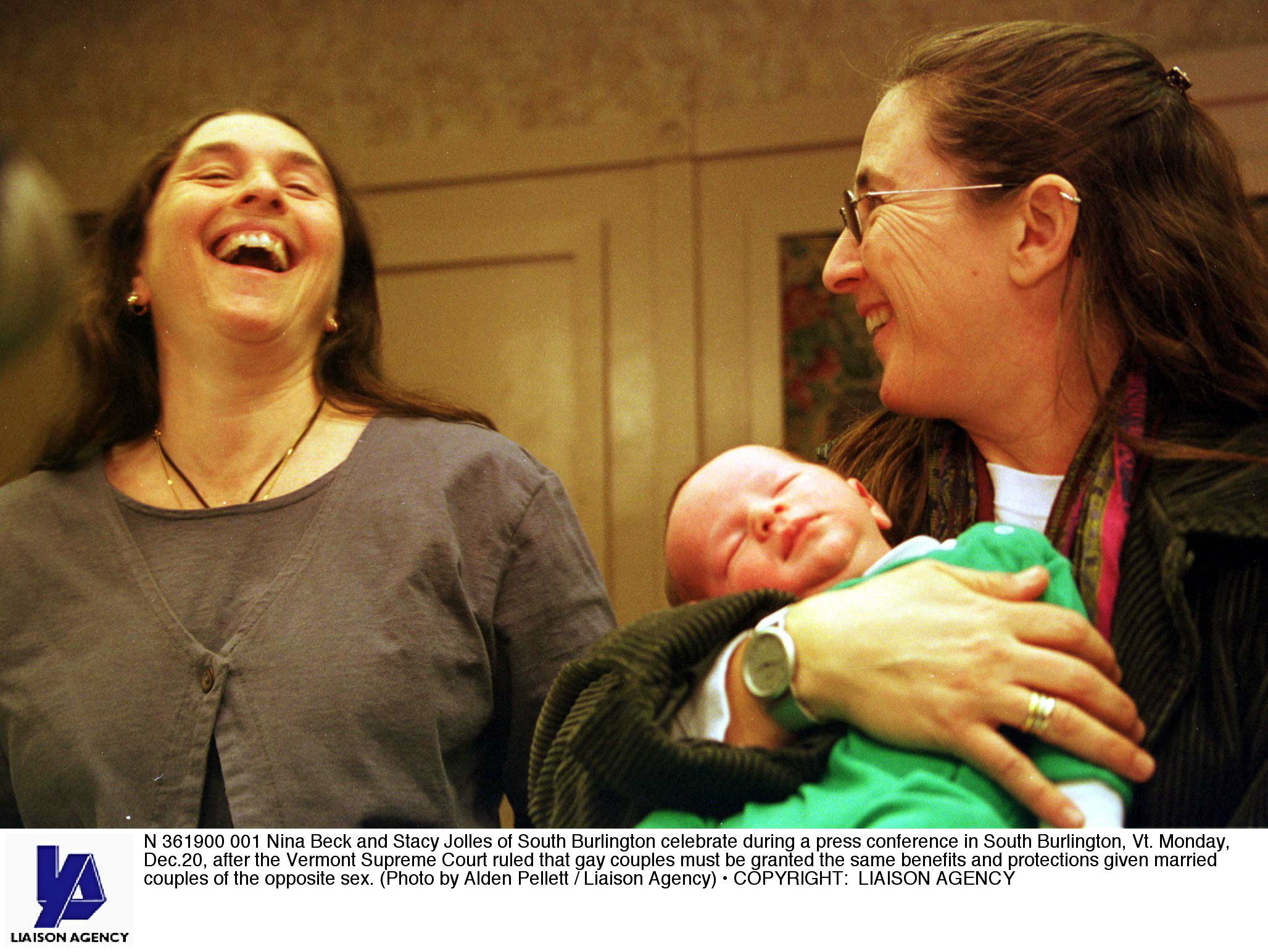
(Photos: Nina Beck and Stacy Jolles of South Burlington celebrate during a press conference in South Burlington, Vt. Monday, Dec.20, 1997, after the Vermont Supreme Court ruled that gay couples must be granted the same benefits and protections given married couples of the opposite sex. By Alden Pellett/Liaison Agency/via Getty.

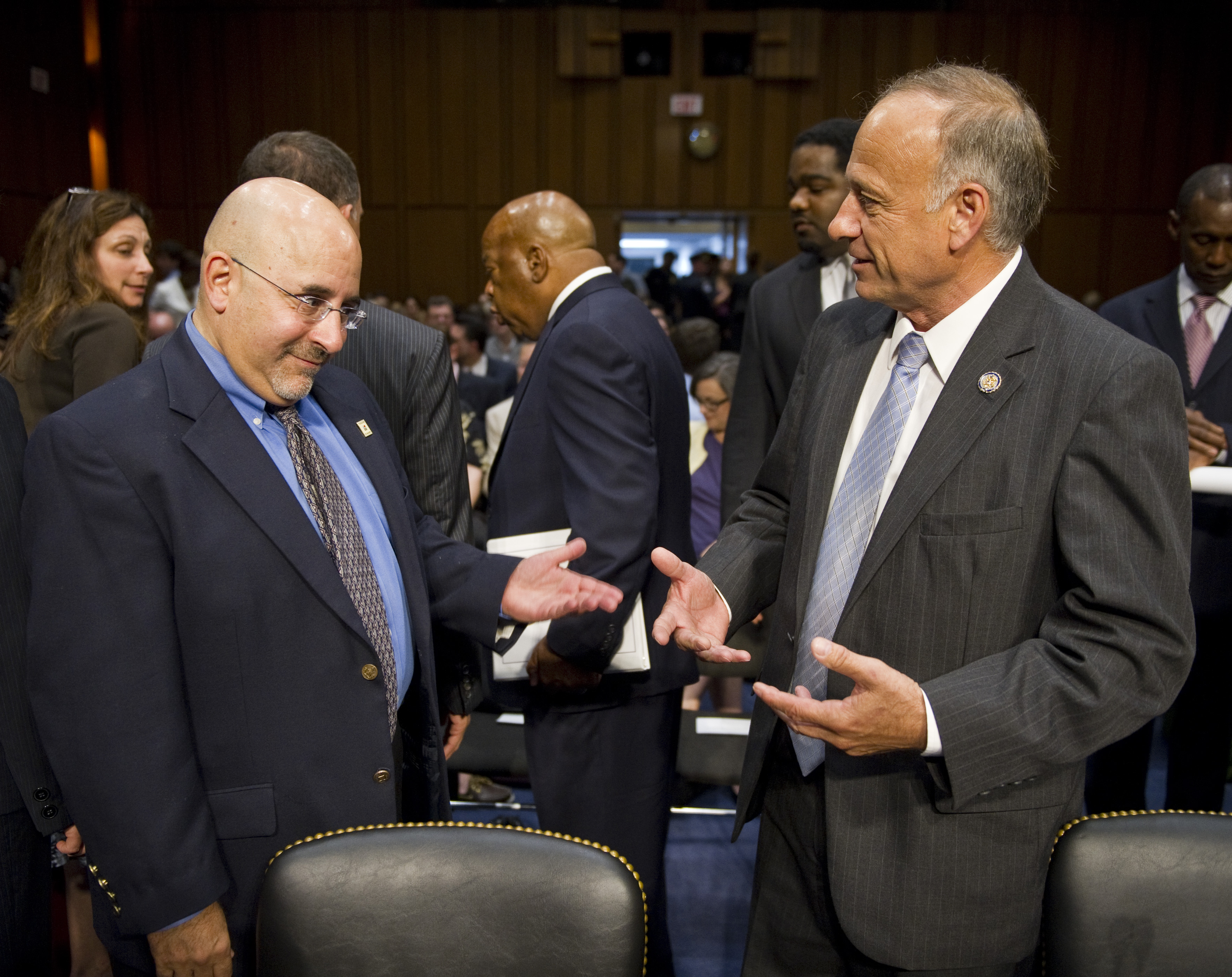
Evan Wolfson, founder and executive director of Freedom to Marry, and Rep. Steve King, R-Iowa, talk before they testified during the Senate Judiciary Committee hearing on proposals to repeal the Defense of Marriage Act (PL 104-199). By Scott J. Ferrell/Congressional Quarterly/Getty Images.)

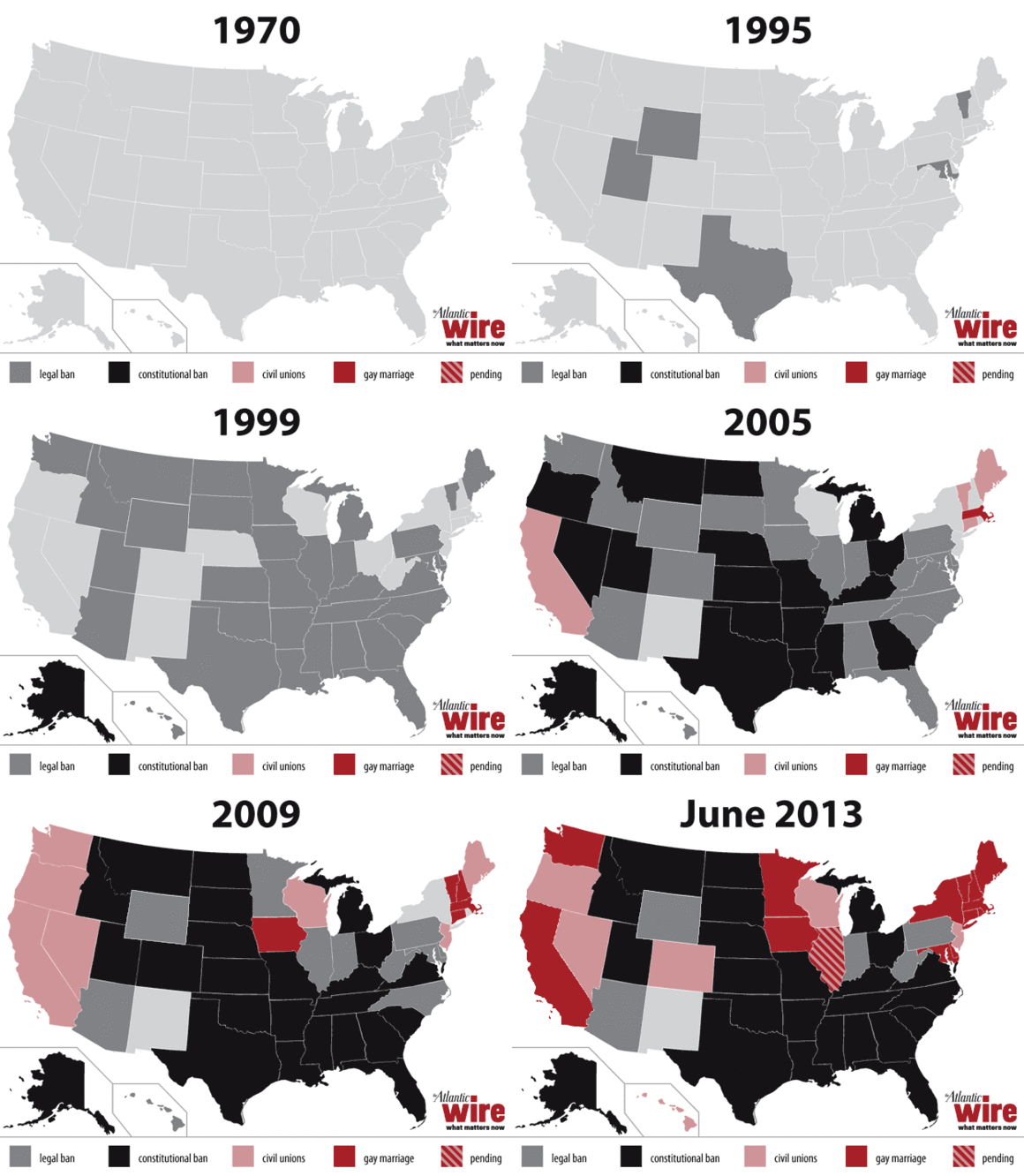
(Illustrations: The Atlantic Wire’s history of marriage equality. The cover of the first book to make an extended case for marriage equality, in 1995.)

[Subsequent posts on this topic here]
Le Pen, Farage, Putin

Timothy Snyder, whose historic analysis of the conflict between Russia and Ukraine is worth reading in full, situates Putin’s ideology within the rising tide of far-right nationalism in Europe:

More than anything else, what unites the Russian leadership with the European far Right is a certain basic dishonesty, a lie so fundamental and self-delusive that it has the potential to destroy an entire peaceful order. Even as Russian leaders pour scorn on a Europe they present as a gay fleshpot, Russia’s elite is dependent upon the European Union at every conceivable level. Without European predictability, law and culture, Russians would have nowhere to launder their money, establish their front companies, send their children to school, or spend their vacations. Europe is both the basis of the Russian system and its safety valve.

Likewise, the average Heinz-Christian Strache (FPÖ in Austria) or Marine Le Pen (Front National in France) voter takes for granted countless elements of peace and prosperity that were achieved as a result of European integration. The archetypical example is the possibility, on 25 May, to use free and fair democratic elections to the European parliament to vote for people who claim to oppose the existence of the European parliament.

In an equally weighty essay, Pádraig Murphy explores the intellectual heritage of Eurasianism:

The most prominent representative of this school in Moscow is Aleksandr Dugin, a professor at Moscow State University and leader of the Centre for Conservative Research. … Dugin is a disciple of Sir Halford Mackinder (1861-1947), the geopolitician who introduce the concept of the “Heartland”, or the “world island”, the Eurasian land mass, and who theorised that “who rules the world island commands the world”. He contrasted this with the Sealand, essentially the geopolitical sector dominated by sea power – in his time, Britain, now, the United States.

Dugin sees Russia as dominating the Heartland, the term he consistently uses. He explicitly harks back to the Slavophiles who, he says, had the concept of the Heartland, while the Westernisers did not, but also to the Eurasianists and their disparagement of Romano-German civilisation. The White emigration in Prague, he says, declared Russia not a part of European culture, but a separate “state world”, made up of a unique blend of western and eastern cultures.

Previous Dish on Dugin here. Meanwhile, Keating remarks on the role of the Cossacks in Russia’s conservative revival:

It began with Boris Yeltsin signing a number of decrees recognizing special rights, including the right to bear arms, for Cossack groups, but their re-emergence has accelerated under Vladimir Putin, who has made them something of a symbol of his conservative nationalist ideology. In 2005 Putin signed a bill allowing registered Cossack organizations to select members of special Cossack units in the Russian military and giving himself the right to appoint Cossack generals.

Cossack military schools have been formed. Cossack patrols have been policing cities in 19th-century military garb, including Moscow. In Krasnodar, home to Sochi, 1,000 Cossacks were put on the government payroll ahead of the Winter Olympics. They’ve also at times served as conservative cultural enforcers, policing ethnic minorities from southern Russia and leading campaigns against controversial artwork including Pussy Riot and a staged reading of Lolita in St. Peterburg.

Previous Dish on the new Russian chauvinism here and here.

Iraq Is Still FUBAR

IRAQ-UNREST-RAMADI

Ned Parker previews the April 30th elections:

For months, suicide bombers have been dynamiting themselves in crowded Shiite markets, coffee shops, and funeral tents, while Shiite militias and government security forces have terrorized Sunni communities. The Iraqi state is breaking apart again: from the west in Anbar province, where after weeks of anarchic violence more than 380,000 people have fled their homes; to the east in Diyala province, where tit-for-tat sectarian killings are rampant; to the north in Mosul, where al-Qaeda-linked militants control large swathes of territory; to the south in Basra, home to Iraq’s oil riches, where Shiite militias are once more ascendant; to Iraq’s Kurds, who warn that the country is disintegrating and contemplate full independence from Baghdad.

More than 2,500 Iraqis have been killed since the start of the year, including nearly three hundred in the first ten days of April; in the capital itself, which has become a showcase for the country’s multiplying conflicts and uncontrolled violence, there have been several brazen attacks on government buildings, and a terrifying string of car bombings, including eight on April 9 alone.

It looks like Maliki, who is running for a third term, will remain in power:

With elections now two weeks away the prime minister appears confident.

One way his Shiite political opponents might challenge his bid to continue in office would be to form a ruling coalition with Sunnis and Kurds after the election. But despite their shared wish to replace Maliki, the competition among his Shiite opponents to claim his position, and the most lucrative governmental posts, may prevent them from coming together. Sunni political figures are in a similar battle for preeminence within their own community. Sunni candidates also face threats from members of ISIS, the Qaeda-linked group, who consider any participation in the election as traitorous. Deteriorating security conditions in the north and west are likely to limit Sunni voter turnout, and the electoral commission has already announced that some areas in western Anbar will not be able to cast ballots. In any case, a lengthy negotiation period will likely be required after the election to form a new government, during which Maliki, by virtue of his office, will continue to exercise the most power in the land.

In other Iraq news, the Committee to Protect Journalists (CPJ) has just named Iraq #1 on its “2014 Global Impunity Index,” which “spotlights countries where journalists are slain and the killers go free”:

With 100 journalists murdered in the last decade and 100 percent impunity, Iraq is the worst offender on the Impunity Index, a spot it has held since 2008, when CPJ first compiled the index. Nine new murders in late 2013 amid a resurgence of militant groups broke a two-year quiescence in fatal anti-press violence. Three of the victims, plus two media workers, were killed in a single attack when armed militants bombed and stormed Salaheddin TV station in Tikrit on December 23. Al-Qaeda affiliate Islamic State of Iraq and Sham (ISIS) claimed responsibility for the attack, according to news reports accusing it of warring against the Sunni people.

(Photo: A damaged car with blood trails is seen next to a crater at the site of twin suicide bombing the western Iraqi city of Ramadi, the provincial capital of Anbar province, on April 16, 2014. The attacks targeted two checkpoints killing five people and injuring 12 according to police and medical reports. By Azhar Shallal/AFP/Getty Images)

Your Merch, Your Ideas, Ctd

question-mark-T_

Our updated poll is embedded below (if you are using a mobile phone or tablet, please click here). Based on your votes, we have removed some of the least popular ideas and added in some more. In addition to many of your submitted slogans, we have added a multiple-choice section where you can indicate your preference for various types of merch (totes, dog bowls, hats, etc). The most popular picks will be mulled over by the Dish staff and mix-and-matched with other ideas, and we will have an professional graphic designer whip up the final versions.

If you could take a minute and give us your final input on this poll, even if you’re already filled it out before, we would be most grateful. Just mark “Sweet” if you could see yourself purchasing an item with that slogan or “Lame” if you definitely would not. For the second section, check off as many items as you like – as many items as you could see yourself purchasing at some point. Thanks to everyone for your help; we really appreciate it.


This embed is invalid

Why Aren’t Gay Men On The Pill? Ctd

A straight female reader chimes in:

As I was listening to Dave Cullen discuss Truvada I could only think … well, welcome to my world!  The birth control pill was “unleashed” on women in 1960.  I graduated from college in 1967 and moved to Chicago to work.  When I went to my doctor to get a prescription for them, boy did I get a lecture. “Now, you aren’t going to have an affair with a married man are you?” At that point I was dating a divorced man, so maybe that was the same?  But the feelings about the pill and women were almost exactly the same as Cullen was talking about and which Limbaugh expressed when Sandra Fluke testified about the contraceptive requirement in the ACA.  We were going to be irresponsible; we were sluts – all because we wanted to protect ourselves from getting pregnant when we had sex, just like Cullen wants to protect himself and others from HIV when he has sex.

We haven’t gotten very far, have we?

The comparison to the birth control pill brings to mind this great quote from Jim Pickett, the director of advocacy for the AIDS Foundation of Chicago:

You’re here because people barebacked. Your grandmother was a barebacker. That secretary in your truvadaoffice, when you’re invited to her baby shower, she’s a barebacker. You’re bringing gifts for someone who engaged in risky fucking behavior. What the fuck are you doing? She’s a bad person. We would never [say] that. We’re like, ‘Yay! You’re pregnant! What is it? Woohoo!’ With a gay man, it’s like, ‘Oh my God. You’re reckless, you’re careless, you’re insane, you’re self-destructive, you want to hurt yourself and others.’ And we ignore the fact that gay men have the same needs to feel close and intimate and pleasure. 

Another reader asks:

How is Gardasil – an intervention to prevent a potentially incurable disease – somehow morally correct and non-contributory to increased sexual activity, and yet Truvada is not? In the name of prevention and facing the realities of sexual behavior, we have railed against Christianists’ opposition to sex education, condoms for teens and now a vaccine. It’s time we are consistent about ourselves.

Another responds to this video from Dave Cullen:

As a straight female, I have real issues with the whole “it feels better bare so why not do it that way.”

My late husband and I had a good marriage, but one area in which he was difficult was birth control. He didn’t like condoms and didn’t want to use them. He didn’t want to go to the store and ask the pharmacist for condoms. He refused to have a vasectomy when he didn’t want more kids, so I got a tubal ligation.

All the things he feared and resented I had to take on. I had to go to the store and ask the pharmacist for birth control pills (and deal with the side effects); I had to research and decide on an IUD and a doctor to insert it; I had to have a tubal ligation after my last pregnancy. And yes, I had to do those things because we didn’t want and couldn’t afford a large family. If we had not both been products of the 1950s, the marriage probably wouldn’t have happened, because I would not have been as subservient and the relationship would not have progressed with his issues about birth control.

Although I like sex without condoms better if I’m protected from disease and pregnancy, being a widow means condoms are in my future if I meet a guy who wants to fill them. I don’t think censoring opinions about “bare is better” works. But anyone who exalts barebacking should do so while communicating that there’s no good mutual sexual experience – one that is good at the moment and also good in memory forever – that leaves one partner worried or angry about pregnancy, disease, or discomfort. Bare isn’t better if it isn’t the best mutual choice, and it isn’t a decision that should be made on the basis of penile nerve endings alone.

Read the entire PrEP thread here.

(Video: A brief history of the birth control pill)

Growing Up In Syria’s Civil War

Syria Deeply is publishing the diary of a teenage girl living in Syria. A moving passage from the first entry:

I remember well the day cattle food, or fodder, was smuggled into the city. We milled the animal feed to make dough.

It didn’t take us long to get used to the bad taste and weird texture of our new “bread.” It brought us a semblance of happiness with the little olives, juice or yogurt – Syrian food staples – that we had. Our only concern was to eat. One can never get used to sleeping on an empty stomach.

Our collective will to eat meant we started getting creative with the cattle feed. We cooked it as if we were cooking rice or wheat. We became so accustomed to it that we almost forgot what chicken, meat and fruit looked like.

One of the hardest days was when we heard that a car carrying fruit and candy had entered the city. At first, we were beyond thrilled, but our happiness was fleeting. The exorbitant prices for the items on display meant no one could actually afford them.

That day, a young boy with holes in his shoes squeezed his mother’s hand as they passed by the fruit car. He begged her for an apple. Holding back her tears, she promised to make him “fodder cake” when they got home. Similarly, a father ignored the car carrying the goods and picked up the pace as he dragged his daughter, who was demanding a banana or an orange. Who would believe that the availability of fruit would be worse than the lack of it? Is it not a child’s right to have an apple, a banana or a small piece of candy?

In this world, we have been stripped of our rights, starting with food.

Obama’s Meep Meep On Healthcare

obamasmug

There are plenty of imponderables left on the fate of the ACA, Obama’s signature domestic policy achievement. Premiums could still spike later this year; the full data on the numbers with actual, paid-for health insurance via the exchanges is not yet known; the resistance on the right to it is still mighty; in many states, the lack of Medicaid expansion guts a key part of the law’s intent. If you want to read an attempt to argue that Obamacare is as big a liability for Obama this fall as the Iraq War was for Bush in 2006, well go read JPod. My reaction after reading his screed was: seriously?

There’s simply no denying that the law has been rescued by an impressive post-fiasco operation that did to ACA-opponents what the Obama campaign did to the Clintons in 2008 and to Romney in 2012. Obama out-muscled the nay-sayers on the ground. I have a feeling that this has yet to fully sink in with the public, and when it does, the politics of this might change. (Since the law was pummeled at the get-go as something beyond the skills of the federal government to implement, its subsequent successful implementation would seem to me to do a lot to reverse the damage.) There are some signs that this is happening. A new Reuters/Ipsos poll finds the following:

Nearly one-third of respondents in the online survey released on Tuesday said they prefer Democrats’ plan, policy or approach to healthcare, compared to just 18 percent for Republicans. This marks both an uptick in support for Democrats and a slide for Republicans since a similar poll in February.

That’s mainly because of renewed confidence and support from previously demoralized Democrats. But it’s also a reflection, it seems to me, of the political vulnerability of Republicans who have failed to present a viable alternative to the law, and indeed seem set, in the eyes of most voters, merely to repeal ACA provisions that are individually popular. And this bad position is very likely to endure because of the intensity of the loathing for Obama/Obamacare among the Medicare recipients in the GOP base. It seems to me that right now, the GOP cannot offer an alternative that keeps the more popular parts of Obamacare without the air fast leaking out of their mid-term election balloon. And so by the fall, the political dynamics of this may shift some more in Obama’s direction. By 2016, that could be even more dramatic. One party – the GOP – will be offering unnerving change back to the status quo ante, and the other will be proposing incremental reform of the ACA. The only thing more likely to propel Hillary Clinton’s candidacy would be a Republican House and Senate next January.

It’s that long game thing again, isn’t it? Like the civil rights revolution of the Obama years, it seemed a close-to-impossible effort to start with, and then was gradually, skillfully ground out. It also seems true to me that the non-event of the ACA for many, many people will likely undermine some of the hysteria on the right. The ACA-opponents may be in danger of seeming to cry wolf over something that isn’t that big a deal. Yes, they may have premium hikes to tout as evidence of the alleged disaster. And every single piece of bad news on the healthcare front will be attributed to the ACA, fairly or not. But the public will still want to know how premiums can go down without people with pre-existing conditions being kicked out of the system, or without kids being kicked off their parents’ plan, and so on. I think, in other words, that the GOP’s position made a lot of short-term political sense in 2010 and even 2012. But it’s a much tougher sell in 2014, let alone 2016. Once again, they have substituted tactics for strategy. Every time they have done that with Obama, they have failed.

Or maybe I’m biased because my own insurance situation has gotten better. Here’s what’s happened in my individual case.

I stayed on my Newsweek plan via COBRA for my first year as a new business-owner. But when I went on the exchanges this year before my COBRA ran out, I was pleasantly surprised. My old plan had a premium for me and my hubby of $1,535.59 per month, with an in-network out-of-pocket maximum of $2,500 per person. So in 2013 I had total out-of-pocket costs (premiums plus my out-of-pocket maximum of $2,500) of $20,927.08. This year, my ACA plan – a Platinum DC-based one – has a monthly premium of $1,106.33 for the two of us, with an in-network out-of-pocket maximum of $1,800 per person. My out of pocket medical costs this year will therefore be $15,075.96. (One small note: my previous plan was slated for a reduction in premiums this year as well. Not by as much as my current plan – but a significant one nonetheless. But since my COBRA option ran out this June, it wasn’t really a choice.)

So I’m a lot better off with Obamacare this year. I’m also buoyed by the fact that DC’s exchanges have a high number of the young and healthy in them – balancing out my aging AIDSy ass. So I’m reasonably confident my plan won’t go down the toilet any time soon, or face big hikes in premiums. And this new insurance means a lot more to me than the old one – because it cannot be taken away, even if the Dish goes belly-up. When you are a long-term HIV survivor, that kind of health security and independence is, well, priceless. Obamacare affected me in another critical way as well. Its assurance of a stable insurance market that does not screen out someone with a pre-existing condition made me far more comfortable starting my own business. It gave me a baseline of security that simply didn’t exist before. It helped make entrepreneurialism possible.

Yes, I am just one tiny, and rare example. But for me, at least, Obamacare has over-delivered and over-performed. If my experience is replicated more widely, then I suspect the polling and politics will shift yet again.

Meep motherfucking meep.

(Photo: Dennis Brack/Black Star/Getty Images)

Viruses On The Loose

Martin Furmansky chronicles the history of dangerous viruses escaping from labs. The bottom line:

Looking at the problem pragmatically, the question is not if such escapes will result in a major civilian outbreak, but rather what the pathogen will be and how such an escape may be contained, if indeed it can be contained at all.

Experiments that augment virulence and transmissibility of dangerous pathogens have been funded and performed, notably with the H5N1 avian influenza virus. The advisability of performing such experiments at all—particularly in laboratories placed at universities in heavily populated urban areas, where potentially exposed laboratory personnel are in daily contact with a multitude of susceptible and unaware citizens—is clearly in question.

If such manipulations should be allowed, it would seem prudent to conduct them in isolated laboratories where personnel are sequestered from the general public and must undergo a period of exit quarantine before re-entering civilian life. The historical record tells us it is not a matter of if but when ignoring such measures will cost health and even lives. Perhaps many lives.

Want To Brush Up On Your Potions?

Screen Shot 2014-04-15 at 1.31.06 PM

Alex Heimbach points Harry Potter superfans to Hogwarts is Here:

The website works as a sort of cross between a MOOC (massive open online course) and an RPG (a role-playing game, like Dungeons & Dragons). You start by creating an account and choosing a house. (No sorting hat here, unfortunately.) I went with Ravenclaw, which seemed fitting for an optional intellectual endeavor. I wasn’t alone in that decision: Ravenclaw is the second most popular house (after Gryffindor, of course) and has the most house points (which you gain by completing assignments).

Once you enroll at the virtual Hogwarts, you can join a dorm, buy books from Flourish and Blotts, and even write for The Daily Owl. Though you might be drawn in by these social trappings, the curriculum itself is surprisingly rigorous. As a first year student, you are expected to complete seven courses: Charms, Potions, Defense Against the Dark Arts, Astronomy, Herbology, History of Magic, and Transfiguration. Every course consists of nine lessons, each of which involves a written introduction, some supplemental reading, and a number of assignments.