Face Of The Day

spencer_GYI0051798751

Mark Murrmann appreciates the work of Chris Hondros, the renowned photojournalist who was killed alongside Tim Hetherington in Libya in 2011:

Though he published thousands of photos, one of Chris Hondros’ best known images remains seared in my mind: a young Iraqi girl crying, covered in the blood of her parents who were just killed by the US soldiers towering over her. I first saw it in the New York Times—a shocking story with a mesmerizing image. I was just finding my way in the world of photography at the time, thinking maybe I wanted to be a war photographer. Hondros’ photos stood out for his ability to capture moments of clarity in tense, difficult situations. …

Testament, a new offering from powerHouse Books, stands as a retrospective of Hondros’ work, and also reveals him as a skilled writer and speaker who often talked publicly about his profession and the impact of photography, especially war photography, on society. Excerpts of his writings, speeches, and interviews are interspersed with the photos, giving a better idea of the man, and where he was coming from as a photographer. It’s this extra stuff that makes Testament much better than just another collection of great photos from horrific situations. Proceeds from sales of the book, incidentally, go to the Chris Hondros Fund, established to support the work of conflict photographers and spread awareness of issues that arise from reporting in war zones.

Buy the book here. A photo essay of many of Testament‘s images here.

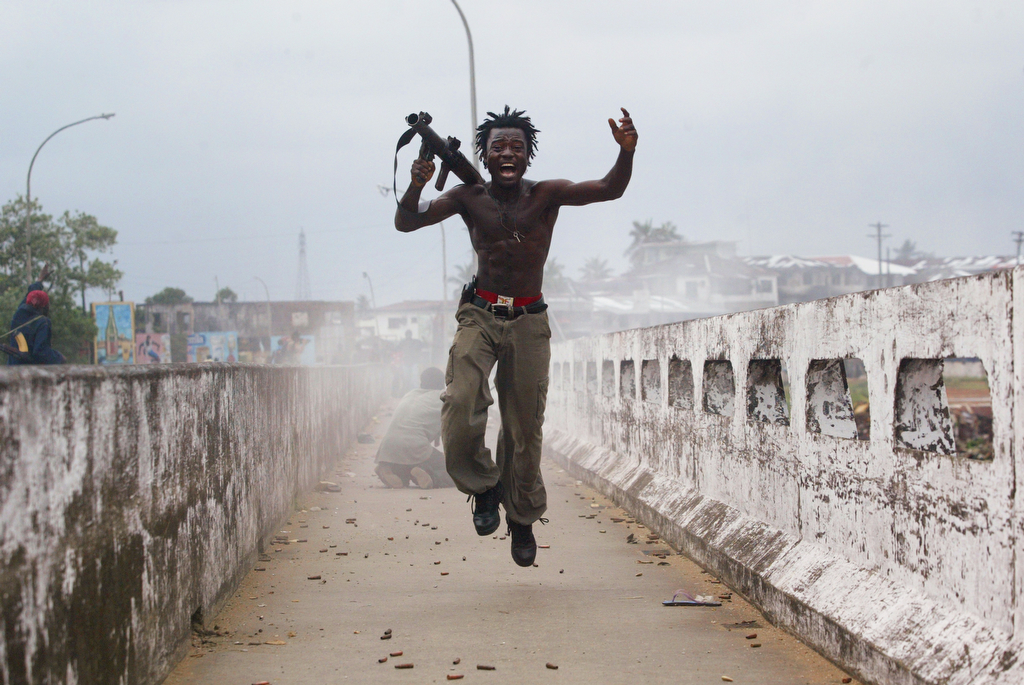
(Photo: Joseph Duo, a Liberian militia commander loyal to the government, exults after firing a rocket-propelled grenade at rebel forces at a key strategic bridge in Monrovia, Liberia on July 20, 2003. It’s the cover-photo for Testament – photographs by Chris Hondros/Getty Images, text by Chris Hondros, published by powerHouse Books.)

If America Had Scandinavia’s Tax Rate

American Taxes

Jonathan Cohn celebrates tax day by calling for higher taxes:

[T]axes in the U.S. are among the lowest in the developed world. The average for countries in the Organization for Economic Cooperation and Development, an organization of rich countries, is higher. And in countries like Sweden, Norway, and the Netherlands countries, the average is much higher. In those nations, taxes account for more than half of total national income.

That level may sound scary but, as many of us have written before, you could make a good case that the people of Scandinavia and Northern Europe know what they are doing. They are far more secure, thanks not only to national health insurance but also to generous provision of child care and unemployment benefits. And despite the high tax burden, their economies have historically been strong—in part, because the combination of investment and a secure safety net makes people more comfortable with a dynamic, ever-changing economy. The wonks used to call this economic model “flexicurity.”

Douthat pushes back:

Cohn concedes the very general point that we can’t simply impose Swedish structures on the United States and call it a day, but he doesn’t address the more specific problem suggested by that concession:

Namely, that a lot of liberal proposals essentially ask us to assume that American government — the quasi-imperial government of a vast, diverse, immigrant-heavy continent of three hundred million people — can somehow, in some future dispensation, approach the efficiency of welfare states administered on a much smaller scale and for a much more homogenous population. Which is to say, they wave away one of the central problem with existing public outlays in the U.S., which in other contexts they’re happy to highlight — the absence, in core areas like health care and education, of a clear link between increased spending and better outcomes. Or else they acknowledge the link, but assert that the best way to reform our kludgeocracy is to pursue greater efficiency in program design while simultaneously pouring more money into the system overall — using a heaping-full of sugar to make the medicine go down, if you will. (This was the basic theory of Obamacare, and also of more bipartisan reforms like No Child Left Behind.)

It isn’t a crazy theory, but I think it’s reasonable to worry that in a system as inefficient and cross-pressured as ours, the sugar simply offsets or counteracts the medicine’s effects. And that possibility makes a strong case for holding the tax burden constant while seeking de-kludge-ification, rather than pre-emptively handing more money to bureaucracies and programs that aren’t exactly being managed with Nordic efficiency, and aren’t showing the most impressive of results.

Mona Chalabi provides some perspective with the above chart:

On individual taxes as a percentage of GDP, U.S. rates are consistent with the OECD average. But when it comes to corporations, the overall U.S. tax rate (2.3 percent) falls below the median (2.7 percent) and the average (3 percent):

The Destruction Of Syria’s Economy

Joshua Keating highlights it:

Even at an annual growth rate of 5 percent, which seems extremely optimistic, it would take Syria 30 years to get back to its pre-war GDP, according to a recent analysis by Jihad Yazigi, a visiting fellow at the European Council on Foreign Relations who writes about the country’s economy on his website, the Syria Report.

Aryn Baker looks at the broader picture:

[T]he economic toll will not be limited to Syria alone. There are more than 2.5 million Syrian refugees in neighboring Lebanon, Jordan, Iraq and Turkey, and even though international aid agencies help host countries, it is rarely enough to make up for the infrastructural burdens. And the refugees are likely to remain in place until they have something worthwhile to go back to, which could take years. “How are we going to get these people back to their villages in Syria, to rebuild what has been destroyed?” asks Sami Nader, an economist and professor at Lebanon’s St. Joseph University. “All the factories are destroyed; where will they work?” According to the United Nations, there are now more than one million Syrian refugees registered in Lebanon, making up a quarter of the country’s population. Lebanon’s own economy, beset by insecurity and political volatility, was already on the verge of bankruptcy, says Nader. “This Syria situation could just push us over the edge.” The cost of war isn’t just immeasurable. It doesn’t know borders, either.

How Greed Became Good

John Paul Rollert traces the pursuit of self-interest over three centuries. He focuses on Ayn Rand and her influence:

[C]apitalism is the only economic system in which [Rand wrote] “the exceptional men” are not “held down by the majority” and in which … the “only good” that humans can do to one another and “the only statement of their proper relationship” are both acknowledged: “Hands off!” A woman who titled a collection of essays The Virtue of Selfishness, Rand was given to brackish candor. Yet at a time when many people think that the common good is more often imperiled than empowered by unbridled greed, she provides an alternative defense of the acquisitive instinct by appealing to an ethics of gross achievement and a formulation of personal liberty that looks with suspicion and disdain on any talk of civic duty, moral obligation, or even prudential restraint. Her aim was simple: To relieve greed, once and for all, of any moral taint.

“I think greed is healthy,” an apparent acolyte told the graduating class at Berkeley’s business school in 1986. “You can be greedy and still feel good about yourself.” The speaker was Ivan Boesky, who shortly thereafter would be fined $100 million, and later go to prison, for insider trading. His address was adapted by Oliver Stone as the basis for Gordon Gekko’s “greed is good” speech in Wall Street. An exhortation to shareholders of a sagging company, it reads like a corporate raider’s war cry, with Gekko the grinning avatar of Agency Theory.

Such a blunt endorsement of greed today remains far beyond the mainstream. If we tolerate greed, it is because we accept the hard bargain of the Invisible Hand. We believe that greed can do good, not that it is good. That, we are unwilling to say.

(Video: Gordon Gekko preaches greed in Wall Street)

Why Is This Night Different From All Other Nights?

Screen_Shot_2014-04-14_at_12.56.03_PM

Max Fisher points out that the Passover seder is a popular ritual among American Jews, even those who aren’t observant:

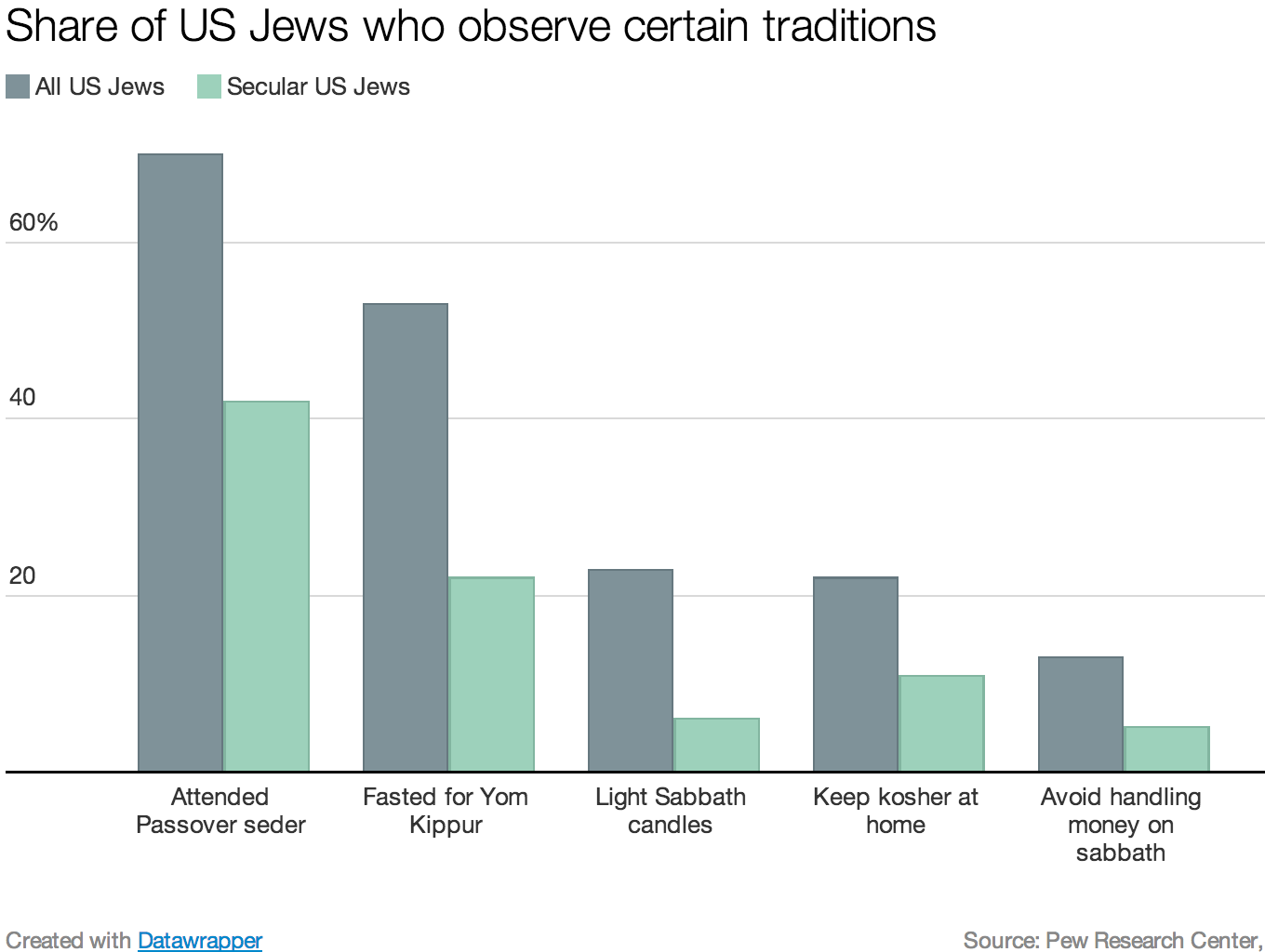
Passover, which commemorates the ancient Jews’ Biblical flight from Egypt to Israel, is celebrated by nearly three out of four US Jews, and 42 percent of secular Jews. If you live in a place with a significant Jewish population, there’s a pretty good chance you know someone who’s going to a seder — the ritual-heavy dinner that marks Passover — or are going yourself. Among religiously observant Jews, 78 percent attend a seder.

Compare those numbers to the share of US Jews who fast during Yom Kippur (fasting is a central component of observing the holiday, and many Jews who fast will do so partially). Only 53 percent of US Jews fast; its 62 percent among religious Jews and just 22 percent among secular Jews. In other words, a secular Jew is about twice as likely to attend a Passover seder as he or she is to fast during Yom Kippur, even though the latter is by far the more important holiday. About 22 percent of US Jews report themselves as secular, so the fact that they are so much more likely to observe Passover is a big deal for its cultural prominence.

Goyim are getting into the holiday as well:

[F]or many, the allure of Passover stretches beyond a curiosity ticket to a Jewish ritual. The seder itself and the themes it explores have a way of resonating outside the boundaries of the tribe. Rick Weintraub, a Jewish-born convert to Christianity, has been leading seders in churches for about 30 years. Around 500 Christian participants will join him this year at The Hills, a church in North Richland Hills, Texas.

The seder speaks to Christians on two levels, he explains.

On the symbolic side, the motif of the sacrificial lamb, whose blood was painted on Israelites’ doorframes to ensure they were “passed over” during the killing of the firstborn, resonates with the image of Jesus as the lamb of God who suffered in order to save others. On the historic side, Jesus and most of his disciples were Jewish, and their last supper is widely thought to have been a Passover seder. Just as the seder allows Jews to relive the exodus, the ceremony allows Christians to recreate the last supper. Weintraub explains that by observing a seder, “the Passover becomes a living event.”

But Rebecca Cynamon-Murphy discourages this, calling it disrespectful to Jews:

Christians mounting their own reading of the Haggadah almost always want to discuss how Jesus is like the paschal lamb, using the occasion to show how all the Hebrew scriptures point to Jesus as fulfilling the prophecies. This theological exercise, known as supersessionism, is problematic enough in a purely Christian context, but as part of a Jewish ritual it is deeply out of place.

Spinning the “Old Testament” this way reduces the prophecies, the ambiguities that Jewish scholars have debated for centuries in the Talmud and in yeshivas, the morals derived from stories of flawed protagonists and, in fact, the entire narrative arc of the Jewish people as simply a preamble to the main act. Because Jewish people do not believe this interpretation of their holy texts and given the atrocities committed by members of our own faith because of this difference in belief, it’s like adding salt to the wounds of history for a Christian family to take one of the most sacred Jewish celebrations and twist it to reflect our own beliefs.

And Bernard Avishai worries that Israel has lost touch with the holiday’s core message of freedom:

I’ve noticed a new conceit this year on Reshet Bet, Israel’s dominant radio station. Almost all the broadcasters signed off with the phrase “pesach kasher,” a kosher Passover, something you did not hear in Israel a generation ago (and I have not heard since Talmud Torah, the orthodox school I went to in Montreal, in the nineteen-fifties). Guests speak about where the line in Europe passed between sweet gefilte fish and the salty kind. One rabbi, to his credit, spoke of the importance of complicating the intimacy of the family meal by remembering the refugees of the Syrian civil war and from sub-Saharan Africa, though he did not suggest what could be done about them. Not one interviewer asked about the universal importance of political freedom. (Is there even any point in asking why nobody thought to invite a Palestinian resident of Ramallah, you know, to ask what it felt like to be denied the most obvious forms of it?)

Presumably, the radio celebs were trying to be ingratiating to religious people; most of the radio hosts live secular lives in Tel Aviv, and are not fussing over cleaning their houses of leavened bread. The thing is, ingratiation suggests a communal expectation—in this case, that listeners increasingly think of Passover in terms of dietary strictures and ritual symbols, old-style laws, not the move from slavery to emancipation.

The Neocons Lose Their Shit Over Rand Paul

Senators Gather To Caucus Over Hagel Nomination

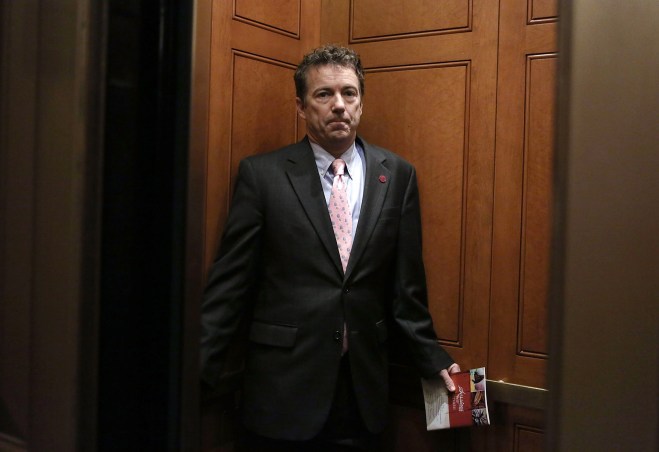
And so we begin to get into – finally! – a real debate about foreign policy within the GOP. With Ron Paul, the neocon stranglehold on Republican foreign policy was easily maintained. With Rand Paul? Not so much. And so we have three sallies against him this week from three classic sources: Bret Stephens, Rich Lowry and Jennifer Rubin. Bret Stephens is a very gifted writer, and his cri de coeur today is quite something.

So let me concede up-front: I fully agree with Stephens that Paul’s theory that Dick Cheney decided to invade Iraq in order to burnish the bottom line of Halliburton is foolish as well as stupid. Occam’s razor does all the work. We know that in the wake of 9/11, Cheney panicked. He was terrified of another attack and his fetid imagination ran wild. One way in which he could manage to recover was by seizing the initiative – and Iraq was sitting right there, as it had been for years. Along with instituting torture – another panic move – Cheney’s pursuit of war needed no underhand motive. And it is asinine and completely fruitless to make unprovable slurs.

But on containing Iran’s potential nuclear capacity? Paul is perfectly sane, and in line with US strategy against far more formidable nuclear adversaries during the Cold War. If he is completely out of the mainstream so was George Kennan and every president from Truman to Reagan. To describe the strategy that won the Cold War as somehow extremist is simply bizarre. Here’s Paul’s basic position:

“I’ve repeatedly voted for sanctions against Iran. And I think all options should be on the table to prevent them from having nuclear weapons,” Paul said on “This Week” Sunday. But he said those who oppose the idea of containment — or living with an Iran with nuclear weapons — ignore that such an outcome has been necessary in the past.

“They said containment will never ever, ever be our policy,” Paul said of those who oppose Iran getting nuclear weapons at any cost. “We woke up one day and Pakistan had nuclear weapons. If that would have been our policy toward Pakistan, we would be at war with Pakistan. We woke up one day and China had nuclear weapons. We woke up one day and Russia had them … The people who say ‘by golly, we will never stand for that,’ they are voting for war,” he added.

Well, they are, aren’t they? And you can tell by the failure to address this core point. Stephens doesn’t address it, preferring to mock Paul’s alleged electability and pick the low-hanging fruit of Halliburton. Lowry doesn’t go there, either. And Rubin of course simply flaps her arms up and down:

It has been the position of three presidents that a nuclear-armed Iran is intolerable. It is an existential threat to Israel. It is not simply that it is “not a good idea” for Iran to get the bomb. He is far, far outside the mainstream on this — and far to the left of President Obama.

But of course insisting that an Iranian nuke is intolerable is the only viable negotiating strategy to prevent it. Paul agrees with the “all options on the table” mantra. His cardinal sin is in asking what happens if the strategy fails, as it might – and as the neocons devoutly wish. What then? Rubin makes further points: Paul’s remark

reveals extreme naivete about how enemies read signals.

But he’s not the president. And containment of the nukes with even more crippling sanctions is obviously not something the Iranian regime would like. Why are they in these negotiations in the first place? In some ways, the threat of sanctioned containment is more troubling for Tehran than threats of another religious war in the Middle East. The former hurts Iran alone. The latter hurts both of us. Then this:

It reveals that he listens to no competent adviser.

Pardon my smacked gob, but an unreconstructed believer in the Iraq War is now claiming competence as a virtue?

Only in the hermetically sealed universe of the Washington Post op-ed page does that still fly. Then this:

He apparently is tone deaf, not understanding how this will strike average voters. Former ambassador to the United Nations and potential 2016 candidate John Bolton observes, “One wonders if he understands what he is saying.”

Again, someone citing John Bolton in a case for reaching average voters somewhat undermines her point. And I’d say the average voter, when asked to pick between another Middle East war and even tighter sanctions on Iran, may not fall into the camp Rubin expects. As for de-Reaganizing Paul – yes, that is now a verb – well, again, mentioning arms and Iran may not be the best rhetorical strategy in that context. Paul is not as naive as the man who thought he could placate the ayatollahs by trading arms for hostages. (Chait has a hilarious line on this as well.)

What do we make of this? I’d say it’s a sign that the neoconservative wing of the GOP is deeply alarmed by the traction Paul has on foreign policy with a base that remembers Iraq and Afghanistan more vividly than Bret Stephens. And the combination of the ferocious attacks with an inability to rebut its core point – isn’t containment preferable to war? – suggests a bit of a bluff. Paul should avoid the conspiracy theories and focus on the argument. And on that ground, he’s winning.

(Photo: Alex Wong/Getty)
Mental Health Break

You New Yorkers will probably love this:

Via Brian Heater:

Filmmaker Geoff Tompkinson tours through some of New York City’s most celebrated spots in “New York Noir,” a short that utilizes the hyper-lapse film technique, a combination of time-lapse and camera movements. The piece is primarily monochrome, though Tompkinson has added select color back like the yellow of taxis back in. You can see a number of videos featuring other metropolitan areas like Venice and Istanbul over on Tompkinson’s Vimeo page.

Running The Government Off Its Land

Brian Feldman narrates what went down in Nevada this weekend:

Government officials from the federal Bureau of Land Management attempted to seize cattle from a Nevada farmer over the weekend, arguing that the farmer, Cliven Bundy, owed money to the government for grazing his cattle on public land. On Saturday, the week-long dispute ended with a four-hour standoff between the bureau and nearly 1,000 of Bundy’s supporters, some armed.

The dispute began in 1993, when Bundy’s allotment of land for grazing cattle was altered to include some environmental protections. Bundy did not accept the change and continued to use the land anyway without paying grazing fees. In 1998, a judged order that Bundy remove the cattle and pay trespassing damages—Bundy did not comply. In 2013, a judge authorized the government to impound the approximately 900 cattle, located on the ranch about 80 miles from Las Vegas.

John Hinderaker defends Bundy even though he acknowledges he has no legal grounds for his claim:

To begin with, his family has been ranching on the acres at issue since the late 19th century. They and other settlers were induced to come to Nevada in part by the federal government’s promise that they would be able to graze their cattle on adjacent government-owned land. For many years they did so, with no limitations or fees. The Bundy family was ranching in southern Nevada long before the BLM came into existence. …

The bedrock issue here is that the federal government owns more than 80% of the state of Nevada.

This is true across the western states. To an astonishing degree, those states lack sovereignty over their own territory. Most of the land is federal. And the federal agencies that rule over federal lands have agendas. At every opportunity, it seems, they restrict not only what can be done on federal lands, but on privately-owned property. They are hostile to traditional industries like logging, mining and ranching, and if you have a puddle in your back yard, the EPA will try to regulate it as a navigable waterway.

Kilgore is dismayed at those standing up for the rogue rancher:

Call it “individualism” or “libertarianism” or whatever you want, but those who declare themselves a Republic of One and raise their own flags are in a very literal sense being unpatriotic.

That’s why I’m alarmed by the support in many conservative precincts for the Nevada scofflaws who have been exploiting public lands for private purposes and refuse to pay for the privilege because they choose not to “recognize” the authority of the United States. Totally aside from the double standards involved in expecting kid-glove treatment of one set of lawbreakers as opposed to poorer and perhaps darker criminal suspects, fans of the Bundys are encouraging those who claim a right to wage armed revolutionary war towards their obligations as Americans. It makes me really crazy when such people are described as “superpatriots.” Nothing could be more contrary to the truth.

Matt Ford scrutinizes Bundy’s flawed understanding of state sovereignty:

Bundy’s claim that the land belongs to Nevada or Clark County didn’t hold up in court, nor did his claim of inheriting an ancestral right to use the land that pre-empts the BLM’s role. “We definitely don’t recognize [the BLM director’s] jurisdiction or authority, his arresting power or policing power in any way,” Bundy told his supporters, according to The Guardian.

His personal grievance with federal authority doesn’t stop with the BLM, though. “I believe this is a sovereign state of Nevada,” Bundy said in a radio interview last Thursday. “I abide by all of Nevada state laws. But I don’t recognize the United States government as even existing.” Ironically, this position directly contradicts Article 1, Section 2 of the Nevada Constitution[.]

The Sight Of Sound

DL Cade flags the above video on Schlieren Flow Visualization, “a photographic trick that allows you to see density changes in air and, therefore, actually capture sound waves on camera”:

Starting off with a simple diagram and heat as an example, producer Adam Cole breaks down how this type of photography works, after which he shows you several examples of actual sound waves captured using a high-speed camera and Schlieren Flow Visualization.

Meanwhile, artist Adam Brown explores the question of what a digital photo “sounds” like in his project “Concentrism.” His process: “take a digital photo, turn it into audio waves, etch them onto a vinyl record, and ‘play’ it back using a USB turntable and a projector”:

For most of us, the point of taking a picture or recording sound is to hold on to something fleeting. And fleeting moments, Brown points out, aren’t relivable without a “carrier” — whether that’s a piece of silver gelatin paper, a vinyl record or a hard drive. There is no lasting message without the medium. So what happens to the message when the medium changes?

Brown doesn’t just want people to think about the transformation process — he wants them to see and hear it. He plays the records, which project the image as they spin, for an audience. Sometimes in galleries, sometimes in lecture halls, the projected images take a few minutes to “play,” slowly appearing line by line as the audio waves are turned back into a photo. …

One of the most unique elements in the performance is the sound that accompanies the image as it plays. Observers are literally “listening to data.” The noise emitted is actually the noise that the image is making as it translates, pixel by pixel, from sound to light. “It’s really a low bass rumble,” Brown says. Apparently, photos sound like white noise.

This embed is invalid