Total Recall

Screen_Shot_2014-04-05_at_2.44.26_PM

In the wake of another massive recall, this time by Toyota, Brad Plumer examines why auto recalls are becoming more common:

Automakers typically recall cars or trucks when they’ve identified a defect that could jeopardize public safety. That’s not always a simple call, though. Many problems are obvious hazards — like faulty airbags. Other defects, however, are less clear-cut. What if a car has windshield wipers that, under very rare conditions, might become “improperly torqued”? (Toyota faced this situation last year.) Should the company issue a costly recall? Or let it slide?

Since the 1990s, more and more automakers appear to be erring on the side of issuing a recall — even for seemingly minor problems. In February, for instance, Kia recalled 11,000 vehicles simply because the door stickers gave incorrect guidance on tire inflation.

Todd Wasserman offers some other possible explanations:

While the public climate may be prompting some proactive recalls, Roger Lanctot, associate director of Strategy Analytics, blames onboard software and algorithms related to airbag deployment. Lanctot points out that GM, Nissan, Toyota and Chrysler, among others, have instituted recalls related to the technology over the last two years. “This is just the beginning of software recalls,” Lanctot says. “In the past it was all about mechanical failures.”

Another possible factor is the auto industry’s use of modular components. As The Wall Street Journal points out, more and more carmakers are using more and more components across different models. While that saves costs, “if things do go wrong, auto makers can have a hard time containing them,” the article notes.

Danny Vinik puts the Toyota recall in perspective:

largest_vehicle_recallsJust two months after General Motors’ controversial recall, Toyota announced its own recall on Wednesday morning of 6.4 million vehicles across 30 different models from 2004 to 2013—more than the total number of automobiles in Belgium alone. In fact, the 6.4 million vehicles are more than twice as many cars as are in New Zealand, according to data from the World Bank. …

The recall of 6.4 million vehicles is the fifth largest in history—slightly less than Toyota’s 2010 recall for faulty gas pedals.

The Peace Isn’t Being Kept In Darfur

Column Lynch has a three part series (one, two, three) looking at African Union-United Nations Mission in Darfur (UNAMID). The first installment points out the continued violence in the country:

The failure of the peacekeepers to protect civilians can be attributed to multiple factors. Internal UNAMID documents say that troop-contributing countries supplied their blue helmets with broken vehicles and low-grade weaponry, while more powerful foreign powers declined multiple U.N. appeals to give the peacekeepers helicopter gunships to reinforce the mostly African infantry battalions. U.N. headquarters in New York, according to the documents, has also routinely rebuffed UNAMID commanders’ requests that underperforming peacekeeping contingents, or those that decline to carry out direct orders, be sent home and replaced by other troops. Sudan’s government forces and militias, meanwhile, have tormented the blue helmets, hampering their effectiveness.

Part two highlights the attacks on peace-keepers:

As of Feb. 28, 2014, a total of 191 U.N. peacekeepers have died in Darfur since January 2008, when the U.N. and African Union jointly took charge of the operation in Darfur. Only a handful of U.N. operations since the 1960s — including the original Congo operation (249) and those in Lebanon (303), the former Yugoslavia (213), and Sierra Leone (192) — have exacted a higher toll.

Sixty-two of those 191 deaths were a result of violent attacks, including ambushes, carjackings, and robberies. Sudan’s special prosecutor for Darfur has opened numerous investigations, but as of today, not a single person has been held accountable for killing a UNAMID peacekeeper.

The final installment tries to explain the mission’s failures:

Michael Gaouette, a former U.N. official who led the U.N. peacekeeping department’s Darfur team in 2008, said that many of the new forces’ shortcomings were foreseeable and inevitable. The notion of a peacekeeping mission as the solution to Darfur’s ills became part of the message tirelessly promoted by foreign governments, humanitarian groups, and well-intentioned celebrities like George Clooney. The problem, he said, was that none of the conditions necessary for a successful peacekeeping mission — a ceasefire, a viable political settlement, or true consent from the Sudanese government — were in place. Darfur also held “zero strategic importance” for the few countries, including the United States, with the military capability to deploy an effective expeditionary force in a place like Darfur, Gaouette said.

“This all begins with this problem being insoluble in the short term, which was an unacceptable admission. Something had to be done right away,” he said. “It was mind-bogglingly ridiculous to propose that peacekeeping would be the key that unlocked the door to the Darfur solution. And yet peacekeeping was graspable, peacekeeping in its most simplified, misunderstood form — sending soldiers to a place in trouble.”

A Hairbrained Regulation

14

Anita Little covers the controversy that arose last week over the Army’s new hairstyle guidelines, which critics say are biased against black women:

Basically, almost every natural hair option that black women in the Army could wear is now off limits. One of the few traditionally natural hairstyles that was listed as appropriate is cornrows, but a slew of specifications and rules surrounded even that. The diameter of each cornrow can’t be more than one-fourth of an inch, and no more than one-eighth of an inch of scalp may be shown between cornrows.

The only way to realistically meet the new standards would be to shave one’s head, perm one’s hair or wear weaves or wigs.

[Georgia National Guard Sergeant Jasmine] Jacobs said twists like the one she wears are very popular among black women soldiers because the style requires little maintenance when in the field. Her hair’s thickness and curliness makes pulling her hair back into a bun (a style popular among white women soldiers) impossible.

Elizabeth Nolan Brown proposes a simple solution:

I understand the need for the army to issue broad guidelines on acceptable hair styles, as it does in other areas of appearance. But, beyond that, it could be left up to individual unit commanders. The current regulations do include a waiver system, under which women can appeal and be granted exceptions on a case by case basis. Why not start from a place of allowing women and their immediate supervisors to make those determinations? Surely people smart and capable enough to fight and die for our country are smart and capable enough to assess for themselves which hairstyles are an interference and which aren’t.

Mark Thompson looks at what else the new guidelines prohibit:

The new regulations, issued last week, clamp down on tattoos, haircuts, sideburns, fingernails, teeth and jewelry. Tattoos are a big deal in the military. But from here on out, tattoos are barred from a soldier’s head, face, neck, wrist, hands and fingers (existing tattoos in those locations are permitted). Any enlisted soldier with such tattoos will not be eligible for promotion to warrant officer or officer ranks.

How Not To Get Murdered

The Economist provides tips:

First, don’t live in the Americas or Africa, where murder rates (one in 6,100 and one in 8,000 respectively) are more than four times as high as the rest of the world. Western Europe and East Asia are the safest regions. And the safest countries? Liechtenstein recorded no murders at all in 2012, but its population could fit in a football stadium. Among those countries whose populations number in millions, the safest is Singapore, which clocked up just 11 murders in 2012, or one killing per 480,000 people. In Honduras, the world’s most violent country, one in every 1,100 residents was killed.

Other pointers: “be a woman” and “grow older.”

How Did Heartbleed Happen?

Rusty Foster blames the bug on the insufficient attention we pay to open-source software:

OpenSSL, which is used to secure as many as two-thirds of all encrypted Internet connections, is a volunteer project. It is overseen by four people: one works for the open-source software company Red Hat, one works for Google, and two are consultants. There is nobody whose full-time job it is to work on OpenSSL. ….

Unlike a rusting highway bridge, digital infrastructure does not betray the effects of age. And, unlike roads and bridges, large portions of the software infrastructure of the Internet are built and maintained by volunteers, who get little reward when their code works well but are blamed, and sometimes savagely derided, when it fails. To some degree, this is beginning to change: venture-capital firms have made substantial investments in code-infrastructure projects, like GitHub and the Node Package Manager. But money and support still tend to flow to the newest and sexiest projects, while boring but essential elements like OpenSSL limp along as volunteer efforts. It’s easy to take open-source software for granted, and to forget that the Internet we use every day depends in part on the freely donated work of thousands of programmers.

The developer who introduced the bug called it “a simple programming error.” Update from a professional software developer:

Most of the commentary on the Heartbleed bug has focused on the proximate cause of the problem. As reported, this is indeed a simple programming error, of the kind that I could see almost anyone making from time to time. There’s lot of talk in the community about various engineering best practices (code reviews and so forth) that might have prevented this. And there’s certainly an interesting discussion about whether this being open source has helped, hurt, or is irrelevant. But zoom out a bit, because this particular bug has a root cause that’s deeper than the simple programming error. This XKCD comic gives a pretty good explanation of what happens with Heartbleed. If, after reading this, you’re wondering why a simple “are you alive” check requires the server to repeat back to the user an arbitrary block of data instead of just saying “yup, I’m here”, you’re not alone. This is a completely unnecessary feature of the protocol, that adds no functionality of any real value. One thing we’ve learned about developing secure systems is to reduce the “attack surface”, which means that any entry points and bits of protocols that aren’t required should be eliminated, because they might serve as vectors for attacks. Which is exactly what happened here. This bug doesn’t exploit the main part of the protocol – the gnarly stuff that actually deals with cryptographic keys – but rather goes after a flaw in this unnecessary appendage.

As a community, we need to get better about reviewing and analyzing the designs of these systems before they ever turn into code. And we also need to find a way to get smart people reviewing the unsexy bits of these systems more frequently.

The Best Of The Dish Today

Only days after Reihan declared himself still a neocon, the latest results of the Iraq War and the triumph of good over evil came in. The Shiite democracy is getting ready to legalize marriage for girls as young as nine years’ old:

The legislation, known as the Jaafari law, introduces rules almost identical to those of neighboring Iran, a Shia-dominated Islamic theocracy. Ayad Allawi, a former Iraqi prime minister, warned on Tuesday that approval of the law would lead to the abuse of women. “It allows for girls to be married from nine years of age and even younger,” he said. “There are other injustices [contained in it] too.”

While there is no set minimum age for marriage, the section on divorce includes rules for divorces of girls who have reached the age of 9 years. Marital rape is condoned by a clause that states women must comply with their husband’s sexual demands. Men are given guardianship rights over women and the law also establishes rules governing polygamous relationships.

Hanaa Edwar, a well-known activist and head of the charity Al-Amal (“Hope” in Arabic), has campaigned against the law as a setback for women’s rights in a country that has struggled since the 2003 invasion. “It turns women into tools for sexual enjoyment,” she said. “It deletes all their rights.”

So we spent a trillion dollars, thousands of American lives and tens of thousands of Iraqi lives to “delete all the rights” of Iraqi women. I wonder if anyone has asked Condi Rice about that.

The most trafficked post of the day continued to be “Why Aren’t Gay Men On The Pill?” – with replies from readers and Truvada-user Dave Cullen here. Runner-up: my defense of Ayaan Hirsi Ali against her hard-left critics at Brandeis. Other popular posts included my socks’ appearance on Colbert last night and the response to Jim DeMint’s surreal view of American history. You can comment on the posts at our Facebook page. See what people are saying about @sullydish here. It can get brutal over there:

:/

Meanwhile, our most popular reader thread right now is on ADHD and how to medicate for it. And these posts have updates you might have missed: a video for “Colbert To Take Over Letterman!” and another disclosure that Ayaan Ali Hirsi is indeed a personal friend. A Dish dad got Beard Of The Week honors. Also: sloth squeaks.

21 25 more readers became subscribers today. One writes:

I just resubscribed – basically I had been riding free for a few months. The main reason I re-upped: not that I wanted to read the full pieces, although that is an attraction, but because I want to be part of your project – not just in an abstract way, but in reality. When I have emailed you thoughts on various issues, or links or suggestions, they have in several cases wound up as items in your blog. You have replied to my emails personally. One day you had a link, totally unexpected, to my wife’s scholarly book, based on a TLS book review – which blew my mind and hers. Though I’d taken some time off, I wish to reconnect and support you always, and I’ll be in touch.

It doesn’t get much better than that. If you’ve been procrastinating, subscribe!, and we’ll be able to keep the Dish both alive, profitable and ad-free – something almost unheard of on the commercial web.

See you in the morning.

Dust To Ice

Lauren Davis watched We Will Live Again, seen above:

Filmmakers Myles Kane and Josh Koury focus much of their documentary on Cryonics Institute founder Robert Ettinger and staff members Ben Best and Andy Zawacki (the latter lives on the premises most of the week) and their thoughts on the cryonics movement. But facility, with its tanks stacked with men and women hoping to be revived (and, in some cases, their pets), is a magnetic costar. It’s remarkable that, for all of the science fiction dreams that cryonics evokes, the Cryonics Institute itself is fairly non-descript, a warehouse outside of Detroit dedicated to keeping its clients—or patients as Ettinger calls them—on ice. Even the acceptance and storage of the institute’s 100th patient seems fairly straightforward—packing more ice onto the body and placing it in a container.

A Conservative Minority

A recent study found that white people get more conservative when they’re told they are becoming a minority:

The authors, Maureen Craig and Jennifer Richeson of Northwestern, use data from two main experiments. In one, a group of survey respondents was told that California had become a majority-minority state, and the other group was told that the Hispanic population was now equal in size to the black population in the US. Then, all respondents were asked what their political ideology was. The group that was told whites were in the minority in California identified as more conservative than the second group.

In another experiment, one group of respondents read a press release saying that whites would soon become a minority nationally in 2042, while a second group read a release that didn’t mention race. The group primed by race then endorsed more conservative policy positions.

Bouie worries about the finding:

[E]ven if there’s no minority-majority it’s still true that the United States is becoming browner, with whites making up a declining share of the population. And if this Northwestern study is any indication, that could lead to a stronger, deeper conservatism among white Americans. The racial polarization of the 2012 election—where the large majority of whites voted for Republicans, while the overwhelming majority of minorities voted for Democrats—could continue for decades.

That would be great for Democratic partisans excited at the prospect of winning national elections in perpetuity, but terrible for our democracy, which is still adjusting to our new multiracial reality, where minority groups are equal partners in political life. To accomplish anything—to the meet the challenges of our present and future—we’ll need a measure of civic solidarity, a common belief that we’re all Americans, with legitimate claims on the bounty of the country.

With extreme racial polarization—and not the routine identity politics of the present—this goes out the window.

A Greek Rebound?

test

Greece issued its first new bonds since its restructuring this morning, raising 3 billion euros. Mark Gilbert, however, discourages celebration:

The front page of today’s Financial Times newspaper heralds today’s sale as Greece coming “out of bond exile,” and describes it as “a sign of growing confidence in the region’s weakest economies.” I beg to differ. First, the sale is evidence that yield-starved bondholders staring at record-low returns on even Italian and Spanish debt holdings are growing more desperate with every lurch lower in bond rates. Second, it shows that investor faith in European Central Bank President Mario Draghi’s pledge to do “whatever it takes” to secure the future of the euro remains unshaken, even though that July 2012 promise has never been tested.

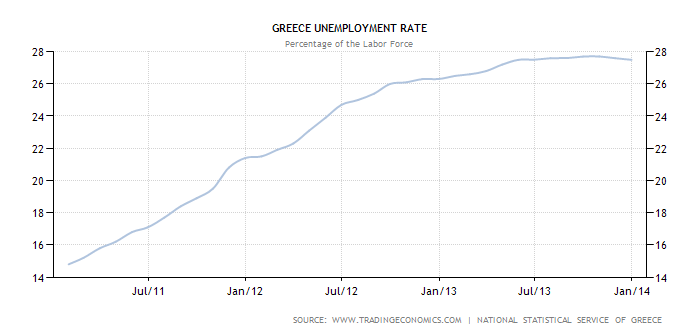
Pointing to the chart above, Ryan Cooper thinks it’s very premature to talk about a recovery:

Indeed, I rather fear this could be the worst of all worlds.

 Moving off the Euro would have been awful, but at least held the prospect of returning to growth and full employment within a couple years (from a much lower base). By contrast, the bank Natixis recently estimated that, given very generous assumptions, it will take Spain (which is in similarly dire straits) 25 years to return to 2007-era employment. A nation can do a great deal of catch-up growth in that time.

Realistically, I’d guess this means that Spain, Greece, Italy, Portugal, Ireland, etc., will never recover fully, and instead we’re witnessing the birth of a crummy, tattered Franco-German empire with a permanently depressed periphery.

Sam Ro describes just how crippling the country’s unemployment rate still is:

According to new data from the Hellenic Statistical Authority, Greece’s unemployment was at a staggering 26.7% in January. This is up from 26.5% a year ago, but down from 27.2% in December. In January 2009, the unemployment rate was at 8.9%. The economic crisis has been particularly harsh for young workers. The unemployment rate among 15-24-year-olds and 25-34-year-olds were at 56.8% and 35.5%, respectively.