Yglesias Award Nominee

.jpg

“I would argue that conservatism and the cause of limited government are undermined by loose talk and an excessive animus toward the federal government. These days, in fact, conservatives would be well served to focus a good deal more attention on the purposes of government, not simply its size. I say that because during the Obama era the right has been very clear about what government should not be doing, or should be doing much less of, and for understandable reasons. But it has not had nearly enough to say about just what government should do. That needs to be corrected — and in the process conservatives need to be careful to speak with care and precision about our Constitution and the role of the federal government in our history,” – Pete Wehner, Commentary.

This was in response to Jim DeMint’s surreal attempt to force American history into his rigid ideology. Somehow, in DeMint’s imagination, the civil war was won without “big government.” But the federal government is never “bigger” than in wartime, its powers never so expansive. When that federal government is sending troops to conquer half the country, how much “bigger” can it get? You can totally see why Chait pounces thus:

Everybody knows the slaves were freed by Ronald Reagan, and he did it by cutting taxes.

Kilgore goes deeper:

[DeMint’s ]rap is based on a series of palpable falsehoods that are extraordinarily common in the exotic world of “constitutional conservatism:” the deliberate conflation of the Declaration of Independence with the Constitution (this is how they sneak God and “natural rights”—meaning property and fetal rights—into the latter); the idea that the Civil War was about everything other than slavery; and the claim of Lincoln’s legacy, even though the Great Emancipator was in almost every respect a “big government liberal” as compared to the states rights Democrats—DeMint’s ideological and geographical forebears who touted the Constitution even more regularly (and certainly more consistently) than today’s states rights Republicans.

But this is more than a debate. DeMint now runs the Heritage Foundation, and has run it into the ground with know-nothingism and partisanship.

What was once a right-of-center oasis in rigorous social science, economics, social policy, science proper and other academic disciplines, is now a purely political operation, run by ideologues. And the consequences of replacing solid research with ever-more abstract ideological posturing are dire. A major political party is flying blind a lot of the time.

Look at the response to the ACA. Heritage once innovated several features of Obamacare; now the GOP scrambles to produce anything as a real alternative that can grapple with some of the same issues. Paul Ryan issues a report on poverty that rests on fatal misunderstandings of social science. Another potential candidate, Ben Carson, rightwing “intellectual”, Allen West, puts out a book with fake quotes pulled off the Internet. And the seriously smart ones – Ted Cruz, par exemple – specialize and revel in demagoguery they must know is irrelevant to governing.

This is the mark of a party more interested in selling books to a devoted audience, not a party capable of actually running a government. Which is why, in my view, the GOP is increasingly conceding the full responsibility of running a country in favor of a constant stream of oppositional pirouettes and rhetorical excesses. That may win a few midterms; but it will never win a general. Nor should it.

(Photo: Jim DeMint by Mandel Ngan/AFP/Getty)

Why Aren’t Gay Men On The Pill? Ctd

During a recent “Ask Anything” taping with Dave Cullen, to discuss his book Columbine for the 15th anniversary this month, he opened up about his experience with Truvada, which he’s been taking for almost a year now:

Meanwhile, the in-tray is starting to fill up with responses to my post:

Thank you so much for your writing on Truvada and celebrating it for the godsend that it is. I’m in a serodiscordant couple, so to hear it described as a “party drug” makes me feel ill. If eliminating fear at the heart of a relationship is a party, then, yeah, that’s a party I’ll go to. If wanting to fuck the person I love safely makes me a whore, well then I suppose I’m a whore. The names can’t hurt our community as much as HIV has. So if takes being called names to finally end this virus, then let them call us whatever they want.

Another:

Your blog has been one of the few places I can go for reassurance about PrEP ever since going on it six months ago. I am 28 years old and have grown up in a generation of gay men that has been taught that truvadanot using condoms is tantamount to instantaneous seroconversion. When I first started taking Truvada, I was excited to share my experiences with friends and loved ones. But since that time, I have decided to no longer disclose my use of prep, since I have experienced a significant amount of backlash from friends as well as prospective sex partners. It can sometimes be a passive remark, like a friend telling me that this is a “lifestyle choice.” Other times, it is a more brash statement, like “truvada whore”. They assume I am on the pill because of a sex life that is somehow more licentious than my counterparts that are not on prep, which isn’t true.

The advent of PrEP has created a unique relationship between those who are taking steps to prevent HIV seroconversion and those who already have HIV: a shared interest in treating and eradicating a devastating health threat. But in our own community, we continue to face backlash thanks in no small part to misinformation propagated by groups like AIDS Healthcare Foundation. On one side we see a group looking toward effective treatment options built on a foundation of openness. On the opposite side is a swath of gay men who stigmatize those who have HIV, and yet, are simultaneously wary of those men who take pills to prevent getting the HIV disease. A paradox, if ever there was one.

Another reader:

OMFG you spoke the truth here, thank you. What’s frustrating is that so few people are speaking it. Unfortunately, I am recently (December 2013) HIV positive. (Don’t date pathological liars.) However, the drug cocktail (Complera in my case) is amazing, and I’m already undetectable with no side effects, but it would of course be better if I weren’t on it in the first place.

I’d been active in HIV/AIDS related work heavily 15-20 years ago, when I was much younger, and fell out of it for various reasons, so it’s been an education diving back into the weeds of it. Because of highly effective treatment options, HIV is a fundamentally different disease than it was in 1999, when I was last in a job working with mostly HIV+ patients. It’s now a treatable, chronic condition and not a terminal illness, and one that’s harder for treated patients to transmit and one for which it’s possible for non-patients to get a pretty effective prevention drug for.

Yet it feels like the public health and prevention strategies are still stuck in 1992, when the disease was still a death sentence. No wonder HIV infection rates amongst gay men are rebounding. We need to fight the disease as it exists today. That disease profile includes the current prognosis, transmission risks and prevention tools, each of which has changed dramatically since current HIV public health measures came into place. It’s happening, but not fast enough, and that slow pace is causing more people (like me) to get infected unnecessarily.

Andrew, you can sometimes be a pain in the ass, riding your hobby horses, and sometimes I want to slap you. It’s your best AND your worst quality, and it can be infuriating, even when I agree with you. But it’s moved the needle before (gay marriage, anyone?), and I think you have an opportunity to move the needle here to save lives and reduce the infection rate. Agree or disagree with you, when you get passionate on a topic, you’re hard to ignore and you force the conversation into the open, and this is a conversation that’s not being had in the open enough.

So please make this the first of many posts on the subject, and infuriate and annoy the hell out of us. You’ll do a world of good.

A Prescription For A Full Belly

Research shows that one in three American adults with chronic disease have trouble paying for food or medicine. Erin Marcus considers how to address this link between illness and food insecurity:

The SNAP program, for the most part, operates independently of the health system. Applicants aren’t required to meet with a health professional, and most internists and other adult medical specialists don’t routinely make direct referrals to the program.

But what if SNAP were more like WIC, and referrals to the program became second nature for clinics serving chronically ill, low-income people? … One idea might be for clinic check-in staff to screen patients for food insecurity when they arrive for their appointment, perhaps by having them answer some questions on a tablet or mobile phone that would automatically trigger a referral to SNAP. It doesn’t have to be complicated—one study found that a single question—“In the past month, was there any day when you or anyone in your family went hungry because you did not have enough money for food?”—was effective at determining food insecurity among parents at a clinic serving low-income children.

Kids With Degrees But Low GDPs

Although investing in education leads directly to higher incomes at the individual level, Charles Kenny notices that the connection doesn’t seem to hold at the national level. He wonders why:

Analysis by Lawrence Katz and Claudia Goldin suggests that increased educational attainment among Americans from 1915 to 1999 might account for 10 percent of the growth in U.S. GDP over that time. Some commentators contend that this an underestimate (PDF). But at the global level, no relationship has been found between a more educated population and more rapid economic development. There has been an explosion in schooling in developing countries, but many show nothing like explosive growth in GDP per person. By 2010, the average Kenyan had spent more years in school than the average French citizen had in 1985. But Kenya’s GDP per capita in 2010 was only 7 percent of France’s GDP per head 25 years earlier.

What explains the limited impact of increased education on economic growth?

A possible answer is that education acts as a filter rather than an investment. A recent study (PDF) in Italy found that test scores had a significant impact on the earnings of employees—but none on the earnings of self-employed people. One interpretation of that result is that schooling signals persons with intelligence and ambition, rather than actually imparting or indicating skills that make them better at their jobs over the long term. Signaling helps as a screening tool for employers, but makes no difference to people who work for themselves. Presumably, they already know how smart and ambitious they are.

Ask Dayo Olopade Anything: Who’s Better For The Environment?

In our final video from the whip-smart Olopade, author of The Bright Continentshe outlines why Africans are often greater conservationists than their Western counterparts:

Meanwhile, a reader sounds off:

I’ve been liking what Dayo Olopade has said so far, but this latest bit on fat and lean economies is extremely problematic in my view.

Everyone likes to make fun of everyone rushing out to buy a slightly better iPhone, but if you look at where people spend their money, it’s mostly on healthcare, housing, and education. This is true almost the world over, whether the economy is “fat” or “lean”. I’m sure she wouldn’t have problems with anything like this, but if you’re going to make an entire classification for economies then you need to complain about more than the iPhone.

There’s actually some good economic literature looking at this on the other side, with a seminal paper titled “Economic Lives of the Poor“, which talks about the types on consumption decisions made by the very poorest people, those living on less than 2$ or 1$ a day (they talk about both groups, and not just in Africa). The thing is, these poor groups also tend to spend their money in ways that we would call inefficient, like 10% of their income on alcohol and tobacco and 10%on weddings and funerals (varying by country of course). So these people who are quite possibly starving are spending 20% of their income on things that aren’t necessary. And they often buy sweet food instead of something that provides calories more cheaply (7% of their income on sugar!).

But see how uncomfortable this position is? Who the heck am I to say that this spending is making their life worse? If you or I were in their position, wouldn’t we like a little bit of chocolate every now and then, just to make the day tolerable? Wouldn’t you get drunk when you could, just to forget the awfulness of things?

Look, I’m not trying to equivocate the a new iPhone with starving, but saying you know what other people should buy better than they do is a very slippery slope, and one that I will never be comfortable with, no matter their good intentions.

For all of Dayo’s Ask Anything videos, go here.

(Archive)

So, What Do You Make?

Pay disclosure, or letting employees know what their co-workers earn, has been touted as a remedy to wage discrimination against women, but Emiliano Huet-Vaughn’s research suggests that its benefits may extend beyond that:

What I found was that people in the group shown their relative earnings position were more productive than those that weren’t given that information. In fact, the work output of those in the informed group increased by about 10 percent after they learned their relative positions.

Why did pay disclosure increase productivity? We’re not sure, but the answer may be that people care about their position relative to their coworkers. We may work harder even if we don’t see a raise if we know that we’re doing well compared to our peers. Workers may care about the level of their earnings not only because it lets them buy goods and services, but because it also lets them know where they stand in their peer groups, giving them an internalized sense of status.

Lookin’ Sharp

Screen Shot 2014-04-08 at 1.47.10 PM

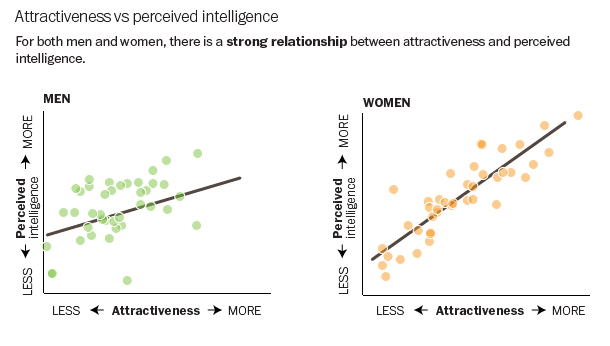
Christopher Ingraham parses a study finding that more attractive people are perceived as more intelligent:

The researchers found a strong relationship between how attractive a person was rated, and reviewers’ assumptions about how intelligent they were. This relationship was especially strong among women. But when it came to actual intelligence, there was a significant gender gap: reviewers were able to accurately gauge the real intelligence of men, but not of women. They’re not exactly sure why this would be, but one possible explanation is that women are simply judged more pervasively on their looks than men are: “The strong halo effect of attractiveness may thus prevent an accurate assessment of the intelligence of women.”

Hyperactive Prescribing? Ctd

A clinical psychologist writes:

I work primarily with children and families and I am routinely asked to do ADHD evaluations. Typically big crowds show up in October, after those first parent-teacher conferences, and again in April, as the year winds down and parents panic about their kids’ grades. I have three major points to make:

I. ADHD is absolutely over-diagnosed. There are two populations where this happens:

(1) Non-upper-class boys (and a few girls) who display disruptive or aggressive behavior, whose schools go diagnosis-shopping so the kid can be chemically restrained with stimulant drugs. In most cases, the behavior is totally operant: The kid has learned that if he curses, threatens, hits, dances on the furniture, etc., he will be sent out of the classroom and/or out of the school. Mission accomplished! And then people have the balls to tell me that “discipline doesn’t work.” Well, no shit. If you consistently reward a behavior, you get more of it.

2) Upper-class children whose parents go diagnosis-shopping so their kids can get extra services, supports, and stimulant medication to help them study.

II. ADHD is absolutely under-diagnosed. There are two populations where this happens:

1) Girls (and a few boys) who are merely distractible, not hyperactive or impulsive, so they’re not behavior problems. Your daydreamers. Your space cadets. Your absent-minded professors. These kids get called lazy. Unmotivated. Disorganized. Won’t do her homework. Makes simple mistakes; she should know better! She knows what to do, she just doesn’t do it! These kids develop a very negative self-image because they get a lot of negative feedback from their environment. They wind up depressed. I have seen one kid become suicidal because he truly believed he was stupid and would never achieve anything meaningful in life. (The under-diagnosis is more likely when the kid is intelligent and does well on standardized tests. Jimmy is so intelligent, but…)

2) Adults who are older than about 30 and were missed as kids. They (we) grew up before the great over-diagnosis wave, or grew up outside of the urban areas where it was more common. These people tend not to have achieved everything they could have. They tend to have problems in their working life because they forget things, miss details, make simple errors that most people just wouldn’t make. Quite a few develop hobbies or great big life projects that never quite coalesce. Most develop some neat tricks to compensate for their problems with attention, memory, and task completion. Some really believe, after a lifetime of negative feedback from their environment, they are stupid and underachieving. Depression and low self-esteem is fairly common in this group. A few develop anxiety problems because they’re terrified of the constant mistakes they make at work.

III. Your reader who’s a counseling psychology student is full of shit. ADHD and other learning disabilities show up when they show up, when the kid’s compensatory abilities intersect with an environment that’s too demanding for them. That can happen in childhood or it can happen later. The big points where it shows up, in my experience, are in about fourth grade, in the transition to middle or high school, or once in a while in college or beyond.

Another adds, “The fact that a third-year graduate student in psychology can say this is terrifying”:

While I agree that medicating kids who don’t have ADD is a problem, under-diagnosis is as well. I’m a 34-year-old man with ADD (the inattentive form). I was only diagnosed with it 18 months ago, and the first day I took medication was a revelation. I felt more alert and less foggy than I ever had before; the continual slush and confusion that sapped my brain on a daily basis was gone.

Why did it take until 32 for me to be diagnosed? Three of the big warning signs for ADD – bad grades in school, trouble holding down a job, and more car accidents – never showed up. The inattentive variety wasn’t well known – Driven to Distraction didn’t even come out until my freshman year in high school. ADD people thrive on structure, so if you’re someone who enjoys school and works hard, it’s possible for you to do well despite ADD. I was a creative person, too (still am) so the ADD behaviors I did have just got written off as spaciness.

Unfortunately, as my struggles with my creative work increased, my combined ADD and depression drove me to suicidal thinking, which so alarmed my therapist that she sent me to a talented and sympathetic psychiatrist who, after digging into my life, diagnosed me. (A key “tell” for him: while I like to read, I can’t get through two pages of a book without my brain veering off into some related fantasy.) I am not exaggerating when I say that without this diagnosis and treatment for the disorder, I could be dead.

Another identifies himself as “one of those ‘privileged’ students your psychological doctoral student scoffed at”:

I was diagnosed with ADHD after failing to get my master’s degree for six years. My entire life has been hampered by this problem that no one thought I had because I didn’t fit the typical hyperactive behavior profile. I think back to the times when I was playing outfield, trying desperately to pay attention through an inning and failing. About how I couldn’t excel at a simple manual labor job because I’d “zone out” and slow down. And how I got good (but not great) grades, but it took me about twice as long to finish my assignments as other people.

After my diagnosis and a prescription of amphetamine, my life fell into place. I started taking and excelling in advanced mathematics courses I’d been dreaming about for half a decade. Jesus, it even helped my fucking social issues. It was probably the most content I had ever been in my life.

But then my doctor left, and a new one took over. He decided I was not ADHD, but was in fact one of those people “gaming the system,” as your psychology student described it. Thus my diagnosis was rescinded. I have never been more furious in my life than when I was sitting in his office, realizing that he didn’t give a shit what I said; he’d already decided I was a fraud, and the appointment amounted to Kabuki theatre.

The fallout was pretty epic. I could barely keep up with my next semester’s workload, and to this day (over a year later) I’m not functioning at the level I was before stimulants. I lost my research position due to inability to work. Now I have no funding, even without taking courses or working I cannot make inroads with my thesis, and I’m realizing that without stimulants I will never excel in my chosen career of engineering. Since this is the United States, I can’t afford to see doctors independent of the university system, so I live in a state of perpetual impasse: my choice is to either be effectively owned by the psychiatric system for the rest of my life, or walk away from the career I’ve been building for most of my life. I have no money, no job, no future, and no hope.

Previous Dish on ADHD herehere, and here.

The Best Of The Dish Today

After all the rancor of the last few days, it’s great to focus on something positive in the gay world. That interview above is, to me at least, deeply, deeply moving. It’s really worth watching in full. How much better to advance understanding this way than by getting people fired.

Alas, the discourse police have been busy again. My friend Ayaan Hirsi Ali is now the latest casualty of the culture war in which elements of the hard left seem far less interested in a free exchange of ideas, than in the rigid imposition of a new orthodoxy. She just had her honorary degree from Brandeis withdrawn after the usual complaints about “sensitivity”. Yes, she’s controversial. She has said some tough, tough things about Islam. But if she hasn’t earned the right to say those things, who has? She made a statement today about it, which you can find here. Money quote:

What was initially intended as an honor has now devolved into a moment of shaming. Yet the slur on my reputation is not the worst aspect of this episode. More deplorable is that an institution set up on the basis of religious freedom should today so deeply betray its own founding principles. The “spirit of free expression” referred to in the Brandeis statement has been stifled here, as my critics have achieved their objective of preventing me from addressing the graduating Class of 2014. Neither Brandeis nor my critics knew or even inquired as to what I might say. They simply wanted me to be silenced. I regret that very much.

I regret it every time someone is silenced by intimidation.

Speaking of shaming, the most trafficked post of the day was my take on a chance to end HIV among gay men, “Why Aren’t Gay Men On The Pill?” – and how hideous shaming of men protecting themselves from HIV may be perpetuating the epidemic. Next up: the final roundup of reader emails in the thread, “A Nation Defined By White Supremacy?” Other popular posts included a depressing look at how prisons have replaced psychiatric hospitals, followed by hathos-filled trailer about a guy infatuated with attractive female bloggers.

You can comment on the posts at our Facebook page. See what people are saying about @sullydish here. Posts with reader updates you might have missed: The Impulsivity Of Suicide and Beer-Soaked Meat Is Good For You – which is now surging on Facebook.

22 31 more readers became subscribers today; you can join them here.

See you in the morning.