“If Mitt Romney had had the Jeb package, we would have won in 2012,” – John Sununu.
Month: April 2014
Tart Attacks
Rex Weiner makes the case for political pie-throwing, insisting that a “gooey face is an instant social equalizer”:
While I abhor pointless violence, I have long believed there are some people in this world who deserve to be smacked in the face with a pie. Vladimir Putin, for example, or my girlfriend’s ex-husband—anyone for whom a well-aimed pie could serve as a rebuke and a corrective measure. The legal code may define it as a violent act—when comedian Jonnie Marbles pied Rupert Murdoch, he earned jail time for assault—but to my mind, what motivates the striking thrust is not violence but idealism. Che Guevara once said, “The true revolutionary is guided by great feelings of love.” I say the tart’s trajectory is often guided by faith in humanity—or at least a sense of humor.
Just leave the glitter at home! It never leaves you. Weiner goes on to describe the rise and fall of Agents of Pie-Kill, a pie-for-hire collective he helped found in the 1970s:
At its peak, Agents of Pie-Kill’s roster numbered half a dozen agents. We pulled in a fair amount of cash revenue and inspired imitators worldwide. Time called us “the biggest fad since streaking.” Every day the news would report someone somewhere getting a pie in the face. Our own Agent [Aaron ] Kay scored headline-making hits against the conservative pundit William F. Buckley and antifeminist Phyllis Schlafly. …
It wasn’t long before we noticed Agent Kay had switched to autopilot. He couldn’t stop throwing pies at people: Watergate operative Gordon Liddy, New York City mayor Abe Beame, Senator Daniel Moynihan, and even rock poet Patti Smith. The list goes on. Agents of Pie-Kill had created a monster. And suddenly, the times were a-changin’ once again: Nixon was gone, the war was over, and a peanut farmer was president. Time to close the patisserie.
(Video: Kay comments on the 2011 pieing of Rupert Murdoch and details his own exploits)
Hyperactive Prescribing? Ctd
Several readers sound off:
This thread has hit me a little close to home. I was misdiagnosed with ADHD when I was in preschool and was held back a year as a result. Because of the misdiagnosis, I’ve been a year older than most of my peer group for my whole life.
My parents sent me to a private Catholic school in suburban Philadelphia that required all of its kindergarteners to undergo a psychiatric screening for learning disabilities. I had previously been in the school’s pre-K program for a year. I remember the screening vividly. I was separated from my mom for what must’ve been a maximum of 10 minutes, and the doctor spoke to me for maybe half of that. He asked if I had a lot of friends, and I excitedly told him I did, and that I had memorized all of their phone numbers. I then went on to tell him each of those phone numbers for a minute or so.
Big mistake.
It turns out that in the report he filed with the school, and which my mom still has, he indicated that my hyperactivity was potentially indicative of ADHD, and recommended that I repeat pre-K. All based on the phone number recitation. Follow-up was recommended, but luckily my mom never had me go in for any prescriptions. I repeated the year because my parents thought it’d be too disruptive to force me to transfer schools, and the school wouldn’t budge on letting me go through.
So I was diagnosed as potentially hyperactive based on a 10-minute conversation with a psychiatrist who was paid on contract by my private school, and my parents were essentially forced to pay another year’s worth of tuition or transfer me to a different school. I’m not saying he probably had an incentive to diagnose kids coming to him from my school, but it certainly worked out for both him and the school. He’d get a lot of potential patients, in addition to whatever contract he had with them, and the school would get a few easy grade-repeaters.
I can say comfortably that the only net positive I ever got from the situation was being able to buy beer for my friend when we were sophomores in college. Aside from that, I’ve felt a year behind since I was a toddler, all because of this ridiculous over-diagnosis trend among the white upper class.
A similar story from another reader:
I have a 12-year-old son who is very bright and easily distracted. We have to stay on his butt about getting his homework done and being prepared for school, but we work hard at that, and he has gotten mostly straight-As this year, with no chemical assistance. It could have been a different story.
When he was entering third grade, he was assigned a teacher who I had heard wonderful things about, but when I went to parents’ night before school started, she scared the crap out of me. Within the first week of class, I’d already heard from her twice about how my son seemed distracted and had not gotten some assignment done. She treated it like a major crisis, so we set up a meeting with her. She said she’d looked through all his academic records and was surprised to see that he had not had academic problems in the past. She never used the words ADHD, but she strongly implied it. (My son had once had a preschool teacher who had implied something similar.)
I freaked out and we took our son to see his pediatrician, who after spending less than five minutes talking to us and to my son, offered to write us a prescription for Ritalin. Just like that. No recommendation for any further analysis or therapy, no discussion of the pros and cons. We said “No thanks.” Over the course of the next few weeks, everything settled down for my son, and by the time of our first parent/teacher conference his teacher seemed almost to have forgotten what she put us through in the first weeks of the school year.
I think boys and girls learn differently, and teachers are pressured to fit so much into every school day to keep up with all the standardized tests and so forth that they don’t have time to devote to different learning styles. So a lot of boys are drugged to make the day go more smoothly. It sounds harsh, but I believe it to be true.
A psychologist in training offers a different perspective:
As a third-year doctoral student in counseling psychology, I have some experience with testing for ADHD. I have spent two years working in my campus disability services office with an ADHD caseload, and I spent two semesters actually performing ADHD testing for a local medical school in my city. I realize what you posted was about children, but I think the overprescribing of ADHD meds to children is a symptom of a much larger cultural shift among their parents.
I was shocked when I started working at the medical school at how many students came in wanting to be tested for ADHD (and many were seeking meds). These were high-achieving students who had mostly sailed through private high schools and rigorous undergrad programs. A lot of them already had master’s degrees in things like biology and public health, but suddenly when they entered medical school they thought they might have ADHD. Why? Because medical school is hard. It is nearly impossible, and for the first time in many of their lives, they were being challenged. And they had no idea how to do it. So obviously they must have ADHD.
My caseload also includes a lot of students who do genuinely have ADHD, and they really, really struggle. If you truly have it, it is going to show up in your life long before you hit college, and it is going to be obvious. Those students deserve our compassion, and the accommodations they seek just to level the playing field.
But when I see (mostly privileged) medical students trying to game the system to gain a competitive edge, it makes me furious. But even worse, most of them truly believe they have it! Because suddenly something is difficult for them. This is the generation where everything is supposed to be easy, and if it’s not, there must be a problem.
Valley Boys
Ann Friedman favorably reviews HBO’s new series Silicon Valley:
Beyond the superficial thrill of jokes about corporate executives who wear toe-separator shoes, “Silicon Valley” is an unexpectedly compassionate portrayal of a much-maligned archetype: The boy-wonder programmer who finds himself suddenly a CEO. “Silicon Valley”’s stammering protagonist, Richard, is indeed sympathetic. He writes brilliant code but can’t figure out the best practical use for it. He manages to score a substantial investment in his startup, but can’t even explain what his company does. He hires his friends and then can’t figure out how to manage them. He asks a bank teller if she can help him incorporate in the state of California.
The overall effect is that of the bromantic comedy “Entourage,” another show that made me feel real affection for men who display clueless privilege and casual sexism, only relocated 350 miles north.
James Poniewozik also likes the show:
Hardware-wise, the show is a definite dongle-fest;
the only significant recurring female character in the early going is Peter’s head of operations Monica (Amanda Crew). But its very, very male world presents a very, very different take on masculinity from Entourage, whose bros sampled from an endless sushi-conveyor-belt of hot Hollywood women. Silicon Valley‘s is a culture of man-children, misfits, and macho “brogrammers”; among the apps one entrepreneur creates is NipAlert, for detecting–well, just what you’d think, reminiscent of the actual sexist gag app TitStare unveiled at the TechCrunch Disrupt conference last year. The women aren’t subservient so much as they’re absent, or isolated. Noting the separation between the sexes at a lavish party, Dinesh notes, “Every party in Silicon Valley ends up like a Hasidic wedding.”
Nolan Feeney compares the show to Betas, another start-up culture sitcom:
[P]ortraying Silicon Valley accurately was a top priority for both shows. HBO initially reached out to Silicon Valley creator Mike Judge about doing a show about gamers, but Judge passed on the idea—he wasn’t one himself and thought that if a program about hardcore video game fans misrepresented any part of that community, it’d be ripped apart. Previous unsuccessful shows about Silicon Valley before didn’t fare well in part for that reason: Bravo’s low-rated Start-Ups: Silicon Valley drew criticism because it seemed distractingly fake for a show that was supposed to be “reality.” …
Still, in the course of their research, both Silicon Valley’s and Betas’ productions learned that many of their preconceived notions about Silicon Valley shenanigans weren’t far off. Eccentric bosses really do buy up islands and jet off to lavish, adventurous vacations; some people truly do admire Steve Jobs because of, not in spite of, his “asshole” qualities. “Some of the best satire is when you depict stuff accurately,” Berg says. “You put ridiculous things on camera and they look ridiculous. You’re just holding up a mirror to a lot of stuff.”
David Auerbach disagrees about the quality of Judge’s research:
Office Space resonated with people because it nailed many of the tiny details of office life, and you could tell Judge knew them well. Reusing that same job experience for Silicon Valley, rather than actually investigating tech culture, smacks of laziness. Judge didn’t do his research when parodying lefties in his awful bomb The Goode Family, and he didn’t do it here.
HBO has made the first episode available for free here. Previous Dish on dongle jokes here.
Full-Contact Assimilation
Amazonian tribes tend to die off not long after being introduced to the modern world:
It’s still happening today in Brazil, where 238 indigenous tribes have been contacted in the last several decades, and where between 23 and 70 uncontacted tribes are still living. A just-published report that takes a look at what happens after the modern world comes into contact with indigenous peoples isn’t pretty:
Of those contacted, three quarters went extinct. Those that survived saw mortality rates up over 80 percent. This is grim stuff. “Our analysis dramatically quantifies the devastating effects of European colonization on indigenous Amazonians. Not only did ~75 percent of indigenous societies in the Brazilian Amazon become extinct, but of the survivors, all show evidence of catastrophic population declines, the vast majority with mortality rates over 80 percent,” writes Marcus Hamilton of the University of New Mexico in a paper published in Scientific Reports. …
Sure, people don’t go in and kill entire tribes directly, they offer indigenous people the chance to assimilate into modern culture. But, as Hamilton notes, the trappings of modern society—access to better healthcare, technology, and education—haven’t improved tribes’ overall outcomes.
The View From Your Window
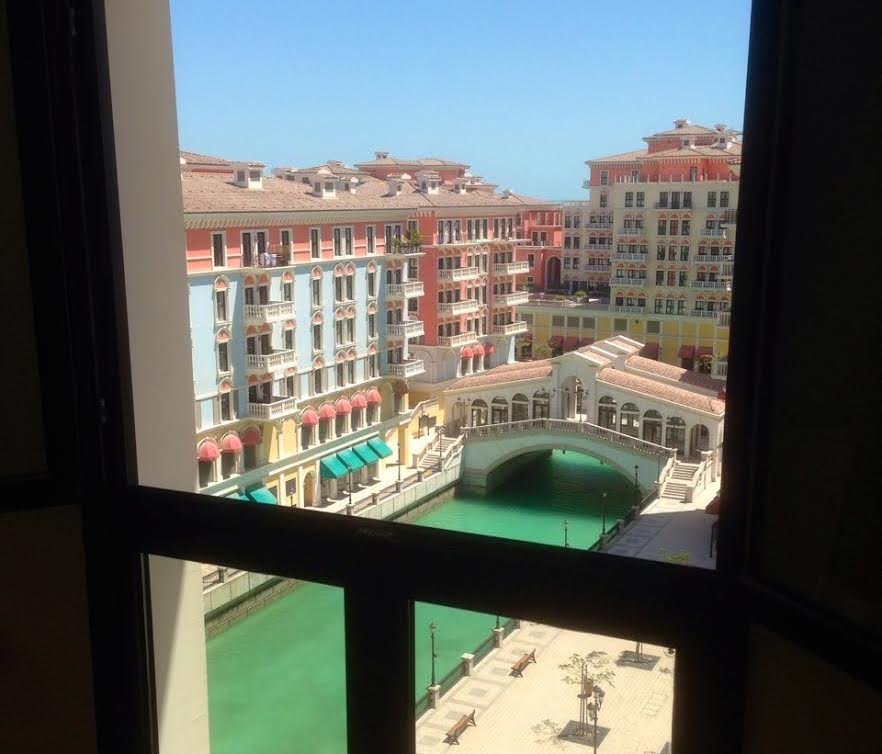
Doha, Qatar, 12 pm
Treasure Amidst The Torment
Ron Charles reviews Ayelet Waldman’s Love and Treasure, the writer’s first novel about the Holocaust:
Waldman is a wonderfully imaginative writer, but she’s drawn the central event of her absorbing new novel directly from history. The Hungarian Gold Train, as it came to be called, carried a trove of stolen goods worth millions of dollars. The Allies intercepted the train before it reached Germany and promised through various international agreements to return the property. That pledge to the dead Jews and their families was gradually thwarted by politics, postwar chaos and, yes, the victors’ avarice.
In its geopolitical scope, this crime is so encyclopedic that it could easily overwhelm a novel’s boundaries. But Waldman has devised a multi-part structure that allows her to focus on several distinct moments during a 100-year period. As with the painting in Susan Vreeland’s “Girl in Hyacinth Blue ” and the manuscript in Geraldine Brooks’s “People of the Book,” the link between these separate stories in “Love and Treasure” is a pendant decorated with the picture of a peacock. In Waldman’s exceedingly clever treatment, this piece of jewelry is not intrinsically valuable; it accrues value only as it passes from one unlikely hand to another, demonstrating the curious and tragic ways that history binds us together.
Adam Kirsch reveals more of the novel’s rich detail:
Drawing on what was clearly extensive research, Waldman brings to life the world of the Central European Jewish haute bourgeoisie, reveling in its textures, exposing its hypocrisies, and cheering on the incipient feminism that Nina represents. We enjoy the chance to scoff at Dr. Zobel as he insists that Nina’s menstrual cramps must have a psychological origin and when he blindly follows Freud in insisting that there must be some sexual trauma in her past. In fact, Nina is as healthy as can be—she is the third and best in the series of Waldman’s idealized heroines. This section also makes clear that Waldman’s Jewish ideal is neither hard and calculating, like Israel, nor soft and bland, like America, but excitingly, romantically, idealistically European.
It is easy, of course, to celebrate a paradise that is lost. But it is this third section of Love and Treasure, this fantasia on historical themes, that allows Waldman to write most freely and fully. Perhaps this is because, in 1913, the insoluble moral and political dilemmas raised by the Holocaust are not yet on the horizon. Like a film played backward, the possessions fly off the Gold Train and back into the hands of their owners, who march back home from the death camps and resume their comfortable lives. This is the kind of restitution we dream about, rather than the a partial and compromised kind the courts offer. Naturally, we can only achieve it in a work of the imagination.
Carolyn Kellogg describes how Waldman chose her subject:
She had already set herself the task of writing about visual art, something she knew little about, so researching the novel would allow her to learn something new. And when her friend Eleni Tsakopoulos Kounalakis was named ambassador to Hungary, Waldman wanted to go visit her and make it a business trip. “So I Googled the words ‘Hungary,’ ‘Holocaust’ and ‘art,’ I kid you not, and I found the Hungarian Gold Train. That is how I chose what to write.”
Serendipity aside, a real sense of political engagement runs through “Love and Treasure,” particularly in the form of an Israeli war hero, an American soldier managing the spoils of war found on the Hungarian Gold Train and women in 20th-century Budapest fighting for the right to vote. “I don’t believe in political novels – I think they’re bad,” Waldman says. “But I can’t help myself. That’s the way my mind works. I dig my teeth into an idea, and it’s an idea that inspires me and excites me, and then I find myself writing about it.”
Ilene Prusher adds:
There is something about this multi-period Jewish novel, taking the reader on a journey through time in America, Europe and Israel, that feels imminently familiar. The overall arc of the plot, with its objets trouvés that span generations, feels similar to the blueprint of other contemporary novels by major Jewish American female writers, such as Nicole Krauss’ “History of Love” and “Great House,” and Dara Horn’s “In the Image.”
In each of these, a mysterious found object – a desk, a book, a set of photographic slides – provides a labyrinthine link between past and present. And whether in the foreground or in the backdrop, there is always a Holocaust angle present. The more one unpacks the past, these stories all suggest, the more one understands the present. There is something about this path that feels slightly timeworn.
Why Do Zebras Have Stripes? Ctd
A reader writes:
Your post exploring the possible explanations for zebra stripes reminded me of the “dazzle camouflage” technique Allied ships employed during WWI to confuse the Germans when they attempted to torpedo them. It’s an incredible story and the images are amazing. Here is an article explaining how it happened.
A Wiki intro:
“Dazzle camouflage,” also known as “razzle dazzle” or “dazzle painting,” was a family of ship camouflage used extensively in World War I and to a lesser extent in World War II and afterwards. Credited to artist Norman Wilkinson, it consisted of complex patterns of geometric shapes in contrasting colors, interrupting and intersecting each other. Unlike some other forms of camouflage, dazzle works not by offering concealment but by making it difficult to estimate a target’s range, speed and heading. Norman Wilkinson explained in 1919 that dazzle was intended more to mislead the enemy as to the correct position to take up than actually to miss his shot when firing.
(Image of the USS Mahomet painted in dazzle camouflage circa November 1918 via Wikipedia)
Stymied By Sprawl
A recent study (pdf) ranked Atlanta as the nation’s most sprawling metro area. New York, unsurprisingly, was the most compact:

Sarah Goodyear explains why the report matters:
Residents of more sprawling regions were stuck with fewer transportation options and higher combined costs of housing and transportation, despite higher housing costs in more compact cities. An average household in the San Francisco metro area (a national leader in terms of density, with a score of 194.1) spends 46.7 percent of its budget on combined housing and transportation. In Tampa, Florida, which scores a dismal 98.5, that proportion is 56 percent.
Residents of compact metro areas also have longer, healthier lives, with lower BMIs, lower blood pressure, lower rates of diabetes, and fewer car crash fatalities. An average American in a more compact county has a life expectancy three years longer than one in a less compact county. All these are observations of correlation, not causation. But they tell a remarkably consistent story. Not only can cities limit sprawl through the use of specific policy tools, but the benefits for their citizens of doing so are real and life-changing.
Haya El Nasser adds, “One of the most striking findings is that living in more compact and connected metro areas can help low-income children get ahead financially as adults”:
“A child [in a low-sprawl area] born in the bottom 20 percent of the income scale has a better chance of rising to the top 20 percent of the income scale by the age of 30,” said Reid Ewing, a professor of city and metropolitan planning at the University of Utah and the lead researcher. For example, the probability that an individual in the Baton Rouge, La., area – the sixth worst in terms of sprawl – will move from the bottom to the top income bracket is 7.2 percent, compared with 10.2 percent in Madison, Wis., the least sprawling among medium-size metro areas. “My explanation at this point is that a low-income person living in a very compact area has a much better access to jobs” and the city is “more likely to be well-integrated,” he said.
Meanwhile, Bill Bradley notes that “one metropolis largely associated with gridlock traffic as a way of life has, in some ways, reversed the trend”:
We’re talking about Los Angeles, where the freeway can often be confused for a parking lot. In 2002, Smart Growth America ranked L.A. 45 out of the 83 metro areas it studied. Twelve years later the city has jumped to 21 out of 221 on the sprawl index. How, exactly, has L.A. improved its sprawl ranking?
Anecdotally, people might talk about the resurgence of its downtown. But lead researcher Reid Ewing told reporters something different: It’s due to a multi-prong approach, not coffee shops. “Los Angeles has actually densified very substantially,” Ewing said during a press call. “They’ve built light rail, and there’s been a lot of infill development.” With light rail generally comes some economic development – whether it’s mixed-use, office buildings or new housing – and L.A. has been proactive about not just density, but also displacement. Developers are allowed to build higher than the city’s height limit if they make affordable housing a part of their project.
(Chart via Smart Growth America’s “Measuring Sprawl 2014”)
The Egg Crackup

American egg consumption has slumped significantly from a mid-century high:
In 2013, the average American ate less than one egg per day (roughly .68), according to unreleased data from the United States Department of Agriculture (USDA). Back in 1945, at the peak of American egg consumption, the average American cracked open well over one full egg per day (1.15 to be precise). That’s almost 70 percent more than today.
One big reason:
“Eggs are a fairly price-sensitive foodstuff,” David Harvey, an agricultural economist at the USDA, told Quartz. “Egg consumption is affected not only by the price of eggs, which has been rising, but also the price of competing protein products, like meat, which have been falling.” That dynamic helps explain why egg consumption peaked in the forties: The answer might lie in wartime rationing. “My suspicion is that people were consuming more eggs around the time of World War II, because meat was being so heavily rationed,” Harvey said.
 The Dish
_cropped.jpg)