Vox’s “Explanatory Journalism” Explained

It sounded vague in the abstract, so check out the actual result: “Vox Cards” that act as instant primers on the background of an issue:

They’re inspired by the highlighters and index cards that some of us used in school to remember important information. You’ll find them attached to articles, where they add crucial context; behind highlighted words, where they allow us to offer deeper explanations of key concepts; and in their stacks, where they combine into detailed — and continuously updated — guides to ongoing news stories. We’re incredibly excited about them.

Incredibly excited? They must be bouncing off the walls in downtown DC. But check ’em out. Max Fisher has cards on Ukraine, Sarah Kliff on Obamacare, and Brad Plumer on GM. I’d say they’re useful, handy, but not exactly revelatory. We’ve already got Wikipedia, after all. And hyperlinks. But it’ll be interesting to see how these cards interact with breaking news in the days and months ahead. A reader has a similar take:

Before the Vox launch, I read Ezra and Matt for their generally astute analysis and, preferably, their candor.

Right now, the innovation of the site – those yellow cards – seems to be not much more than a glorified wiki or an FAQ. I would be sad if we lost their voices in the service of their creating a new “news delivery model”. Format and organization are important, but to me what’s most important about the blogosphere are the opinions and the writing. Are they actually contributing perspectives that will drive the conversation? Otherwise the site’s a little too elementary for my taste. I remain open-minded, since it’s still early, but I was disappointed by the kickoff.

Another:

Vox Cards, eh? SNOOZE! That’s absolutely nothing new, as the New York Times and Bloomberg News (where I work) have had very similar round-ups of major topics for a while now. At Bloomberg we call them QuickTakes. Here are a few: EbolaBitcoinACA exchangesIran.

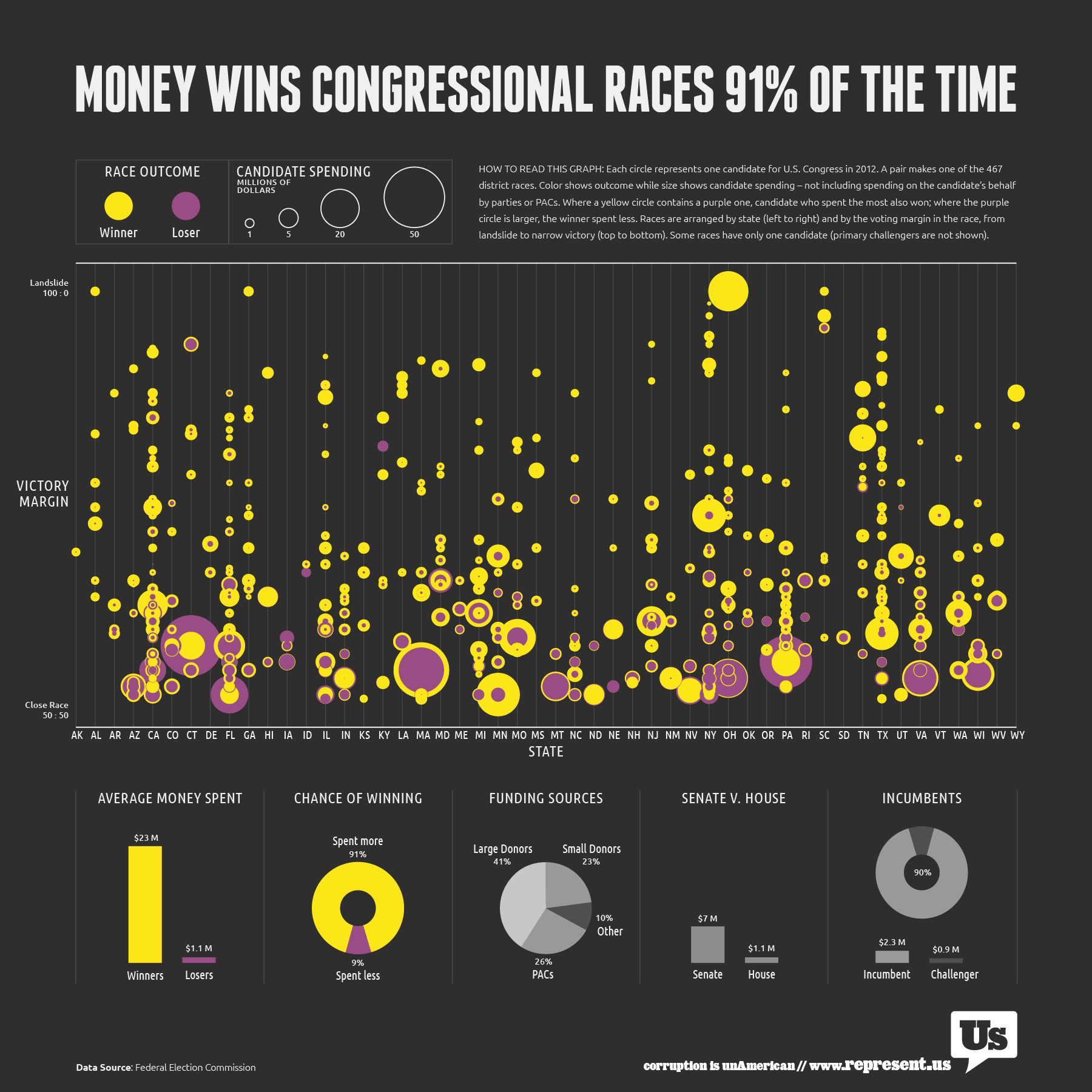
The Safe Money Is On The Flush Candidate

Money In Politics

Beinart calls for increased scrutiny of the mega-donors in a post-McCutcheon world:

The media, for the most part, still treats elected officials as the key players in our political process. They get most of the scrutiny. Mega-donors, by contrast, are permitted a substantial degree of anonymity. Now that must change. If Adelson or the Koch brothers or their liberal equivalents can single-handedly shape presidential campaigns and congressional majorities, their pet concerns and ideological quirks deserve more journalistic attention than do those of most members of congress. It’s no longer enough to have one reporter covering the “money and politics” beat. Special correspondents should be assigned to cover key mega-donors, and should work doggedly to make their private influence public.

Wesley Lowery passes along the above chart (click here for a larger version).

The “Cuban Twitter” Cock-Up, Ctd

As the blogosphere continues to discuss the story of ZunZuneo, the USAID project to create a social media network in Cuba that could be used to foment political subversion, Zeynep Tufekci criticizes the project for lending credence to authoritarian claims that Internet activists are all American stooges:

Unfortunately, what might have been a well-meaning attempt to bring some free speech to the Castros’ Cuba now threatens the efforts of millions of people around the world who are harnessing the power of social media to challenge censorship and propaganda, and have no connection to the U.S. government. Admittedly, most authoritarian governments hardly needed an excuse to taint social media as a tool of foreign powers. They’ve being doing it for years. But for their core supporters, their rantings about American plots behind every tweet just got a lot more credible.

Jon Lee Anderson worries about our increasing reliance on private contractors to carry out sensitive state projects:

Quite apart from the rights or wrongs of the U.S. government using commercial social media for espionage or to organize political subversion in Cuba, the case presents another troubling issue: ZunZuneo was being run through a private operator, a firm called Mobile Accord, that had won a financial contract from the U.S. government. This is consistent with a growing pattern in recent years, in which implementation of the most sensitive aspects of American security policy is increasingly handed over to contractors who are working for money, not necessarily for philosophical or even patriotic reasons.

The mercenary firm Blackwater, renamed XE and then Academi (after earning notoriety in the killing of seventeen Iraqis in Baghdad’s Nisour Square, in 2007), has effectively become an action arm of the C.I.A., its personnel loading the missiles on the drones that are fired at presumed terrorists based on White House decisions. Clearly, there are risks to this ever-expanding outsourcing. That outraged patriot who divulged the N.S.A.’s secrets was first a C.I.A. contractor and then an N.S.A. contractor.

Looking back at Mobile Accord’s relationship with the government, which began in 2009 with a similar project in Pakistan, Robinson Meyer notes an irony:

In 2010 and 2011, the White House, the State Department—the entire apparatus of American diplomacy—pushed an Internet freedom agenda. American interests, they said, were advanced by the penetration of networked tech abroad. Then the U.S. government got into being a tech client and discovered it wasn’t everything it was cracked up to be. ZunZuneo’s story is that of hundreds of other startups in 2011 and 2012—ZunZuneo just happened to be supported by the U.S. government. ZunZuneo’s monetary supporters weren’t the only ones who, in 2011, discovered that they’d backed a product with no clear monetization strategy, nor were they the first to panic and look for an exit. …

Who did ZunZuneo benefit most of all, eventually? Cubacel: The Cuban government’s state-run mobile monopoly which owned the physical infrastructure through which ZunZuneo messages traveled. USAID, in trying to harass the Cuban government, wound up financially supporting it.

Greenwald was unsurprised at the revelations:

These ideas–discussions of how to exploit the internet, specifically social media, to surreptitiously disseminate viewpoints friendly to western interests and spread false or damaging information about targets–appear repeatedly throughout the archive of materials provided by NSA whistleblower Edward Snowden. Documents prepared by NSA and its British counterpart GCHQ–and previously published by The Intercept as well as some by NBC News–detailed several of those programs, including a unit devoted in part to “discrediting” the agency’s enemies with false information spread online.

José Cárdenas, who was involved in USAID’s Cuba Democracy Program during the Bush administration, defends projects like ZunZuneo:

That the programs were implemented discreetly was precisely to protect peoples’ lives. The Castro regime has been abusing the Cuban people for five decades; no one was about to advocate advertising the details of what we were trying to accomplish on the island.

In any case, critics of U.S. policy towards Cuba have consistently mischaracterized the Cuba Democracy Program as something sinister or unprecedented. In fact, there is nothing sinister or unique about the program, which is administered by both the State Department and USAID. It is what is known within the bureaucracy as a “cross-border program” into a non-presence country — meaning we are trying to help support people living in repressive states in which we have no local development office. There are, or have been, at least six other countries in which the U.S. government runs similar cross-border programs.

And, though they fault the project for lacking a long-term strategy, the Bloomberg editors commend its aims:

Yes, the Cold War is over, and the end of the Cuba embargo is long overdue. But the Cubans are not gentle socialists. And there is a kind of Cold War 2.0 – between democratic nations and a growing cadre of repressive states that stretches from Russia to Egypt and onward to Latin America. These countries will use any digital means necessary to stifle free expression. USAID’s so-called “Cuban Twitter” plan was by no means perfect, but arguing that such programs are unnecessary is the equivalent of bringing pen and paper to a flame war.
The Best Of The Dish This Weekend

I penned a post last night reflecting on the weekend’s continuing debate about the defenestration of Brendan Eich. It’s called “The Quality of Mercy,” and we ran a batch of emails from readers as dismayed as I am. In case you missed the dissents over my Eich stance, go here. You can vent any remaining ire toward me at our Facebook page and read these criticisms over my Clinton comparison.

In other Dish: “the sacrament of friendship“; a new variety of bikini-waxing – “hippie in the front, porn star in the back” (somewhat NSFW); why zebras have stripes; and poems from Elizabeth Bishop and Richard Wilbur.

There’s also plenty of time to join me in our book club this month. For details, see here. Update from a reader:

I am interested in reading the commentary for the book club when it begins, but I doubt that I would be participating in the discussion. It appears to me that one has to purchase the book in order to join the club. I just obtained the Ehrman book from my local library. Will I be able to “join”?

Absolutely. You don’t have to purchase the book through our affiliate link to participate in the club; it’s just there for your convenience and a small way to support the Dish. We actually provided a public library link in our original post – here it is again. Anyone can participate in the book discussion, which will start right after Easter.

Afghanistan Gets Out The Vote

The Economist reports that the Afghan election “was marred by sporadic violence, allegations of fraud, and other controversy – yet by some measures it was perhaps the most successful election Afghanistan has ever held”:

Before the polls opened at 7am, eager voters were already queuing outside polling centres in cities across the country. Even as rain fell across much of the country, the patient and orderly queues (somewhat of a rarity in Afghanistan) were well served by election officials who handed out plastic sheets to keep them dry. And the voters kept coming. So many came in fact that some polling centres had run out of ballots by midday.

Juan Cole lists “surprising pieces of good news” from the election:

1. The nearly 400,000 Afghanistan National Army and police forces were deployed throughout the country effectively. They stopped traffic into the capital of Kabul from afternoon on Friday, allowing the Saturday vote to avoid being disrupted. This operation was a difficult and complex one, and that the security forces were capable of it is a good sign.

2. Afghans were relatively enthusiastic about voting. Some 7 million went to the voting both out of 12 million who are eligible to vote (58%). The turnout was about twice that of the 2009 presidential [campaign].

3. Fully one third of those who voted were women. Women came out in large numbers in the big urban centers. In Taliban strongholds in the south and east, however, many had to stay home.

Liza Schuster is a bit less sanguine:

Afghanistan is still an insecure country.

The security forces did an amazing job yesterday and the people responded by turning out to vote in unexpectedly high numbers. But this was only achieved by effectively shutting down the city. Traffic was virtually non-existent. I lost count of the number of times our car was stopped and searched and our ID cards examined. Some of the voters talked of the importance of signing the Bilateral Security Agreement as soon as the new president is installed. Even given the success of yesterday’s security operation, there is a strong sense that some international forces will be needed for the foreseeable future.

Hyder Akbar went home to vote:

A phone call comes in to give us good news that people have lined up to vote in a certain area — only to be updated half an hour later that everyone has scattered after the Taliban attacked the polling station.

Another friend calls to say the Taliban have already warned him that he will be dealt with — they had heard he had been campaigning for one of the candidates. My own vote becomes an eventful event: just as I receive my ballots, another wayward missile comes flying toward the town, and everyone hunches down — another close call, but it lands in some field, and I go on to vote.

As I walk out, I notice a man vigorously trying to clean the ink off his fingertip — a sign that you have voted. Overhearing his conversation, he is telling his friend that he has to travel on the road up north and doesn’t want it chopped off — a grim reminder of how easily the tentative progress of the past decade can be erased.

The BBC explains what comes next:

Although there are eight candidates for president, only three are considered frontrunners – former foreign ministers Abdullah Abdullah and Zalmai Rassoul, and former Finance Minister Ashraf Ghani Ahmadzai. Analysts say Dr Abdullah has fought a polished campaign, Mr Ghani has strong support among the new urban youth vote, and Dr Rassoul is believed to favoured by Mr Karzai. However, no candidate is expected to secure more than the 50% of the vote needed to be the outright winner, which means there is likely to be a second round run-off on 28 May.

Max Boot calls the election a “triumph” but thinks “we should not exaggerate its likely impact”:

The three leading candidates are said to be Ashraf Ghani, Abdullah Abdullah, and Zalmai Rassoul. All three men, who have served at various times in Hamid Karzai’s cabinet, are qualified for the top job and reasonably friendly to the United States. All three have indicated they will sign the Bilateral Security Accord that Hamid Karzai negotiated. But there is a huge question as to whether any of them will be up to the job of improving one of the most corrupt and dysfunctional governments on the face of the earth and defeating one of the most potent insurgencies in the world.

Surrender, Ann Friedman! Ctd

You should read her column copping to her error while sticking to her guns. But, to be honest, I’m really in agreement with her on the basic issue, and my comment about Daley was (humorously) about Daley and not about all those identifying as bi, as I have pointed out repeatedly. And I’m proud of the fact that the Dish has published one of the more poignant, informative and lively threads on the bisexuality question you are likely to find. Meanwhile, a reader quotes me:

“There is such a thing as gaydar. Bidar? Not so much.”

Actually, I think bisexual detection should be called Bi-Fi, as it can be just as spotty.

Heh. Another contemplates the topic more seriously:

I find these discussions and all the fantastic letters you’re getting on bisexuality very interesting. I think using the homo/hetero/bi sexual categorization is messing up this discussion. The big problem we have I think is that we’re trying categorize people here based on sexual attraction. I believe that a majority of human beings of either gender can, in the right circumstances enjoy sex with a member of either gender. Really, sex is not – or should not be – a big deal.

The more important issue I think, is who we’re romantically attracted to – that is both sexual attraction and emotional attraction simultaneously.

If we were to throw out the homosexual, heterosexual and bisexual labels and focus on romantic interest – say homoromantic, heteroromantic and biromantic – then the landscape would become a lot more clear. I suspect we would find that the majority of humans are hetero-romantics, with a minority of homo-romantics and an even smaller group of bi-romantics. Though the bi-romantic percentage is probably higher for females than males.

Of course the difficulty is that identifying sexual attraction is easier than identifying romantic inclination. But we all have some idea of who we want to settle down with even if we haven’t fallen in love yet. And yes, there will of course be exceptions where you’re eventually proven wrong, and people who really are fluid, but those would be the exceptions rather than the norm.

Another:

My boyfriend is a subscriber and I am an infrequent reader but, at his urging, read every word of the bi thread. It was beautiful and moving and angering and empowering, all in turns. One thing I don’t think was explicitly stated, but was implied throughout, is how goddamn lonely it is to be bisexual in America.

The boyfriend and I are both bi and live in a pretty gay-positive mid-sized city. We are both adamantly out, including family and co-workers. But one thing that both of us struggle with is feeling that we have that tight circle of friends who understand and can validate our experience. Not that gay people can only be friends with gay people, but I know none who are without a gay support network to bolster them. Because of the heavy pressure to shut the hell up and stay in the closet and be who you are behind closed doors, bisexuals infrequently find their bi support network.

Right now, my boyfriend and I are in the process of trying to make that bi network happen (again), but I was reminded of what we are up against today when I ran across this description of a gay bowling league: “This is a mostly gay and lesbian league, but we are transgender and straight welcoming!” I’m sure who ever wrote this meant nothing by it and it was just an “oversight”, but what it says to me, to all bisexuals, is that even straight people get on the bus before bisexuals in the LGBT “community”.

The simple truth is that this is heartbreaking for those of us who are trying to live our lives being honest about who we are. It is a repeated and constant slight, especially to those of us who could pass for straight but have chosen instead to be out. So thank you for allowing us a platform for our voices and for making our lives less isolated.

Why We Disregard Uncomfortable Facts

Ezra discusses research on “identity-protective cognition”:

[Professor Dan] Kahan doesn’t find it strange that we react to threatening information by mobilizing our intellectual artillery to destroy it. He thinks it’s strange that we would expect rational people to do anything else.

“Nothing any ordinary member of the public personally believes about the existence, causes, or likely consequences of global warming will affect the risk that climate changes poses to her, or to anyone or anything she cares about,” Kahan writes. “However, if she forms the wrong position on climate change relative to the one that people with whom she has a close affinity — and on whose high regard and support she depends on in myriad ways in her daily life — she could suffer extremely unpleasant consequences, from shunning to the loss of employment.” …

Recognizing the problem is not the same as fixing it, though. I asked Kahan how he tries to guard against identity protection in his everyday life. The answer, he said, is to try to find disagreement that doesn’t threaten you and your social group — and one way to do that is to consciously seek it out in your group. “I try to find people who I actually think are like me — people I’d like to hang out with — but they don’t believe the things that everyone else like me believes,” he says. “If I find some people I identify with, I don’t find them as threatening when they disagree with me.” It’s good advice, but it requires, as a prerequisite, a desire to expose yourself to uncomfortable evidence — and a confidence that the knowledge won’t hurt you.

Reservations Over Marriage Equality

Kate Redburn assesses the state of gay unions among Native American tribes, focusing particularly on the Navajo Nation, which bans same-sex marriage:

So what happens to a gay Navajo person who wants to get married?

If she lives on the portion of the Navajo Nation that overlaps with New Mexico or Utah, she can probably get a marriage license from one of those states on the principle of using state institutions. She and her wife would then be entitled to federal marriage benefits, following the Supreme Court’s finding in United States v. Windsor that DOMA was unconstitutional. If the couple returned to the Navajo Nation, however, the Navajo Nation’s authority would not recognize their marriage, and it’s unclear whether they would still be eligible for federal benefits. The laws in New Mexico and Utah are so new, in fact, that it appears that no Navajo couples have yet tested this approach.

What we do know is that tribal authority is strong enough to allow same-sex marriages on Native lands even when state law prohibits it outright. Take the much-documented union of Darren Black Bear and Jason Pickel, who wed in Oklahoma last October under the jurisdiction of the Cheyenne and Arapahoe Tribal Court despite the fact that gay marriage is banned by the state constitution (although if Judge Terence Kern has his way, Oklahoma’s ban will be thrown out). Of the 562 federally recognized tribal governments within the United States, eight allow gay marriage and just six have banned it outright.

Anti-Democratic Diction

Citing Orwell’s classic essay “Politics and the English Language,” Brett Max Kaufman parses the language games of the NSA. He argues that the “government’s mass-surveillance apparatus, and the secret legal gymnastics that purportedly justify it, is a chilling expression of Orwell’s worst fears”:

The government has consistently argued that its mass call-tracking program is not “surveillance” because it doesn’t involve the monitoring of the contents of communications—even though mining a database of phone records can actually reveal a great deal more than listening in on our calls and reading our emails. And when the government protests that it isn’t “collecting” information, it actually means that it hasn’t yet “tasked” it for “subsequent processing.” Rather—as we learned in the wake of Director of National Intelligence James Clapper’s false denial to Congress that the NSA “collected” data on millions of Americans—what the NSA is doing is merely “accumulation.” (Query whether America’s philatelists are now “accumulating” stamps.) …

The basic genius of Orwell’s great essay is its recognition that language is an “instrument which we shape for our own purposes.” The government’s word games do this all too cynically, allowing it to secretly accumulate (or is it collect?) extraordinarily broad power.