The Hounding Of A Heretic

The guy who had the gall to express his First Amendment rights and favor Prop 8 in California by donating $1,000 has just been scalped by some gay activists. After an OKCupid decision to boycott Mozilla, the recently appointed Brendan Eich just resigned under pressure:

In a post at Mozilla’s official blog, executive chairwoman Mitchell Baker confirmed the news with an unequivocal apology on the company’s behalf. “Mozilla prides itself on being held to a different standard and, this past week, we didn’t live up to it,” Baker wrote. “We didn’t act like you’d expect Mozilla to act. We didn’t move fast enough to engage with people once the controversy started. We’re sorry. We must do better.”

The action comes days after dating site OKCupid became the most vocal opponent of Eich’s hiring. Mozilla offered repeated statements about LGBT inclusivity within the company over the past two weeks, but those never came with a specific response from Eich about his thousands of dollars of donations in support of Proposition 8, a California ballot measure that sought to ban gay marriage in the state.

Will he now be forced to walk through the streets in shame? Why not the stocks? The whole episode disgusts me – as it should disgust anyone interested in a tolerant and diverse society. If this is the gay rights movement today – hounding our opponents with a fanaticism more like the religious right than anyone else – then count me out. If we are about intimidating the free speech of others, we are no better than the anti-gay bullies who came before us.

Update: A continuation of my stance here and my response to dissenting readers here.

Small Rulings With Big Impacts

Rick Hasen sees the McCutcheon opinion as an example of the chief justice’s “long game” at work: concealing sweeping rulings in a cloak of judicial minimalism. In keeping with this style, he notes, the ruling enables a much more dramatic erosion of the regulatory regime down the line:

[T]he court seems to open the door for a future challenge to what remains of the McCain-Feingold law: the ban on large, “soft money” contributions collected by political parties. These contributions were banned because it had become clear that political parties were becoming conduits for access between elected officials and big donors. Today Roberts rejects ingratiation and access as a problem, and says that this funnel of significant money to parties could serve the purpose of strengthening political parties and thus be a good thing. He writes: “When donors furnish widely distributed support within all applicable base limits, all members of the party or supporters of the cause may benefit, and the leaders of the party or cause may feel particular gratitude. That grati­tude stems from the basic nature of the party system, in which party members join together to further common political beliefs, and citizens can choose to support a party because they share some, most, or all of those beliefs. … To recast such shared interest, standing alone, as an opportunity for quid pro quo corruption would dramatically expand government regulation of the politi­cal process.”

Building on Hasen’s argument, Emily Bazelon takes Roberts to task for handing Congress instructions he knows they won’t follow:

Roberts tells Congress it can still achieve the ends of fairer and cleaner elections, it just has to alter the means it chose for getting there. Never mind that this Congress will do no such thing, just as it has failed to take up Roberts’ invitation last June to pass a new version of the Voting Rights Act.

 … Every time the rules of campaign finance loosen, money finds new ways to get to the giver’s intended recipient. Surely that will be the case this time, too. As Breyer says, “in the real world, the methods of achieving circumvention are more subtle and more complex.” Roberts waves away these concerns by telling Congress to just tighten up if it sees new problems emerging. Restrict transfers among candidates and political committees. Make it harder to earmark donations. Rely on the benefits of disclosure. It will be Congress’s fault, not the court’s, if politics tilt further toward the rich.

Dahlia Lithwick worries “that the court has located itself so outside the orbit of the 99 percent that it simply doesn’t matter to the five conservatives in the majority that the American public knows perfectly well what bought government looks like”:

Roberts honestly seems to inhabit a world in which what really worries the average Joe about the current electoral regime is not that his voice is drowned out by that of Sheldon Adelson, but that he might be forced to spend his millions “at lower levels than others because he wants to support more candidates” or that he is too busy making billions of dollars at work to volunteer for a campaign, or that he has Jay Z and Beyoncé on standby to perform at a house party in the event that his billions are tied up elsewhere this week.

Really, it’s weird. The man takes the Metro to work, and yet he handily dismisses what every human American knows to be true: That if dollars are speech, and billions are more speech, then billionaires who spend money don’t do so for the mere joy of making themselves heard, but because it offers them a return on their investment.

Looking back at the previous holdings of the Roberts court, Waldman sees the total dismantling of the campaign finance regulations as its inevitable legacy:

Every time this Court has confronted a question of campaign finance, where there is a conflict between the freedom of wealthy donors to do as they wish on one hand and the integrity of the system on the other, it has sided with the wealthy donors. Every time.

Surrender, Ann Friedman! Ctd

Still silence on her Twitter feed, now that my prediction about Tom Daley not actually being a bisexual has been borne out. Dan Savage couldn’t resist this morning:

That “transition identity” thing happens. And asking people to pretend something that commonly happens doesn’t happen—asking them to ignore their own experience, asking them not to recognize themselves in others—isn’t the answer.

It’s particularly gratifying after I was all but accused of bi-phobia in the New York Times Magazine’s latest cover-story because I said what I believed to be true in a single specific case. You know what? There is such a thing as gaydar. Bidar? Not so much. And c’mon, Ann. Eat the crow!

McCutcheon’s Winners And Losers

Cillizza tallies them up, counting joint fundraising committees as among the big winners:

These organizations allow a donor to write a single check that is then split up between a handful of candidates/committees. So, if you wrote a $50,000 check, for example, the first $32,400 would go to the national party committee (that’s the current federal donation limit for a single year) and the remaining $17,600 would be parceled out in $2,600 increments to candidates. Prior to the McCutcheon ruling, an individual could give only $123,200 in a single election cycle: $48,600 to candidates (which breaks down to 18 “max out” candidate donations) and $74,600 to federal party committees. That limit is now gone. “An individual may now make as many ‘max out’ contributions to candidates in an election cycle, and to parties and PACs in a calendar year, as he or she wishes,” according to a summary of the opinion from the political law wing of Perkins Coie. The joint fundraising committee will almost certainly be the preferred vehicle that candidates and party committees set up to collect — and disburse — big checks from wealthy individuals.

Harry Enten runs the numbers:

First, the parties will become more powerful. Over the past few elections, most people looking to get around donation limits gave tons of money to Super PACs. Now contributors can ingratiate themselves with a party by giving directly. Along the same lines, major bundlers (e.g. those who have a habit of getting ambassadorships) will gain more pull.

Second, very few donors hit the limits set out by the Federal Election Committee (FEC) in 2012. Per Open Secrets, only 2,972 donors maxed out to committees, and only 591 maxed out to candidates. Maxed-out donors leaned about 3 to 2 toward giving to Republican candidates. Only 646 donors hit the limit on both committees and candidates. These numbers, however, probably slightly underestimate the GOP advantage going forward, because top Super PAC donations leaned 2 to 1 toward Republicans in 2012, according to the Sunlight Foundation.

Noting that the ruling empowers the biggest of the big donors, Lee Drutman mulls what that implies:

Of the top 1,000 donors in 2012, 580 gave at least 90 percent of their party and candidate contributions to Republicans, as compared to 326 who gave at least 90 percent of their party and candidate contributions to Democrats. (This doesn’t count super PAC money, since super PACs are technically non-partisan.) Given that these donors will be able to give more money to candidates and parties directly, Republicans are likely to have an advantage.

Second, they are far more likely to come from the financial sector than any other sector. Just over one third of these donors work in the financial sector. No other sector comes close. This means Wall Street and Greenwich billionaires are likely to become even more important players in funding elections.

Responding to the notion that the ruling might help the GOP in its war on rogue “outside groups,” Weigel notes that these groups don’t seem too concerned:

Funny thing: None of the outside groups seems bothered by the decision. “This is a great day for the first amendment, and a great day for political speech,” said Club for Growth President Chris Chocola in a statement. “With Citizens United and now McCutcheon, the Supreme Court has continued to restrict the role of the federal government in limiting and regulating speech.” …

Americans for Prosperity, which has been pounding Democratic incumbents with TV ads all year, struck the same chords. “We always welcome more participation, more voices, and more activity,” said spokesman Levi Russell. “Our mission and focus is distinct from any political party or typical PAC—so this decision is not likely to impact us.”

Finally, Scott Lemieux considers the ruling a blow for Average Joe:

As Ari Berman of The Nation points out, there is a particularly cruel irony about the Roberts Court’s attack on campaign finance reform in cases like McCutcheon and Citizens United. On the one hand, the Court is making it nearly impossible for Congress or state legislatures to reduce the influence of money in politics, holding restrictions unconstitutional even in cases where they don’t suppress speech at all. On the other hand, the Court has been extremely hostile to the voting rights. On the one hand, they’ve upheld vote suppression at the state level even when these restrictions are directed at concededly non-existent problems. On the other hand, they’ve eviscerated the Voting Rights Act with an opinion that finds no discernible basis in the text of the Constitution or the Court’s precedents. To the Roberts Court, money should talk as loudly as possible while ordinary voters can take a walk.

A Poem For Thursday

5452189241_be5621b8f5_o

“Church Bells” by Guillaume Apollinaire (1880-1918):

O my dark-headed gypsy boy
You hear how the bells go
We made the two-backed beast of love
Thinking no one would know

But all the bells around the town
Could see our naked fun
And from their perch in steeple-tops
Are telling everyone

Tomorrow Cyprian and Mark
Lawrence upon his grill
The girl who runs the pastry shop
And my own cousin Jill

Will smile whenever I go by
I won’t know where to hide
And you’ll be gone And I shall cry
And wish that I were dead.

(Translated, from the French, by Anthony Hecht. From Poets Translate Poets: A Hudson Review Anthology, edited by Paula Deitz, with an introduction by Mark Jarman. © 2013 by Syracuse University. Reprinted by permission of Syracuse University Press. Photo by Michael Henson)

The Ukrainian Federation?

Frum fears that when Russian officials speak of a “federal” solution for Ukraine, they really mean partition:

In the context of Ukraine and its already-dysfunctional institutions, “federalism” is code for rule by local oligarchs in tandem with their Moscow overlords. Such an approach would dash any hope of Ukraine developing transparent and responsive institutions, honest policing, and an economy that offers something like opportunity to more than a well-connected few. …

As Putin said in his speech justifying the annexation of Crimea, he cannot accept Ukraine as a distinct nationality. In tsarist times, the preferred Russian term for Ukraine was “Little Russia,” with all the condescension that phrase implies. The New Yorker’s David Remnick reports that Putin told President George W. Bush that Ukraine is “not even a country.” Putin, it seems, views Ukrainian independence as fundamentally absurd, as well as wrongheaded and dangerous.

Putin’s machinations notwithstanding, Ilya Somin points out that federalism might actually be a good idea:

Federalism has often been a successful strategy for reducing ethnic conflict in divided societies. Cases like Switzerland, Belgium, and Canada are good examples. Given the deep division in Ukrainian society between ethnic Russians and russified Ukrainians on the one hand and more nationalistic Ukrainians on the other, a federal solution might help reduce conflict there as well by assuring each group that they will retain a measure of autonomy and political influence even if the other one has a majority in the central government. Although Ukraine has a degree of regional autonomy already, it could potentially would work better and promote ethnic reconciliation more effectively if it were more decentralized, as some Ukrainians have long advocated.

In any case, Posner thinks Ukraine is doomed:

Ukraine has never shown itself able to exist as a viable independent nation. Throughout nearly all of its history, it has been a province of Russia, or divided between Russia and other neighbors. The major period of independence from 1991 to the present–a blink of an eye–has been marked by extreme government mismanagement that has resulted in the impoverishment of Ukrainians relative to Poles, Russians, and other neighbors. In the 1990s, many experts doubted that Ukraine would survive. Now that Russia is back on its feet, their doubts seem increasingly realistic.

A Nation Defined by White Supremacy? Ctd

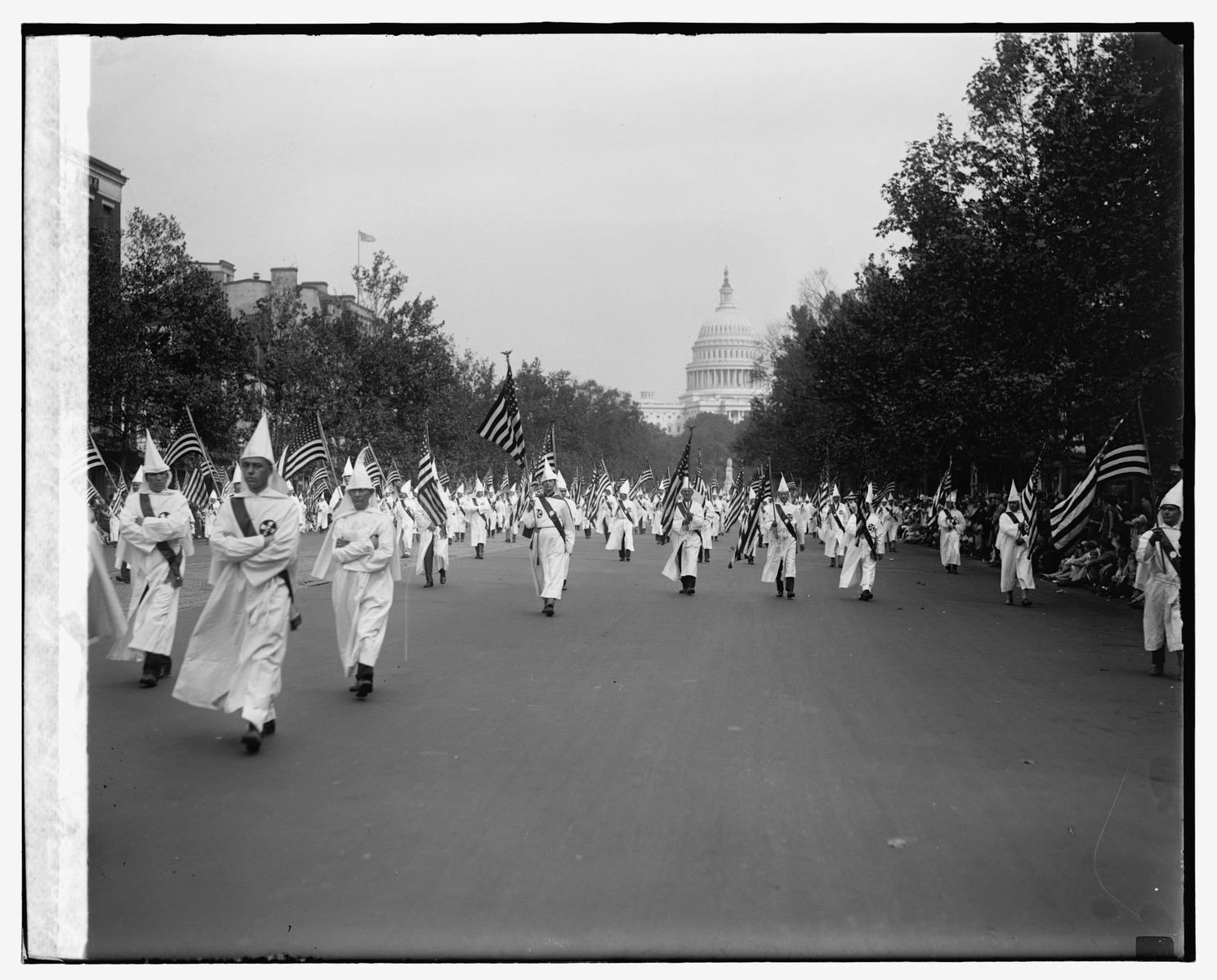
Ku_Klux_Klan_parade12.tif

The in-tray had been flooded with responses to the Coates-Chait debate and we will continue to air them as I gather my thoughts. A common sentiment from readers:

I’m glad to read this thread because I didn’t realize others also saw changes in Ta-Nehisi’s writing. Personally, I’m not troubled by his opinions or his anger. What bothers me is his certitude. His blog was so exciting because he wrestled with seemingly contradictory arguments and truths, and resisted being seduced by certainty. He tolerated doubt and wrestled with ideas. He embraced the sentiment of that old H.L. Mencken quote, “For every problem, there is a solution that is simple, neat, and wrong.” He had a point of view and opinions but approached the ideas and problems as though his point of view was both valuable and limiting. He never stopped searching, questioning and listening. I haven’t read anything from that guy in a while. I miss him.

Another:

I’m an avid TNC reader, but he just went off on a tangent with this back and forth. Obama does talk to African Americans differently – and if he can’t use himself as an example of working hard in spite of the odds (which are always changing, albeit far too slowly), then who could? Obama doesn’t get to pull out a wand and change a history of white privilege or supremacy.  There is no executive order for it.  But he can say that he’s an example of working hard and finding a place in a new America that isn’t so racist. I can’t say Coates’ rebuttal is an “attack,” but it sure turned into something other than a debate.

Then there’s the “knife in back” line.  I don’t grok why someone saying “Hey, things are getting better” (essentially Chait’s point) is so objectionable.  The counterpoint of “Yeah, but things are still bad, and the reason they are bad is because things have always been that way” is … well, I don’t know.  True, I suppose.  But that isn’t really a response to “things are getting better.”  It’s a worthwhile history and cultural lesson in search of a pupil.

Rudy Giuliani became a national caricature for his reflexive “noun, verb, 911” spiel.  Coates is getting close to doing that on this topic.  It isn’t 1850 or 1950, except when it is.  In 1950, it was always 1950.  In 2014, less so. That seems to be the point Chait got around to.

A different view:

I have read the posts and want to provide some context for what you see as Coates’s “pessimism.” I am an African American in my mid-40s.  Several years ago, I was involved in a yearlong series of programs where “big issues” were discussed by leaders in my city.  Because race is a thread that touches virtually every issue confronting our city – from education to criminal justice to housing – the very first program focused exclusively on race and racial awareness.  About midway into the program, each African American was asked, “Do you think race relations will be better in your lifetime?”

These were people from different corners of the country, with vastly differing life experiences.  They were Gen Xers, Gen Yers and Baby Boomers.  They all were senior professionals in the for-profit, non-profit and public sectors, all leaders in their respective milieus.  Nevertheless, when asked that critical question about race relations improving in their lifetime, not a single person said they thought that they would.  I later learned that this question was asked in each year of the series’ existence, and that it was almost always responded to in the negative by the African-American participants.

These weren’t a group of pessimists; in fact, the very reason these people were in the room together was because they thought they could make a difference in their city.  And they didn’t mean that nothing would improve. Rather, it was the sincere belief of optimistic people that, in general, the same fights they fought before are the same fights they are fighting now, and on balance, would be the same fights that they’d have for decades into the foreseeable future.

I could point to dozens of reasons big and small why this was the case, some of which touch me personally, and others that do not. It’s Trayvon Martin and all the other black kids who have been killed with no criminal consequences for being somewhere someone else didn’t think they should be and/or holding innocuous items that were mistaken for weapons.  It’s the flagrant use of government institutions to try to prevent African Americans from easy access to voting and the representation of their choice (again) and the Supreme Court’s gutting of the Voting Rights act for its so-called obsolescence.  It’s seeing Obama being called “the Food Stamp president” and treated as a pretender who lied, cheated and stole his way to the presidency.  Twice.  It’s the starving of largely black urban cities of moneys to fund the adjacent white suburbs.  It’s black kids having to create “I, Too, am Harvard,” because in 2014, even they are still having to shout from the rooftops that they deserve to be where they are.

It’s the personal indignities big (being detained by the police for asking for directions – at a police station) and small (being repeatedly seated in front of the kitchen door in empty restaurants) that my siblings and I suffer, as my mother and father suffered before me, and that I see my teenage nephew – who looks more man than the child he is – already having to deal with.  It’s these things and so many others and being able to draw a straight line between “back in the day” and “how is this happening now?”  In other words, there is a clear historical context for many of the issues currently being grappled with that African Americans recognize.  However, all too often, when we draw the line between this history and the present, that past is treated as nonexistent, too ancient to count or otherwise somehow irrelevant, and we are accused of being angry, pessimistic, hysterical or even radical.

From its founding documents forward – touting inalienable rights for “all men” while legally conferring none on a group of people based upon their skin color – America has been a place of hope, disappointment and ambivalence for black Americans.  It is these experiences and the feelings (and resulting behaviors) that they engender that Coates is trying to convey, grapple with and encourage his readers to think about and better understand.

Another is more optimistic about the future:

Over the years, Coates has provided ample evidence to convince me of his main argument – that white supremacy has been inseparable from the American project, and far more pervasive than either liberals or conservatives wish to acknowledge. But that does not preclude genuine progress. I consider my daughters, now 8 and 10 years old.

To my white daughters, the president of the United States – the most powerful person in the country President Obama Returns From Vacation In Hawaii Over Christmasand the world – looks like Barack Obama. He is essentially the only president they have ever known; the very idea of “President” is inseparable from Mr. Obama. The very idea of “first family of the United States” for them is inseparable from Michelle and Sasha and Malia Obama. To my daughters, the smartest man in the world is Neil deGrasse Tyson, who comes on their TV once a week to blow their minds about the nature of the universe. The fact that he is a black man is not strange or revolutionary to them. From their perspective, it is entirely normal that black people are associated with prestige and power and intellect and public adoration. (FWIW, their elementary school principal is also black.) For them, this is the way things have always been, as long as they have been conscious human beings.

Yes, as my daughters grow older, they will confront the reality of how their society treats their black peers who have not reached such heights as the Obamas or deGrasse Tyson. They will be tempted to imagine that there is no such thing as racism anymore, and it is possible they will cling to this illusion at the expense of seeking to understand their history and society. But it’s also possible that, given the “normal” under which they’ve acclimated themselves to the world, they will more readily identify and respond to racism and its pernicious manifestations.

My daughters are just two kids out of millions growing up as Americans under the same model of what is normal. My sincere question to TNC (which I can’t ask, because there is no way to provide feedback to him anymore): Does this not constitute progress in the long battle against white supremacy in America? And if it doesn’t, what does progress look like?

I can find little to fault in his diagnosis of our past and present. The disagreement boils down to a difference of opinion about what the future will hold. He can amass plenty of evidence to support his assertion that the future will see more of the same injustice, the ongoing prosecution of America’s longtime war against black families. I can appreciate why he is pessimistic on this question. But I look at the world through my daughters’ eyes, and I find reason to hope he is wrong.

(Top photo of a KKK parade in 1926 via Wikimedia Commons. Bottom photo of the First Family from Getty)

What Does “Corruption” Mean?

One of the key arguments in Chief Justice Roberts’s opinion in McCutcheon is that aggregate limits on campaign donations do nothing to prevent corruption. Sam Kleiner calls this argument “remarkably uninformed when it comes to the relationship between wealthy donors and elected officials,” and questions Roberts’ understanding of “corruption”:

Roberts says that legislation cannot seek to limit what he calls the “general gratitude a candidate may feel toward those who support him or his allies, or the political access such support may afford.” Roberts said “spending large sums of money” would not “give rise to such quid pro quo corruption.” The reality is, of course, that looking for evidence of direct trades of a Congressional vote for a donation will reveal very few instances of corruption. However, as Lawrence Lessig has established, there is a broader system of “dependence corruption” in which candidates must rely on wealthy donors in order to have access to the political system. The Roberts Court reflects a lack of understanding in how money actually operates in our political system and has adopted such a hollow understanding of corruption that they are able to view our system as free of any corrupting influence.

In his analysis, Lessig also points out that defining corruption down to quid pro quo corruption alone gives the lie to the “originalism” of the Court’s conservative wing:

[B]y “corruption,” the Framers certainly did not mean quid pro quo corruption alone. That exclusive usage is completely modern.

And while there were cases where by “corruption” the Framers plainly meant quid pro quo corruption, these cases were the exception. The much more common usage was “corruption” as in improper dependence. Parliament, for example, was “corrupt,” according to the Framers, because it had developed an improper dependence on the King. That impropriety had nothing to do with any quid pro quo. It had everything to do with the wrong incentives being allowed into the system because of that improper dependence. …

If the originalists on the Court believe the Framers would have permitted laws regulating the freedom of speech if those laws targeted “corruption,” why would an originalist use an understanding of the term from a 1976 per curium opinion  (Buckley v. Valeo) rather than an understanding of the Framers—corruption as in “improper dependence”—made manifest by the Framers again and again?

Noah Feldman notes that the connection between campaign finance and corruption is even younger than Buckley v. Valeo:

What is fascinating and important about the debate over the meaning of the word “corruption” is that the word, which has become a talisman, only appears once in Buckley v. Valeo. The reason for campaign finance law, from its inception, was to facilitate greater equality among voting citizens by stopping the richer ones from influencing the political process too disproportionately. This objective doesn’t depend on the semantic question of whether a system heavily influenced by money should be described as “corrupt.” But in the years since Buckley, the rationale of avoiding the appearance of corruption has come to dominate the doctrine and discourse of the court when campaign finance is on the table. This is an example of misdirection, whether conscious or unconscious, from the fundamental question of whether the Constitution allows Congress to try to enhance voter equality by reducing the influence of money.

On the other hand, David Bernstein calls Justice Breyer’s understanding of corruption, elaborated in his dissenting opinion, “dangerous”:

Breyer adds that “corruption,” by which he means individuals engaging in too much freedom of speech via campaign donations, ”derails the essential speech-to-government-action tie. Where enough money calls the tune, the general public will not be heard. Insofar as corruption cuts the link between political thought and political action, a free marketplace of political ideas loses its point.”

The danger of this argument is that analogous reasoning could be used to censor major media corporations such as the New York Times, Hollywood, and so on, to wit: ”When Hollywood spends billions of dollars each year advancing a liberal agenda, the general public will not be heard.  Instead of a free marketplace of ideas, we get a marketplace in which major Hollywood moguls have hundreds of thousands of times the ‘speech power’ of the average American.”  And given that almost everyone deems it appropriate to regulate the economic marketplace to counter inefficiencies and unfairness, why should the much-less-efficient (because it’s much more costly for an individual to make an error in his economic life than to have a mistaken ideology)  marketplace of ideas be exempt from harsh regulation?