Languishing Links

gmh_grid_600

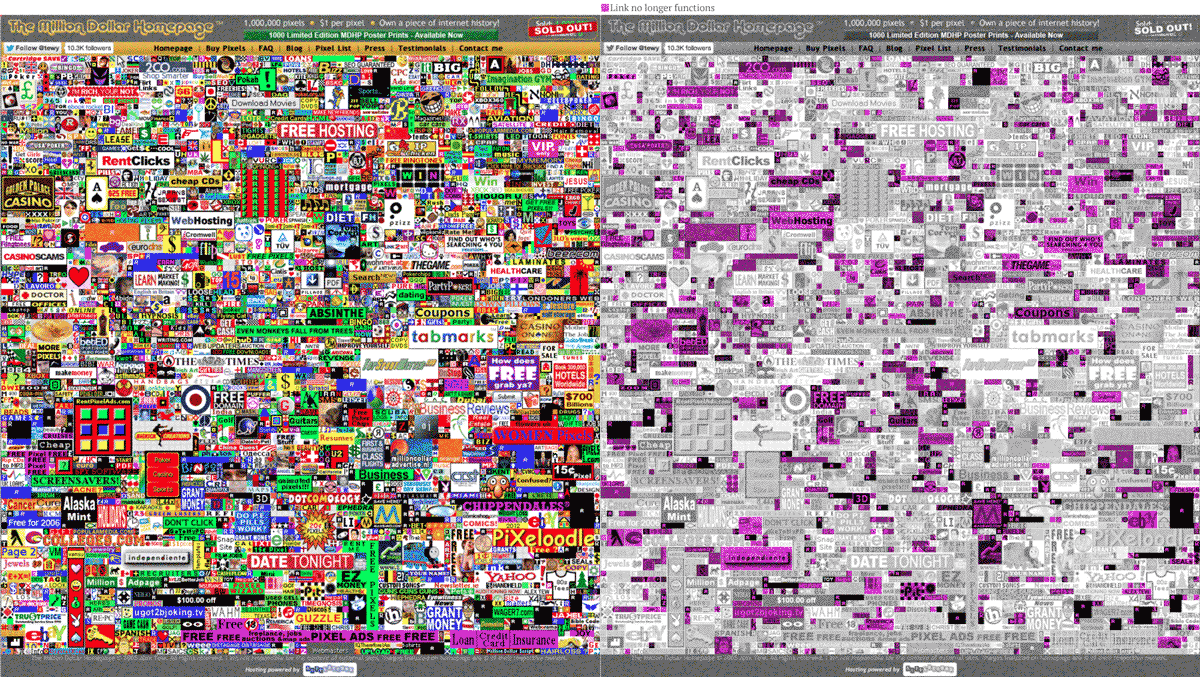
David Yanofsky did a link-rot analysis of The Million Dollar Homepage and found that 22 percent of its pixels are dead:

These non-functioning links account for 221,900 of the million pixels—$221,900 worth of real estate, assuming the pixels have kept their value in the last eight years. The atrophy of links has been shown to stabilize over time, meaning we should expect fewer than 22% of links to break over the next eight years. The longer a link continues to work on a webpage, the longer it can been expected to work into the future.

Nonetheless, it remains a problem for thought experiments and seminal works alike. Researchers at Harvard found that at least 50% of URL-based legal citations in US Supreme Court opinions, for instance, no longer point to the originally referenced material.

Life After A Stroke, Ctd

A reader writes:

Having had a stroke myself when I was 46 (I’m now 57), I can empathize with Mr. Dyer’s situation. After reading his description, he was quite fortunate.  His impairments were quite limited and he never mentioned any need of rehabilitation services.  But I was concerned about his driving, considering the visual deficits he described.  The problem is that stroke survivors tend to develop a sense of overconfidence once they feel healed, but his visual impairments may be more involved than he notices. The brain needs closure.  Stroke-induced visual deficits can be masked by the brain as it searches to fill in missing visual information with what it perceives should be there, and that perception is often a mismatch with reality.

An example: Patients with ischemias of the right cerebral cortex often develop a condition called visual neglect or visual field cut.  The damaged brain may not see an obstacle in a hallway to the left but the brain has experienced that hallway before, so it plugs in that missing information as an obstacle.  The patient walks into the object, insisting it is not there.  Now imagine driving on a familiar street with an oncoming car on his left.

I forgot to mention I am a retired medical speech pathologist with 25 years of practice.  The cognitive issues are a major pain in the ass. Reading for enjoyment is limited.  In fact, if you have a blog entry over three paragraphs, I go into brain lock.

Another stroke survivor:

I read Geoff Dyer’s story with interest. When I reached the end I realized an obvious point. “Oh my God” I thought.

He’s writing about this year! He’s not even three months in. While his stroke was milder than mild, he’s barely had time to sort out it’s impact. I am also a survivor. I’ll have my fifth re-birthday over Memorial Day weekend. My two strokes happened within hours, and like Geoff’s, they were mild. I continue to play tennis, and I’m in the market for a ping pong table. It won’t fit in my apartment, and I don’t really have the money – I haven’t worked since – but I’m looking (I love the game so).

One of the mantras that survivors hear from their doctors is that six months is the golden window at which point you’ll know the extent of your recovery. What I, and many survivors will tell you, is that recovery continues beyond that point. Almost five years later, I’m still getting better. What’s more, is that as time passes, my awareness of the stroke’s impact has increased as well.

In Letters to a Young Poet, Rilke notes that “the point of life is to live everything.” What he didn’t say, is that while change can happen in an instant, we have to live into what follows. It will be interesting to see what Geoff has to say about his stroke in three more months, in a year, and again in two. In this piece it seems clear to me that he’s not sure what the lasting impact of his stroke is:

There had certainly been some cognitive impairment, but my wife insisted that this had occurred before the stroke. I used to pride myself on my sense of direction but that had long gone south, or maybe north or east. I had trouble concentrating but that too had been going on for ages; I put it down to the internet, not to my brain blowing a fuse or springing a leak. So no, nothing had gone permanently wrong in my head, or at least nothing had gone wrong that had not been in the process of going wrong for a while…” [italics are mine]

One of the experiences I had that is similar to what Dyer described in the quote, is that the people who knew me best were quick to locate impairments to pre-existing issues, or associate it with age-related issues. For me, this speaks to the way we really don’t know how to talk about strokes without relating it to experiences we have had, or our sense of pre-existing conditions. When it comes to ailments we cannot see, our imagination fails us. It takes seeing someone who is “sadly diminished” as Dyers describes Gilbert Adair – using Adair’s own words – before we admit it is real. A year after my strokes, I broke my wrist riding a bike. I received more care afterwards simply because people could see my cast.

Two months after my strokes, I could describe to folks what I was doing when I had the strokes. It’s a story I had to learn because I was having short-term memory issues. At the same time, I wasn’t aware of what I was living into. I pretty much lived in the present moment. I’m smart, and my ability to create coping mechanisms, allowed me to mask impacts I couldn’t see or put words to. As a result, I didn’t begin to become aware of what was happening to me, until fifteen months later.

Almost five years later I feel like myself again. Part of my brain is dead. I understand more of what the lasting impact of my strokes are. I’ve lived into this new life of mine. I know that I have gifts, what they are, and that they should be shared. I am very close to the person I was before (it’s glorious). Will Geoff experience something similar? Something different? Time will tell.
Mr. Faulkner Goes To Hollywood

William Faulkner won the Nobel Prize for brilliant novels like The Sound and the Fury (1929) and As I Lay Dying (1930), but when he needed money, he turned to Hollywood. John Meroney retraces the writer’s steps:

It all started in 1932, when, riding on the success of his novel Sanctuary, Faulkner got word that Leland Hayward, a prominent Hollywood talent agent, had secured for him a $500-a-week contract (the equivalent of $8,500 today) to write scripts at Metro-Goldwyn-Mayer. Faulkner was a modernist, and film was still a new, exciting form of storytelling. But that wasn’t the reason Faulkner accepted. It was the money.

At the same time Faulkner received the offer from Metro, he got news that his publisher, Cape & Smith, was bankrupt. Faulkner had been planning on $4,000 ($68,000 in today’s money) from the company for Sanctuary but was informed he wouldn’t see any of it. Suddenly, he was broke. Word apparently got around Oxford. When he tried writing a check for three dollars at a sporting goods store, the owner told him, I’d rather have cash. All at once, Hollywood became attractive. Faulkner didn’t even have the money to send a wire to answer yes. Eventually MGM advanced him some cash and paid for his train ticket, and days later he arrived in Culver City.

Amidst tales of an affair and lots of bourbon, Meroney includes tantalizing details of scripts Faulkner wrote that never made it onto the screen. How his Hollywood adventures came to a close:

I discovered that Faulkner’s upward trajectory peaked with an offer to work exclusively with [director Howard] Hawks in their own independent filmmaking unit. “He and I had a talk at the fishing camp…. I am to be his writer,” Faulkner wrote to [his wife] Estelle in 1943. “He says he and I together as a team will always be worth two million dollars at least.” It was an outstanding plan, one that would appeal to filmmakers even today. Faulkner wrote, “We can count on getting at least two million from any studio with which to make any picture we cook up, we to make the picture with the two million dollars and divide the profits from it. When I come home, I intend to have Hawks completely satisfied with this job, as well as the studio. If I can do that, I won’t have to worry again about going broke temporarily…. This is my chance.”

The dream of a lifetime. One that would have launched Faulkner and Hawks into the Hollywood stratosphere. But it was never to be. Hawks had a reputation for going over budget on his pictures, which meant that the $4 million required to produce [the proposed WWII epic] Battle Cry ($53.8 million in today’s money) would surely mean more…and more…and more. The studio said no. Faulkner’s romantic dream of filmmaking had come to an end. He would continue to do work for Hawks, including writing screenplays for Hemingway’s To Have and Have Not and Chandler’s The Big Sleep, both of which became films starring Bogart and Bacall. To an outsider, those classics might seem like the pinnacle of a career. For Faulkner, they were little more than paychecks, not the imaginative, unique film projects he and Hawks had once dreamed of making on those summer nights up at June Lake.

Previous Dish on Faulkner here, here, here, and here.

Do Ivy-Leaguers Make Better Teachers?

Jack Schneider suggests no:

It is not unreasonable to think that if a teacher with a B average from a good college is sufficient, a teacher with an A average from the Ivy League must be better. Yet that isn’t the case. Consider the content of an average standardized test for seventh-grade math and then check out the senior thesis of a Harvard math major. The two documents are worlds apart. In short, the academic backgrounds of teachers matter; but only up to a point. As research indicates, beyond a certain threshold level of content mastery, there is little return to student achievement. And additional research indicates that higher-prestige colleges do not produce markedly more effective teachers.

On the whole, then, we might conclude not only that American teachers are generally well prepared academically, but also that recruiting a more selective slice of the public into classrooms may be both impractical and unproductive. This, of course, is not to say that teacher training is perfect, or that the pool of teacher candidates is ideal. It does, however, suggest that simple solutions like Teach For America-style recruiting are unlikely to make much of a difference.

The Best Of The Dish Today

The best came from the in-tray today. One reader, at 7.44 am:

I will not be RickRolled today. I will not. I’m on to you.

A followup from the reader at 1.52 pm:

NOOOOOOOOO

Heh. Another:

God Dammit. That’s literally the first time in my life I’ve fallen for a Rickroll. I even knew full well what today’s date was; I’ve been proudly outsmarting little jokes like that all morning long. I tip my hat, sir.

Others were less polite: “You fucker!” / “Bastard!” / “Damn you!”.  Another didn’t compute:

When I click onto the link under the headline “Rand Paul Said What?“, I get a link to some singer named Rick Roll. Just an FYI.

LOL. Another reader:

You know, it never occurred to me, but Paul kinda looks like Rick. If he ever does the song, he has my vote.

Another emailed during the few minutes before we switched out the initial Rickroll link for an ad-free version, which are really hard to find on YouTube these days:

I’m actually quite disappointed this year.  Someone on YouTube in their infinite wisdom stuck an ad in front of the video, so instead of the familiar synth-drum fill, I got Olive Garden. Another example of how aggressive advertising ruins everything on the Internet.  Many thanks for the ad-free nature of The Dish.

The thanks goes to all the subscribers for making it possible, such as this one:

If I weren’t already a subscriber, getting Rick Roll’d on April Fool’s Day would have brought me into the fold.

You can join him and 28,122 others here. See you in the morning.

Finding A Voice For The Voiceless

Rupal Patel, a speech scientist behind the Human Voicebank Initiative, wants to diversify and liven up the range of computer-generated voices available to people physically unable to speak. Megan Garber explains the process:

It works like this: Volunteers come to a studio and read through several thousand sample sentences (sourced from books like White Fang and The Wonderful Wizard of Oz). Patel, [collaborator Tim] Bunnell, and their team then take recordings of a recipient’s own voice, if possible, to get a sense of its pitch and tone. (If the recipient has no voice at all, they select for thing like gender, age, and regional origin.) Then, the team strips down the voice recordings into micro-units of speech (with, for example, a single vowel consisting of several of those units). Then, using software they created—VocaliD, it’s called—they blend the two voice samples together to create a new, lab-engineered lexicon: an acoustic collection of words that are at the disposal of a person who needs them to communicate.

Randy Rieland elaborates:

The project’s website, VocaliD.org, has both a sign-up page for donors and another for those hoping to get a personal voice. The latter must submit their names and other relevant information such as their speech ability, which can range from “completely non-vocal” to “can make sounds but not words” to “can use some words for communication.”

While only a handful of voices have actually been created during the project’s infancy, more than 10,000 people already have volunteered to be voice donors, Patel says. “Several hundred” others, she says, have signed up to get new voices. … Her vision is to collect a million different voice samples by 2020. But already her work is making an impact. The site features an audio file, only two sentences long, provided by a young woman described as having a “severe speech impairment.” Her words are as clear as day:

“This voice is only for me. I can’t wait to try it with my friends.”

Is Literary Criticism An Art Or Science? Ctd

Scott Esposito weighs in on the debate:

I don’t see the point of asking whether literary criticism should be an art or a science. It’s obviously not a science and never will be. There’s simply no way as a critic that you can form hypotheses and test them, that being the heart of the scientific method. Yes, sure, you can try to determine the structures beneath texts, movements, etc., but I’ve never seen a literary critic make a single falsifiable prediction, not even in the sense of how it’s done in social sciences like economics and political science. And of course theorists like Paul de Man did nothing of the sort … not even Roland Barthes, who’s probably much closer to a “literary critic/scientist” than de Man, got even close to science.

Meanwhile, from the in-tray:

I took a course on 19th-century European novels from Dr. Moretti while at Stanford some 10 years ago, before he founded the Literary Lab, and his interest in analytical literature shouldn’t be taken as a reflection of his overall approach to books.

His lectures in what was very much a “great books” kind of course (Flaubert, Zola, Hardy, Dickens – the list goes on) were wonderful, penetrating 90-minute monologues on very un-quantitative questions of character and theme and setting and everything any classic lit buff would expect. I skipped a fair number of classes in college, but I never missed a Moretti lecture. So I think his new endeavor’s critics make valid big-picture critiques, but Moretti’s hardly advocating analytics as the sole (or even best!) approach to literature. Instead he’s doing his best to arrest Stanford’s incredibly lame degeneration into a school of pre-meds, pre-laws, and pre-techs – bringing in other disciplines to attract students otherwise warded off by the techie scorn of anything “squishy.”

And his approach actually makes sense! Great books are great, but the overwhelming majority of printed works are not. If these non-great books won’t yield arresting experiences, why not use them to ask and answer some macro-level questions about literature? Computers are bad at some things, but they’re great at boring repetitive stuff … like, say, scanning and parsing thousands of mediocre books no research assistant would want to approach. Moretti’s a brilliant scholar and teacher who’s using Stanford’s prodigious tech resources for some interesting research. There’s no battle of civilizations here, just an earnest effort to expand the relevance of literary analysis at a time when it’s not terribly valued.

Burma Still Isn’t Free

MYANMAR-POLITICS-CENSUS

Min Zin worries that the country will grow increasingly unstable:

Under the current Burmese system, the people do not directly elect the president: parliament does, in a complicated procedure that gives disproportionate power to the military. Even though the current ruling party is unlikely to win both houses of parliament in the 2015 elections, the military members of parliament can still nominate its leader as their candidate for the presidency. So it’s entirely possible that army chief Min Aung Hlaing, who reaches retirement age next year, will enter politics and become the military’s nominee for the presidency.

And that, obviously, is a problem. The military has dominated politics in our country for the past half-century. As long as the military continues to control the presidency rather than handing power over to a civilian leader like Aung San Suu Kyi, the legitimacy and stability of the political transition will be incomplete.

Jay Ulfelder, while a bit more sanguine about Burma’s liberalization, zeroes in on the same problem:

[W]hat’s emerged so far is more like the arrangements that hold in monarchies like Morocco or Jordan. There, loyal opposition parties are allowed to contest seats in the legislature, and a certain amount of free discourse and even protest is tolerated, but formal and informal rules ensure that incumbent insiders retain control over the political agenda and veto power over all major decisions.

For that to change in Burma, the country’s constitution would have to change. When military elites rewrote that document a few years ago, however, they cleverly ensured that constitutional reform couldn’t happen without their approval. So far, we have seen no signs that they plan to relinquish that arrangement any time soon. Until we do, I think it’s premature to speak of a transition to democracy in Burma. Democratization, yes, but not enough yet to say that the country is between political orders. What we have now, I think, is a partially liberalized authoritarian regime that’s still led by a military elite with uncertain intentions.

(Photo: Burma police provide security during census taking in the village of Theechaung on the outskirts of Sittwe in the western Myanmar state of Rakhine on April 1, 2014. Tens of thousands of census-takers fanned out across Myanmar on March 30 to gather data for a rare snapshot of the former junta-ruled nation that is already stoking sectarian tensions. By Soe Than Win/AFP/Getty Images. More Dish on the census here. )

Are 12 Steps Necessary?

A new book by Lance and Zachary Dodes suggests there might be better alternatives to Alcoholics Anonymous:

Peer-reviewed studies peg the success rate of AA somewhere between 5 and 10 percent. That is, about one of every fifteen people who enter these programs is able to become and stay sober. In 2006, one of the most prestigious scientific research organizations in the world, the Cochrane Collaboration, conducted a review of the many studies conducted between 1966 and 2005 and reached a stunning conclusion: “No experimental studies unequivocally demonstrated the effectiveness of AA” in treating alcoholism. This group reached the same conclusion about professional AA-oriented treatment (12-step facilitation therapy, or TSF), which is the core of virtually every alcoholism-rehabilitation program in the country.

Many people greet this finding with open hostility. After all, walk down any street in any city and you are likely to run into a dozen people who swear by AA—either from personal experience or because they know someone whose life was saved by the program. Even people who have no experience with AA may still have heard that it works or protest that 5 to 10 percent is a significant number when we’re talking about millions of people. So AA isn’t perfect, runs this thread of reasoning. Have you got anything better? 

In a review of the Dodes’ book, Jake Flanagin considers how AA took hold:

According to Dodes, when the Big Book [AA’s founding literature] was first published in 1939, it was met with wide skepticism in the medical community. The AMA called it “a curious combination of organizing propaganda and religious exhortation.” A year later, the Journal of Nervous and Mental Diseases described it as “a rambling sort of camp-meeting confession of experiences … Of the inner meaning of alcoholism there is hardly a word. It is all surface material.”

That perception has since radically changed, albeit gradually, thanks in no small part to the concerted efforts of AA’s early pioneers. They “realized early on that to establish true legitimacy, they would eventually need to earn the imprimatur of the scientific community,” writes Dodes. Which they did, with aplomb, largely by manufacturing an establishment for addiction scholarship and advocacy that did not previously exist. They created a space for AA to dictate the conversation.

Meanwhile, Mano Singham questions how we define rehabilitation:

One thing that I have not been clear about is what constitutes a ‘success’ in such rehabilitation efforts. Does it mean that the person kicks the habit entirely forever? Is it considered a failure if an addict replaces the addition with a more harmless substitute (like chewing gum) that they never get rid of? What if they stop being severely addicted to alcohol (say) but end up drinking the occasional beer or at socially acceptable levels? Or if they find that they are totally dependent on a support group for their entire lives to stay sober?

I see all of these things as successes because people have replaced a practice that was harming their lives with one that is under control. But maybe that is because I have no experience with such extreme addictions and that there is no escape from them unless you make a total break.

Previous Dish on AA and its alternatives here, here, and here.

Knowing The Score

How do we identify “expressiveness” in music? It depends on who’s listening:

Recent empirical work has shown that listeners tend to be unable to say if the expressiveness they are hearing originates from the composition or the performance. Studying the experience of professional musicians highlights how differently they approach their performance. For them the score is never just notes on paper but already music imagined as sound. This imagination depends on their socio-cultural, historical position, personality, and education. They use metaphors and heuristics, short-cuts that package up accumulated knowledge and speeds up problem solving in preparation for and during performance. They rarely speak of specific emotions to be conveyed but conceive of music as “emotional,” “dramatic,” “uplifting,” or “turbulent,” for instance.

This is true of music and musicians of other artistic traditions, like classical Hindustani music. According to the dhrupad singer Uday Bhawalkar, “Music without emotion is not music at all, but we cannot name this emotion, these emotions, we cannot specify them.” The sentiments or emotions that we encounter in daily life become transformed into aesthetic experiences in theatre.

(Video: Uday Bhawalkar sings Dhrupad)