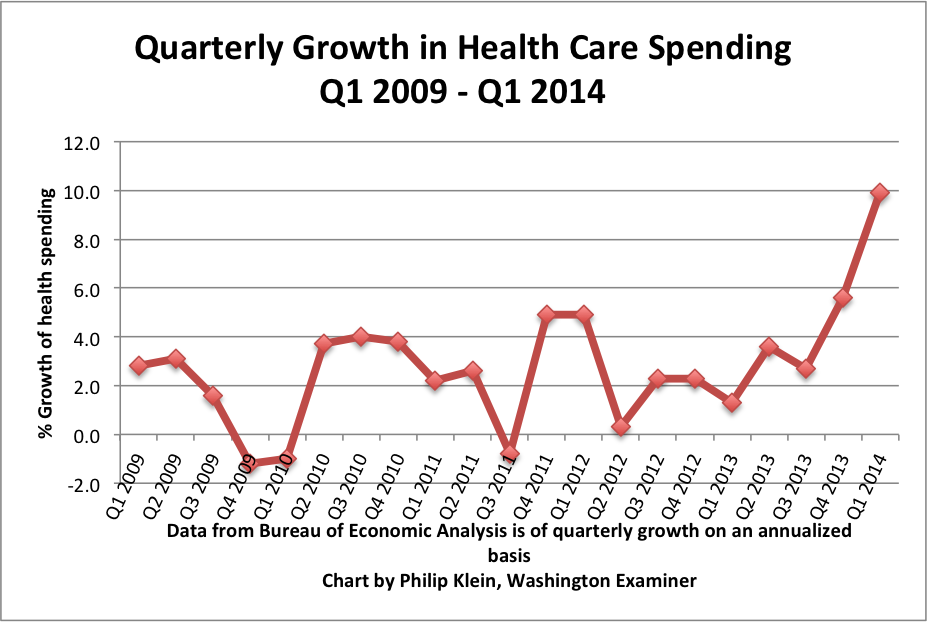
Phil Klein highlights it and provides the above chart:
For several years, Obama and his allies had been crediting a slowdown in the rate of growth for health care to payment reforms imposed by the law. But other analysts predicted that spending would pick up as the economy improved and people started loosening the family purse strings. As I reported earlier this month, there were already signs of growing health care spending in the fourth quarter of 2013, when it jumped 5.6 percent, which had been the fastest clip since 2004.
But the 9.9 percent jump (on an annualized basis) came in the quarter from January through March, which was the first three months in which individuals who gaining coverage through the law were able to use it. That was the fastest rate recorded since health care spending grew at a 10 percent rate in the third quarter of 1980.
Chait reminds Klein that a temporary spike in spending was predicted for this year:
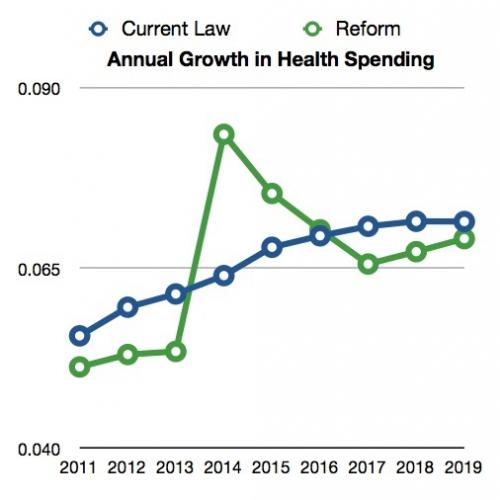
If you think I’m simply making up some after-the-fact excuse, advocates of health-care reform were pointing this out at the time the bill was being debated. Here’s Jonathan Cohn explaining in 2009 how the new health-care law was projected by Medicare actuaries to bend the long-term curve of health spending downward while still allowing for a big spike when new customers came online in 2014 … He even had a chart!
See that 2014 spike? That’s now.
Klein fires back:
[A]t no point did I write that the BEA report was definitive proof that costs would explode for as far as the eye could see. In fact, I even noted that the estimate for health care spending was, “preliminary and subject to revision in the coming months.” So I’m not sure what [Chait] thinks he has “debunked.”
As far as the broader issue, there’s been a huge debate within the health care policy community as to whether the historically low rate of growth in health care spending that was recorded from 2009 through 2012 could be attributable to the health care law or other long-term factors – or if it was temporary, and largely driven by the economic downturn.
Cohn joins the conversation:
The big unknown remains what happens next. There’s evidence to suggest that health care has undergone a real revolution, so that costs won’t continue to rise as quickly as they did historically. Hospitals are getting more aggressive about stopping infections and following up with patients after discharge. Insurers are bargaining harder with providers. Most people in and around the health care industry expect that, after an initial jump, health care inflation will settle back down at a lower level. But where will it settle? Will it be low enough to spare us painful fiscal trade-offs in years and decades to come? And what role will Obamacare end up playing in this trajectory?
The answers are impossible to know right now, in part because it depends on future decisions—about how strongly to stand by existing cost control efforts, and what new efforts to try. Even among like-minded experts, there’s lot of disagreement.
Kliff adds:
One important fact we don’t know is whether the increase in health care care is making people healthier. We don’t know the balance between care that people need (which they might have put off because they were uninsured) and care that was unnecessary, but still made accessible because of new health plans.
 The Dish