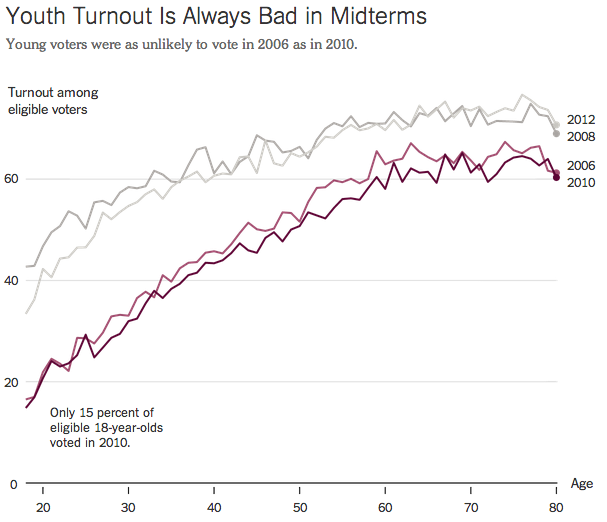
Nate Cohn drives that point home:
Much of the optimism on Democratic turnout stems from Mr. Obama’s successful turnout operation in 2012, or from experiments showing large increases in turnout when voters receive targeted mailers or contacts. But political scientists and campaign operatives found that even Mr. Obama’s impressive ground operation was worth less than one point in his presidential elections. And those experiments are usually conducted in extremely low turnout elections, like a local mayoral race, in which there are many more marginal voters. Finding people who are potential voters but not existing voters in a national election is harder.
Even Democratic operatives know the limits of the ground game. In a New Republic cover article that otherwise suggested that a strong turnout operation could solve Democratic problems, Guy Cecil, executive director of the Democratic Senatorial Campaign Committee, conceded that field operations would “only solve our problem if the election is a close one.”
Charlie Cook expects Democrats to have a rough election:
[A]n array of new polling from a variety of sources suggests that Democrats have no reason to be encouraged at this point. Things still look pretty awful for the party. Especially meaningful to consider is that—no matter how bad the national poll numbers appear for Democrats—eight of their nine most vulnerable Senate seats this year are in states that Mitt Romney carried in 2012. Further, nine of the most competitive 11 Senate seats in both parties are in Romney states; the numbers in these states will likely be considerably worse than the national numbers.
 The Dish