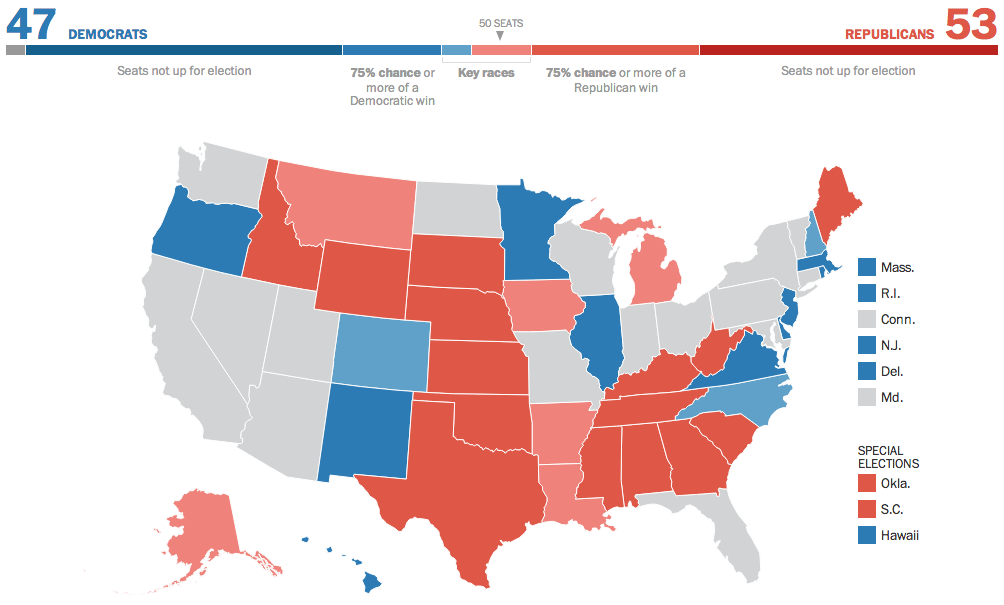
John Sides shares the WaPo’s midterms forecast:
Right now, the model estimates that Republicans have an 82 percent chance of re-taking the Senate.
How did we arrive at this conclusion? You can read more about that model here, but in brief: the model looks at Senate elections between 1980-2012 and estimates the effect of several key factors in the country and in individual states or races — the rate of economic growth, the popularity of the president, whether it’s a midterm or presidential year, the most recent presidential election outcome in that state, whether the incumbent is running, and each candidate’s qualification (measured as highest elective office to date).
Why do these factors add up to a significant GOP advantage? The main problem for Democrats is that it’s a midterm year — and the president’s party almost always loses seats in the midterm. Moreover, conditions make it difficult for Democrats to overcome this tendency: the economy is not growing that strongly and, partly as a consequence, President Obama is not that popular. Moreover, as many have noted, many seats that the Democrats must defend this year are in Republican-leaning states.
Kilgore explains how this model differs from all the others:
Election Lab, reflecting the proclivities of its “fundamentals matter most” proprietors, will place more emphasis on economic and approval ratings factors than on current polling, certainly until late in the cycle. Unsurprisingly, Election Lab enters the fray with a more robust prediction of Republican Senate gains than the competition, showing not only Montana, South Dakota, Arkansas, Alaska, West Virginia and Louisiana flipping from blue to red, but also Iowa and Michigan, which most observers show as leaning Dem. That’s particularly interesting since they also have Kay Hagan is pretty good shape in North Carolina.
Meanwhile, Kyle Kondik looks ahead to the 2016 Senate races:
Of the nine Senate Republicans who represent states Obama took in 2012, seven will be on the ballot in 2016. Sens. Mark Kirk of Illinois, Pat Toomey of Pennsylvania and Ron Johnson of Wisconsin will likely start the cycle with their odds of winning reelection no better than 50/50. Sen. Chuck Grassley of Iowa could easily get another term if he wanted it, but he’ll be 83 on Election Day 2016 and might retire, triggering a highly competitive race. Sens. Kelly Ayotte of New Hampshire, Rob Portman of Ohio and Marco Rubio of Florida will probably start as favorites by a small margin, assuming they run for reelection. Additionally, Democrats could credibly target seats in less conservative red states—places like Arizona, Georgia, Indiana and North Carolina—particularly if some incumbents, such as the 77-year-old John McCain, retire.
 The Dish