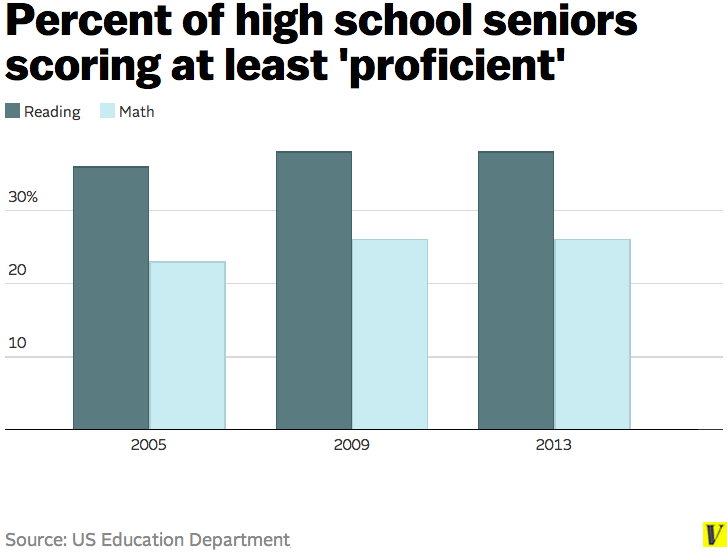
Libby Nelson finds “little good news” in the latest National Assessment of Educational Progress (“the nation’s report card”), which the DOE released yesterday:
Just 26 percent of 12th-grade students scored as proficient or better in mathematics in 2013. In reading, 38 percent were proficient or better. And there has been no improvement in 12th-graders’ scores since 2009, the last time students took the tests. … Scores released in December showed that fourth-grade and eighth-grade students have slowly improved their performance in reading and math, even though less than half of them score as proficient in those subjects. But Wednesday’s data show high school seniors haven’t even made incremental progress.
Why are seniors doing so poorly, when younger students are improving? Demographics might be a factor:
One change that probably has influenced the 12th-grade scores somewhat is the demographic changes of America’s seniors since testing began in 1992, as well as an upward trend in graduation numbers. The percentage of students who are Hispanic has risen from 7 to 20 percent in that time, and the percentage of students with a disability has doubled, from 5 to 11 percent, while the portion of students who are white has dropped from 74 percent to 58 percent. At the same time, the average freshman graduation rate has risen from 74 percent to 81 percent, meaning more students who might have dropped out in the past are now included in the sample that are tested.
But Jill Barshay is unsatisfied with that explanation:
[H]ere’s the thing. When you look at top achieving students in the top 75th and 90th percentiles. Their scores are FLAT. … High achieving students aren’t improving at all. So you can’t blame the infusion of more low performing students in the testing pool for the disappointing test scores. Even if we hadn’t introduced a greater number of weaker students into the mix, the scores of our high school students would still be stagnant.
Indeed, when you drill down by percentile, it’s the weakest students who are showing modest improvements. If not for their improvements, the national average would have declined!
Also, Maya Rhodan notes that, in the longer term, minority students’ scores are improving faster than those of white students:
Between 2005 and 2013, African-American students’ math scores jumped by five points and white students saw their scores go up by four points. Asian/Pacific Islander students and Hispanic students experienced the highest gains, with math scores increasing by 10 and seven points, respectively. Yet achievement gaps persist between racial groups and genders. Boys scored an average of three points higher than girls in math, and girls scored about 10 points higher in reading than boys. Whites scored 30 points higher than blacks in math and 21 points than Hispanic students. In reading, whites scored 30 points higher than blacks and 22 points higher than Hispanics.
 The Dish