Alibaba, China’s answer to Amazon, has filed a prospectus (pdf) with the SEC for what might turn out to be the biggest Internet IPO ever:
The real figure is expected to climb to between $15 billion and $20 billion as the company gets closer to its actual sale. If it lands in the upper end of that range, Alibaba could easily eclipse Facebook’s $16 billion, making it the largest Internet IPO in history. The biggest IPO of any type on record was done by the Agricultural Bank of China, which raised $22.1 billion, according to the Wall Street Journal.
Whatever valuation Alibaba lands on, the IPO is expected to be a windfall for Yahoo. Marissa Mayer’s company holds a 22.6 percent stake in the Chinese e-commerce platform and plans to sell a chunk of that in the public offering. Depending on Alibaba’s valuation, that deal could hand Yahoo a $10 billion to $15 billion pile of cash.
Nick Bilton looks at just how huge the company is:
As of 2013, it had 231 million active users across its services, including Alibaba.com, a site where small businesses sell goods to companies abroad, and Tmall.com, a site on which Western companies like Apple and Nike market their products. Each active user, according to the company, makes 49 purchases a year. All told, the company said it now processed more than 11 billion orders a year. …
With its scale, Alibaba has generated lots of jobs. At the end of last year, Alibaba said it had 20,884 full-time employees — all of whom were located in China. Facebook, in comparison, has 6,818. As for the value of the company itself, Alibaba is expected to have a share price that could value the company at roughly $200 billion. (Amazon.com is valued at $137 billion; Facebook is valued at $150 billion.)
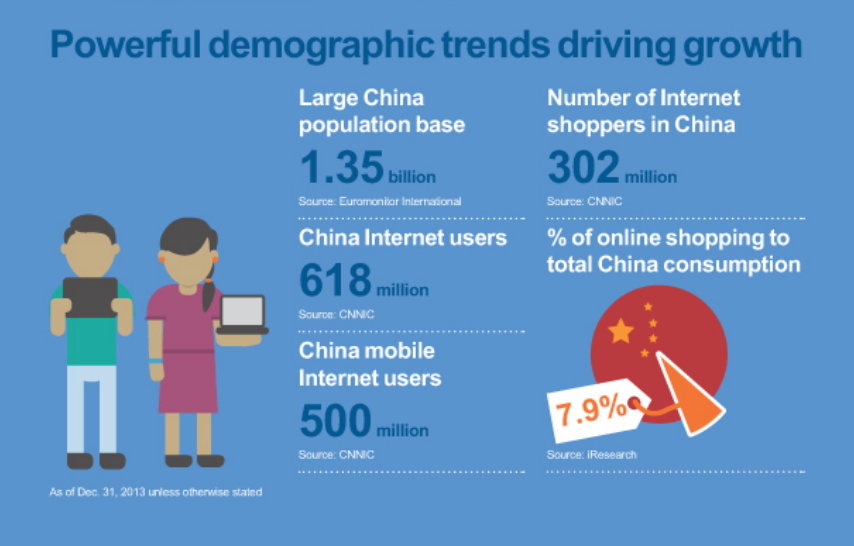
All the big numbers in Alibaba’s prospectus reveal how much potential there is to grow in China, a market which the company thinks hasn’t been fully tapped yet. Alibaba said that only 618 million people use the Internet in a country of 1.35 billion people. Of those, 302 million shop online. The company also has potential to increase its mobile users; 500 million people are connected to the Internet using mobile devices.
But Bershidsky doubts that Alibaba, whose success in China depends partly on state largesse, will make much headway internationally:
The charming story of English teacher Jack Ma setting up Alibaba in a small apartment must be understood in the context of Beijing’s efforts to help the company thrive and expand. Alibaba’s cloud division, in particular, has benefited from government funding under a special five-year plan to boost cloud-computing development. The division accounted for about 1.4 percent of Alibaba’s revenue in the nine months to Dec. 31.
The Chinese national champions’ business is mainly local. As Ma himself said about eBay more than 10 years ago, “EBay is a shark in the ocean. We are a crocodile in the Yangtze River. If we fight in the ocean, we will lose. But if we fight in the river, we will win.”
John Aziz, on the other hand, thinks that Alibaba has great potential even without the hoped-for international reach:
The really exciting thing for Alibaba is that China is still a market where the majority of people don’t even have internet access yet (just 42 percent had it at the end of 2013 compared to 81 percent in the U.S.). China is still rapidly industrializing, and millions of people are still moving from the countryside into the cities, providing a huge amount of room for Alibaba to grow in China.
Jack Ma, Alibaba’s founder, named the company Alibaba based on his impression that it was a name that could be recognized globally, by people from India, Germany, Japan, China, the United States, and so on. His ambitions have always been global. And Alibaba’s original business model was about connecting manufacturers in China to firms in the West. Whether the obvious love Chinese consumers have for Alibaba’s services can translate to Western consumers remains to be seen. But expect to see much, much more of them in the coming years.
 The Dish