New research indicates (NYT) that Hispanic American Catholics are moving away from the church:
There are positive findings: Mass attendance in parishes with Hispanic ministries is 22 percent higher than in the average parish, a promising sign in a church that has seen attendance at Masses dropping over the last few decades. Rates of
baptism and first communions are also higher.
But attendance rates at weekday Mass are quite low, participation in non-sacramental activities like youth groups is low, and contributions to collection are also low, often reflecting economic hardship. Parishes serving Hispanics often have fewer staffers per parishioner than other parishes, according to the study; parishes with high numbers of Hispanic parishioners are also less likely to have a parish school.
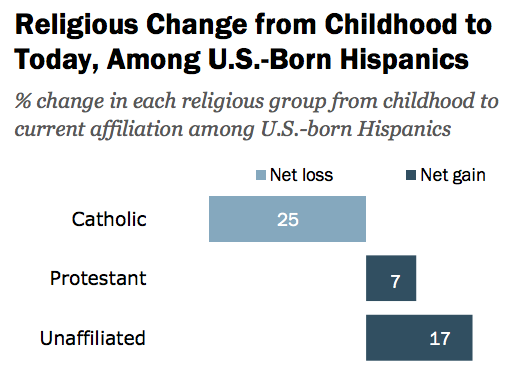
A Pew study released Wednesday also shows the Hispanic Catholic community is shrinking:
Most Hispanics in the United States continue to belong to the Roman Catholic Church. But the Catholic share of the Hispanic population is declining, while rising numbers of Hispanics are Protestant or unaffiliated with any religion. Indeed, nearly one-in-four Hispanic adults (24%) are now former Catholics, according to a major, nationwide survey of more than 5,000 Hispanics by the Pew Research Center. Together, these trends suggest that some religious polarization is taking place in the Hispanic community, with the shrinking majority of Hispanic Catholics holding the middle ground between two growing groups (evangelical Protestants and the unaffiliated) that are at opposite ends of the U.S. religious spectrum.
Elizabeth Dias comments on the Pew study, writing that the findings “are groundbreaking, but not surprising for anyone following the community closely”:
Latinos are joining Protestant churches, the report confirms, for socio-economic reason and not just religious ones. Half of Protestant converts say they left their childhood religion because evangelical churches reach out and help their members more. (Note: “Protestant” in most Latino communities tends to be synonymous with both evangelical and Pentecostal charismatic—Latino communities in the mainline Protestant churches are much smaller by comparison.) The social service priority of these congregations is significant draw. Evangelical Latino churches often act as a social safety network for their members, especially when it comes to basic needs like food, clothing, and health care.
Emma Green sees the findings as “a bad sign for the Church.” Mano Singham observes that the Pew survey suggests “Hispanics are not that different from the rest of the population”:
For example, they support same-sex marriage by 46-34% and 40% say abortion should be legal or mostly legal, as opposed to 53% who think it should be illegal. Hispanics also solidly reject traditional gender roles in marriage, saying that “a marriage in which both husband and wife hold jobs and help take care of the children (79%) is preferable to a traditional arrangement where the husband is the financial provider and the wife takes care of the house and children (18%).”
Meanwhile, Aaron Blake refutes the idea that changes in Hispanic religious affiliation will necessarily translate to success for the GOP:
Among the Hispanics who continue to affiliate with a church, just 22 percent are Protestant — compared to more than half of the United States population. Why is that important? Because Protestants — and especially evangelicals — are much more likely to be Republicans than Catholics are. In fact, the only Christian group that skews heavily GOP is evangelicals, and only 16 percent of Hispanics affiliate with evangelicals.
(For more on the differences between Christian groups, see this recent Pew study, which found that about half of white Catholics and mainline Protestants were Republicans, compared to 70 percent of white evangelicals.) The fact that the Hispanic population is still dominated by Catholics —and increasingly unaffiliateds — means it’s much less likely to swing to the GOP.
 The Dish