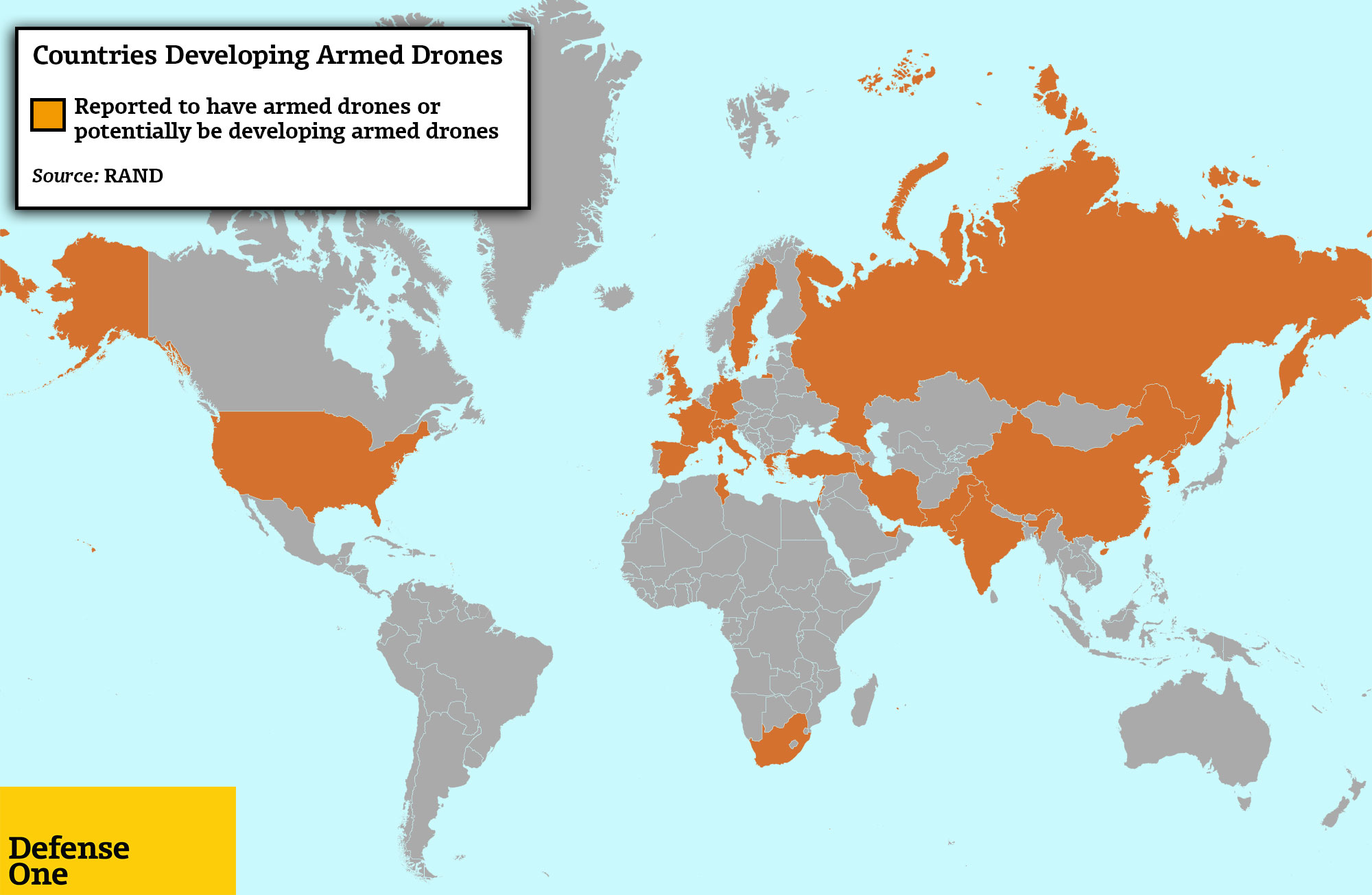
Patrick Tucker reports that it’s likely that nearly every country will have armed drones within 10 years:
After the past decade’s explosive growth, it may seem that the U.S. is the only country with missile-carrying drones. In fact, the U.S. is losing interest in further developing armed drone technology. The military plans to spend $2.4 billion on unmanned aerial vehicles, or UAVs, in 2015. That’s down considerably from the $5.7 billion that the military requested in the 2013 budget. Other countries, conversely, have shown growing interest in making unmanned robot technology as deadly as possible. Only a handful of countries have armed flying drones today, including the U.S., United Kingdom, Israel, China and (possibly) Iran, Pakistan and Russia. Other countries want them, including South Africa and India. So far, 23 countries have developed or are developing armed drones, according to a recent report from the RAND organization. It’s only a matter of time before the lethal technology spreads, several experts say.
Friedersdorf blames the US for not setting norms for drone use while we still had a virtual monopoly on the technology:
There’s no way to go back and undo what we’ve done. But it remains the case that the sooner we start thinking farsightedly about the international drone norms that we want, the more we can do to bring them about. The best chance for future success would require us to put constraints on American behavior before other countries match our technology. That would create a short-term disadvantage, but it could pay huge long-term dividends.
Instead, the United States seems intent on developing weaponized drones that also operate autonomously. By the time an article can be written about how every country will have that technology available to them, it will be too late to stop it.
Meanwhile, Michael Horowitz fears that the Pentagon may be squandering our advantage:
As military robots shift from filling niche capabilities like bomb disposal to performing essential tasks throughout the military, they will challenge existing status hierarchies in the services. Likewise, as these devices become more capable of working with manned systems to multiply the effectiveness of U.S. forces or replace manned forces in some instances, they will require changes not only in the way the services fight, but also in the way they have thought about recruiting, training, and promoting since the creation of the modern American defense establishment in 1947. Those are threats to the military’s very identity — and they will provoke bureaucratic pushback.
Zack Beauchamp examines what can be done to change that:
[CSIS drone expert Sam] Brannen wants to create a new office in the Pentagon: the Defense Unmanned Systems Office (DUSO), with a whole staff dedicated to streamlining drone spending and thinking creatively about which systems could help the US innovate strategically and tactically.
This central drone office, DUSO, would coordinate “the cross-[Department of Defense] research, development, testing and evaluation” budget. It would also “conduct a review across existing DoD roles and missions to determine potential areas where unmanned systems technology could create military advantage” in order to “energize the use and development of unmanned systems beyond” surveillance and counterterrorism.
Every year, Washington’s think tank community produces countless reports with policy recommendations; most of them go nowhere. But, much to Brannen’s surprise, DUSO somehow ended up in congressional legislation.
 The Dish