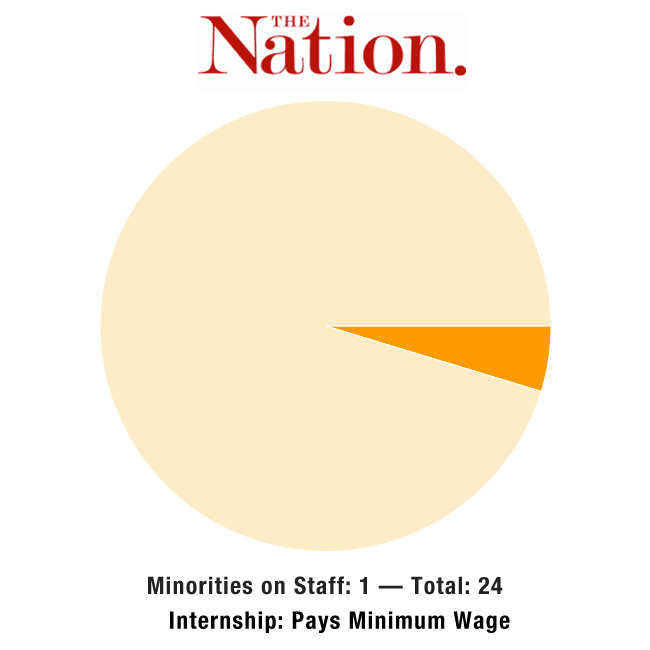
Gabriel Arana, the only member of an ethnic minority on the staff of The American Prospect, examines why the newsrooms of progressive publications’ are so monochromatic and how that undercuts their social mission:
Nearly 40 percent of the country is non-white and/or Hispanic, but the number of minorities at the outlets included in this article’s tally—most of them self-identified as liberal or progressive—hovers around 10 percent. The Washington Monthly can boast 20 percent, but that’s because it only has nine staffers in total, two of whom belong to minority groups. Dissent, like the Prospect, has one.
Given the broad commitment to diversity in our corner of the publishing world, why is the track record so poor? …
[T]he primary reason magazine staffs are so white is structural. “We practice fairly specialized form of journalism and the pool of people who do it isn’t terribly large to begin with, and then you look at the group of people who are practicing at a higher level and it’s just not a diverse pool,” [The New Republic editor Franklin] Foer says.
The road that ends with a spot on staff at places like The New Republic, The Atlantic, or the Prospect is paved with privilege. It starts with unpaid internships, which serve both as training grounds and feeders to staff positions. “Most of our staff comes through our intern program,” says Harper’s editor Ellen Rosenbush. “Do we get as many applicants of color as we’d like? Probably not, but we do get them and we have hired them.” There’s a straightforward reason for the dearth of intern applications: Those who can afford to rely on mom and dad for a summer or a semester tend to be well-off and white.
Alyssa responds:
Relying on your network is a way to speed up the hiring process. You can discard résumés that do not come backed by personal recommendations, or skip reading résumés altogether and just start talking with candidates who have been identified for you.
If organizations could remove time pressure from the hiring process, that network would become less necessary. Hiring managers and editors could take the time to read résumés, cover letters and clips from a much larger pool of applicants. If someone promising does not come in during the initial wave of applications, the publication can repost or revise the job ad and reach out to more potential sources of candidates.
 The Dish