Hugh Byrd and Steve Matthewman warn that electrical blackouts are “becoming increasingly common” across the globe and “will only get more frequent and severe”:
Electricity systems are complex, high-tech assemblages in which small failures can interact in unanticipated and often incomprehensible ways. The North American grid, for example, is
arguably the world’s largest machine, but is highly fragmented. It crosses borders and regulatory zones and has no single owner or manager. Over 3,100 utility companies are on it.
Other continent-scale grids have similar weaknesses. The vulnerability of such systems is demonstrated by the Italian blackout of 2003. The event began when a falling tree broke a power line in Switzerland; when a second tree took out another Swiss power line, connectors towards Italy tripped and several Italian power plants failed as a result. Virtually the whole country was left without power. It says something when a nation can be brought to a halt by two trees falling outside its borders. …
Resource depletion is already having an effect on countries that rely on fossil fuels such as coal for electricity generation. Countries with significant renewable resources are not immune, either. Weather is not predictable and is likely to become less so, courtesy of climate change: in the past decade shortages of rain for hydro dams has led to blackouts in Kenya, India, Tanzania and Venezuela. Deregulation and privatization have created further weaknesses in supply as there is no incentive to maintain or improve the grid. Almost three-quarters of US transmission lines and power transformers are more than 25 years old and the average age of power plants there is 30 years.
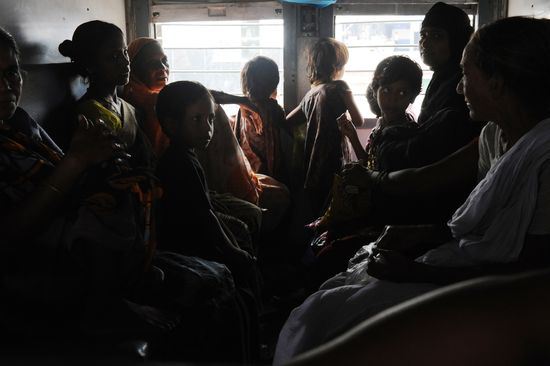
(Photo: Indian women and children wait inside a darkened train carriage at a railway station in New Delhi on July 31, 2012. A massive power failure hit India for the second day running as three regional power grids collapsed. By Roberto Schmidt/AFP/Getty Images. Dish coverage of the blackouts here.)
 The Dish