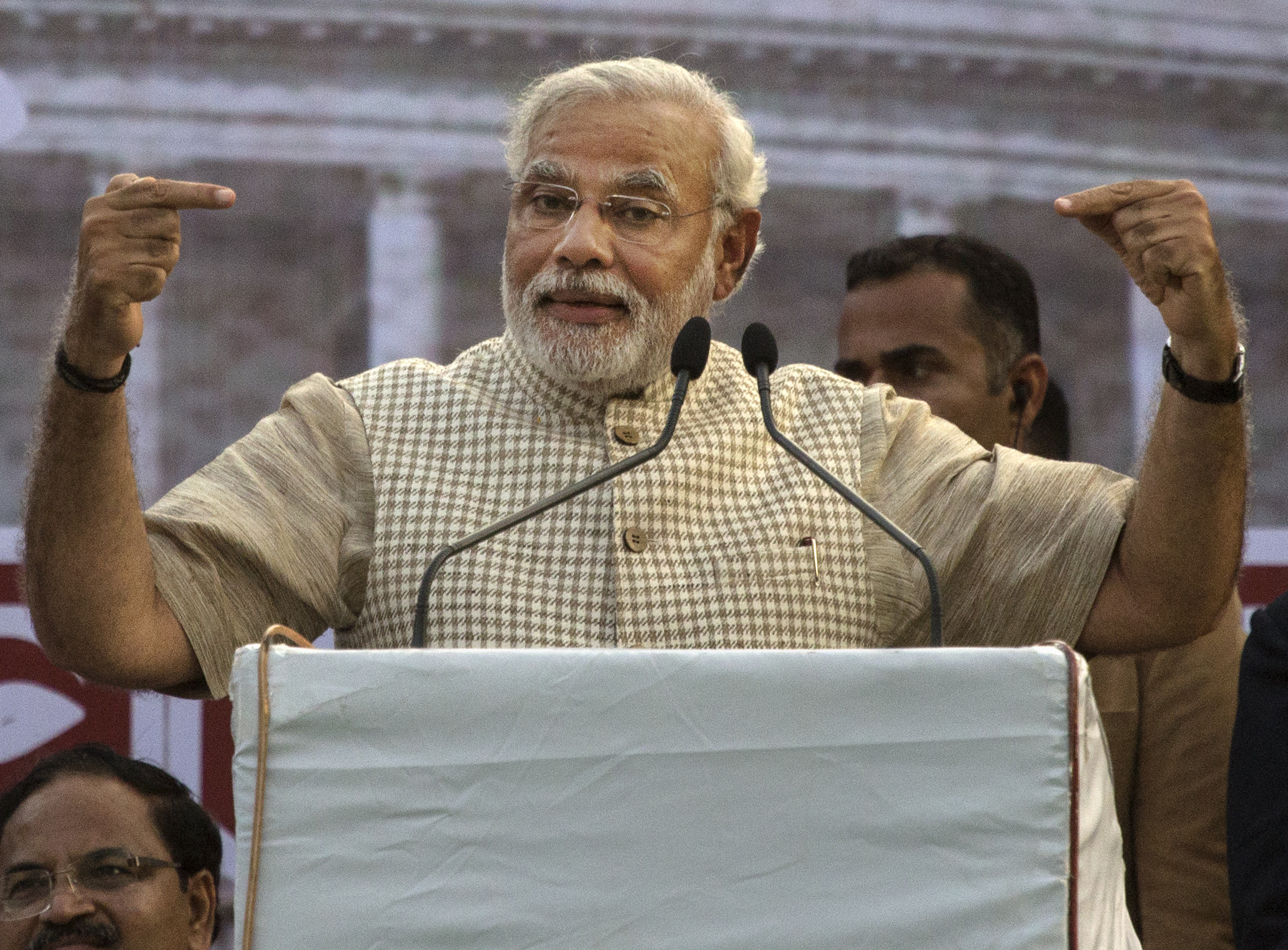
Narendra Modi, as expected:
According to Reuters, Modi’s Hindu nationalist Bharatiya Janata Party and allies (altogether as the National Democratic Alliance) are leading in races for 337 of 543 available parliamentary seats, more than six times the number of their next [closest] rival. It looks to be the most lopsided election victory in India in more than 30 years.
Meanwhile, Rahul Gandhi, leader of the Congress Party campaign, was leading his race by a slim margin, and a loss there would be particularly embarrassing considering that the seat he is running for has been held by his uncle, father, and mother before him — all former titans of Indian politics. The Economist notes that, “Newspapers report that Rahul Gandhi left the country earlier this week, which looked not only like an admission of defeat but an abdication of responsibility (he has since returned).”
Daniel Berman thinks Modi represents a sea change in Indian politics:
Almost everyone over 45 who I spoke with opposed him; every single person I spoke with under 40 was voting for him. Why? Because Modi this year offered a different narrative, one that is far more attuned to Indian aspirations than the one it has been cast in.
Rather than seeing India as a leader of the developing world and a peer of Brazil, Modi and the BJP portray it as a sleeping developed country, a peer of European and Chinese civilization as one of the three great cultures of world history, condemned by invasion, Arab in the 9th century, not British in the 19th, to weakness and underdevelopment. For Modi and the BJP, Congress by embracing non-alignment and its sequel in the BRIC concept had condemned India to underdevelopment, using its affirmative action programs to turn one of the most effective civil services in the world into one of the world’s least efficient and corrupt.
Chandrahas Choudhury looks back at how India’s democracy has evolved in recent years:
Even five years ago, Indian democracy had hot spots — mainly urban centers and more developed states — as well as black holes, where information from the world did not penetrate and even democracy took on a largely feudal cast. Newspapers and television controlled public discourse, and what they chose to ignore, the country did not debate. Today, a single tweeted picture or YouTube video spreads like wildfire on the Internet, meaning that many more people can participate in the national conversation. Television has flattened the differences between city and village, rich and poor, raising expectations across the board.
It’s a new environment ideal for a presidential-style election in which a party invests all its energies in one candidate: in this case, the Bharatiya Janata Party’s Narendra Modi. Modi himself (Twitter followers: 4 million) is probably the Indian politician who best understands the power of social media and the Internet, and his election machine includes a large Internet force, including, some reports say, a 2 million-strong volunteer squad that fights battles for him online.
But Jayati Ghosh worries about what Modi’s win means for India’s Muslims:
The “communal peace” that has supposedly prevailed in Gujarat since [the pogrom against Muslims during Modi’s time as chief minister] has been achieved at a tremendous cost to the minorities, essentially by terrorising them into submission. Muslim families and individuals are increasingly ghettoised, finding it impossible to buy or rent accommodation in dominantly Hindu areas. Muslim youths are not only discriminated in employment but much more exposed to being picked up, interrogated and even imprisoned on mere suspicion of being terrorists. Bank loans are hard to come by for people from minorities, and intercommunity social mingling, particularly between young men and women, is frowned upon.
That this “peace of the graveyard” may be extended across India is a frightening prospect. … In a speech in West Bengal, Modi declared that only Hindu migrants from Bangladesh were welcome; the others would be repatriated. His henchmen declared in Uttar Pradesh that anyone who did not support Modi should go back to Pakistan, where they belonged. That all this belligerence only seems to have helped them at the polls is alarming.
Max Fisher focuses on Modi’s foreign policy ideas, which are also troubling:
His anti-Muslim rhetoric, and his past accusations that political opponents are “Pakistani spies,” suggests he would worsen rather than improve relations with Pakistan. The two countries are armed with nuclear weapons, have frequent and ongoing disputes, and have fought several wars, most recently a 1999 conflict that got dangerously close to open nuclear warfare.
Modi’s party has already suggested it may revise the country’s “no first use” policy, by which India promises not to launch nuclear weapons except to defend against a nuclear attack. In other words, a Modi-run India would lower its standards for nuking another country.
Adam Taylor points to the other big story of the day, which is the Congress Party’s unprecedented crushing defeat:
Congress Party has long been a mainstay of Indian politics. It was the party that won India its independence, led by men like Mahatma Gandhi and Jawaharlal Nehru, India’s first prime minister. Since 1947, the center-left party has remained the dominant party, and for the last 10 years it had led India under Prime Minister Manmohan Singh.
So what explains this historic defeat? The “WhyCongressLost.In” thinks it knows why: Rahul Gandhi. The Web site is one of those delightful single serving Web sites that has popped up over the past few years. All it does is serve you up random quotes from Gandhi, including such gems as:
People call us an elephant.. We are not an elephant.. we are a beehive.. it’s funny but think about it. Which is more powerful? an elephant or a beehive?
The Bloomberg editors give Modi some free advice on how he should govern:
A good place to start would be to keep an election promise to introduce a combined goods and services tax — something his own party has long opposed because it would force revenue losses on state governments. (Modi should offset some of the losses using central revenues.) He should move to phase out petroleum subsidies. He should give state and local governments much greater flexibility in regulating labor markets, land sales and more. Economic competition among the states — a model that Modi has long advocated — is the best way to push the national economy forward.
True, several of those state governments will be run by political rivals. So much the better. Like any leader claiming a clear mandate, Modi will be tempted to ride roughshod over his weakened opponents. His record in Gujarat is not reassuring in this regard. From Russia’s Vladimir Putin to Turkey’s Recep Tayyip Erdogan, such charismatic figures tend to overreach, weakening their nations in the end. Modi would do better to find common ground. On economic policy, that shouldn’t be impossible.
Michael Schuman considers the monumental task Modi faces in fixing the Indian economy:
What Modi will have to do is no secret. More than two decades after Manmohan Singh (now the outgoing prime minister) began dismantling the web of controls on private enterprise known as the License Raj, the bureaucracy has struck back. The deregulation never went far enough, and that has allowed India’s meddlesome civil servants to impede the progress of critical investments. Many large-scale projects have stalled, while new ones have almost evaporated. Businessmen struggle to acquire land and get environmental approvals and other permits.
The World Bank ranks India a miserable 134th out of 189 countries on its ease of doing business index, which measures the difficulties faced starting a company, dealing with construction permits and other factors behind competitors like China or Indonesia. Without a boost to investment, the economy will continue to stagger. That means Modi will have to strip out red tape and streamline bureaucratic procedures to make it less burdensome for companies to invest and create jobs. On top of that, Modi will have to speed along improvements in the country’s strained infrastructure — from roads to ports to power — to bring down the costs and enhancing the efficiency of doing business.
(Photo: BJP leader Narendra Modi gestures as he speaks to supporters after his landslide victory on May 16, 2014 in Vadodara, India. By Kevin Frayer/Getty Images)
 The Dish