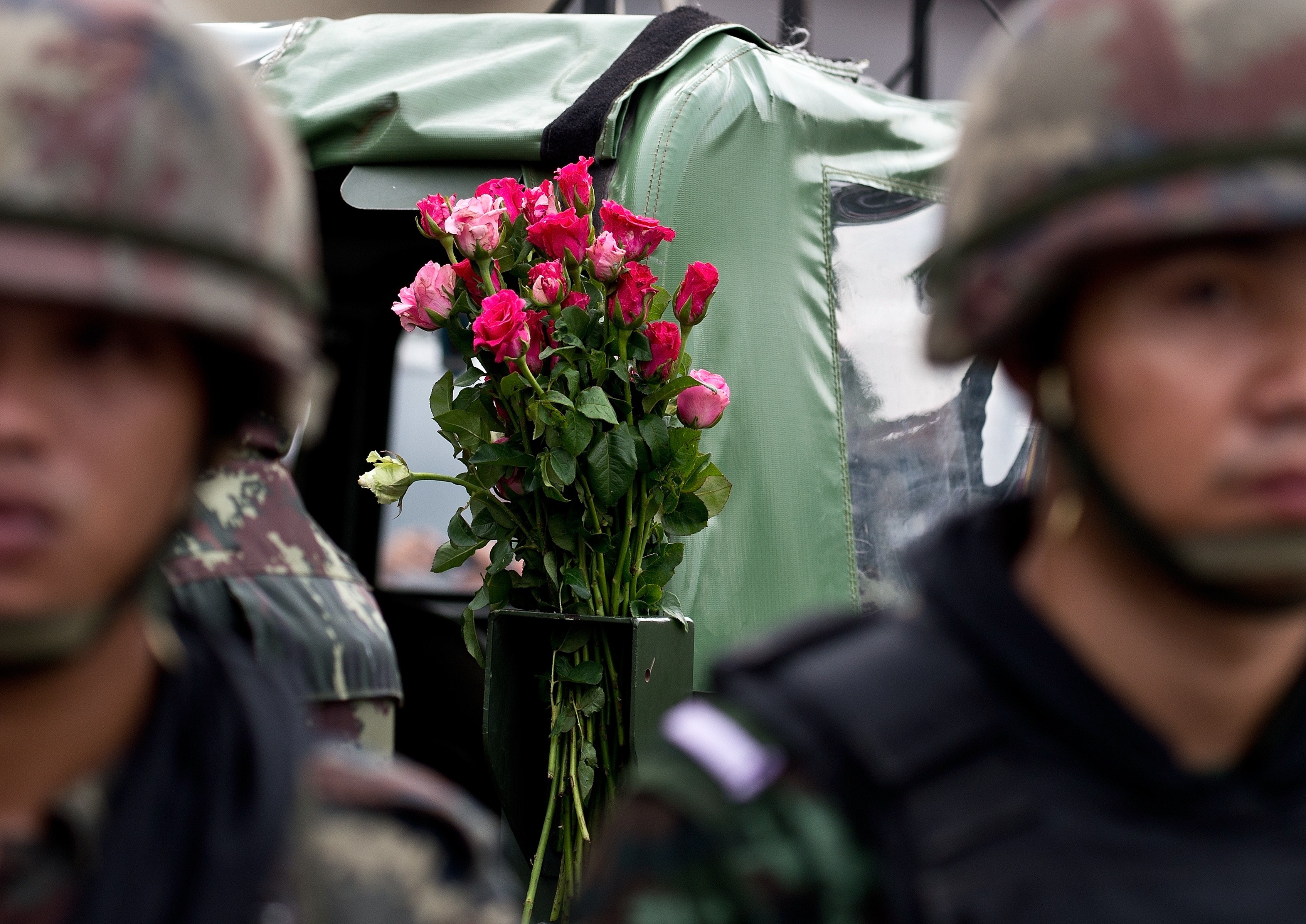
General Prayuth Chan-Ocha, the leader of last week’s coup d’etat in Thailand, announced yesterday that the coup had received the blessing of King Bhumibol Adulyadej. Ritika Singh considers the “convoluted” relationship between the monarch and the military a big part of the country’s problem:
The ailing King, who enjoys prestige in Thailand that is hard for Westerners to understand, has been largely absent from this recent political crisis. There has been speculation about his role behind the scenes, but his lack of open involvement—unlike in previous crises—could actually have exacerbated this situation. The monarchy and the military have been intricately tied together for decades, and the King has supported many of the coups that have plagued Thailand. At the end of the day, what the King wants, goes. Thais who believe that the King’s playing puppet master to the country is preferable to the machinations of inept politicians, again, do not see the long-term erosion of democratic institutions that this induces.
The Thai military’s adventurism in its country’s politics—and the popular support for it—demonstrates how complicated the problem of extricating the military from politics still is in many developing countries. Thailand is not alone here. It is one of the biggest hurdles to a democratic transition in Pakistan, Egypt, and other countries as well. If the role of the military and people’s attitudes toward it don’t change, the endless cycle of coups won’t change either.
Recalibrating his prognosis for Thailand, Jay Ulfelder expects that the “risk of yet another coup will remain elevated for several years.” Furthermore:
Thailand’s risk of state-led mass killing has nearly tripled… but remains modest.
The risk and occurrence of coups and the character of a country’s national political regime feature prominently in the multimodel ensemble we’re using in our atrocities early-warning project to assess risks of onsets of state-led mass killing. When I recently updated those assessments using data from year-end 2013—coming soon to a blog near you!—Thailand remained toward the bottom of the global distribution: 100th of 162 countries, with a predicted probability of just 0.3%. If I alter the inputs to that ensemble to capture the occurrence of this week’s coup and its effect on Thailand’s regime type, the predicted probability jumps to about 0.8%.
That’s a big change in relative risk, but it’s not enough of a change in absolute risk to push the country into the end of the global distribution where the vast majority of these events occur.
Uri Friedman sees Thailand as an example of a new trend, in which the middle class chooses stability through military rule over democracy with less certain outcomes:
[T]he Thai military’s express goal in seizing power this week was to restore political stability and economic growth. And the move followed massive anti-government protests, just like the coup in Egypt that overthrew Mohammed Morsi last year. In both Egypt and Thailand, the protest movements that prompted military intervention enjoyed support from middle- and upper-class citizens. These aren’t isolated cases. Joshua Kurlantzick, a fellow at the Council on Foreign Relations, has argued that around the world, a growing middle class “is choosing stability over all else,” and embracing “the military as a bulwark against popular democracy.”
The idea of a popular, “middle-class military coup” isn’t necessarily new—it has echoes in Latin America in the 1960s and 70s—but it’s making a comeback in the few coups we’re still seeing today, with troubling implications for democracy in the countries where they take place.
Jessica Schulberg contemplates the US response:
That the U.S. is now legally bound to do something that would be contrary to its interests—and not necessarily beneficial to the Thai people—raises doubts about the utility of Section 508 of the Foreign Assistance Act [which requires cutting aid to countries that experience military coups]. “Laws that don’t have escape clauses, like national interest waivers or national security waivers, almost never work,” said a former State Department official. “All that happens is that the government will either deny the obvious—say it’s not a coup—or if the government allows itself to be bound by it, it is deprived of the necessary flexibility in coping with each unique circumstance.”
(Photo: Roses given by coup-supporters decorate a military vehicle as Thai army soldiers stand guard at the Victory Monument in Bangkok on May 27, 2014. By Manan Vatsyayana/AFP/Getty Images)
 The Dish