Max Fisher characterizes the foreign policy doctrine laid out in Obama’s West Point commencement address as one of the most dovish in decades:
The case where Obama made his argument for dovishness most tellingly was, interestingly, on terrorism — the foreign policy issue where he has been consistently the most hawkish. No, Obama did not announce he was grounding the drones, but he made a telling case for continuing even this sole hawkish element of his foreign policy in a way that more aligned with dovish principles.
“The most direct threat to America at home and abroad remains terrorism,” Obama said, citing this as a reason for the US’s continued interest in Afghanistan and Syria, among other global hot spots. But he said the US should fight terrorism not with direct military action but indirectly. “I believe we must shift our counter-terrorism strategy – drawing on the successes and shortcomings of our experience in Iraq and Afghanistan – to more effectively partner with countries where terrorist networks seek a foothold,” he said. “We need a strategy that matches this diffuse threat; one that expands our reach without sending forces that stretch our military thin, or stir up local resentments.”
In other words, the US will continue its global fight against terrorism — the one bullets-and-bombs fight that Obama said necessitated American involvement — but will do it by shifting more to relying on regional governments that share America’s concerns about terrorism. The upside is that this means a lower US military commitment, the downside is that it will continue America’s long and ugly history of working with (and thus helping to prop up) despotic regimes.
What the fuck is “dovish” about that? It’s a judgment about how best to defeat Islamist terror, not an argument that we shouldn’t. This entire hawk-dove framework, after the last two decades, is asinine. David Corn’s takeaway from the speech is that there is no “Obama doctrine”:
For years, Obama has been trying to form and sell a balanced approach that justifies certain military interventions and limits others—while redefining national security interests to include climate change and other matters. That’s a tough task. The world is not a balanced place. It’s likely that Obama’s handling of foreign policy will continue to be judged on a case-by-case basis and less on the establishment of an integrated doctrine. Given the global challenges of this era, a grand plan may not be realistic.
I stand by my view that Obama is an old-school conservative in foreign policy (with some unfortunate liberal impulses). His obvious predecessors in style and substance are Eisenhower and George H.W. Bush. And Joe Klein considers that wise:
The President made no threats or promises that he couldn’t carry out, which was a relief. He refused to cave to his feckless domestic opponents–and he paid no commitment other than lip service to the human rights activists who represent a significant strain on his foreign policy staff. He offered no bright line “Obama Doctrine,” which is probably a very good thing. The last President who stood at West Point and offered a Foreign Policy Master Plan was George W. Bush, who made the case for pre-emptive war in 2002. We know where that led. The only appropriate doctrine in a world where the American military–and military spending–is peerless has to be subtle and humble: We’ll take each case as it comes. We’ll lead coalitions to help solve the problems of the world, but we also reserve the right to defend ourselves unilaterally against direct security threats. We will be prudent in word and deed. We won’t bluster about our “indispensability” but will prove it through our actions.
But Goldblog wishes Obama would dream bigger:
Foreign policy, for him, is a management challenge: containing threats, quieting unhappy allies, limiting damage. There is no particular vision associated with his detached, cold-eyed approach to foreign affairs. He recently described his policy this way: “You hit singles; you hit doubles; every once in a while we may be able to hit a home run.”
This is an accurate rendering of presidential reality, and yet it is strikingly unambitious, especially from a politician who initially promised so much. Obama is not the analyst in chief. He sometimes seems hesitant to set lofty goals — stopping the slaughter in Syria, rolling back the advance of autocracy — because he’s afraid that the words would commit him to action. This is understandable, given the rhetorical and actual overreach seen during George W. Bush’s first term. And yet setting impossible goals, shining-city-on-a-hill goals, speaks to the noblest part of the American experience. No, this does not mean the deployment of U.S. forces to fix problems that don’t need a military fix. It means looking for ways to advance the cause of freedom, which is the traditional role of the U.S. in the world.
My own view is that too aggressive an attempt to “advance freedom” would also misunderstand what we’ve learned from Iraq and Afghanistan, and the entire neocon project. Less is sometimes more. Imposition of “freedom” is not the same as a culture’s and a society’s indigenous maturation into modern secularism. That can be coaxed, encouraged, supported – look at the Burma policy – but a light touch is often the best option. Drum appreciates Obama’s acknowledgement that over-reliance on our military power has gotten us in huge trouble:
It’s nice to hear Obama say this so directly. Oh, the usual suspects will howl, but no one who has paid even the slightest attention to the history of the past 50 or 60 years can really question this. Our world isn’t yet beyond the need for war, but for war to be an effective instrument of policy it needs to be used judiciously. It needs to be used when core interests are at stake and, equally importantly, it needs to be used only when it’s likely to succeed on its own terms. If we don’t know how to win, or if we have unrealistic ideas of what it even means to win—both of which were the case in Afghanistan and Iraq—then we shouldn’t fight. This isn’t a matter of deep foreign policy thinking, it’s just common sense. Like it or not, there are lots of problems in the world that US military force can’t solve.
Carpenter calls the speech “magnificently sane.” The Bloomberg View editors, however, weren’t satisfied:
Set aside the contradiction between Obama’s boilerplate about how “America has rarely been stronger relative to the rest of the world” and his warnings, barely two breaths later, about China’s burgeoning military, Russia’s belligerence and the competing aspirations of a new global middle class. And never mind the awkward facts he didn’t mention, whether Russia’s absorption of Crimea or the growing nuclear threat posed by North Korea. Most troubling is the mushiness of the initiatives he proposes as a way to extend U.S. leadership without putting boots on the ground.
Start with the request to Congress for a new Counterterrorism Partnerships Fund of as much as $5 billion. Building the capacity of other nations to fight terrorism is a good investment. This proposal, though, seems more like a slush fund — covering everything from helping Syria’s neighbors cope with the turmoil next door and training security forces in Yemen to “facilitating French operations in Mali.” Such programs require the closest supervision: Mali’s 2012 coup, for instance, was led by an officer who received U.S. military training. Meanwhile, potentially working against such efforts is a planned cut of $1.6 billion in U.S. humanitarian assistance to strife-torn countries.
Neither was Kori Schake:
The president speaks of the United States as the world’s indispensable nation and cites three examples: “When a typhoon hits the Philippines, or schoolgirls are kidnapped in Nigeria, or masked men occupy a building in Ukraine — it is America that the world looks to for help.” But in two of those crises, the United States has done next to nothing.
Neither was Thomas Wright:
[T]he president failed to explain how he will use non-military tools to exercise leadership in the international order. Astonishingly, he did not mention trade once, despite the fact that his administration is actively negotiating the Trans Pacific Partnership and the Transatlantic Trade and Investment Partnership. Surely this would be a natural place to start for a foreign policy that looks to shape the international order without intervening militarily. It will confirm fears that this administration is unwilling to invest political capital to achieve a breakthrough on trade. He also did not distinguish between military power, which can be used to deter, and the use of force, instead choosing to lump them together.
Neither was David Rothkopf:
[H]e did not address in a meaningful way perhaps the greatest weak spot in his foreign policy. He has no middle game. The United States is well-prepared to win a global conflict of the type we all hope must never be fought. He is very comfortable with minimalist, orthoscopic, pinprick responses to problems. But most of the challenges we face, from Russia in the Crimea to Assad in Syria to China in the East and South China Seas, are middle-range problems,where neither a big war nor a big speech will get the job done. Yet time and again, especially during this president’s second term in office, this administration has proven that beyond empty or limited gestures — a few sanctions on Putin’s Russian cronies, legal action against Chinese PLA officers who will never see the inside of a court, halting efforts in Syria that have only empowered Assad — it lacks the creativity, will, or appetite for moderate risk to undertake effective responses.
Larison was especially dissatisfied:
As expected, Obama’s commencement speech at West Point contained very little new or interesting, rehashed many familiar boilerplate arguments about U.S. “leadership,” the “indispensable nation,” and American exceptionalism, and trotted out caricatures of opposing positions to use as foils for the rest of Obama’s remarks. If we judged it solely as a commencement address to West Point graduates, it would probably be viewed as a well-delivered but largely uninspired recitation of some basic liberal internationalist themes combined with a survey of current administration policies. Judged against the expectations that the White House set for the speech (a “broad vision,” the start of a new “foreign policy offensive”), it has to be considered a weak effort. It will persuade no one that wasn’t already on board with the vast majority of what Obama has done, and that leaves a great many people unsatisfied.
Ambers is not quite so critical:
Obama never uses crises in the way that others have. The Arab Spring was a managerial problem from day one. Critics still bash him for failing to side with the true democrats, but really, even today, who the heck are the true democrats? Who stands for American values? Whose version of freedom is closer to ours? What Obama understands, and perhaps understands to a degree that limits his willingness to say otherwise, is that the American version of freedom cannot be exported under current conditions. Maybe in the future, things will change. But now, they cannot.
And Fred Kaplan pushes back on one common critique:
President Obama’s speech at West Point on Wednesday morning could be called a tribute to common sense, except that the sense it made is so uncommon. The ensuing cable pundits’ complaints—that it was insufficiently “muscular” or “robust”—only proved how necessary this speech was. Obama’s point was not (contrary to some commentators’ claims) to draw a “middle-of-the-road” line between isolationism and unilateralism. That’s a line so broad almost anyone could walk it.
The president’s main point was to emphasize that not every problem has a military solution; that the proper measure of strength and leadership is not merely the eagerness to deploy military power; that, in fact, America’s costliest mistakes have stemmed not from restraint but from rushing to armed adventures “without thinking through the consequences, without building international support and legitimacy for our action, without leveling with the American people about the sacrifice required.”
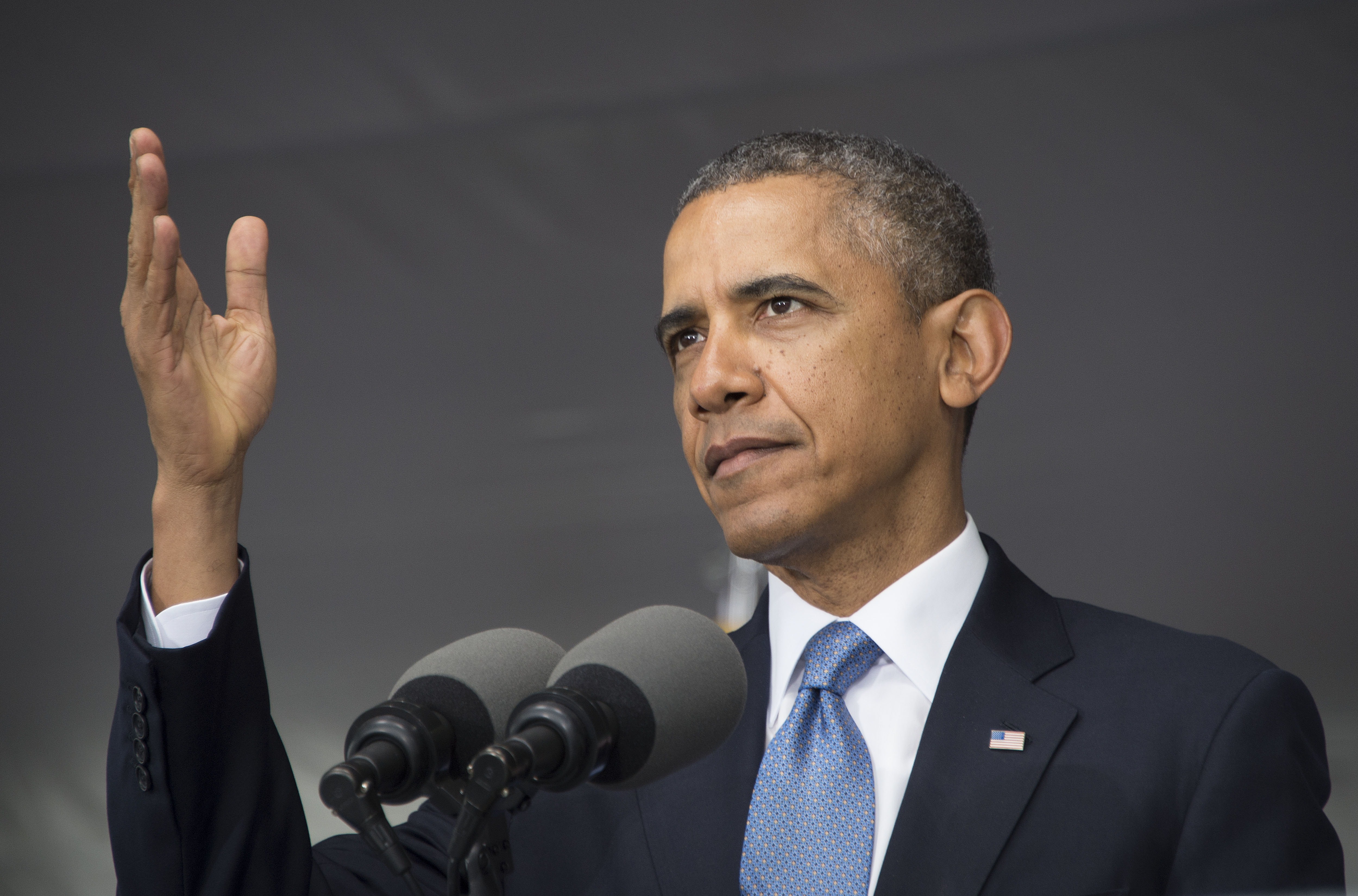
(Photo: US President Barack Obama delivers the commencement address to the 2014 graduating class at the United States Military Academy at West Point, New York, May 28, 2014. By Jim Watson/AFP/Getty Images.)
 The Dish