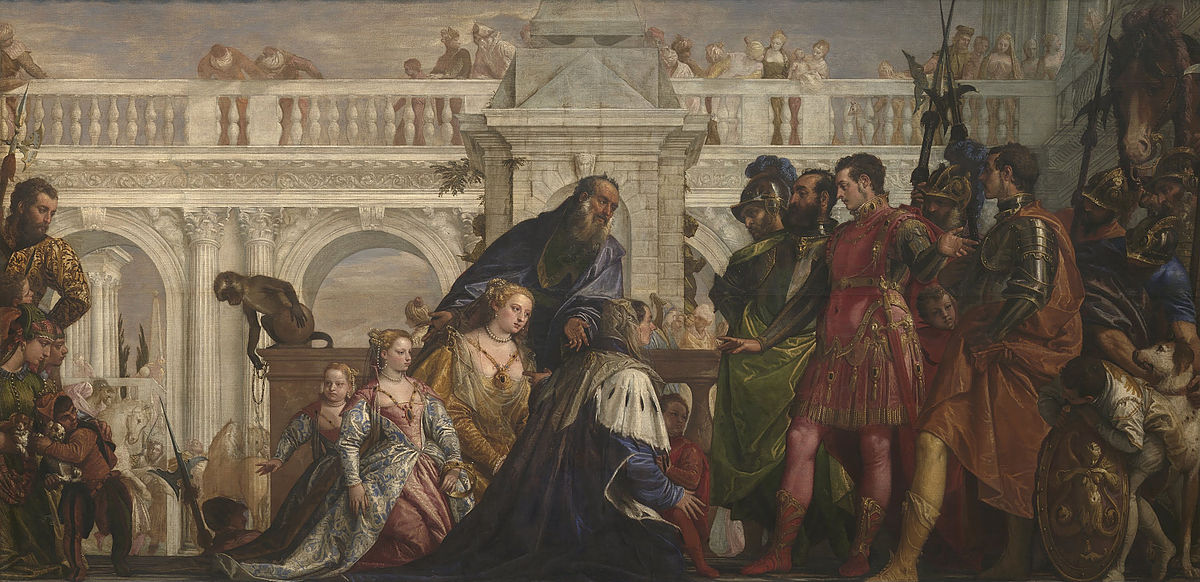
Andrew Butterfield praises “signs of renewed interest” in the art of Paolo Veronese, who, he says, “has often been regarded as a gifted but superficial painter.” He singles out The Family of Darius before Alexander, seen above, as a work “long regarded as among the greatest Venetian paintings”:
The Family of Darius before Alexanderreveals the seriousness of purpose with which Veronese worked. As few other painters of the Renaissance, he sought to make images that drew on the resources of all the arts, not just painting. Veronese had studied sculpture first, and the experience remained fundamental to his approach to image-making. His idea for any picture began with the main figure or figures, which he planned by emphasizing strong motion and forceful disposition in space. Like so many sculptors in the Renaissance, he saw the movements and gestures of the figures, not the expressions on their faces, as the primary means for conveying the emotional content of a scene.
Butterfield goes on to note that Veronese drew inspiration from architecture, theater, and even rhetoric:
Veronese’s style is overtly rhetorical. In the Renaissance, painting was often said to be a form of mute poetry, but Veronese’s first biographer, Carlo Ridolfi, writing in 1646, instead compared his art to oratory. This comment may appear to emphasize the artificial, ceremonial, and unnatural qualities of Veronese’s art. But it was meant as praise:
in the Renaissance, rhetoric was seen as the foundation of the humanities. It is striking to note that in 1557, the year after he published the first Italian edition of his commentary on Vitruvius, Daniele Barbaro also published a treatise about literature and rhetoric calledOn Eloquence. There he praisesgrandezzaas the highest and most sublime style, appropriate for the most elevated topics. The elements he names as the main components ofgrandezza—majesty, vehemence, splendor, vivacity—read almost like a list of the qualities of Veronese’s art. …
Veronese’s prodigious facility, love of magnificence, and untroubled service to the dreams of wealthy clients were all counted against him for much of the twentieth century. Few great artists have seemed less radical or rebellious. But this reaction overlooks his own ambitions as a painter. The show at the National Gallery makes it possible again to see why so many writers were drawn to this artist, and why so many painters, from Annibale Carracci and Giambattista Tiepolo to Delacroix and Cézanne, thought of Veronese as one of the supreme masters of art.
(Image: The Family of Darius before Alexander, 1565–1567, via Wikimedia Commons)
 The Dish
