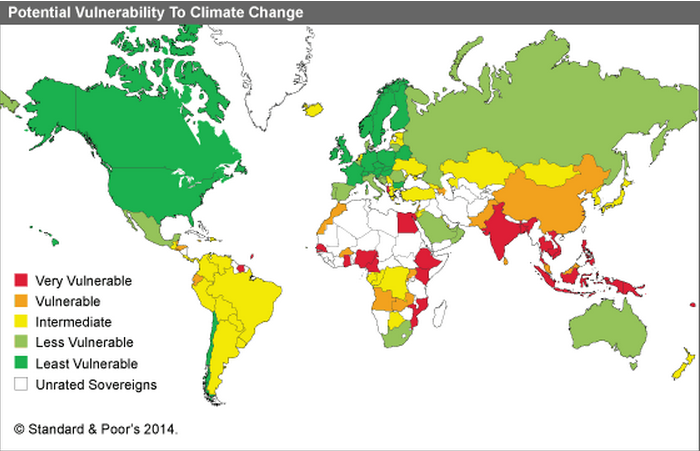
John McDuling notes that credit agencies, at least, seem to be taking climate change seriously:
Over the past week or so, one of the most prominent credit agencies, Standard & Poor’s, has, in a series of reports, attempted to quantify the financial impact of climate change. The company looked at the impact of changing weather patterns on various industries, including utilities and insurance.
Among other things, the ratings agency ranked nations based on the percentage of their population living below an altitude of 5 meters (about 16 feet), their share of agriculture in total economic output, and their ranking in the GAIN Vulnerability Index, a measure developed by the University of Notre Dame that measures countries’ vulnerability and readiness to deal with climate change.
Stephen Leahy considers the plight of island nations:
The government of [Pacific island nation] Kiribati is hoping to buy thousands of acres on one of Fiji’s islands to relocate its 115,000 residents. While relocation may mean survival, the literal disappearance of their islands risks the overwhelming loss of their culture and identity. When you live on tiny islands in the middle of the enormous Pacific Ocean, land has a very special meaning.
Eric Holthaus and Chris Kirk created an interactive map of country-by-country carbon emissions. The basics:
The world’s top 12 emitters are now China, the United States, India, Russia, Japan, Germany, South Korea, Iran, Canada, Saudi Arabia, Mexico, and the United Kingdom. But it’s not even really close. China now emits more than 20 times what the United Kingdom does, mostly using the same technology that helped England start the Industrial Revolution all those years ago.
The continuing acceleration in global CO2 emissions leads to some crazy numbers: Over the past 10 years, the world has emitted more CO2 than it did from the entire period since the start of the Industrial Revolution up to about 1970. In 2011 alone, the world emitted more than it did in the 30 years between 1850 and 1880. That’s one of the big reasons climate change is such an urgent issue and why we must find a way to stop the trend, and fast: With emissions like these, more than ever, each year matters.
 The Dish