
Hulett’s Landing, New York, 5 pm
Hulett’s Landing, New York, 5 pm
Andrew Bacevich argues that Tom Clancy “was among the first to intuit that the antimilitary mood spawned by Vietnam represented an opportunity”:
What Clancy did was seize the role of Reagan’s literary doppelgänger—what the Gipper might have become had he chosen writing instead of politics after ending his acting career. Clancy’s own career took off when President Reagan plugged Red October as “my kind of yarn.” As well he might: Clancy shared Reagan’s worldview. His stories translated that worldview into something that seemed “real” and might actually become real if you believed hard enough. Reagan was famous for transforming the imagined into the actual; despite never having left Hollywood during World War II, he knew, for example, that he had personally witnessed the liberation of Nazi death camps. Similarly, Clancy, who never served in the military, imagined a world of selfless patriots performing feats of derring-do to overcome evil—a world that large numbers of Americans were certain had once existed. More to the point, it was a world they desperately wanted to restore. Clancy, like Reagan, made that restoration seem eminently possible.
Soon after Clancy’s death, the Washington Post published an appreciation entitled “How Tom Clancy Made the Military Cool Again,” written by a couple of self-described Gen-Xer policy wonks. “Clancy’s legacy lives on in the generations he introduced to the military,” they gushed, crediting Clancy with having “created a literary bridge across the civil-military divide.” His “stories helped the rest of society understand and imagine” the world of spooks and soldiers. Perhaps not surprisingly, those who served or aspired to serve found those stories to be especially gratifying. Clancy depicted American soldiers and would-be soldiers precisely as they wished to see themselves.

Eric Randall shares the story of a high-schooler whose joking edit to Wikipedia became an established truth:
In July of 2008, Dylan Breves, then a 17-year-old student from New York City, made a mundane edit to a Wikipedia entry on the coati. The coati, a member of the raccoon family, is “also known as … a Brazilian aardvark,” Breves wrote. He did not cite a source for this nickname, and with good reason: he had invented it. …
About a year later, Breves searched online for the phrase “Brazilian aardvark.” Not only was his edit still on Wikipedia, but his search brought up hundreds of other Web sites about coatis. References to the so-called “Brazilian aardvark” have since appeared in the Independent, the Daily Mail, and even in a book published by the University of Chicago. Breves’s role in all this seems clear: a Google search for “Brazilian aardvark” will return no mentions before Breves made the edit, in July, 2008. The claim that the coati is known as a Brazilian aardvark still remains on its Wikipedia entry, only now it cites a 2010 article in the Telegraph as evidence.
This kind of feedback loop – wherein an error that appears on Wikipedia then trickles to sources that Wikipedia considers authoritative, which are in turn used as evidence for the original falsehood—is a documented phenomenon. There’s even a Wikipedia article describing it.
(Photo of a baby South American coati by Alex Proimos)
“In mixed company, puns are, along with politics and religion, best left alone,” states Ted Trautman, who traveled to Austin, Texas, to compete in the O. Henry Pun-Off World Championships:
Contestants in the “Punslingers” bracket, facing off in pairs onstage, are given a theme—Disney, weather, et cetera—and forced to make thematically relevant puns every ten seconds or so until one contestant runs out of ideas. … Just as a slam-dunk in basketball earns the same number of points as a layup, this portion of the Pun-Off rewards a contestant for the quantity of her puns rather than their quality. As the moderators explained several times, in a refrain later echoed by desperate contestants defending their ripostes, “It doesn’t have to be good. It just has to be a pun.” The Punslingers event may be the only sport on Earth in which the highest level of play is the most painful to watch. …
[M]y favorite moment of the day occurred during a round in which players had to pun on the theme of “Groups (human and animal)”—e.g., flock, herd, choir, and the like.
The two men on stage had exhausted most of the obvious words in the category, and were beginning to butt heads with the moderators…. After a healthy volley one of the contestants offered an invalid answer, and then another, courting disqualification. And then he rebounded with the perfect pun—not the most clever, not the most original, but one that managed to both keep the round going and poke fun at the increasingly strict moderators: “Next year,” he said, “this topic ought to be band.” Despite the limits on both time and topic, this contestant delivered a pun in the heat of the moment that, against all odds, actually made sense. The crowd went wild, perhaps forgetting for a moment that on Monday they would have to return to a world where words mean just one thing at a time.
According to Susan Schulten, it was WWII:
More Americans came into contact with maps during the Second World War than in any
previous moment in American history. From the elaborate and innovative inserts in the National Geographic to the schematic and tactical pictures in newspapers, maps were everywhere. On September 1, 1939, the Nazis invaded Poland, and by the end of the day a map of Europe could not be bought anywhere in the United States. In fact, Rand McNally reported selling more maps and atlases of the European theaters in the first two weeks of September than in all the years since the armistice of 1918. Two years later, the attack on Pearl Harbor again sparked a demand for maps. Two of the largest commercial mapmakers reported their largest sales to date in 1941, and by early 1942 Newsweek had named Washington, D.C. “a city of maps,” one where “it is now considered a faux pas to be caught without your Pacific arena.”
(Map from Port of Seattle Victory Book, 1944, via Seattle Municipal Archives)
“I am afraid to forget. I fear that we human creatures do not forget cleanly, as the animals presumably do. What protrudes and does not fit in our pasts rises to haunt us and make us spiritually unwell in the present. The discontinuities in contemporary life are cutting us off from our roots and threatening us with the dread evil of nihilism in the twentieth century. We may become refugees in an inner sense unless we remember to some purpose. Surely the menace of new and more frightful wars is not entirely unrelated to our failure to understand those recently fought. If we could gain only a modicum of greater wisdom concerning what manner of men we are, what effect might it not have on future events?
It is exceedingly unlikely that I shall ever be able to understand the why and wherefore of war. But sufficient reflection through the mirror of memory may enable me to make sense of my own small career. The deepest fear of my war years, one still with me, is that these happenings had no real purpose. Just as chance often appeared to rule my course then, so the more ordered paths of peace might well signify nothing or nothing much. This conclusion I am unwilling to accept without a struggle; indeed, I cannot accept it all except as a counsel of despair. How often I wrote in my war journals that unless that day had some positive significance for my future life, it could not possibly be worth the pain it cost,” – J. Glenn Gray, The Warriors: Reflections on Men in Battle.
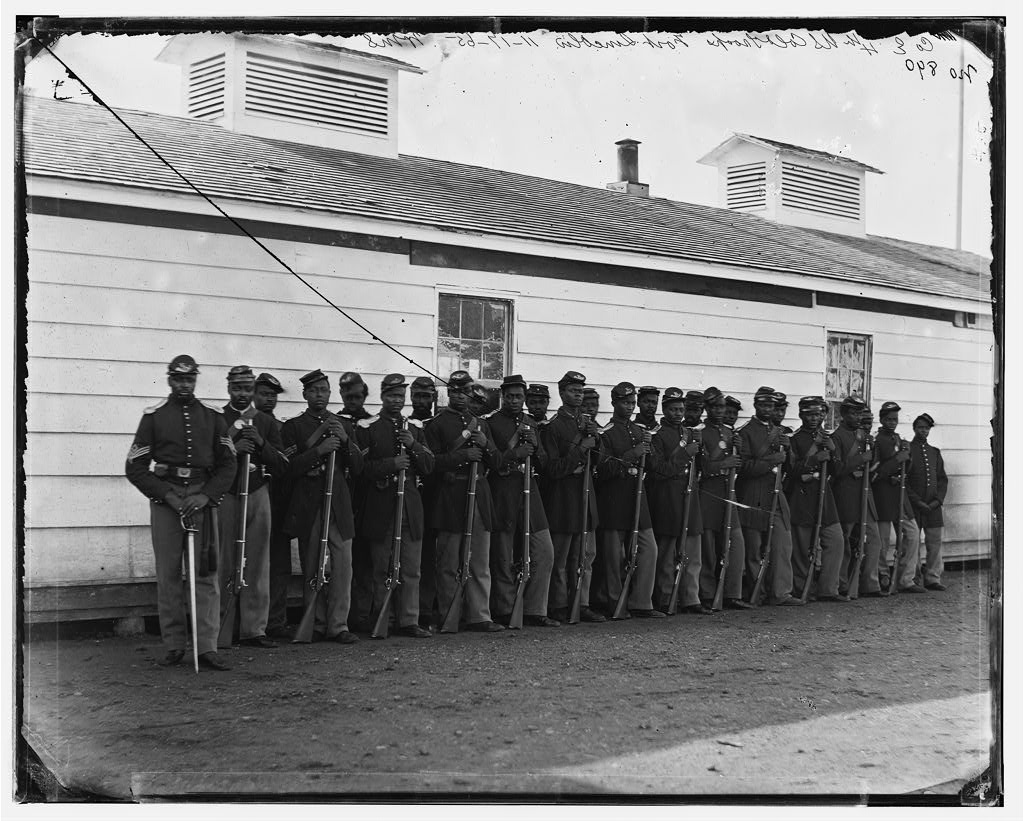
From “The Colored Soldiers” by Paul Laurence Dunbar:
If the muse were mine to tempt it
And my feeble voice were strong,
If my tongue were trained to measures,
I would sing a stirring song.
I would sing a song heroic
Of those noble sons of Ham,
Of the gallant colored soldiers
Who fought for Uncle Sam!In the early days you scorned them,
And with many a flip and flout
Said, “These battles are the white man’s,
And the whites will fight them out.”
Up the hills you fought and faltered,
In the vales you strove and bled,
While your ears still heard the thunder
Of the foes’ advancing tread.Then distress fell on the nation,
And the flag was drooping low;
Should the dust pollute your banner?
No! the nation shouted, No!
So when War, in savage triumph,
Spread abroad his funeral pall—
Then you called the colored soldiers,
And they answered to your call.And like hounds unleashed and eager
For the life blood of the prey,
Sprung they forth and bore them bravely
In the thickest of the fray.
And where’er the fight was hottest,
Where the bullets fastest fell,
There they pressed unblanched and fearless
At the very mouth of hell.
(From War Poems, selected and edited by John Hollander © by John Hollander 1999. Used by permission of Everyman Library. Photo of the men from Company E, 4th United States Colored Infantry, circa 1864, from Library of Congress Prints and Photographs Division)
A biology professor writes:
While the scientific reviews of Nicholas Wade’s new book have been almost uniformly negative, your treatment of the matter seems to have missed the major point of both Wade’s book and the damning criticisms. What Wade gets wrong is not that there are genetic differences among human populations, and that you can tell where a person (or his ancestors) are from by looking at these differences (on this point he is simply correct: the geographic division of humanity into genetically diagnosable groups is not a “social construction,” but a fact of nature). Rather, Wade’s major and unsupported claim is that differences between contemporary human societies are genetic and have evolved extraordinarily quickly.
Here, for example is Jerry Coyne on the book. Allen Orr, in the New York Review of Books, has a very similar view of Wade’s book. Both Coyne and Orr are geneticists, experts in the study of species and their origins (they coauthored a book on the subject 10 years ago). While the fact of geographically-based genetic subdivision (which is what biologists mean by “race”) may drive some to apoplexy, its not news to a geneticist. It’s Wade’s “second part” that doesn’t hold up to critical analysis, and this is what knowledgeable scientific reviews have pointed out.
Wade’s application of genetics to the differences between societies is indeed the most troubling and evidence-starved part of his book. I didn’t miss it; I highlighted Coyne’s and Orr’s reviews last week. And I fully accept “the geographic division of humanity into genetically diagnosable groups.” But what’s the utility of calling those genetic divisions “race”? Having two definitions for race, one biological and one societal, is liable to make individuals think the socially constructed racial categories are exactly the same as the biological ones and lead individuals to incorrectly justify social hierarchies using biology.
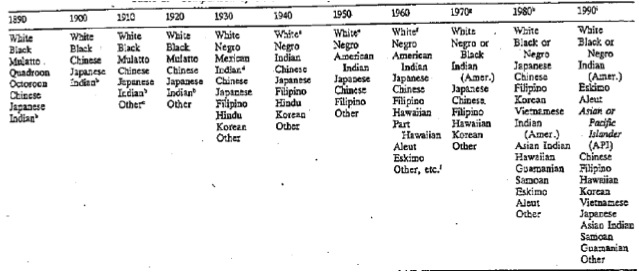
The graphic at the top of this post, from Jennifer Raff’s review of Wade’s book, shows the “United States census classifications of race or color, 1890-1990.” A highlight from Raff’s takedown of A Troublesome Inheritance:
Human biological variation is real and important. I’ve studied it my entire professional career. We can see this variation most easily in physical traits and allele frequency differences between populations at extreme ends of a geographic continuum. Nobody is denying that. Let me repeat this: no one is denying that humans vary physically and genetically. All anthropologists and geneticists recognize that human differences exist. But Wade, and others who agree with him, have decided that certain patterns of variation—those which happen to support their predefined notions of what “races” must be—are more important than others.
Wade’s perspective fits with a larger pattern seen throughout history and around the world. Folk notions of what constitutes a race and how many races exist are extremely variable and culturally specific. For example, the Bible claims that all peoples of the world are descended from Noah’s three sons, mirroring the popular concept of three racial divisions (Caucasians, Africans, and Asians). On the other hand, the five-part division of races seems most “logical” to Wade. Anticipating confusion on this point he claims: “Those who assert that human races don’t exist like to point to the many, mutually inconsistent classification schemes that have recognized anywhere from 3 to 60 races. But the lack of agreement doesn’t mean that races don’t exist, only that it is a matter of judgment as to how to define them” (p. 92).
A matter of judgment. So, rather than being defined by empirical criteria, as Wade had asserted so confidently earlier in the book, it really is just a subjective judgment call. The differences between groups are so subtle and gradual that no objective lines can be drawn, so Wade draws his own on the basis of his own preconceptions.
A reader adds:
It should be mentioned that there are some reputable scientists who defend something like Wade’s conception of broad races, while being much more careful than he is to point out that these are not really discrete groups, that the number of them and boundaries between them are somewhat arbitrary.
You may have seen the recent comments by Jerry Coyne, Steven Pinker and Alan Orr—none of whom is much bothered by Wade’s assertions of race-as-reality, though they’ve all rubbished his grand, gene-based account of human history. Personally, I have yet to see any of these guys fully justify the notion of fixed, coarse racial categories vs. the much more fluid and contextual idea of populations, which exist at various levels of scale and whose definition depends entirely on what you’re interested in learning.
There is a big cultural and, some would say, ideological split between this subset of evolutionary biologists who’ve denounced the “race as social construct” idea as a “myth,” and the majority of anthropologists, who continue to hold that position.
Another reader takes issue with Charles Mills’ speech on the social construction of race:
My gripe with this clip is that it attempts to illustrate the social construction of race by still preserving fairly recent forms of “racial” categorization as its model: i.e. “whiteness” and “blackness.” Mills then goes on to take these categories, which emerged slowly between four hundred and two-hundred and fifty years ago, and transpose them onto the medieval period.
Neither Medieval Europe nor any portion of Sub-Saharan Africa during Medieval days utilized these markers “white” and “black” as social divisions. A more useful alternative universe might imagine a social order in which completely different categorization schemes emerged. For instance, we know that through the early 1700s Europeans were more likely to classify Africans by their “tribal” origins (I’ll leave aside the problematic ways in which the encounter with Europeans actually served to construct these tribal boundaries as they came to be known). As such, where slave traders captured their labor force was a more prominent marker than that labor force’s “blackness.” “Blackness” emerges as a primary marker only after several generations of intermarriage in the Americas among slaves.
So we’re better served, I would argue, imagining a system that eschewed Blackness and Whiteness as the primary dividing line altogether, and imagine a world where, say, the Iberian Moors, with the help of darker skinned Africans from both East and Sub-Saharan Africa succeeded in displacing the authority of Europeans. In such a system, there may have been a hierarchy that placed Iberian Moors at the top of the social order (perhaps because of language skills that enabled them to serve in clerical positions in dominance of fellow Europeans). And then a “racial” scheme that divided the world according to gradations of skin (or hair, or a combination of features) that privileged something akin to a mocha over various gradations of lighter and darker skin (i.e., the darker or the lighter you were, the lower your status). Or perhaps one in which blonder and redder hair became the marker for subjugation.
The point (which I don’t think Mills did a great job of emphasizing), is that there was nothing inevitable about skin color even being a social marker. For much of human history, it doesn’t appear to have been so.
Another reader adds some context on epigenetics:
Jonathan Marks is quoted as writing:
“the ways in which DNA can be modified in direct response to the environment, and those DNA modifications can be stably transmitted…”
He should clarify what he means by “stably transmitted.” In fact, epigenetic modifications are very rarely felt beyond perhaps third generation. Jerry Coyne wrote, about 3 years ago, a great commentary on how epigenetics is being hyped.
And final reader theorizes about why Wade largely ignores culture:
Apparently Wade has it in his head that culture = easy to change through an implicit logic that if it’s not hard-coded it must be infinitely and immediately mutable. Which is sheer nonsense, of course, but betrays the unscientific bias in his thinking. There’s actually no reason at all to presume that it should be easy to transfer an institution from one society to another given actual institutional behaviors usually depend on a whole accumulation of wider behaviors.
The idea that cultural institutions, which have changed radically over the centuries in those regions, are hard-coded in genes is just kooky. And it’s dangerously self-excusing and deceptive to ascribe inability to easily, in a facile fashion, transfer institutions to genetics. All this is a pity as there is a lot of learning to come from the real – but subtle – influence of genetics in framing human action. That learning is deeply distorted by primitive and fuzzy-minded thinking.
Most of all, though it’s really disappointing to see a science writer for the Times betray the fact he really has a poor grasp of science.
Previous Dish coverage of Wade’s book here.
Charles Marsh’s Strange Glory: A Life of Dietrich Bonhoeffer, a new biography of the German theologian and pastor killed by the Nazis and a hero to many conservative evangelicals in America, has reviewers asking the question. I can’t say if he meant for this to be a wink and a nod or not, but Timothy Larsen begins by noting Bonhoeffer’s rather fastidious attention to what he wore:
You could illustrate almost every momentous turning point in his life with sartorial commentary. When he takes a pastoral internship in Spain, he bombards the senior minister with written inquiries regarding the proper formal wear for dinner parties. The poor, overworked man eventually remarked sarcastically that the new intern should bring his preaching robe.
Bonhoeffer was thrilled by the writings of Barth, but his confidence in the brilliant theologian was shaken when he first met him and observed that he lacked dress sense. When Eberhard Bethge, Bonhoeffer’s student and close friend, arrived at his underground seminary, Bonhoeffer was identified as “the sporty dresser.” He even arranged to get his favorite brown suit delivered to him in prison.
About that “close friend”:
Marsh makes a convincing case that Bonhoeffer harbored feelings for Bethge that extended beyond friendship. Those feelings were unrequited, and Bonhoeffer probably did not consciously acknowledge them. Still, Marsh notes, he was possessive and smothering in his attention. He created a joint bank account and sent Christmas cards signed, “Dietrich and Eberhard.”
This turns into a major, recurring theme in Strange Glory. It fascinated me at first, but I grew tired of Marsh directing the camera angle of every scene so as to rather heavy-handedly keep it in view. Particularly regrettable is his decision to describe this relationship using words from Emily Dickinson—”The heart wants what the heart wants”—given the association between the quotation and Woody Allen’s use of it to justify unsavory behavior.Bonhoeffer, by contrast, was so sexually innocent that I would not assume Athanasius himself surpassed him in this regard. Any such possible desires for Bethge appear sublimated and regulated. Even Bonhoeffer’s physical relationship with his fiancée, Maria—whom Marsh says Bonhoeffer was “smitten” by—comprised only a solitary occasion when, as a prisoner, he kissed her on the cheek in the presence of the public prosecutor. In a late prison letter, Bonhoeffer observed that he had lived a full life even though he would die a virgin.
In a review of the book we flagged last month, John Stackhouse Jr. picked up on the theme as well, remarking, “Marsh defends the chastity of the two men, but one wonders if Marsh might usefully have hinted less and ruminated more.” Meanwhile, after reading Bonhoeffer’s Letters and Papers from Prison – which partly consists of the correspondence between Bonhoeffer and Bethge – Wesley Hill argued last month that the relationship between desire and friendship can be complicated:
What struck me in reading [the Bonhoeffer-Bethge letters], perhaps in contrast to Marsh and Stackhouse’s views, was how unwieldy our categories are—either “homosexual” or “just friends”—when it comes to classifying a relationship as profound as Bonhoeffer and Bethge’s was.
Years after their exchange of letters, and after Bonhoeffer’s death, Bethge fielded a question from a member of an audience who had gathered to hear him speak about his old friend. Surely, the questioner said, “it must [have been] a homosexual partnership” that existed between you and Bonhoeffer—after all, what else could Bonhoeffer’s impassioned letters have signaled? Bethge responded by saying, no, he and Bonhoeffer were “quite normal.” But perhaps an even better response would have been to query that idea of “normal.” Better, perhaps, for Bethge to have explored whether friendship and erotic love might be (in the words of Rowan Williams) “different forms of one passion—the passion for life-giving interconnection.” Pursuing this line of thought might not give us a “celibate gay” Bonhoeffer, but it also might not yield a “just-friends-with-no-hint-of-eros” Bonhoeffer.

In his book The Master of Confessions, Thierry Cruvellier details his experience as witness to the war crime trial of Kaing Guek Eav, or Duch, the Khmer Rouge leader who oversaw the torture and killing of at least 12,000 people from 1975 to 1979. Philip Gourevitch talked to Cruvellier about the psychology of mass murder:
[Y]ou say that what Duch’s trial revealed to you was … his humanity. You write, “Duch is not a psycho or a monster and that’s the problem.” Why, or for whom, is that a problem?
The humanity of individuals who become mass murderers like Duch is a repulsive notion to many people. I can assure you that the predominant reaction, regardless of social and educational background, is to say that they are not one of us. In fact, many people do not even understand how someone can go and defend them in court. … Refusing Duch as one of us may give us peace of mind. It keeps us in the safe belief that if, God forbid, we happened to face extraordinary historical circumstances we would behave like heroes. But it doesn’t help us better understand how mass crimes develop and succeed through mass participation.
At the genocide museum in Phnom Penh, Duch’s victims are presented as victims, which they certainly were. But eighty per cent of them were themselves Khmer Rouge, and if they instead had been asked to be perpetrators the overwhelming majority would have obeyed. To accept that Duch tells us something about ourselves doesn’t mean we accept his crimes, and it doesn’t mean we risk showing him sympathy. It makes us think in more realistic terms about how mass murder operates and how it relies on people like us.
(Image of Duch in November 2009, on the first day of closing statements during his trial, courtesy of Extraordinary Chambers in the Courts of Cambodia.)
 The Dish