How Not To Read The Bible

by Matthew Sitman

From ages 17 to 23, Jessica Misener was a born-again Christian. And then she went to graduate school at Yale, learned a bit of Hebrew and Greek, delved into studying Scripture, and eventually lost her faith, which “hinged almost solely on believing the Bible to be the literal, inspired word of God”:

More and more, I realized that the Bible was a flawed, messy, deeply human book — and that in treating it as an unimpeachable guidebook for life in the 21st century, many conservative Christians were basing their entire worldviews on a text that, in my opinion, wasn’t that much different from any other historical collection of letters and stories. I was forced to confront the fact that I’d converted into a pre-fab worldview: one hatched largely in recent American history from Jonathan Edwards and the theology of the Great Awakening, and one that “family values” politics has buoyed through modern decades.

This was something the evangelical students in my program at Yale talked about often: the behemoth of doubt that sets in as your airtight hermeneutic of scripture is drained from the bottom. Christians from other traditions didn’t have it so bad…We evangelicals, with our infallible view of scripture ripped from our hands, were left gasping for air. If you crumple and toss out a literal reading of the Bible, then what does it mean to talk about Jesus literally dying for your sins?

There are places in Misener’s essay that elicit empathy and interest, especially her descriptions of what faith did in her life – how she liked who she was as a Christian, and how she misses the meaning that religion offered. But I find it utterly baffling to assume – as she implicitly does – that our options for reading the Bible amount to a choice between the evangelical belief in Scripture’s “inerrancy” and the view that it’s little more than an unreliable jumble of tall tales and fables.

This is all the more curious given that, by her own admission, the evangelical position she once held is something of a modern innovation, and that most Christian traditions outside of evangelicalism, such as the Roman Catholic, Anglican, and Orthodox ones, to say nothing of more liberal strains of Protestantism, hold different and often more nuanced and complex understandings of the Bible. In fact, out of fairness to my evangelical friends, I’d even say that within conservative evangelical theological circles you can find approaches to the Bible that uphold inerrancy without reducing it to a simplistic literalism. Misener doesn’t seem to show any interest in any these alternatives. Which is fine, as far as it goes, but it’s worth emphasizing that what she describes as a kind of personal revelation – the Bible is “messy,” and doesn’t really hold up well when read literally – is something that countless theologians and thinkers throughout Church history have affirmed, commented on, and tried to understand. Dreher is on the same page:

It’s a false choice to say that either Scripture is 100 percent infallible in a literal sense, or that none of it is reliable. It’s rather that Scripture requires an authoritative interpretive community, which is the Church. When are we free to read Scripture as a metaphor, and when must we accept it literally? Both [Roman and Orthodox] churches have answers to this, but they aren’t simple answers, and they aren’t strictly binding. You can find Orthodox Christians who believe that Genesis is literally true, and must be affirmed as such, and you can find Orthodox Christians who believe that Genesis is a “true myth” — that is, a symbolic story, like parables, through which God reveals foundational truths about Creation that are beyond the comprehension of us finite creatures (that’s what I believe, for the record).

Now maybe, ultimately, Misener wouldn’t find these alternative ways of approaching the Bible persuasive either. Many don’t, and I sincerely respect them. Or perhaps, after being burned by evangelicalism, Misener just wanted nothing to do with religion – as someone who grew up in a rather severe fundamentalist church, I’m sympathetic to that impulse. There are good reasons to be an agnostic or atheist, and even those of us who continue to be attached to Christianity, which I am, grapple with doubt, uncertainty, and dark nights of the soul. I have to say, though, that the intellectual bankruptcy of certain forms of American evangelicalism strikes me as problematic grounds for jettisoning Christianity.

But most of all, Misener’s essay points to the sad state of so much American religious life, especially the messages delivered by too many Christian churches. She makes clear that, at times, she still feels “a wave of something truly ineffable, a surreal flutter in my soul that the world was vast and overwhelming and rich and meaningful and also not really fucking meaningful at all.” That’s something most of us have felt, I’d guess, whether believer or not. It’s a pity that the brittle, ahistorical, and ultimately untenable evangelicalism she was peddled convinced her that those feelings are alien to Christianity, that faith demands the silencing of doubt and uncertainty. It’s a shame that too many Christian churches present the Bible in such a way that, when an earnest young person encounters the historical-critical approach to it, the result is shock and perplexity. It’s lamentable that more churches aren’t places where such difficulties can be worked through, where you feel welcome even if you are far from having what you believe figured out. Pope Francis has said that the Church should be a “hospital for sinners,” which is to say a refuge for all of us who struggle in all kinds of ways, profound doubt included. Misener’s story is testimony to how far Christians have to go to make the Pope’s words a reality.

Moon Storage Unit

by Tracy R. Walsh

A plan to send a “library of cultural and biological records” to our lunar companion – where, as Paul Marks calmly explains, “they would be preserved in case Earth suffers a pandemic plague, nuclear holocaust, or lethal asteroid strike” – is apparently in the works. Sacred texts would be the first in line:

The Torah on the Moon project, based in Tel Aviv, Israel, has been courting private firms to deliver a handwritten Jewish scroll, the Sefer Torah, to the lunar surface. If they succeed, later flights will carry Hindu scriptures called the Vedas and the ancient Chinese philosophical work, the I-Ching. Each document will be housed in a space-ready capsule designed to protect it from harsh radiation and temperature changes on the moon for at least 10,000 years. “This is an incredible, beautiful project,” says group founder Paul Aouizerate, an entrepreneur and inventor. “These three texts are among Earth’s most ancient documents, created over 3,000 years ago. They are significant to billions of people.”

But not everyone’s behind the idea:

“The Sefer Torah has unique symbolic value and is nowadays the most sacred object in Judaism,” says Nicholas de Lange, a researcher in Jewish and Hebrew studies at the University of Cambridge. “Such an object is supposed to be treated with extreme respect and care. I find it hard to believe that shooting it into space can fall under this heading.”

“I Know What You Did Last Sunday”

by Jessie Roberts

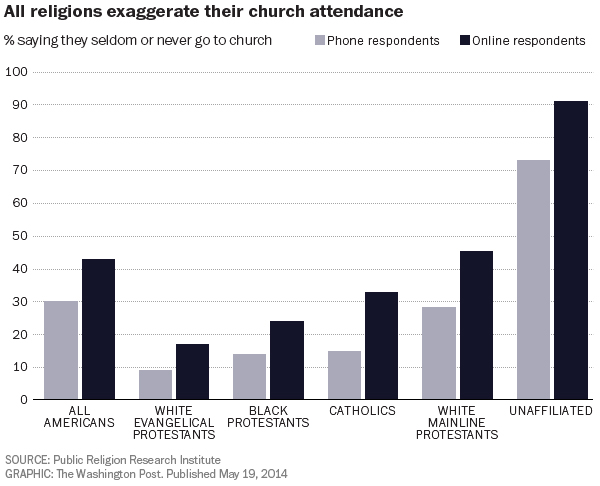
dish_churchattendance

That’s the clever title of a new study that reveals Americans exaggerate how often they go to church:

The study, by the Public Religion Research Institute, used an intriguing method to try to measure exaggeration: It asked the same set of questions in telephone interviews, and in an online survey, and compared the results. Researchers say that online surveys, with their lack of human questioners, significantly reduce “social desirability bias” in polling — the tendency of people to exaggerate behaviors that they think will impress others. In this study, the group that took the online surveys reported much lower levels of worship attendance than those interviewed by telephone.

Jessica Schulberg elaborates on the study’s sneaky methodology:

Why the difference in results?

Talking to another human, even an anonymous one, can cause respondents to exaggerate the truth. “It is a rather unconscious cognitive bias,” says John R. Shook, a professor in the Science and the Public EdM online program at the University of Buffalo. “Even if you talk to a live human voice, someone you will never see, someone in Zaire, the brain rationalizes and tries to present itself in the most positive light possible. You can’t help it.”

But it seems that when it comes to worship attendance, liberals are more inclined to do so. PRRI found that over the phone, only 27 percent of self-identified liberals admitted that religion is not important to them; the number jumped to 40 percent of liberals who responded to an online questionnaire. Conservatives were much more consistent: Only 4 percent of telephone respondents and 6 percent of online respondents said the same.

Last month, Brandon Ambrosino looked at an earlier study that suggested people overreport their actual religious practices. He pondered their motives:

According to [researcher Philip] Brenner, overreporting Muslims and Christians are not maliciously lying on surveys — they’re mishearing the question. Here’s Brenner:

“Like the overreporting of church attendance in North America, the overreporting of prayer in the Muslim world is strongly associated with the individual’s sense of what is central to his or her self-concept. The respondent interprets the conventional survey question about prayer pragmatically rather than semantically, allowing the question to become one about the respondent’s identity, rather than actual behavior.”

In other words, when a religious person is asked, “Do you do religious stuff?” the question she actually hears is, “Are you the kind of person who does religious stuff?” If [Brenner’s] research is any indication, lots of people in North America and the Middle East perceive themselves as the kind of people who do religious stuff — even when they’re not actually doing anything.

Would You Have Followed Jesus?

by Matthew Sitman

Many described in the New Testament as encountering Jesus didn’t know what to make of him, with his strange parables and convention-defying social habits. John Koessler reviews Derek Cooper and Ed Cyzewski’s new book, Unfollowers: Unlikely Lessons on Faith from Those Who Doubted Jesus, which explores what we can learn from them:

Unfollowers focuses on “the people who got it wrong” in the Gospels and invites us to see these familiar stories in a new light. When we see ourselves in their stories we are able to better understand their reaction to Jesus. We also begin to see ourselves more accurately. We would like to think that if we had been present when Jesus taught and performed miracles, we would have been among the few who believed. But this is probably not the case. The authors want us to consider the possibility that we might have responded to Jesus with skepticism, disappointment, and even outright rejection. In the process, they propose to deconstruct our view of Jesus. This is necessary because our tendency is to “imagine that Jesus looks just like and wants the same things as us.” But the book’s real objective is to deconstruct the view we have of ourselves. Or if not to completely deconstruct it, at least provide us with a needed reality check.

The book directs our attention to the unfollowers of the Gospels in the hope that it will close the distance between the lives we live and those we read about in Scripture. Cooper and Cyzewksi do not want us to view these biblical accounts as stories about religious or irreligious people who are now long dead. They want us to understand that they are stories about us. The specific events and people in the life of Christ are used to highlight our own spiritual problems. John the Baptist shows us the folly of projecting our own expectations into God’s plan for our lives. The townspeople of Nazareth cast a light on the shadows of our ambivalence toward Christ and reveal that we expect too little from God, despite all our affirmations of faith. The Pharisees expose our tendency to exclude others, along with our tendency to judge them based on the “external markers of religious devotion” that we have set.

How Unfair Is Being The Fat Girl? Ctd

by Chris Bodenner

A reader makes an excellent point:

This is one of the whitest threads ever. I’m a fat, white woman (though not in high school – then I was taught fat is perceived as bad, but now I know better). I am married to the hottest guy ever and never had a problem getting a date. Of course, most of the men interested in me AND who let me know it are not white. (Living in DC made it easier.)

When we talk about desire and dating and plus-sized women, we are almost always talking about perceptions of us from the privileged perspective of acculturated white American males. Not Black males. Not males from other cultures. White American Males, mostly. But they are just the tip of what is out there.

Yes, being fat as a woman is harder in general than it is for a man, but there are plenty of men that love us, admire us and really want to fuck us. Works for me.

Stoners Sans Stigma

by Jessie Roberts

Micah Hauser appreciates that the “sly, genre-busting” web series High Maintenance depicts potheads as regular people:

[T]he protagonist, an unnamed pot dealer known only as “The Guy,” cycles around New York City delivering his wares to the people. To call him a protagonist, though, is not really accurate — he’s more like a reference point. Each episode focuses on a particular customer, and by extension, their living space, which is where all of these deals go down. …

The show is funny, but not in the ways we’re conditioned to expect from stoner-leaning media. There are no 3-foot bongs, no cross-joints, no late-night expeditions to Shake Shack, no burnouts philosophizing about space and time, man. (Full disclosure: there is some giggling.) These are ordinary people who live ordinary lives and happen to smoke weed. Some of them should probably smoke less — the husband in the newest episode, “Rachel,” bums around all day getting high instead of working on his second book — and some use it to escape particular problems or moments of stress, but most are unremarkable, functional adults. Zero judgment is passed (on the weed smoking, anyway). It’s just part of people’s lives, and the act of smoking and purchasing weed is treated no differently than getting a drink at a bar — an activity portrayed without ceremony in basically every television program in history. Welcome to the 21st century.

Previous Dish on High Maintenance here.

A Stardust Is Born

by Jessie Roberts

PBS’s excellent Blank on Blank series animates a 1988 interview with David Bowie, who describes his alter-ego, Ziggy Stardust, as “half out of sky-fi rock and half out of the Japanese theater”:

Meanwhile, Prospero’s C.G. reviews the Bowie exhibit at Martin Gropius Bau in Berlin:

Fascinated by the early-20th-century German expressionists of the Brücke movement, whose works he frequently went to see, Mr Bowie began painting in Berlin and gained inspiration and motivation for his music. … The exhibition takes visitors through the career of an artist who was constantly reinventing himself. Flickering video screens, quirky costumes, handwritten documents, soundtracks and interviews provide a kaleidoscope of impressions. Thanks to Christine Heidemann, the curator of the show’s new Berlin section, 60 items have been added to the retrospective to give a broader idea of what went on during Mr Bowie’s stint in the German city between 1976 and 1978.

Many items refer to Iggy Pop, whom Mr Bowie lived with. At first the two shared a huge, slightly run-down flat in an old building in West Berlin’s bohemian borough of Schöneberg, then and now home to a large gay community. But Mr Bowie eventually threw his friend out—Mr Pop is said to have done a bit too much fridge-raiding—and found him a flat in the back of his building. Other highlights include letters from 1978 revealing a short correspondence between Mr Bowie and Marlene Dietrich about “Just a Gigolo”, an unsuccessful film in which Mr Bowie played a gigolo who works in a brothel run by Dietrich’s Baroness (her final appearance on screen). According to Mrs Heidemann, Mr Bowie and Dietrich never actually met in person, since his scenes were shot in Berlin (pictured) and hers in Paris.

The Coloniser’s Cocktail

by Matthew Sitman

Nina Caplan finds that, despite the all the pages written about the British Empire, “one great culprit in the colonisation project rarely receives its fair share of blame: gin.” How the gin and tonic helped shape history:

Without quinine, malaria would have felled the conquerors; without gin to alleviate dish_gintnonic the bitterness of this highly effective anti-malarial, the soldiers would have refused to down their medicine.

The Spanish went to the Andes and found the cinchona tree, the bark of which turned out to contain an acrid but exceptionally useful substance. The British planted the tree in their Indian colony and attempted to sweeten that bitter bark with sugar, water and lemon: the resulting “tonic” turned out to be much more palatable when dosed with gin. Halfway down my second Pahit, I still can’t work out which is more peculiar: that those long-ago soldiers needed booze to persuade them to protect themselves from an often fatal disease? Or that a spirit so lethally popular that a quarter of mid-18th-century Londoners averaged a pint of the stuff a day was enlisted to save the lives of those same poor peoplethe ones who became foot soldiers in the Imperial British Army? The ability to withstand malaria helped Britain to conquer half of Africa and keep India subjugated (more or less). So much misery, engendered by one of the world’s most inspired taste combinations.

(Photo by Armando Alves)

How To Make Money In Porn

by Tracy R. Walsh

File lawsuits:

Having found a niche in the crowded world of online pornography, X-art.com still had tens of thousands of fans shelling out money for its movies. Quietly, the Fields were also making some extra money in another way: by becoming the biggest filer of copyright-infringement lawsuits in the nation. In the past year, their company Malibu Media LLC has filed more than 1,300 copyright-infringement lawsuits – more of these cases than anyone else, accounting for a third of all US copyright litigation during that time, according to the federal-litigation database Pacer – against people that they accuse of stealing their films on the Internet.

Today, they average more than three suits a day, and defendants have included elderly women, a former lieutenant governor, and countless others. “Please be advised that I am ninety years old and have no idea how to download anything,” one defendant wrote in a letter, filed in a Florida court. Nearly every case settles on confidential terms, according to a review of dozens of court records. Malibu Media’s attorney, Keith Lipscomb, said that most defendants settle by paying between about $2,000 and $30,000. The income earned by all the suits represents less than five per cent of Malibu Media’s profits, Lipscomb said.