The Comedians Of Conservatism

by Jessie Roberts

Frank Rich looks beyond Dennis Miller to Greg Gutfeld, “a signature personality on two daily Fox News shows: The giggly The Five (in late afternoon) and the fiercer Red Eye (scheduled by Roger Ailes in the stunt time slot of 3 a.m.)”:

Gutfeld is more of a wisecrack artist than a comedian and, like Miller and other comics on the right, is careful to label himself a libertarian, so damaged is the conservative brand. But if you listen to Gutfeld on Fox or read his recent best-selling manifestoNot Cool, he seems much more of a standard-issue conservative and, in keeping with that, older than he actually is (49). His targets are the usual shopworn suspects, some of whom are so far removed from the main arena of 21st-century liberalism that comic complaints about them are deadly on arrival: Rachel Carson, Yoko Ono, Hurricane Carter, Howard Zinn, Mumia Abu-Jamal, Oliver Stone, and even Dan Quayle’s old fictional bête noire, Murphy Brown. In Not Cool, Sean Penn gets 18 references, and even Robert Redford merits nine. Like much of the right, Gutfeld can’t stop fighting battles from the 1960s that are increasingly baffling to post-boomer audiences. It’s as if the clock stopped with the Vietnam War. …

If there’s one universal rule of comedy, it is, as Gutfeld himself has said, that “it’s hard to be funny without being truthful.”

But when he jokes that politically correct Americans are relabeling Fort Hood terrorism “workplace violence” and that they would rather use the term “unlicensed pharmacists” than “drug dealers,” he seems to lack any firsthand knowledge of conversation as practiced on the ground in ­present-day America. His examples of p.c. speech sound instead like the typically outrageous anomalies unearthed by Fox News. He needs to get out of the studio and meet some young people.

Rich reviews Jeff Dunham – whose act with the puppet “Achmed the Dead Terrorist” can be seen above – more favorably:

The gifted ventriloquist Jeff Dunham, as commercially successful a conservative comedian as there is (and one of the most successful touring comedians in the country, period), is best known for Achmed the Dead Terrorist, a puppet given to one-liners like “Where are all the virgins that bin Laden promised me?” Achmed can be funny, not least because he is a goofy, not hectoring, comic creation. And Dunham has a worthy comic nemesis in terrorism, much as Mel Brooks found in Hitler. The trouble with this material is its inevitable shelf life as 9/11 and its ensuing wars keep receding into the rearview mirror of American memory. There’s a reason why the playwright George S. Kaufman long ago said that “satire is what closes on Saturday night.”

Upwardly Immobile

by Jonah Shepp

Gentrification may be the talk of the town (no matter which town), but Richard Florida highlights new research showing that most urban neighborhoods that were poor 40 years ago are still poor today. The study “compared neighborhood-level poverty rates in the country’s 51 largest metro areas in 1970 and 2010.” It found that “very few high-poverty neighborhoods in 1970 dramatically reversed their fortunes over the next four decades”:

Entrenched poverty was just about the most constant thing about these neighborhoods. By 2010, fully two-thirds of these poor neighborhoods, 750 tracts in all, were still beset by chronic and concentrated poverty in 2010. Overall, their populations shrunk 40 percent over those forty years, as many of those who were able to move out did. On the other hand, only a small fraction of neighborhoods had turned around in a way that approximates what we call gentrification. Just 105 tracts, or about 10 percent, saw their poverty rates fall below 15 percent, meaning a smaller proportion of their residents lived in poverty than in the nation as a whole. The populations of these tracts grew by about 30 percent over this same period.

But wait, it gets worse:

The authors traced the fate of what they call “fallen star” neighborhoods – tracts that had below-average poverty rates in 1970 (less than 15 percent), but more than 30 percent of their residents living below the poverty line by 2010. More than 1,200 of these tracts shifted from low to high poverty during this time, contributing to an overall increase in the number of neighborhoods of concentrated poverty. Today, 10.7 million Americans live in 3,100 extremely poor neighborhoods in and around America’s largest city centers.

In other words, for every single gentrified neighborhood, 12 once-stable neighborhoods have slipped into concentrated disadvantage.

Mental Health Break

by Chris Bodenner

Last night’s highly anticipated meteor shower was bust, so here’s a consolation prize:

Rollin Bishop has the details:

Professional photographer Thomas O’Brien has compiled footage of seven years worth of meteor showers filmed around Aspen, Colorado into a single, beautiful time-lapse video. The video includes footage of the Perseid, Geminid, and Leonid meteor showers. O’Brien has also compiled a series of tips on how to photograph meteor showers in anticipation of the Camelopardalids, a meteor shower that’s expected to hit late tonight as the Earth passes through the debris trail of the comet 209P/LINEAR.

When The Principal Controls The Press

by Katie Zavadski

Two intrepid high school students in Michigan, Madeline Halpert and Eva Rosenfeld, tried to combat some of the stigma against depression by using their positions as managing editors of their school paper to write about the struggles of others. They even went so far as to get consent forms signed by the parents whose names they would include in the piece. Yet their principal, like so many others, blocked them from publishing the article (NYT):

As we were putting the stories together, the head of our school called us into her office to tell us about a former college football player from our area who had struggled with depression and would be willing to let us interview him. We wondered why she was proposing this story to us since he wasn’t a current high school student. We declined her suggestion. We didn’t want to replace these deeply personal articles about our peers with a piece about someone removed from the students. After we asked her why she was suggesting this, she told us that she couldn’t support our moving forward with the articles.

From an administrative perspective, this made some sense. It is her job to protect the students to the best of her ability. She believed that the well-being of those who shared their experiences — and most important, their names — would be put at risk because of potential bullying. She also mentioned that she had consulted a mental health professional, who told her that reading about their own depression could trigger a recurrence in some of the students and that those who committed to telling their stories might regret it later.

Our school has a very tolerant atmosphere, and it even has a depression awareness group, so this response seemed uncharacteristic. We were surprised that the administration and the adults who advocated for mental health awareness were the ones standing in the way of it. By telling us that students could not talk openly about their struggles, they reinforced the very stigma we were trying to eliminate.

I’m not certain that this is any better than those who ban books from school libraries. To be sure — there’s a wide maturity and experience gap between a 14-year-old freshman and an 18-year-old senior. But high school students, in my experience, are remarkably capable of rising to the challenge and treating any number of sensitive topics with grace. Unfortunately, in my few years as a counselor at a summer camp for high school journalists, I’ve heard far too many stories of principals refusing to give them the benefit of the doubt. I only wish Halpert and Rosenfeld had named names.

Translating World To Word

by Jessie Roberts

Kathryn Schulz raves about Geoff Dyer’s writing prowess, calling him “one of our greatest living critics” and “one of our most original writers—always out there beyond literary Mach 1, breaking the how-things-usually-sound barrier“:

[T]he essential fact about Dyer’s nonfiction is that it works beautifully when it shouldn’t work at all. Some of that work gets done at the level of the sentence, where Dyer excels. Listen to him on a hot day in Algiers: “Even the ants out on the balcony drag a little sidecar of shadow.” On Roman ruins in Libya: “All around were the vestiges of nouns—columns, stones, trees. No verbs remained.” On a saxophone solo by John Coltrane: “It’s pretty and then dangerous as he reaches so high the sky blues into the darkness of space before reentering, everything burning up around him.”

What’s going on in these sentences is the fundamental business of nonfiction: the translation, at once exact and surprising, of world to word. Writers weight that ratio of exactitude and surprise differently; you can stay close or reach further, out toward the risky and weird. Dyer reaches. You can see it in those precise but strange sidecars, in that startling grammar of ruin, and finally in the sax solo, where, like Coltrane, he pushes so hard on his medium that it threatens to break. Note the word blues, pulling three times its weight—noun, adjective, verb, so much pivoting around it that all the referents go briefly haywire and it seems like the solo is still rising and what’s falling is the sky. And note, too, how the sentence itself is pretty and then dangerous: dangerous because it starts out too pretty (“pretty” is a pretty word; “so high the sky” is Hallmark stuff); beautiful because it ends in so much danger.

Schulz goes on to praise Another Day at Sea, Dyer’s new travelogue of two weeks aboard the USS George H.W. Bush. John McAlley reviews the book (somewhat spoiling its ending in the last paragraph):

Dyer’s tour of the boat (that’s right: boat, not ship) is as closely monitored as an F-18 sortie, even though it’s a relatively stress-free time on the Bush: October 2011, more than a year after President Obama announced the end of America’s combat mission in Iraq. Once Dyer inures himself to the ’round-the-clock “crash and thunder” of the in-transit jets and the “aftertaste of the big meats” served in the mess, he’s at ease to report on the daily encounters prearranged for him. Each brief chapter gives us a peek into another nook and cranny of the carrier’s teeming underworld, or the above-deck “island,” “the bridge and assorted flight-ops rooms rising in a stack from one side of the deck: an island on the island of the carrier.” …

For all the snap and snark in his prose, Dyer can’t tamp down his generosity of spirit forever. This unbeliever — in faith, in wayward military action, in bad food and the snorting of bath salts, even in mourning the death of his parents — ends the breezy Another Great Day at Sea with stunning economy and emotional force, and in the most unexpected way. He says a prayer for the men and women of the USS George H.W. Bush — and for all of us at sea.

Subscribers to The New Yorker can read an excerpt of the book here.

A New York State Of Rhyme

by Matthew Sitman

This year marks the fiftieth anniversary of the publication of Frank O’Hara’s Lunch Poems, which Micah Mattix lauds as a love letter to New York City:

With its references to Park Avenue, Times Square, Pennsylvania Station, liver sausage sandwiches, the Five Spot, the Seagram Building, the opening of the American Folk Art Museum, and much more, it is a very New York book. O’Hara walks around the buzzing city, buys “a chocolate malted” or “a little Verlaine,” remembers a friend’s birthday, and talks to the Puerto Rican cabbies before rushing back to his desk at the MoMA with a copy of Reverdy’s poems in his pocket. Born in Baltimore and raised in Grafton, Massachusetts, O’Hara moved to New York in 1951 and stayed until his untimely death in 1966. The city offered freedom, possibility, movement, all of which O’Hara associated with life. “I can’t even enjoy a blade of grass,” he once wrote, “unless I know there’s a subway handy.” It also offered him a community of fellow outcasts, poets, and artists who became, as Lytle Shaw notes, a surrogate family.

Lunch Poems is still popular with New Yorkers today: In 2012, when the Leonard Lopate Show asked listeners to vote on 10 objects that “best tell New York’s story,” it came in at number six—just above the Brooklyn Bridge.

Even more, Mattix finds the collection has “an appeal that reaches beyond the time and place it was written,” remaining popular, in part, because of the way O’Hara’s language resonates with our own:

Casual, sardonic, funny, and full of pop-culture references, Lunch Poems has all the brevity, informality, irony, and at times chatty pointlessness of modern discourse without having been influenced by it. The volume has never gone out of print, in part because O’Hara expresses himself in the same way modern Americans do: Like many of us, he tries to overcome the absurdity and loneliness of modern life by addressing an audience of anonymous others.

O’Hara’s Lunch Poems—like Facebook posts or tweets—shares, saves, and re-creates the poet’s experience of the world. He addresses others in order to combat a sense of loneliness, sharing his gossipy, sometimes snarky take of modern life, his unfiltered enthusiasm, and his boredom in a direct, conversational tone. In short, Lunch Poems, while 50 years old, is very a 21st-century book.

Last spring the Dish featured one of O’Hara’s poems here.

A Short Story For Saturday

by Matthew Sitman

The last few weeks we have tracked the responses to Adam Begley’s Updike, the new biography of the late novelist and critic, who also was an accomplished poet and short story writer. Today’s featured story is “The Varieties of Religious Experience,” which Updike published in The Atlantic just over a year after the September 11th terrorist attacks. Here are its memorable opening paragraphs:

There is no God: the revelation came to Dan Kellogg in the instant that he saw the World Trade Center South Tower fall. He lived in Cincinnati but happened to be in New York, visiting his daughter in Brooklyn Heights, with a top-floor view of Lower Manhattan, less 9/11 Terrorist Attack on World Trade Centerthan a mile away. He was still puzzling over the vast quantities of persistent oily smoke, and the nature of the myriad pieces of what seemed to be white cardboard fluttering within the smoke’s dark column, and who and what the perpetrators and purpose of this event might have been, when, as abruptly as a girl letting fall her silken gown, the entire skyscraper dropped its sheath and vanished, with a silvery rippling noise. The earth below, which Dan could not see, groaned and spewed up a cloud of ash and pulverized matter that slowly, from his distant perspective, mushroomed upward. The sirens filling the air across the river continued to wail, with no change of pitch or urgency; the mob of uninvolved buildings, stone and glass, held their pose of blank, mute witness. Had Dan imagined hearing a choral shout, a cry of protest breaking against the silence of the sky—an operatic human noise at the base of a phenomenon so pitilessly inhuman? Or had he merely humanized the groan of concussion? He was aware of looking at a, for him, new scale of things—that of Blitzkrieg, of erupting volcanoes. The collapse had a sharp aftermath of silence; at least he heard nothing for some seconds.

Ten stories below his feet, two black parking-garage attendants loitered outside the mouth of the garage, one seated on an aluminum chair, carrying on a joshing conversation that, for all the sound that rose to Dan Kellogg, might have been under a roof of plate glass or in a silent movie. The garage attendants wore short-sleeved shirts, but summer’s haze this September morning had been baked from the sky. The only cloud was man-made—the foul-colored, yellow-edged smoke drifting toward the east in a solid, continuously replenished mass. Dan could not quite believe that the tower had vanished. How could something so vast and intricate, an elaborately engineered upright hive teeming with people, mostly young, be dissolved by its own weight so quickly, so casually? The laws of matter had functioned, was the answer. The event was small beneath the calm dome of sky. No hand of God had intervened, because there was none. God had no hands, no eyes, no heart, no anything.

Read the rest here. For more of his short stories, check out the two-volume John Updike: The Collected Stories, from the Library of America. Previous SSFSs here.

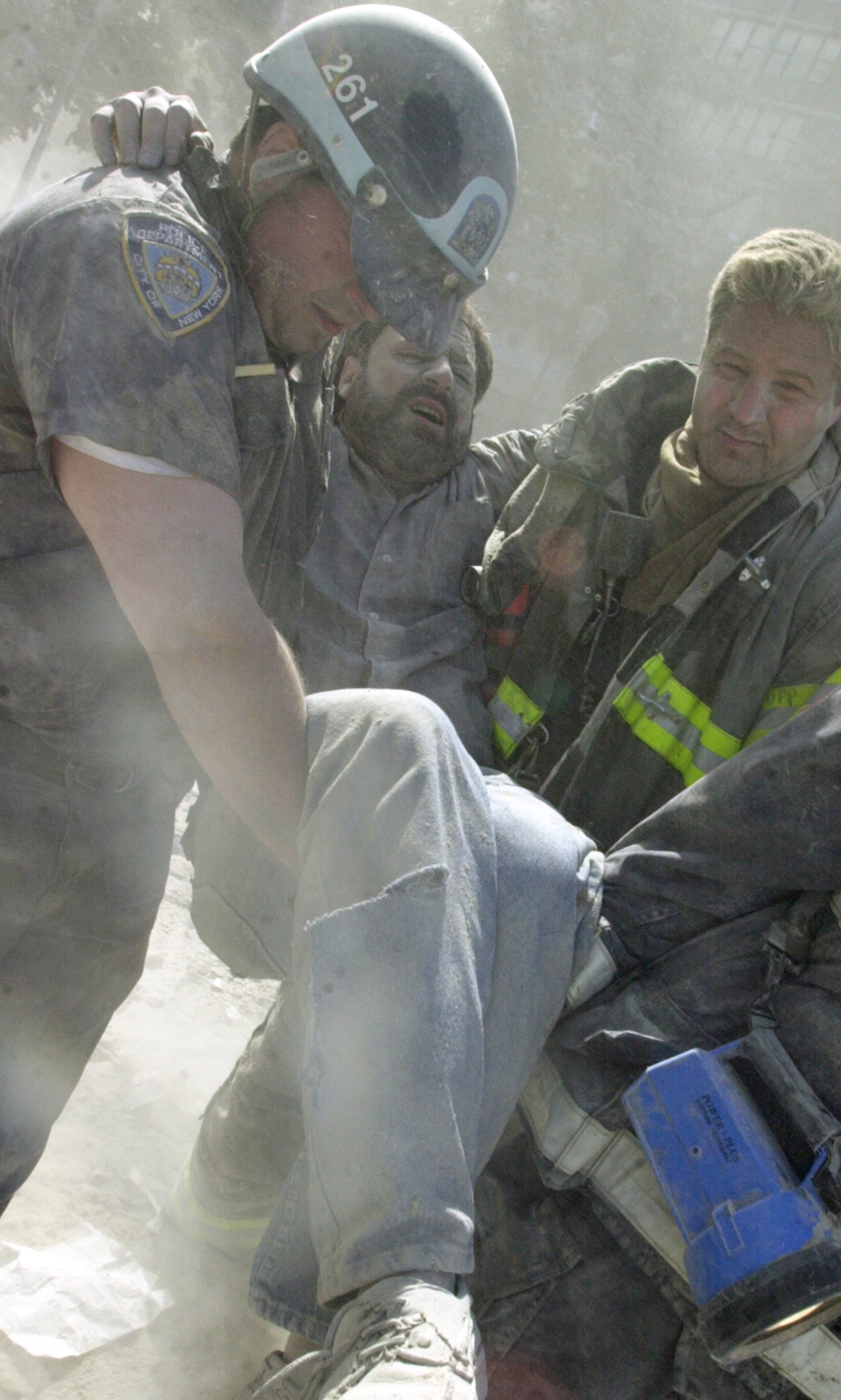
(Photo: New York Daily News staff photographer David Handschuh is carried from site after his leg was shattered by falling debris while he was photographing the terrorist attack on the World Trade Center on Tuesday, September 11, 2001. By Todd Maisel/NY Daily News Archive via Getty Images)

The View From Your Window Contest

vfyw_5-24

You have until noon on Tuesday to guess it. City and/or state first, then country. Please put the location in the subject heading, along with any description within the email. If no one guesses the exact location, proximity counts.  Be sure to email entries to contest@andrewsullivan.com. Winner gets a free The View From Your Window book or two free gift subscriptions to the Dish. Have at it.

A Cure For Aging?

by Jessie Roberts

Richard Walker, a scientist who specializes in aging research, believes the key to ending human aging lies in a rare disease known as “syndrome X.” Babies afflicted with the condition grow older but not bigger, remaining physically “marked by what seems to be a permanent state of infancy.” Here’s an excerpt from Virginia Hughes’s arresting account of Walker’s quest for immortality:

Brooke’s body seemed to be developing not as a coordinated unit, [Walker] wrote, but rather as a collection of individual, out-of-sync parts. He used her feeding problems as a primary example. To feed normally, an infant must use mouth muscles to create suction, jaw muscles to open and close the mouth, and the tongue to move the food to the back of the throat. If these systems weren’t coordinated properly in Brooke, it could explain why she had such trouble feeding. Her motor development had gone similarly awry: she didn’t learn to sit up until she was six years old and never learned to walk. “She is not simply ‘frozen in time’,” Walker wrote. “Her development is continuing, albeit in a disorganised fashion.”

The big question remained: why was Brooke developmentally disorganised? It wasn’t nutritional and it wasn’t hormonal. The answer had to be in her genes. Walker suspected that she carried a glitch in a gene (or a set of genes, or some kind of complex genetic program) that directed healthy development. There must be some mechanism, after all, that allows us to develop from a single cell to a system of trillions of cells. This genetic program, Walker reasoned, would have two main functions: it would initiate and drive dramatic changes throughout the organism, and it would also coordinate these changes into a cohesive unit.

Ageing, he thought, comes about because this developmental program, this constant change, never turns off. From birth until puberty, change is crucial:

we need it to grow and mature. After we’ve matured, however, our adult bodies don’t need change, but rather maintenance. “If you’ve built the perfect house, you would want to stop adding bricks at a certain point,” Walker says. “When you’ve built a perfect body, you’d want to stop screwing around with it. But that’s not how evolution works.” Because natural selection cannot influence traits that show up after we have passed on our genes, we never evolved a “stop switch” for development, Walker says. So we keep adding bricks to the house. At first this doesn’t cause much damage – a sagging roof here, a broken window there. But eventually the foundation can’t sustain the additions, and the house topples. This, Walker says, is ageing.

Brooke was special because she seemed to have been born with a stop switch. The media were fascinated by her case. Walker appeared with the Greenberg family on television several times and explained why he was so interested in Brooke’s genes. “This is an opportunity for us to answer the question ‘Why are we mortal?’” he said on Good Morning America. “If we’re right, we’ve got the golden ring.”