Sensing Too Much, Ctd

by Chris Bodenner

A reader pivots off our post on the FBI having trouble hiring hackers who haven’t smoked pot:

As a computer guy with diagnosed Asperger’s who knows lots of other computer guys who are either diagnosed or show a lot of checklist signs of being on the autism spectrum (including my son – also diagnosed on spectrum), I would like to flag the self-medication aspects of pot use in the case of computer guys and the FBI. Being on spectrum means there are tremendous sensory overloads. I know that marijuana reduces the sensory overload and makes it manageable. That has also been part of the discussions with my spectrum computer colleagues.

[Seen above] is my favourite video to explain the overload. I use it to try to explain the reality of my view of the world when people ask about my Asperger’s. (I believe I first saw it on the Dish.) And this is a link to more information on overload simulations.

A previous Dish thread on pot and Asperger’s here.

“Clarity Comes At A Cost”

by Jonah Shepp

James E. McWilliams considers the expenses that mandatory GMO labeling would likely impose on the food industry. “One change seems absolutely certain,” he writes, that the “food system’s foundation would tectonically shift to accommodate dual ingredient streams (if not multiple streams)”:

Understanding the economic threat of segregation requires understanding the ubiquity of GMOs in our food supply. Eighty-five percent of U.S. corn, 95 percent of U.S. sugar beets and canola, and 91 percent of U.S. soy are genetically modified. Up to 75 percent of the processed foods on the market contain genetically modified ingredients. A GMO label—again, assuming at least some change in consumer choice—means that food producers would have to cleave the food system’s supply chain to segregate and audit GMO and non-GMO ingredients.

This would require them to prevent cross-pollination between GMO and non-GMO crops, store GMO and non-GMO ingredients in different locations, establish exclusive cleaning and transportation systems for both commodities, and hire contractors to audit storage facilities, processing plants, and final food products. Surveying the potential compliance expenses based on a failed 2002 Oregon labeling initiative (Prop. 27), the Washington State report estimated that annual costs today would range from $150 million to $920 million. The administrative expenses of auditing alone could reach $1 million. And as for the legal expenses that would arise from suits over contamination: Let’s just say the vultures are already circling.

But what’s especially daunting is that these costs wouldn’t be fixed.

Recent Dish on the GMO labeling controversy here.

The Key To Emptying Prison Cells

by Patrick Appel

Tough On Crime

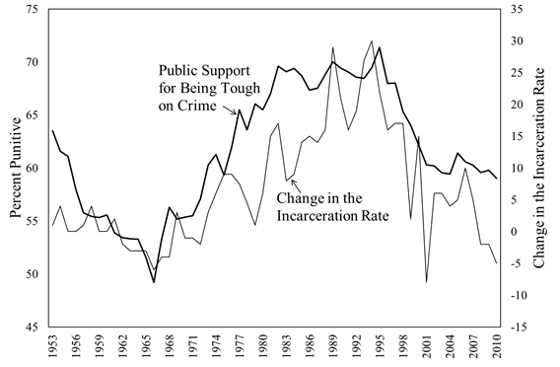
Researcher Peter K. Enns finds a relationship between the incarceration rate is going down and Americans getting less punitive:

[T]o understand the rise of mass incarceration in the United States, we must look to the American public. In recent research, I show that the U.S. public’s support for being tough on crime—i.e., the public’s punitiveness—has been a fundamental determinant of changes in the incarceration rate….

[The figure above] plots the public’s punitiveness and the change in the incarceration rate. Strong similarities emerge. The correlation is an impressive r=0.82. Statistically, this relationship holds even when controlling for the crime rate, illegal drug use, economic inequality, and the strength of the Republican Party. Based on this statistical model, if the public’s punitiveness had stopped rising in the mid-1970s, we would expect approximately 185,000 fewer incarcerations each year—about 20% of the incarceration rate. The expected influence of the public’s attitudes is larger than any of the other variables in the statistical model. Furthermore, an analysis of the public’s punitiveness and congressional hearings on crime suggests that public support for being tough on crime precedes congressional attention to this issue.

Giving Schools An Education In Sexism

by Tracy R. Walsh

Florida’s second-largest school district is under fire for giving teachers of single-sex classes pedagogical tips along the lines of “Girls are not as good at abstract thinking, so they should learn with the help of real-life connections.” Amanda Marcotte rolls her eyes:

The complaint quotes directly from the District’s Single Gender Education Legal and Educational Rationale Brief, and includes such gems as, “Boys tend to prefer non-fiction over fiction. Boys like to read descriptions of real events or illustrated accounts of the way things work, like spaceships, bombs, or volcanoes.” What about girls? “Story problems are a good way to teach algebra to girls. Putting the question in story format makes it easier for girls to understand, and more interesting as well,” the district brief says, adding, “With boys, you can stimulate their interest by focusing on the properties of numbers per se.”

Proponents of single-sex education may claim to be all about maximizing children’s potential, but this ACLU complaint suggests the opposite – that the real result is stifling any children who dare buck gender stereotypes. A girl who wants to be a computer programmer, a girl who’s a budding athlete, a boy who wants to write poetry, or a young man who wants to be a psychologist are all entering a classroom that is hostile to their talents and ambitions. Even if the ACLU of Florida can’t get the schools to stop, hopefully they can educate parents about the dangers of these kinds of classrooms and encourage them to yank their kids out.

Dana Liebelson considers the broader issue of single-sex education:

Gender-based educational programs are not unique to Florida. The ACLU has filed complaints against school districts in other states, including West Virginia, Wisconsin, and Idaho. The National Association for Single Sex Public Education, which supports these kinds of programs, notes, “We understand that some girls would rather play football rather than play with Barbies,” and “girls in single-sex educational settings are more likely to take classes in math, science, and information technology.” Sherwin, from the ACLU, says she doesn’t see anything wrong with single-sex schools that don’t use different teaching methods for boys and girls. But she adds, “Whenever you make sex the most salient category for grouping children, it certainly sends a message about sex difference.”

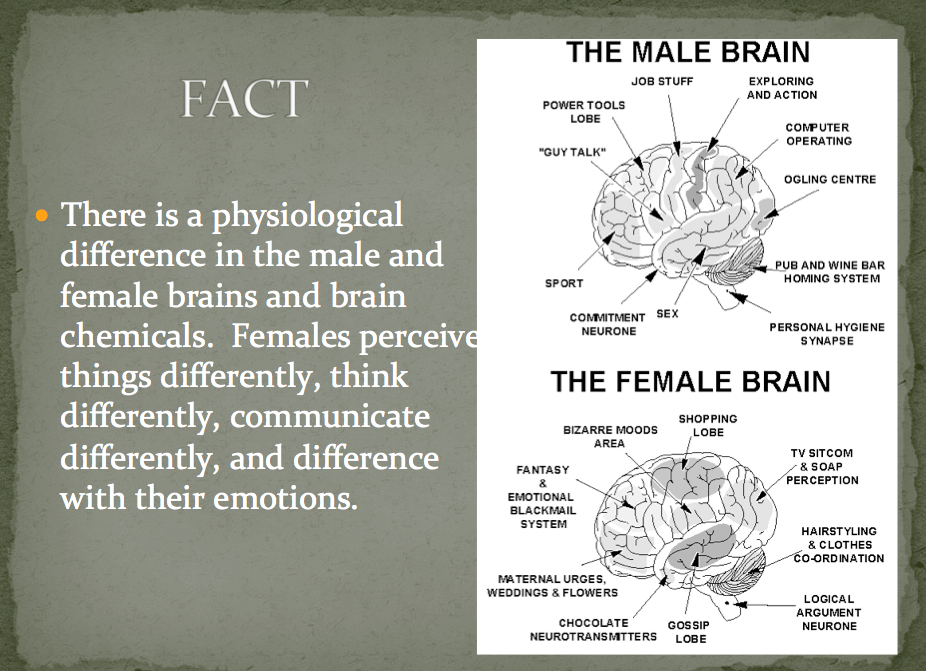
I wish I could say this story surprised me, but health classes at my public high school were filled with sexual stereotyping. One hapless gym teacher explained to my sophomore class that women, as born gatherers, were “programmed” – I remember the word distinctly – to browse endlessly for shoes at the mall, while, men, as natural hunters, would shoot straight to the electronics store. (This being South Jersey, all analogies were mall analogies).

I hope today’s teachers are more enlightened than they were in the early aughts, but that school’s website still hosts materials like this:

Screen Shot 2014-05-21 at 10.11.25 PM

A school doesn’t have to be single-sex to be sexist.

Dish Intern Wanted

by Andrew

[Re-posted from yesterday]

It’s that time of year again. Dish Publishing LLC is seeking an all-purpose intern to handle both administrative tasks and contribute to the editorial process. The admin side of the job will include: dealing with press inquiries and permissions, helping with support emails, managing the staff calendar, taking notes during meetings, making travel arrangements, and generally assisting the executive editors and me with sundry tasks. Strong organizational skills and attention to detail are musts. You need to be self-starting and pro-active in getting shit done.

The editorial side of the job will consist of ransacking the web for smart and entertaining nuggets, maintaining our social media presence, working on larger research projects, and helping the team guest-blog when yours truly takes a vacation. We prefer individuals who can challenge me and howler beaglemy assumptions, find stuff online we might have missed, and shape the Dish with his or her own personal passions. Reporting experience is also a big plus as we try to deepen our coverage. Someone with a background in web entrepreneurialism could catch our eye too.

The full-time internship pays $10 an hour, includes health insurance, and lasts for six months. The position is based in New York City. Since the Dish doesn’t have an office, most of the work will be done from home, but the staff meets regularly for lunch and coffee meetings and social gatherings.  I want to emphasize that this is an intense job for the intensely motivated, and one that can get a little isolating at times. But it’s a pretty unbeatable chance to learn what independent online journalism can be as an integral part a close-knit team. We’ve decided to pare down to one intern to keep our lean budget under control, which means the one individual really does have to be special. You have to already know what we do here and care deeply about the Dish. And a sense of humor is a real asset.

We are hoping to hire very soon, so don’t delay if you’re interested. The cutoff for applications is next Friday, May 30, at midnight. The start date is July 7, but we are flexible. To apply, please e-mail your resumé and a (max 500-word) cover letter to apply@andrewsullivan.com.

A “Meep Meep” Moment In The Gulf?

by Jonah Shepp

News that Iran’s foreign minister Mohammad Javad Zarif has been invited to Saudi Arabia is music to Paul Pillar’s ears. He attributes the emerging thaw between the two regional giants in large part to American leadership, though the usual suspects will deny it:

Rapprochement between Iran and its Arab neighbors is good for the neighbors as well as for Iranians, good for stability in the Persian roadrunnerGulf, and good for U.S. interests in the region.

Secretary of State Kerry’s comments welcoming the Saudi move are doubly appropriate, given that the United States can claim some of the credit because of its role in currently negotiating an agreement with Iran to keep its nuclear program peaceful.  The Saudis’ invitation is very likely being made partly in anticipation of successful completion of those negotiations and the prospect of Iran and the United States taking a step toward a more normal relationship.  This is the sequence that should be expected: the superpower leads, and lesser allies follow.  It is the sequence that should have been obvious to anyone who hasn’t been trying to spin Arab reactions to the negotiations to cast doubts on where the negotiations are going.

To Juan Cole, this overture indicates that the Saudis are copping to the ugly reality in Syria:

Bashar al-Assad has for about a year been winning the Syria war, and the rebels may not seem a very attractive investment any more.

Moreover, the most effective fighting forces have declared themselves a branch of al-Qaeda. Saudi Arabia is deathly afraid of the latter. Riyadh recently discovered a terrorist plot in which the major group fighting in Syria (the Islamic State of Iraq and the Levant) became a threat to their own Saudi backers. That episode may soured Riyadh on the most hawkish strategy in Syria. Indeed, you could imagine a Saudi-Iran alliance against al-Qaeda affiliates, now holding territory in northern Iraq and northern Syria.

But Lina Khatib expects Iran to throw Assad under the bus for the sake of better relations with Riyadh:

The dominant wisdom has been that Iran has thrown its full weight behind Assad and that it would not abandon this ally because Assad guarantees Iran’s strategic interests in the Levant. But Assad himself is less valuable to Iran than the much-coveted nuclear arms deal. Talks between the United States and Iran appear to be heading towards a settlement, while Saudi Arabia’s softened stance towards Iran means that Iran must give Saudi Arabia something in return for cordial relations, because Saudi Arabia remains the stronger regional player in the Gulf. Assad is likely to be the least costly compromise for Iran on both fronts.

Maybe if both countries give up on their unsavory clients, it will force a settlement of the conflict that allows the sane middle to come to the fore. I’m not too sanguine that any good immediate outcome is possible for Syria (or Lebanon) after three years of perpetual disaster, but getting these major regional players to talk about cleaning up the mess in their neighborhood is crucial to end the violence, which in turn is a necessary first step toward rebuilding the shattered Levant. And it would prove that a patient, as opposed to reactive, American foreign policy pays dividends. Obama won’t get much credit—least of all from the neocons, as Pillar rightly points out—because his hand in this isn’t visible enough, but that’s sort of the point, isn’t it?

The Intercourse Is For Fun, Ctd

by Chris Bodenner

Readers keep the thread going:

The problem I have as a parent of three (two boys, one girl) in telling them the truth – that intercourse is fun – is that I’m not sure how to balance that with the message that they’re better off waiting. “It’s one of the most enjoyable things a person can do! But don’t do it until you’re older!” And we say “because”: because you can get pregnant or get someone pregnant, because it can be emotionally complex, etc. But not getting too deep into this rabbit hole is the same reason I don’t tell my kids that I smoked pot and really enjoyed it – because smoking pot, too, is fun. That’s why people do it in the first place.

I do think you need to tell kids the truth. But, knowing kids, I worry that they’ll blow right past that “because” and focus on the fun. If it’s so fun – why wait?

But another looks to reverse psychology:

I can’t think of a better way to get kids to abstain from sex for longer: Let them know the details, and that mom and dad think it’s fun and cool. Kids never want to like what their parents like.

Another reader:

The latest series on sex being fun and yet inexplicable to children reminded me of when we told our kids “the facts.”

My wife worked from home as a lawyer for families seeking a surrogate.  Sometimes the family needed eggs, sometimes sperm, and often a uterus.  She concluded that she could not keep telling stork stories to the kids while working in the kitchen and talking on the phone with clients about sperm count, viability and the other issues that naturally needed to be addressed.

So when my two girls were 9 and 11 my wife decided it was time to have the talk.  At that time we still had our Sunday dinners as a family, so my wife picked a Sunday and just started talking.  My wife thought it was important that we provide more than the usual detail.  She remembered when her mother, in the early 70s, explained the matter to her and left out the erection bit, and that her reaction had been, “That can’t work.  I’m a babysitter and I’ve seen those floppy things.  That can’t go inside me.”

So the kids got the whole shebang.  Even the warning that “boys like it a lot and will try to talk you into it.” My oldest, always more analytic and scientific, simply nodded and took in the info.  The youngest was horrified.  “Does Joel know about this?” is what she wanted to know, Joel being a close family friend who my daughter obviously respected more than us after telling her the weird things we do.  “Joel has three kids of his own,” was an explanation that did not quite solve the question, but time has passed.

Another story about talking to kids honestly about sex:

When I was in middle school in Marin County in 1977, two of our teachers gathered the sixth-through-eighth graders together for “Sexuality Day.” They told us we were free to write down any questions we might have. “Anonymity promotes honesty,” they said, so innocent to the fact that they were sitting in front of a room of leering preteens. So we wrote down questions and the first one pulled from the hat by a stern Mrs. Meyers was “Can you get pregnant by butt fucking?” Her answer: “I prefer the term anal intercourse. And the answer is no.” The next question was “Do you fuck? Do you like to fuck?” The matronly Mrs. Floyd took this one and answered honestly, bless her heart. “I also prefer the term ‘intercourse.’ And many of you know my daughter Kristen so I guess the answer is obvious. And yes, I’m not ashamed to say I enjoy relations with Mr. Floyd!”

Hats off to these brave teachers of yore. You probably couldn’t get away with that kind of nerdy honesty today.

Update from a reader:

One of your readers mentioned Our Whole Lives (OWL), the progressive sexuality education program created by the Unitarian Universalists and the United Church of Christ. Both our daughters went through the middle school OWL program – and then they volunteered to take the more involved high school OWL program as well.

OWL works by answering every question, and providing more information than you could ever want. As some of your readers suggested, knowing all the facts is generally the opposite of an aphrodisiac. My daughters have been part of informative discussions about pleasure and abortion and LGBTQ issues and masturbation and date rape. They’ve been shown illustrations that include different positions and even disabled people having sex. One of them even won a classroom race to get the condom on the banana first.

The result is that while they have a positive attitude toward sex and toward their bodies, their eyes are open. They’ve made it clear that, at ages 18 and 15, they’re in absolutely no rush to go all the way. Meanwhile, adults in our congregation are wondering when they can sign up to take the OWL classes for people over 35 (there are curricula for six different age levels in all), so that they can explore issues such as, say, how to enjoy sex after a mastectomy.

In fact OWL’s success is so strong that one can’t help but wonder if part of the popularity of abstinence-only programs is an unspoken knowledge that they keep kids ignorant and therefore more sexually malleable – that they keep young women more likely to end up barefoot and pregnant per a certain 1950s ideal.
Face Of The Day

by Chris Bodenner

Daily Life In Kiev Ahead Of The Ukrainian Presidential Election

Kiev’s mayoral candidate for the Internet Party, “Darth Vader”, arrives to speak to the media on Volodymyrska Hill in Kiev, Ukraine on May 22, 2014. Amongst his pledges Mr Vader promises “fish for everyone” and “anti gravity tripods for journalists”. Ukraine’s Presidential elections are to be held on Sunday May 25, 2014. By Dan Kitwood/Getty Images.

What’s Race’s Impact On Biology?

by Patrick Appel

While trashing Nicholas Wade’s book on race and genetics, Jonathan Marks points out that Wade ignores epigenetics:

It is hard to find a book on evolution today that fails to mention epigenetics—the ways in which DNA can be modified in direct response to the environment, and those DNA modifications can be stably transmitted—but this is one such book. Flexibility and reactivity are not in Wade’s evolutionary arsenal. To acknowledge the plasticity and adaptability of the human organism—which has framed most scientific work in human biology over the last century—would be to undermine Wade’s theme of the independent, unforgiving external world exacting its selective toll on the human gene pool.

Relatedly, Anne Fausto-Sterling reviews Richard C. Francis’s Epigenetics: How Environment Shapes Our GenesAnn Morning’s The Nature of Race: How Scientists Think and Teach about Human Difference, and Dorothy Roberts’s Fatal Invention: How Science, Politics, and Big Business Re-Create Race in the Twenty-First CenturyHere’s a quote from Roberts that explains her thesis:

Race is a political category that has staggering biological consequences because of the impact of social inequality on people’s health. Understanding race as a political category does not erase its impact on biology; instead, it redirects attention from genetic explanations to social ones.

Fausto-Sterling takes this argument and runs with it:

Morning and Roberts argue convincingly that race is a socially produced set of categories that has profound and often terrible biological consequences. Without putting words into Francis’s mouth, since he doesn’t discuss race per se, he would, I think, agree that epigenetics provides a well-understood tool that ought to be used more frequently in studies of biological correlates of racial inequality in health. If our goal is not just to understand race, but to improve health, then we don’t need research to find genes that cause essential hypertension as much as we need to address the sources of chronic stress. … Understanding race as a producer of health outcomes, but not a result of genetic programming, doesn’t suggest that we abandon biomedical research as it relates to race, but it does suggest that looking for race-oriented genetic precursors of disease is a fruitless labor. We need a different kind of investigation.

It’s true that epigenetics “ought to be used more frequently in studies of biological correlates of racial inequality in health.” But that doesn’t preclude looking for genes that influence health. And some of those genes may well be concentrated in populations with genetic simularies. Just because those populations are not races doesn’t mean that we should focus entirely on epigenetics.

Previous Dish on Wade here.