Mixing Commerce With Consecration, Ctd

by Jonah Shepp

Matthew Hutson offers a theory as to why people are so offended that the 9/11 museum has a gift shop:

What people see in the 9/11 gift shop is a taboo trade-off. On one side of the exchange is cash, and on the other is not just a mug or a hoodie but something much larger. These items stand in for all the suffering they commemorate. The equation is quite simple: “They’re making money off my dead son,” one man told the Washington Post. Some people have a problem not with the merch per se — 9/11 T-shirts were not invented over the weekend — but with the location of their sale. I suspect they see a leveraging of museum visitors’ mourning into commercial gain.

We find taboo trade-offs offensive because secular goods are fungible and sacred ones are not. A hundred dollar bill or a new stereo or bike can be reduced to a single dollar figure, and can be traded for each other based on these values. But we consider certain qualities of life too rich and unique to undergo such valuation without significant loss. How do you put a price on your child’s life? Even to suggest such a thing—that perhaps your son’s bundle of charms and qualms and loves and drives could be squashed into one dollar figure — outrages us. By putting something on sale, “money becomes the most frightful leveler,” the German sociologist Georg Simmel wrote in 1903. “It hollows out the core of things, their individuality, their specific value, and their incomparability.”

Hutson doesn’t mention the unidentified remains of 9/11 victims housed at the site, which lend it a grim solemnity that many believe make it an inappropriate venue for selling kitschy souvenirs or holding boozy donor galas. Jessica Goldstein points out, however, that even among museums that exist to document tragedies, it would be unprecedented if the 9/11 museum didn’t have a gift shop. She compares it to the Oklahoma City National Memorial Museum, whose gift shop drew little controversy when it opened in 2001:

Kari Watkins, executive director of the Oklahoma City Museum, said the gift shops serve two important purposes. They help visitors commemorate the event, and they make a museum fiscally possible. “People come from around the world. They want to remember. They want a token to take back with them,” she said. In the case of her museum, “The store is 25% of our museum revenue.”

There’s been a gift shop at the Oklahoma City Museum since it opened, she said. “We had people who didn’t like it,” she added, even though everything that’s sold there has to be “very mission-related. We’re heavy on the books, postcards, apparel, some things that kids can relate to.” Today, the store at the Oklahoma City Museum offers the same type of merchandise as the 9/11 store: stuffed puppies in rescue dog vests, “Survivor Tree” Christmas ornaments, mugs, charms, apparel.

I grew up in New York and lived through 9/11, and though I was fortunate enough not to lose any friends or relatives on that day, I know people who did – I think most New Yorkers are only a degree or two removed from a 9/11 victim. I haven’t visited the museum, so I’m hesitant to form too strong an opinion, but my gut reaction is to see the museum’s commercial side as a profanation of a place that continues to hold deeply painful and traumatic personal associations for tens or even hundreds of thousands of people.

On the other hand, the museum will need to sustain itself, and people who travel to New York to see it will want to take home mementos of their visit. And this isn’t exactly new, either: I remember taking some friends from Virginia downtown in October 2001 to bear witness to the tragedy, and I could hardly count how many souvenir stands had already popped up on the sidewalk, mere blocks from the rubble. At the time, we were all too shocked to be offended, and grateful, for that matter, that people were coming to New York and spending money here.

But when all is said and done, I think what is really driving the outrage here is that this museum exists in such close proximity to the unidentified remains of a thousand dead human beings whose families are still grieving and will probably never experience the closure that comes with burying their loved ones. Even though the repository is separate from the museum and not open to the public, I can see why victims’ family members would find it troublesome that NYPD t-shirts and commemorative bookmarks are being sold a stone’s throw away.
Ukraine Stumbles Toward The Polls, Ctd

by Jonah Shepp

Steven Pifer surveys the political landscape in the lead-up to Sunday’s presidential elections in Ukraine:

In the final week before the vote, oligarch Petro Poroshenko appears to hold a commanding lead, polling over 30 percent. His nearest competitors, former Prime Minister Yuliya Tymoshenko and former banker Serhiy Tyhypko, each poll in single digits. If anything, Poroshenko’s lead has grown over the past two months, and it appears almost insurmountable. Some analysts project that Poroshenko will win outright on Sunday. That would require that he win virtually all of the undecided vote in the opinion polls. If he does win outright on Sunday, it would be a first for a Ukrainian presidential election; every previous election has gone to a run-off.

Whether or not the election is decided in one round or two, a democratic election process and clear winner will be a big plus for Ukraine. It will remove the cloud of illegitimacy that hangs over the government as seen in the eastern part of the country. It could give a boost to the OSCE-initiated roundtable process that seeks to promote a peaceful settlement of the country’s internal differences.

What would a Poroshenko presidency look like? Annabelle Chapman ponders the question:

Poroshenko has also vowed that one of his first moves will be to dismantle Ukraine’s oligarchic system.

He has pledged to get rid of the “uncompetitive, corrupt benefits” the old authorities created for “families” of businessmen and has promised “zero tolerance for corruption.” This is also a message to voters. In one recent poll, 51 percent of respondents put “untainted by corruption” at the top of the list of criteria they’d like to see in the country’s future president.

Needless to say, this is just what Ukraine needs — but these are strange words, coming from someone who made his career, and his fortune, in just the environment he now condemns. Eight years ago, when Poroshenko took a senior political position in the aftermath of the Orange Revolution, analyst Andreas Umland considered the ironies entailed by replacing old oligarchs with new ones. Fast-forward to 2014, and another revolution in Kiev, and that assessment remains current.

Daniel Berman analyzes Putin’s approach to the elections:

Putin’s changing behavior towards the elections reflects frustration over their outcome. At the time of the agreement with Yanukovych, Putin had reason to believe that a runoff between a Party of Regions-backed candidate and former Prime Minister Yulia Tymoshenko was plausible. Such a runoff would have ensured that no matter who won, Putin would have a friendly face in Kiev. …

If either Tymoshenko or a Party of Regions candidate were to have a chance of victory, they would need the votes of the very Eastern Ukrainian regions were Pro-Russian separatists are threatening to disrupt voting, and where turnout will almost certainly be sporadic and low. Hence Putin’s decision to “release the hounds” in Donetsk and Luhansk indicates that has by and large given up any hope of a victory by either of them, and decided to proceed with other plans even if they would hurt the chances of his own proxies within the Ukraine.

Rajan Menon, on the other hand, expects Russia to be OK with a Poroshenko victory:

Petro Poroshenko will likely win the presidential poll. Yulia Tymoshenko will make a strong showing and continue playing an important part in politics. Neither has ever been aligned with Ukraine’s far right, the Kremlin’s bête noire. Both have a long history of dealing with Russia and are familiar figures to Moscow. Poroshenko, the “Chocolate King,” is a tycoon with substantial business interests in Russia and understands that Ukraine will be ill served by getting caught in a conflict spiral with Russia. And Putin knows that the next president won’t come from the Party of Regions, whose electoral base is in the Donbass, and that Poroshenko is a man with whom he can work.

The election will also help calm easterners’ fears about the right-wing nationalist parties and movements, particularly Right Sector and Svoboda, rooted in western Ukraine. It would be a big mistake for Kyiv and the West to dismiss these apprehensions as nothing more than the product of a Kremlin-run misinformation campaign (not that there hasn’t been one). A sensible policy toward the Donbass requires that they be taken seriously.

Must Animal Shelters Kill?

by Patrick Appel

Brian Palmer defends shelters that euthanize hard-to-adopt animals:

No-kill is an appealing idea. But before condemning U.S. shelter managers as barbarians, look at a country like India, which prohibits the killing of unwanted dogs. The country’s 25 million stray dogs live in deplorable conditions—emaciated, diseased, surviving on trash, and in constant conflict with humans. The country suffers 20,000 human deaths from rabies annually, which represents more than 35 percent of the global total. Contrast this with the situation in the United States. Stray dogs are incredibly rare, and one or two Americans die annually from rabies, invariably transmitted by a wild animal.

The debate between no-kill advocates and traditionalists comes down to this question: What kind of life can we give animals that are surrendered to shelters? And would that life be better than a quick death?

When that life isn’t so great:

The conditions in some no-kill shelters are awful. “If you don’t euthanize animals due to over crowding, they get into fights,” says [PETA’s Daphna] Nachminovitch. “They injure each other. They kill each other. They spin around and throw themselves against the cage. They stop eating. They get sick, and they eventually die. This is the reality.”

PETA’s support of animal euthanasia has come under fire in the past.

Mental Health Break

by Chris Bodenner

Plasticine Rhythm from Andy Martin on Vimeo.

Using the iPhone app ‘Vine’, I created a series of stop motion loops over a period of about 6 months. It was a good way to experiment quickly with plasticine in motion and they were fun to make (a compilation of these Vines can be seen at vimeo.com/94679344).

Sharing The Bottom Line With Workers

by Patrick Appel

Seth Stevenson recommends open-book management:

Some owners or managers might be reluctant to share numbers with employees. One concern is that workers might leak information to competitors. But if employees have been sufficiently motivated by equity stakes or bonuses that are entwined with company performance, the last thing they’ll want to do is harm the company by aiding a rival. An employee of Square, the privately held San Francisco–based payments company, tells me that over the multiple years that Square has been sharing financial numbers with its employees, there’s never been a single leak—despite operating within the incestuous, cutthroat realm that is the Bay Area technology sector.

Another worry is that sharing numbers might fuel employee resentment over how budgets are distributed. But according to [Open-Book Management author John] Case, most low-level workers vastly overestimate how much of their company’s revenue is profit. When they learn how thin the margins truly are, they develop far more respect for attempts to limit needless expenditures. In situations where layoffs become necessary, opening the books can help workers understand why the company was forced to cut jobs. Case credits open-book management for frequently defusing adversarial relationships between labor unions and management.

Will Europe Vote Against Itself?

by Jonah Shepp

Party Leaders Vote In European and Local Elections

Elisabeth Zerofsky examines the Eurosceptic coalition that Marine Le Pen, Nigel Farage, and other right-wing leaders have formed in the European Parliament. They they are expected to make significant gains in the EU-wide elections beginning today:

Le Pen fille has tried to distance herself and the Party from the racist associations of her father. She has also been clear about her vision for Europe, telling a group of reporters earlier this year that she is “only looking for one thing from the European Union, and that is that it explode.” In an interview published in Time last week, she declared, “The E.U. has become a totalitarian structure.” She has sought out other Euroskeptic parties across the Continent and in the U.K. to form the strangest of entities: a pan-European, anti-Europe bloc in the Parliament.

“A self-hating parliament,” is how Mark Leonard, the director of the European Council on Foreign Relations, has characterized it. (Others have spoken of the coalition as a “European Tea Party.”) Leonard told me that the perfect conditions for a popular backlash across the Continent had been laid in the wake of the euro crisis. On the one hand, the debtor countries resent the deeper E.U. interference into internal affairs that austerity has wrought. On the other, countries like Germany, Finland, and the Netherlands, which are providing bailout money, blame the E.U. for not shielding them from fiscal laxity in states that lied about their finances. Now, Leonard says, the Union, which already has the reputation for being a pipe dream of élites, risks “acting out the critique that is often made against it.”

Marc Champion worries about what these parties will do to the union:

There are at least two things to say here. One is that these parties will disagree on many policies, making them a less potent force than their numbers in the next parliament may threaten. The more important message, though, is that the typical recourse of Europe’s mainstream parties — to steal from the policies of the far right in an attempt to prevent more voters from leaking away to them — might give them substantial influence anyhow.

A future molded by these populist parties would create an EU that is increasingly atomized, protectionist, xenophobic, militarily weak, ambivalent about Europe’s most important economic project (the euro) and strategic alliance (with the U.S.), and easily manipulated by powers such as Russia and China. What Europe’s actual leaders need to keep in focus is that even the people who vote for populist parties don’t necessarily want such a future: They’re protesting against the failure of the mainstream parties — and of the EU — to manage the effects of globalization and the financial crisis. They feel unrepresented, and the populists are perceived to be listening and offering simple solutions.ju

Much like the Tea Party, Tracy McNicoll points out, these right-wing populists don’t even need to win elections to have a major impact:

Some argue that whether Europe’s surging populists manage to play nice with one another is beside the point. The real danger is their impact nationally, as their strong showing individually forces governing parties’ hands. After all, David Cameron—left in UKIP’s dust with his Conservatives poised to finish third in Britain this week—has already conceded to a national referendum on Europe by the end of 2017.

In France, where the National Front’s projected victory is deeply embarrassing to mainstream parties, the center-right opposition UMP has fissured over its Europe stance. And France’s ruling Socialists, on the hook to cut a gaping deficit, last week suddenly doled out 1 billion euros in emergency tax breaks for low-income earners, just the crowd Le Pen has successfully courted.

Moreover, with the EU’s credibility on the wane, Euroskeptics need only be nuisances to dig the hole deeper. They don’t need a majority or even tight groups for that; blustery chaos will do.

Simon Shuster notes that Russia will be watching the elections closely:

“I’m certain that the rise of the Eurosceptics will force a change in the architecture of the European Union,” says Sergei Baburin, a nationalist politician in Russia involved in talks with Europe’s right-wing parties. “The European people are feeling a desire to defend their homes, their families, their towns and their nations from this supranational idea of Europe that has been forced upon them by the Americans.”

That desire has found champions among Europe’s fringe politicians. In March, several of them even went to Crimea to add legitimacy to the referendum that allowed Russia to annex that region of Ukraine, and their parties will become part of a strong bloc of Russian apologists within the European Parliament after these elections. One of them, the Ataka party in Bulgaria, even launched its campaign for the European Parliament in Moscow.

But Keating thinks “it’s possible to overstate the connection” between the European far-right and Putinism:

I think it’s safe to say that far-right voters, and indeed most far-right politicians, in Europe are motivated less by events in Ukraine, Eastern Europe, or Syria than by domestic concerns over the economy and immigration. There doesn’t seem to be any conspiracy here. With the combination of a devastating economic crisis and an uptick in immigration, the far right has plenty of ammunition without any Russian involvement. And as former German Chancellor Gerhard Schroeder demonstrates, fawning support for Putinism is hardly limited to the far right.

Daniel Berman, meanwhile, sees the parliament as an ineffectual institution, and isn’t that worried about who leads it:

As noted, the EU Parliament is powerless, what power it does have is diffused by weak party groups with little unity, and unity is even more tenuous among the Far-Right parties, many of which feature parties that are racist against each other. A previous Neo-Fascist grouping fell apart when Romanian members left after Alessandra Mussolini called Romanians “habitual lawbreakers”. So their is little chance of them enacting policy.

The problem is their is little chance of anyone enacting policy either. The EU’s problem fundamentally is that elections cannot be held across dozens of language barriers and be expected to produce a strong government. Voters have too little knowledge of their own candidates, much less anyone else’s. Presidential-style debates as have been tried this year are not a bad idea, but of little consequence when three of the four candidates will likely be in coalition. What Europe needs is a Presidential-style government with a strong executive. Elections for a single office are comprehensible to ordinary voters, and are the only system by which they can exercise control over Europe. As it is, the Parliament just reproduces the European national governments in miniature with has-been politicians while the real power remains in the hands of the professional bureaucracy in Brussels.

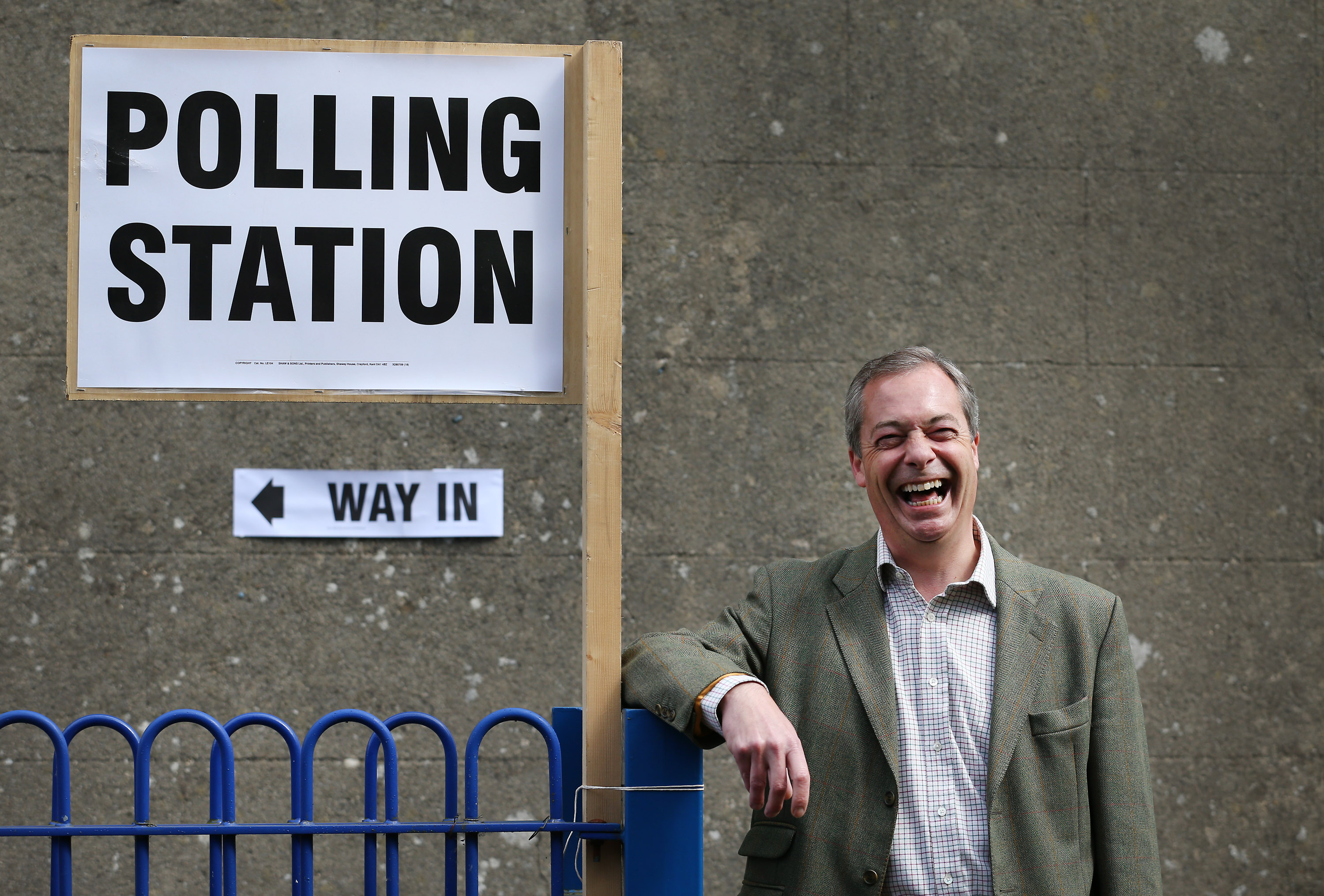
(Photo: United Kingdom Independence Party (UKIP) leader Nigel Farage poses for photographs as he leaves a polling station on May 22, 2014 near Biggin Hill, England. Millions of voters are going to the polls today in local and European elections. By Peter Macdiarmid/Getty Images)

Naming Names

by Jessie Roberts

Oliver Farry considers how a writer’s name can make or break his fortune:

Geoff Dyer is finding himself being shadowed, in a manner akin to Poe’s William Wilson, by another Geoff Dyer, the Financial Times’ Beijing bureau chief, whose books on contemporary China have no doubt snared a few unsuspecting buyers on Amazon. David Cloud Atlas Mitchell has, on at least one occasion, been represented in a broadsheet newspaper by a photo of David Peep Show Mitchell. Dyer and Mitchell are sufficiently successful not to have been damaged by the confusion. Still, circumstances can change. Who now remembers the American writer Winston Churchill – three years Sir Winston’s senior – who was one of the world’s best-selling novelists of the early twentieth century?

Personally, I have to admit I am guilty of neglecting writers on account of their names being just a little too ordinary.

It took me a long time to get around to James Salter and George Saunders and I shamefully ignored the late Mavis Gallant’s work because her name, for some reason, conjured up the image of country parsonages and village fetes. It took best-selling John Green’s zany Flavorwire videos for me to pay attention to him because his name just blended into the background too much.

It’s one thing if you are getting a lot of press from the off – even then, if one is called Smith, it’s surely better to be a Zadie than a Jenny – but if you are relying, like most writers do, on word of mouth and exposure in bookshops and libraries, an ordinary name might not be the one you want. While China Miéville’s success is fully merited from a literary point of view, having a stand-out name has probably never harmed him either. A writer by the name of Peter Jones or Tom Jenkins is going to have a much harder time being remembered.

An Accounting Of American Racism

by Patrick Appel

A history of the fight against housing discrimination in Chicago:

This embed is invalid


These unfair housing policies are a big part of Ta-Nehisi Coates’s new Atlantic cover story, The Case for Reparations,” which is certain to make waves:

What I’m talking about is more than recompense for past injusticesmore than a handout, a payout, hush money, or a reluctant bribe. What I’m talking about is a national reckoning that would lead to spritual renewal. Reparations would mean the end of scarfing hot dogs on the Fourth of July while denying the facts of our heritage. Reparations would mean the end of yelling “patriotism” while waving a Confederate flag. Reparations would mean a revolution of the American consciousness, a reconciling of our self-image as the great democratizer with the facts of our history. …

Perhaps no number can fully capture the multi-century plunder of black people in America. Perhaps the number is so large that it can’t be imagined, let alone calculated and dispensed. But I believe that wrestling publicly with these questions matters as much as—if not more than—the specific answers that might be produced. An America that asks what it owes its most vulnerable citizens is improved and humane. An America that looks away is ignoring not just the sins of the past but the sins of the present and the certain sins of the future.

TNC reflects on his article at his blog:

I rarely hope for my writing to have any effect. But I confess that I hope this piece makes people feel a certain kind of way. I hope it makes a certain specimen of intellectual cowardice and willful historical ignorance less acceptable. More, I hope it mocks people who believe that a society can spend three and a half centuries attempting to cripple a man, fifty years offering half-hearted aid, and then wonder why he walks with a limp.

Freddie deBoer supports Coates:

Reparations would give us the most direct and powerful evidence of the efficacy of direct transfers since the (massively successful) implementation of Social Security. If reparations were paid out over time rather than in a lump sum, it could be a fantastic opportunity to learn how a universal basic income or similar mechanism would work at large scale. Closing the economic gap would go a long way to solving persistent sociological questions. We would see whether the “race science” crowd is right, and black people suffer from genetic cognitive deficits, or if my side is right, and structural economic inequalities cause performance gaps in education and other fields. My guess is that economic parity would lead to great improvements in a host of other quality of life metrics, like education, life expectancy, crime and incarceration rates, etc. We would also learn a lot about prejudice: do emotional and social prejudices cause structural inequalities, or the other way around? Can you attack those inequalities through attention to language and social taboos, or do you need direct economic change? Redressing the enormous black-white wealth gap would be a great moral good in and of itself, and it would also facilitate broader projects of social justice in the future.

Chotiner chimes in:

The best argument against Coates’s proposals is simply that they will prove to be more trouble than they are worth, i.e. that their practical effect will be a negative one. Perhaps white people will feel that they are being attacked, as a mere 95 percent of Fox News segments imply. Or perhaps this will weaken support for the social safety net, because African Americans will sound ungrateful. (The focus of the remaining 5 percent of Fox segments.) But then Coates will have been proven doubly right. If we can’t even have the conversation he wants because people are so defensive or unwilling (or plain racist), it’s just more evidence for what his essay rightfully bemoans.

Danny Vinik calculates the potential cost of reparations:

Larry Neal, an economist at the University of Illinois, calculated the difference between the wages that slaves would have received from 1620 to 1840, minus estimated maintenance costs spent by slave owners, and reached a total of $1.4 trillion in 1983 dollars. At an annual rate of interest of 5 percent, that’s more than $6.5 trillion in 2014just in lost wages. In a separate estimate in 1983, James Marketti calculated it at $2.1 trillion, equal to $10 trillion today. In 1989, economists Bernadette Chachere and Gerald Udinsky estimated that labor market discrimination between 1929 and 1969 cost black Americans $1.6 trillion.

These estimates don’t include the physical harms of slavery, lost educational, and wealth-building opportunities, nor the cost of the discrimination that persists today. But it’s clear the magnitude of reparations would be in the trillions of dollars. For perspective, the federal government last year spent $3.5 trillion and GDP was $16.6 trillion.

The GOP’s Senate Candidates

by Patrick Appel

Beutler sizes them up:

[T]he real issue isn’t whether the “Tea Party,” now vanquished, has been a liability for the Republican Party, but whether the Republican electorate is fractious and reactionary, and has thus kept the Senate out of reach for Republicans two cycles in a row.

The answer is yes. And Republicans have addressed that problem not by running shock and awe campaigns against individual “Tea Party” candidates, but by aligning behind candidates and incumbents conservative enough for the primary electorate yet polished enough (they hope) to avoid Akin-like admissions against interest. There are no Christine O’Donnells this year, but there are no Mike Castles either.

So the questions now are whether the current crop of GOP candidates can actually suppress the right wing Id, and, secondarily, whether the winning candidates of the American right can durably embed themselves into the political system. Just as we know that 2016 (a presidential year) will be a tough one for Senate Republicans, we can also project that conservatives who win swing states this year will face a much different electorate when they’re up again in six years. And come then, their conservatism will be a liability, not an asset.

Molly Ball argues that the Tea Party is still hurting the GOP:

Republican infighting is far more common and more brutal than that experienced by Democrats, egged on by a constellation of rabble-rousing conservative groups who pour money into ginning up the base. These battles, it hardly needs to be said, inevitably push the nominee far to the right in ways that may alienate moderate voters. North Carolina’s Republican Senate nominee, Thom Tillis, sought to reassure primary voters of his anti-Obamacare bona fides by boasting about how he worked to prevent the state from expanding Medicare; now his Democratic opponent, Senator Kay Hagan, is attacking him for his opposition to the expansion, which is generally popular.