
San Francisco, California, 4.46 pm
San Francisco, California, 4.46 pm
David Graham warns observers not to read too much into Mitch McConnell’s win last night:
[H]ere’s what this tells us about the Tea Party-establishment war, and what my colleague Molly Ball calls The Dynamic, the national theme that explains all races: Probably not much. What it shows is that it’s not enough to challenge an incumbent from the right in a red state. It’s not even enough for the incumbent to be very vulnerable. The two cases where Tea Party candidates unseated sitting senators—Mike Lee in Utah and Richard Mourdock in Indiana—have come when the incumbent was caught off-guard and the challenger was a strong candidate. Neither was the case in Kentucky.
Michael Tomasky thinks this election is just a bump in the road for the Tea Party:
[W]hile 2014 is, to be sure, going to go down as a bad Tea Party year in electoral terms, we certainly can’t yet say the same of 2016—a much more important year, i.e. presidential.
In fact, as of today, what we can say about 2016, speculative as it may be, is that the tea party is if anything in the driver’s seat. The guy we’ve all taken to calling the GOP front-runner, Rand Paul, is a Tea Party guy. That simple fact alone hardly makes for anything I’d call dead.
Beyond Paul, numerous potential candidates are backed by the Tea Party or in some sense have that aura about them. Ted Cruz, Marco Rubio, Scott Walker—even Mike Huckabee, if he casts his lure [good] into the waters, will be fishing in the Tea Party pond for votes. Yes, there’ll be a Chris Christie or a Jeb Bush to represent the establishment. But if most of the candidates are flat-out Tea Party people or at least Tea Party-friendly creatures, that means to me that the pull of gravity in that primary season is still going to be pretty far to the right, and driven to some decent extent by Tea Party priorities. And let’s face it: If the party does nominate Paul, the Tea Party will have won the biggest prize in intra-party politics: determining the presidential nominee. So 2016 could well be a huge Tea Party year.
Ben Jacobs makes an important point has been made before:
[T]he lesson is not that the Establishment beat the Tea Party or vice versa but that the two are becoming increasingly similar. There aren’t primaries as there were two or four years ago with moderate mandarins like Mike Castle or Dick Lugar. Instead, the candidates from each wing of the Republican Party are starting to look more alike and taking positions on issues like taxes, immigration and climate change that would have been considered far right wing in George Bush’s GOP. The fights between establishment candidates and Tea Party candidates increasingly bear a greater resemblance to nitpicking theological disputes than to Rockefeller vs. Goldwater in ideological magnitude .
Kilgore unpacks last night’s results:
According to the “Year of the Republican Establishment” narrative, it was the finest of nights for Mitch McConnell and his GOP elite friends. He crushed his own tea party opponent, Matt Bevin and the “Establishment” candidate for Senate in Oregon got lucky when a multi-faceted stalking scandal occurred after most voters had cast ballots by mail. And best of all, in a state where a wild primary threatened GOP calculations to take over the Senate, Georgia, the two “Establishment” candidates will meet in a runoff after snuffing potential Todd Akin clones Paul Broun and Phil Gingrey and possible trouble-maker Karen Handel.
It’s a nice picture, and welcome after the troublesome Senate results last week in Nebraska. But its linchpin, the Georgia Senate race, is a bit — actually a lot — more complicated than that.
One reason why:
It will be interesting to see how Georgia Tea Folk line up for the runoff. Herman Cain is already in Perdue’s corner. Late in the night, major Handel backer Erick Erickson said he’d support Kingston. In an unusually long runoff campaign (nine weeks), with both candidates having access to plenty of money, the steady drift-to-the-right that characterized the entire primary field could continue.
Molly Ball provides more background on the Georgia race. Nate Cohn considers the chances of Michelle Nunn, the Democrats’ nominee:
Ms. Nunn’s job could be made easier if Mr. Perdue or Mr. Kingston proves to be an especially weak candidate. Mr. Kingston, an experienced congressman, seems less likely to make a major mistake, but Mr. Perdue is a political novice.
Ms. Nunn’s chances, then, can’t be completely dismissed. Demographic change has pushed Georgia far enough that a Democrat could conceivably squeak out a narrow win if everything goes right. But there should be no mistaking this race for a true tossup. Ms. Nunn will need to match the best performance by a Democratic candidate for federal office in more than a decade, even though she’s not an incumbent and the state’s white voters have become more conservative. It is possible, but hardly an outcome to count on.

John Upton reviews new research that finds a link between foreclosures and suicides, particularly among middle-aged adults:
To search for relationships between foreclosure and suicide rates, the researchers controlled for certain variables like the unemployment rate, and then honed in on intrastate data. … These steps led the researchers to a grim discovery—one that implicates banks’ irresponsible lending practices in more than just the death of middle-class prosperity.
“Our results suggest that the foreclosure crisis significantly contributed to the increase in suicides in the Great Recession,” the researchers write in their paper.
A statistically significant within-state foreclosure effect on suicide rates was detected between 2005 and 2010 for two age groups studied—30- to 45-year-olds, and 46- to 64-year-olds. The effect for 30- to 45-year-olds was small. It was vast for those who were still of working age but approaching retirement, helping explain the 18 percent suicide rate among 46- to 64-year-olds. [Dartmouth sociologist Jason] Houle says the findings help explain the puzzling rise in middle-aged suicide rates in a recession-wrecked nation.
Jay Michaelson worries that the recent state marriage equality rulings are on a collision course with the Supreme Court:
[T]he lofty rhetoric of these [state] decisions and their legal reasoning are a far cry from Justice Anthony Kennedy’s opinion in United States v. Windsor, which invalidated the Defense of Marriage Act less than a year ago. As a challenge to a state marriage amendment or law now seems destined to end up at the Supreme Court, probably in the next term, these discrepancies should be cause for concern.
Emily Bazelon isn’t fretting:
[T]he momentum raises a question no one would have dreamed of a year ago: Will gay marriage become the law of the land without the Supreme Court doing anything more? … Add it all up, including Pennsylvania, and we’ve arrived at 29 states where same-sex marriage is legal or on its way there unless an appeals court blocks it—past the halfway point and far past the tipping point. (Yes, 32 states still have laws or constitutional amendments on the books that deny marriage equality to same-sex couples. But those are the laws that are toppling like a line of dominoes.)
We’ve arrived here so much faster and more agreeably than anyone could have predicted even a year ago, when the challenges post-Windsor looked like they would split the district courts, take their time wending their way through the appellate process, and maybe arrive back at the Supreme Court in, say, 2017, safely after the next election. Instead, no judge wants to write the opinion denying the benefit of marriage. Judge John Jones of federal district court in Pennsylvania, who issued [yesterday’s] ruling, was endorsed by none other than Rick Santorum, beloved of the religious right. Judges aren’t supposed to rule by the polls, but that doesn’t mean they’re unaffected by the rising tide of public support, especially among young people. As Northwestern University law professor Andrew M. Koppelman said to Adam Liptak in the New York Times: “It is becoming increasingly clear to judges that if they rule against same-sex marriage their grandchildren will regard them as bigots.”
Dale Carpenter analyzes the PA ruling:
Unlike most other district courts recently, Judge Jones held that same-sex couples have a fundamental right to marry. He held that the Pennsylvania couples were not seeking a “new” right but only participation in an old one, the right to marry.
Carpenter also points out that, “unlike most other district courts, he determined that sexual-orientation discrimination triggers intermediate scrutiny”:
This intermediate-scrutiny approach seems to me to be the most doctrinally grounded way to strike down bans on same-sex marriage. It leaves in place the deferential caste of rational-basis review. It also makes clear what every court seems to have recognized recently: that there is a long history of discrimination against gays and lesbians, that sexual orientation is unrelated to individual merit, that it continues to be difficult for homosexuals to get legal protection through the political process in many areas of the country, and that there is not an “exceedingly persuasive” reason to exclude gay couples from marriage (even if there is a jurisprudentially “rational” one).
John Culhane notes that the plaintiffs in PA “won on both liberty and equality arguments”:
Early on, the marriage equality litigation focused on the denial of equality to same-sex couples. That was thought to be a more sympathetic strategy than trying to claim that the fundamental right to marry (a liberty interest, constitutionally speaking) extended to same-sex marriages. That’s because the Supreme Court has sometimes defined “fundamental rights” quite narrowly and limited those rights to those who were historically protected. But increasingly, courts are finding that the fundamental right to marry means a right to marry the person of one’s choice, history aside. That’s what Judge Jones held, with pointed reference to Loving v. Virginia, where the high court struck down an anti-miscegenation law. That states had long barred interracial marriages didn’t make Virginia’s historical choice acceptable, and it’s no longer acceptable in the same-sex marriage context, either.

Steve Kandell, whose sister was killed in the World Trade Center, shares his conflicted experience touring the National September 11 Memorial & Museum:
I can feel the sweat that went into making this not seem tacky, of wanting to show respect, but also wanting to show every last bit of carnage and visceral whomp to justify the $24 price of admission – vulgarity with the noblest intentions. … I think now of every war memorial I ever yawned through on a class trip, how someone else’s past horror was my vacant diversion and maybe I learned something but I didn’t feel anything. Everyone should have a museum dedicated to the worst day of their life and be forced to attend it with a bunch of tourists from Denmark. Annotated divorce papers blown up and mounted, interactive exhibits detailing how your mom’s last round of chemo didn’t take, souvenir T-shirts emblazoned with your best friend’s last words before the car crash. And you should have to see for yourself how little your pain matters to a family of five who need to get some food before the kids melt down. Or maybe worse, watch it be co-opted by people who want, for whatever reason, to feel that connection so acutely.
Rosemarie Ward, noting that many of the items on display were donated by victims’ families, is more moved:
Throughout the space are segments of twisted steel, like sculptures. A fire engine from the back looks a bit battered, but the entire front cab is a ghost of mangled steel. A set of partially damaged concrete stairs nestle between an escalator and the museum’s main staircase. The so-called “Survivors’ Staircase” was an outdoor staircase that led some survivors to safety on nearby Vesey Street. In removing this staircase from the site, architects and archeologists treated it as carefully as an ancient relic. …
The audio and video clips of those who are lost, of those who remain, of construction workers, of firefighters, of ordinary New Yorkers, are very moving. The personal accounts, such as the one from John Napolitano whose firefighting son died that day, are hard to listen to. The last phone calls of those lost are devastating. The multi-media exhibits, designed by Local Projects, are particularly moving. In some places visitors are encouraged to make videos while at the museum, which will become part of the exhibit.
The museum is extremely well done. It offers solace to those who still mourn, and an education for those who were not yet born.
(Photo: Objects recovered from the World Trade Center site are displayed during a press preview of the National September 11 Memorial Museum at ground zero May 15, 2014 in New York City. The museum spans seven stories, mostly underground, and contains artifacts from the attack on the World Trade Center Towers on September 11, 2001 that include the 80-foot high tridents, the so-called ‘Ground Zero Cross,’ the destroyed remains of Company 21’s New York Fire Department Engine as well as smaller items. The museum opens to the public on May 21. By James Keivom-Pool/Getty Images)
Andrew Prokop picks up on Hillary’s new inequality rhetoric:
[In a recent speech,] Clinton is positioning herself as a kind of global crusader against income inequality, urging corrupt and wealthy elites to do something about this challenge. And by bringing up the Arab Spring, she alludes to the “explosive results” that could occur if the US doesn’t do something to address it. “Many Americans feel frustrated, even angry,” she said. Though Clinton never explicitly argues that social upheaval akin to the Arab Spring could happen here, bringing it up in this context clearly underscores the need for urgent action. So rather than arguing that her Secretary tenure makes her qualified to lead on foreign affairs, she’s saying it beefs up her qualifications on domestic policy.
Beinart thinks Hillary is already targeting Jeb:
Clinton is not a great inspirational speaker. She’s at her best arguing a case. And the most effective part of her speech Friday was her case for why Clinton-administration policies—an expanded earned-income tax credit, a higher minimum wage, the State Children’s Health Insurance Program—helped poor and middle-class Americans get ahead, while the Bush administration policies that followed—tax breaks for the rich, unfunded wars—made their struggles harder.
If Republicans are smart, they’ll do everything in their power to avoid this debate. First, because they want to portray Hillary as running for Barack Obama’s third term, not her husband’s, since the Obama legacy is trickier to defend. Second, because the 2016 GOP nominee needs to embody change, which is hard to do when you’re depicted as George W. Bush. Third, because Bill Clinton is about 20 points more popular than Bush, and that’s highly unlikely to change over the next two years.
The one Republican presidential candidate who can’t avoid this debate is Jeb, a man who is known to the vast majority of Americans only as George W. Bush’s brother. Running him in 2016 is like nominating a close relative of Jefferson Davis as the Democratic Party’s nominee in 1872 or nominating a prominent member of Herbert Hoover’s cabinet to represent the GOP in 1948: It dredges up a past the party desperately needs to transcend.
Ruth Bettelheim suggests allowing kids to attend schools close to their parents’ workplaces:
According to the Census Bureau, US commute times are an average of 25 minutes one way. Over 40 percent of commutes take even longer. For some parents, this is exacerbated by the need to drop kids off at school and pick them up at the end of the day. Plus, married couples are spending 185 more hours per year at work than they did ten years ago, which puts extra stress on families and reduces parental involvement in schools.
In the long-term, companies would get a lot of benefits from funding the expansion or creation of public schools near their office sites. Bloomberg Business Week reported that 80 percent of employers said child care caused workdays to get cut short – and created more problems than any other family-related issue in the workplace. Businesses save between $150,000 and $250,000 per year when there are on-site or nearby preschools. Economic benefits include reduced absenteeism and turnover, along with increased employee satisfaction and loyalty – all of which substantially improve productivity.
Jay Ulfelder is working on one:
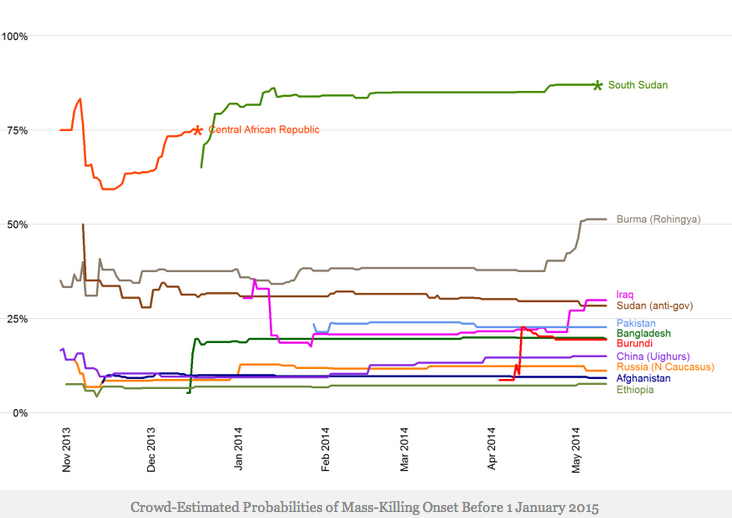
For the past couple of years, I have been working as a consultant to the U.S. Holocaust Memorial Museum’s Center for the Prevention of Genocide to help build a new early-warning system for mass atrocities around the world. Six months ago, we started running the second of our two major forecasting streams, a “wisdom of (expert) crowds” platform that aggregates probabilistic forecasts from a pool of topical and area experts on potential events of concern. (See this conference paper for more detail.)
The chart [above] summarizes the output from that platform on most of the questions we’ve asked so far about potential new episodes of mass killing before 2015. For our early-warning system, we define a mass killing as an episode of sustained violence in which at least 1,000 noncombatant civilians from a discrete group are intentionally killed, usually in a period of a year or less. Each line in the chart shows change over time in the daily average of the inputs from all of the participants who choose to make a forecast on that question. In other words, the line is a mathematical summary of the wisdom of our assembled crowd—now numbering nearly 100—on the risk of a mass killing beginning in each case before the end of 2014.
The discussion continues:
That reader in a semi-monogomous relationship with his GF who has her own place can live as they please but still have each other … and that’s great – without kids. With kids that’s called an amicable divorce.
Another skeptic:
So this reader is in a non-monogamous relationship with someone they don’t live with. Congratulations, you’ve discovered dating. This is not exactly a breakthrough.
I met the woman who would become my wife when we lived on opposite sides of the country. I moved to be with her and we married a year after I got to town. But even before we got hitched, we lived together. I love her, so I want to be around her. Like everyone, we have times where we recharge individually, but good grief; I couldn’t imagine saying “I love you, I’m so grateful to have you in my life, now go away.”
There’s also the joy of intimacy, and I mean real intimacy – of having someone in your life, of giving yourself to them, of just being around someone. My wife isn’t a roommate with benefits. This is not someone I dig and want to hook up with occasionally. I love her. It would be insane not to want to be around her.
But another reader has had success with living apart together:
Can we talk some more about LAT? It’s something I’ve been thinking about a lot lately. My long-time partner and I maintain separate households in neighborhoods about a half-hour drive away from each other, but we’ve lived together periodically when circumstances dictate (I had to get out of my place for awhile while it was being worked on; he had to sublet his place for a few months while he was unemployed).
Living together just hasn’t worked out so well for us. Both of us live in an expensive city, so our places are small, and we have very different styles when it comes to maintaining our space. I like a clean, peaceful place, and he tends to leave a trail of clothes and crumbs wherever he goes. I sometimes like to binge-watch shows on Netflix, which he hates. Living together, domestic resentments piled up (I don’t like to clean up after another adult, but he’s never going to be as orderly as I am, etc.), and we grew tired of seeing each other morning in and morning out, much as we enjoy sleeping in the same bed, and the focus of many of our conversations were domestic issues. It got boring, even though I find him anything but boring.
We plan to marry, but we will still live apart and date. Visiting each other on weekends and one or two nights during the week builds in enough space that we have lots of unshared experiences to talk about, and enough space that we’re overjoyed to see each other when it happens. Sex isn’t on the table nightly and therefore easy to avoid; when we see each other, it’s with anticipation. I wouldn’t have it any other way. I want to be with this man for the rest of my life, but sharing a domestic existence would grind that desire right out of me. I’m at an age at which I don’t need a relationship for child-bearing or asset-building; I’m in it for good times, affectionate companionship, and mutual support. It makes sense to keep the good times rolling. Luckily for me, we see absolutely eye-to-eye on this.
Another:
I’ve been so excited to see these posts; they are very comforting to me right now. My husband of seven years recently took a too-good-to-pass-up job offer in San Francisco, moving away from me and our pet rabbit, who live in Boston. It hasn’t been easy, but so far, it’s been working for us. He came home two weekends ago, and we spent the best weekend we’ve had together in years. It’s easier to spend quality time together once a month than every night in front of the TV and laptop screens.
Like the other reader, I see very real advantages to living apart, like moving to the neighborhood he never wanted to live in, and getting the farm share he wouldn’t eat. But as we learn to navigate this new normal in our relationship, it’s tremendously helpful to see that many other people are making it work.
Update from the original reader:
Love the responses, and let me add an addendum: Yes, my GF don’t have (or want) kids (or marriage) which makes it simpler for us. Exactly: for us. We don’t think that our way is for everyone, yet people who criticize the LATs of the world (and they are legion, including many family members, gay and straight, who push us to get married) assume that what works for them (Living together! Daily intimacy! Every damn day forever and a day!) should work for everyone. We all share certain things in common (the desire for love and affection, intimacy and support) but we’re also all different and people ought to do what works for them without scorning or dismissing those who do otherwise.
In a review of Paul Jankowski’s Verdun: The Longest Battle of the Great War, Robert Zaretsky considers what kept soldiers from deserting the trenches:
Why did they accept being fodder for cannons when they saw through the official justifications for the hecatomb, when there seemed no end in sight, when the only winner was the battle itself? The reasons were complex. … In the end, it was neither military constraint nor fear of punishment that kept men in the trenches. Nor was it patriotism or republicanism, even though Jankowski suggests that many soldiers absorbed the dehumanizing propaganda aimed at “les boches.” Instead, what mostly kept the men going – the fuel to a Beckettian “I can’t go on, I will go on” – were the bonds to family and fellow poilus.
Perhaps the most astonishing statistic of the war, and not just Verdun, is that more than 10 billion letters were sent to and from the home front and front lines. As Paul Fussell pointed out long ago, it was a literary war, one in which the literature of letter writing reminded soldiers why they were fighting. This sense of duty was deepened by the presence of fellow soldiers to either side of them in their shared hell. It was, Jankowski concludes, a kind of duty that “sprang from within themselves, from allegiance rather than enmity and attachment rather than antipathy.”
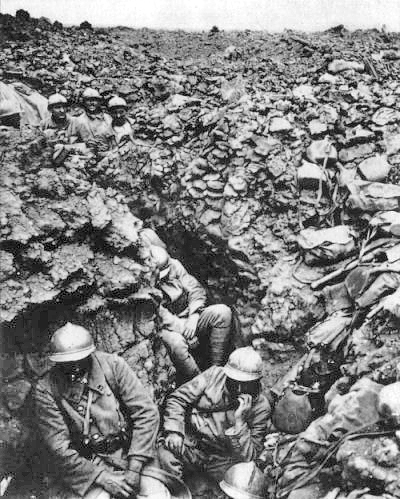
(Photo: French soldiers of the 87th Regiment, 6th Division, at Côte 304 (Hill 304), northwest of Verdun, 1916. Via Wikimedia Commons.)
 The Dish