Why “Race” Isn’t Biological

by Patrick Appel

This speech by Charles Mills, which we’ve posted before, does an excellent job explaining the social construction of race:

Nicholas Wade’s new book on race and genetics, which takes the biological basis of race as a given, provides no consistent definition for “race.” During his debate with Wade, anthropologist Agustín Fuentes pointed out that “Wade uses cluster, population, group, race, sub-race, ethnicity in a range of ways with few concrete definitions, and occasionally interchangeably throughout the book.” In a response to Wade’s book, Fuertes explains how A Troublesome Inheritance gets race so wrong:

The originators of the computer program most often used to support the argument that humans divide into the continental genetic clusters (which Wade says are “races”) comment that their model (called structure) is not well-suited to data shaped by restricted gene flow with isolation by distance (as human genetic variation data on large scales are). They warn that if one does try to apply this model to those data, the inferred value of K (how many clusters emerge) can be rather arbitrary. For example, one article Wade cites shows not three, not five, not seven but 14 clusters, six of which are in Africa alone.

So when Wade states in chapter 5 of his book, “It might be reasonable to elevate the Indian and Middle Eastern groups to the level of major races, making seven in all,” he notices a problem: “But then, many more subpopulations could be declared races.” But he has a solution: “[T]o keep things simple, the 5-race continent based scheme seems the most practical for most purposes.”

Sure, it is practical if your purpose is to maintain the myth that black, white and Asian are really separable biological groups. But if your goal is to accurately reflect what we know about human biological variation, then no, it is a really not practical at all; in fact, it is flat-out wrong. What we know about human genetic variation does not support dividing humans into three or five or seven “races.”

Other writers who argue that race is biological aren’t as sloppy as Wade. And, even though I do not believe that defining race biologically is correct, it’s best to engage with the strongest arguments of those who disagree. For starters, here is part of a 2012 post by Jerry Coyne that defends defining human races biologically:

What are races?

In my own field of evolutionary biology, races of animals (also called “subspecies” or “ecotypes”) are morphologically distinguishable populations that live in allopatry (i.e. are geographically separated).  There is no firm criterion on how much morphological difference it takes to delimit a race.  Races of mice, for example, are described solely on the basis of difference in coat color, which could involve only one or two genes.

Under that criterion, are there human races?

Yes.  As we all know, there are morphologically different groups of people who live in different areas, though those differences are blurring due to recent innovations in transportation that have led to more admixture between human groups.

Coyne, in the midst of a scathing review of Wade’s book, writes that “Wade’s discussion of genetically differentiated subgroups, whether or not you want to call them ‘races’—is not too bad.” H. Allen Orr, who tears Wade’s book to shreds, likewise defends a genetic definition of race:

The central fact is that genetic differences among human beings who derive from different continents are statistical. Geneticists might find that a variant of a given gene is found in 79 percent of Europeans but in only, say, 58 percent of East Asians. Only rarely do all Europeans carry a genetic variant that does not appear in all East Asians. But across our vast genomes, these statistical differences add up, and geneticists have little difficulty concluding that one person’s genome looks European and another person’s looks East Asian. To put the conclusion more technically, the genomes of various human beings fall into several reasonably well-defined clusters when analyzed statistically, and these clusters generally correspond to continent of origin. In this statistical sense, races are real.

Coyne adds:

This is what I also claimed, and of course got slammed by the race-denialists who are motivated largely by politics.  To a biologist, races are simply genetically differentiated populations, and human populations are genetically differentiated.  Although it’s a subjective exercise to say how many races there are, human genetic differentiation seems to cluster largely by continent, as you’d expect if that differentiation evolved in allopatry (geographic isolation).

Relatedly, Razib Khan argues that “the modern American consensus that race is a social construct is true but trivial”:

It’s true because a de facto race such as “Latinos/Hispanics” were created in the 1960s by the American government and elite for purposes of implementing public policies such as affirmative action. Obviously this is a classic case of a social construct, as the quasi-racial category is based upon social, not biological, factors (Latinos/Hispanic can explicitly be of any race, though implicitly it’s transformed into a non-white class in the United States). A group like “black Americans” ranges from people with considerably less than 50% African ancestry to more than 90% African ancestry (though almost always black Americans who are not immigrants from Africa or first generation offspring of those immigrants have some segments of European ancestry). The problem is that people move from this non-controversial point, that some racial categories are social constructs, to the assertion that all racial categories are social constructs, and that phylogenetic clustering of human populations is irrelevant or impossible. It is not irrelevant, or impossible. Human populations vary, and that variation matters. Human populations have specific historical backgrounds, and phylogenetics can capture that history through methods of inference.

I disagree with Khan calling “phylogenetic clustering of human populations” races, but Razib is far more intelligible here than Wade is in most of his book. Nevertheless, the biological definitions of race outlined above are problematic because they are not the same as the social definitions of race. There is significant overlap between the biological and social definitions but defining “race” two ways only confuses matters. In an interview, Wade offers an explanation for why he uses the term “race” as he does:

It seems that the problem might be, as you said, that there is so much historical baggage associated with the term race. Is there a way to get around that? Do we just need a different term than race to talk about these genetic differences?

I’m not sure how that will play out. The geneticists, if you read their papers, have long been using code words. They sort of dropped the term “race” about 1980 or earlier, and instead you see code words like “population” or “population structure.” Now that they’re able to define race in genetic terms they tend to use other words, like “continental groups” or “continent of origin,” which does, indeed, correspond to the everyday conception of race. When I’m writing I prefer to use the word race because that’s the word that everyone understands. It’s a word with baggage, but it’s not necessarily a malign word. It all depends on the context in which it’s used, I guess.

Wade says that “everyone understands” the word race. But what everyone understands are the social definitions of race: White, Black, Latino, Asian, Native American, Samoan, and so on. Wade dismisses geneticists who use terms like “population structure,” “population stratification,” “ancestry” and “ancestry informative markers.” But those terms are useful when discussing genetics because they allow for far more complexity and specificity than our social definitions of race do.

Obviously, skin color and the other physical characteristics society uses to categorize individuals racially are biological. But skin color and other physical traits are not the same as race. And, as Khan noted recently, one “of the ironies of traits which we use to differentiate populations, such as skin color and facial features, is that these might actually have relatively shallow time depth within a given lineage.” So prioritizing skin color above all other ancestry informative markers finds little basis is biology. In a 2012 post, Fuentes argued against a biological understanding of race for related reasons:

Even something thought to be so ubiquitous as skin color works only in a limited way as dark or light skin tells us only about a human’s amount of ancestry relative to the equator, not anything about the specific population or part of the planet they might be descended from.

There is not a single biological element unique to any of the groups we call white, black, Asian, Latino, etc. In fact, no matter how hard people try, there has never been a successful scientific way to justify any racial classification, in biology. This is not to say that humans don’t vary biologically, we do, a lot. But rather that the variation is not racially distributed.

Alfred W. Clark, a strong defender of Wade’s book, has a useful round-up of commentary on A Troublesome Inheritance. In it, he dismisses Fuentes by arguing that he is suffering from a “slightly more sophisticated version of Lewontin’s Fallacy.” What is Lewontin’s Fallacy? In a 2005 NYT article arguing that race is biological, Armand Marie Leroi explained it:

The dominance of the social construct theory can be traced to a 1972 article by Dr. Richard Lewontin, a Harvard geneticist, who wrote that most human genetic variation can be found within any given “race.” If one looked at genes rather than faces, he claimed, the difference between an African and a European would be scarcely greater than the difference between any two Europeans. A few years later he wrote that the continued popularity of race as an idea was an “indication of the power of socioeconomically based ideology over the supposed objectivity of knowledge.” Most scientists are thoughtful, liberal-minded and socially aware people. It was just what they wanted to hear.

Three decades later, it seems that Dr. Lewontin’s facts were correct, and have been abundantly confirmed by ever better techniques of detecting genetic variety. His reasoning, however, was wrong. His error was an elementary one, but such was the appeal of his argument that it was only a couple of years ago that a Cambridge University statistician, A. W. F. Edwards, put his finger on it.

The error is easily illustrated. If one were asked to judge the ancestry of 100 New Yorkers, one could look at the color of their skin. That would do much to single out the Europeans, but little to distinguish the Senegalese from the Solomon Islanders. The same is true for any other feature of our bodies. The shapes of our eyes, noses and skulls; the color of our eyes and our hair; the heaviness, height and hairiness of our bodies are all, individually, poor guides to ancestry.

But this is not true when the features are taken together. Certain skin colors tend to go with certain kinds of eyes, noses, skulls and bodies. When we glance at a stranger’s face we use those associations to infer what continent, or even what country, he or his ancestors came from – and we usually get it right. To put it more abstractly, human physical variation is correlated; and correlations contain information.

Genetic variants that aren’t written on our faces, but that can be detected only in the genome, show similar correlations. It is these correlations that Dr. Lewontin seems to have ignored. In essence, he looked at one gene at a time and failed to see races. But if many – a few hundred – variable genes are considered simultaneously, then it is very easy to do so.

But this still fails to prove that races are biological. Calling these populations “races” is a semantic rather than a scientific decision. Wikipedia provides useful context on this front:

Philosophers Jonathan Kaplan and Rasmus Winther have argued that while Edwards’s argument is correct it does not invalidate Lewontin’s original argument, because racial groups being genetically distinct on average does not mean that racial groups are the most basic biological divisions of the world’s population. Nor does it mean that races are not social constructs as is the prevailing view among anthropologists and social scientists, because the particular genetic differences that correspond to races only become salient when racial categories take on social importance. From this sociological perspective, Edwards and Lewontin are therefore both correct.[13][14][15]

Similarly, biological anthropologist Jonathan Marks agrees with Edwards that correlations between geographical areas and genetics obviously exist in human populations, but goes on to note that “What is unclear is what this has to do with ‘race’ as that term has been used through much in the twentieth century – the mere fact that we can find groups to be different and can reliably allot people to them is trivial. Again, the point of the theory of race was to discover large clusters of people that are principally homogeneous within and heterogeneous between, contrasting groups. Lewontin’s analysis shows that such groups do not exist in the human species, and Edwards’ critique does not contradict that interpretation.”[6]
Will Congress Ever Act On Climate Change?

by Patrick Appel

Ronald Brownstein doubts it:

Much like gun control, climate is an issue that unites Republicans by ideology but divides Democrats by geography. Even if Democrats can build a bigger Senate majority through the next few election cycles—they are positioned to add seats in 2016 even if they lose control in 2014—such gains probably won’t produce the 60 votes needed to break a filibuster against legislation to limit carbon emissions.

The Democrats’ problem is that they cannot build a big Senate majority without winning seats in states heavily dependent on coal, which would suffer the most from limits on carbon. Democrats now hold 21 of the Senate seats in the 19 states that rely on coal to produce a majority of their electricity and half of the seats in the 10 states (some overlapping) that mine the most coal. Resistance from some coal-state Democrats doomed climate legislation in 2009, even when the party controlled 60 Senate seats and then-Speaker Nancy Pelosi narrowly muscled a cap-and-trade bill through the House. Senate Democrats such as North Dakota’s Heidi Heitkamp and Indiana’s Joe Donnelly remain equally unenthusiastic today.

The View From Your Window Contest: Winner #205

by Chris Bodenner

vfyw_5-17

A reader furrows his brow:

This is a toughie.  A nondescript scene of a generic Midwest downtown.  The only clue I see is the low rise of hill in the near distance, which suggests that there is a moderate-sized river at its base.  I’m just taking a guess with Iowa City, Iowa.  Or it could be Council Bluffs, or Sioux City or …

Another heads south:

I don’t have time for searching this week so I’ll just go with my first impression.  It’s someplace in the USA amid rolling hills or ridges and it peaked economically in the 1950s. I’m reminded of northeast Oklahoma, so I’ll guess Tahlequah.

The West Virginia cities of Morgantown and Charleston were also choices. One of only two non-US guesses:

Something about the VFYW picture this week seems French to me, but not in an obvious way.  I’m going to go with Lausanne, Switzerland in the French part of Switzerland as my guess.  My second guess is Montreal, Canada.

The other reader got thrown off by the photo’s untimely nature:

Totally looks like Minnesota or environs at first glance.  But where ever it is, it looks like fall; so I’m going Southern Hemisphere and taking a stab at Hobart, Tasmania.

The photo looks like fall because it was sent to us last November. (We often have to reach back into our archives because suitable window views for the contest are hard to find.) Another reader heads to the Northeast:

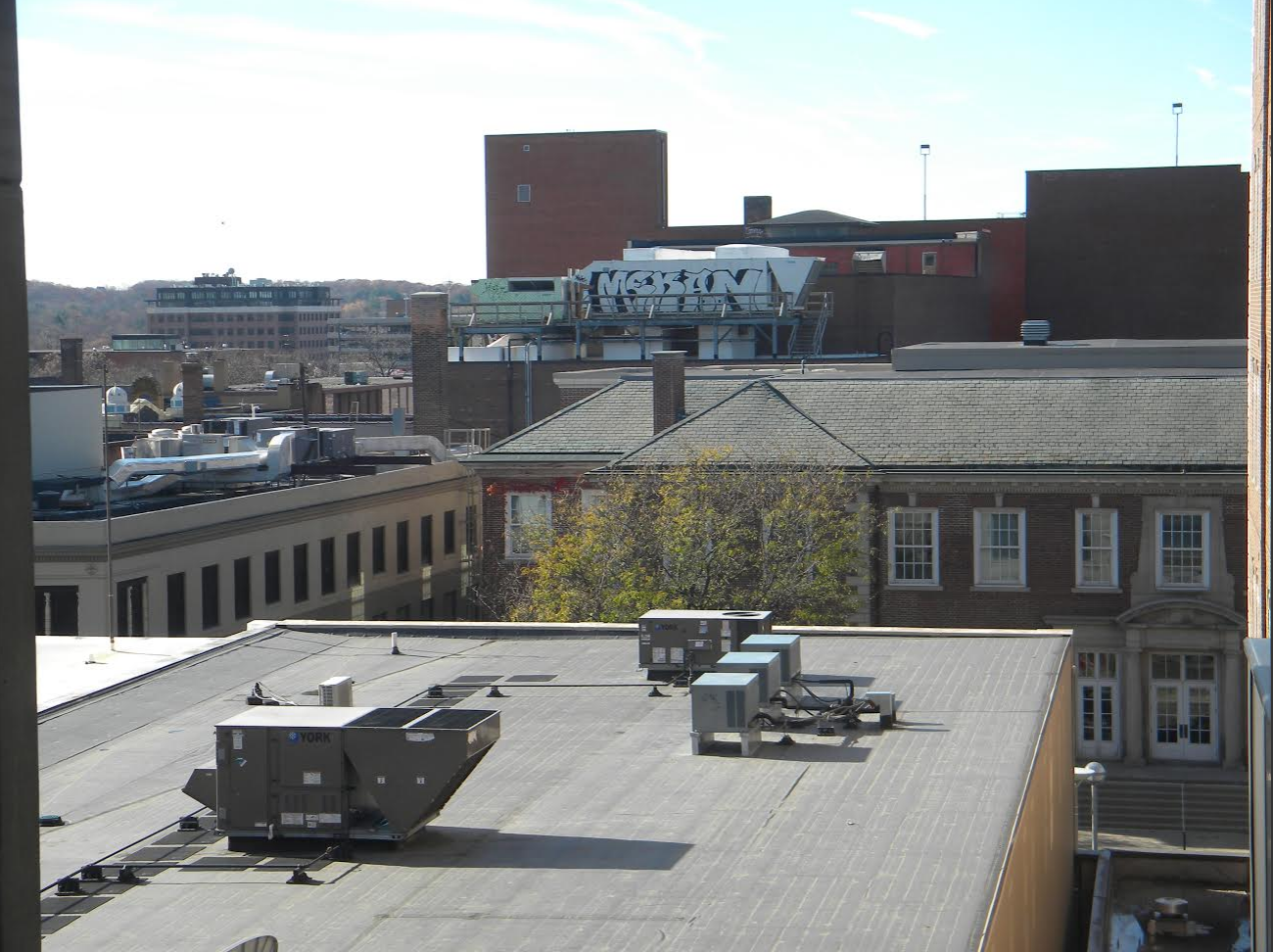
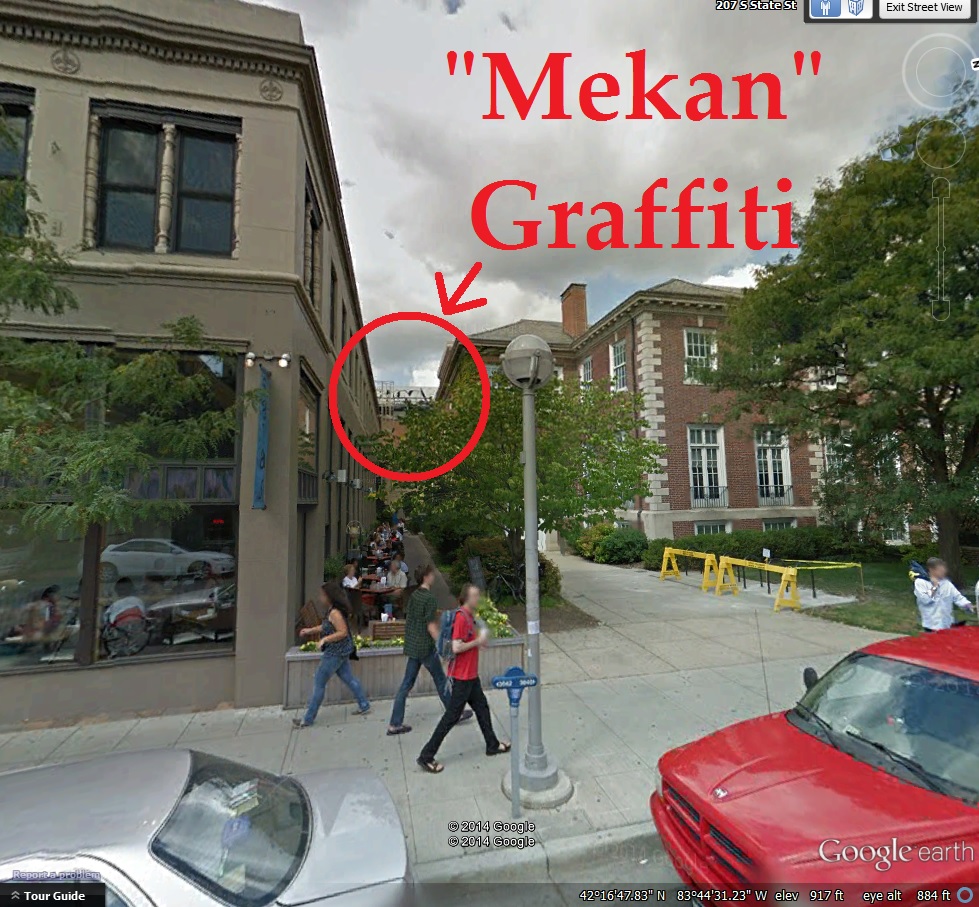
As soon as I saw this picture, I thought: New Brunswick, NJ … maybe the Rutgers campus? Perhaps from a dormitory window? Not that I’ve ever been to Rutgers. And while I made a few trips to New Brunswick back in 2000 and 2001 (I had Johnson & Johnson as a client), I don’t remember any details. And yet it came instantly to mind. That’s as far as I can get. I went on Google Images looking for the graffiti tag MEKAN (still not sure I’m reading it correctly), and got plenty of hits – but none in this “font.” (Which in itself was interesting – is Mekan a real name?)

Another spots the tag from a different angle:

Graffiti

Another reader:

East Stroudsberg, Pennsylvania? I’m only guessing this because I got lost through this town one way, trying to find a quick place to get some food after my wife was recovering from giving birth at the nearby hospital.  Wild guess but I felt it was worth a try.  The place does look likes it’s up in the mountains somewhere, and the buildings seem to have that appearance of collegiate uniformity.

Another college try:

This is a photo taken from the roof of a building next to the Maxwell School of Citizenship and Public Affairs – the building with the white window frames – and its extension, the Eggers Building to its left, looking out over the western part of the campus and Syracuse University. I am a 1994 M.A. in Political Science alum of the Maxwell School’s Program on the Analysis and Resolution of Conflicts (PARC) at Syracuse University. Go Orange!

Another:

I have no idea. Feels like the Northeast: tree, architecture, bricks, light. I generally do OK regarding latitude on the VFYWs, so let’s see … Worcester, Massachusetts?

Remarkable guess: the latitude of both cities is 42.2 degrees. But the window isn’t in the Northeast. Another goes with the Northwest:

Finally, you publish a VFYW contest photo of Seattle, Washington!  Even though I’ve lived there for over 30 years and can’t quite put my finger on the exact Univ Washington campus location where your photographer snapped that pic, those orange-red bricks were used to build almost every building on campus.  The extra bricks were used to pave Red Square.

Another gets the right state:

Detroit, Michigan? Only because that looks like a Mekan graffiti tag, and I’ve seen it around Detroit, albeit never on a non-descript rooftop that could be virtually anywhere they sell York air conditioners!

Another nails the right city:

University of Michigan, Ann Arbor.

*drops mic*

Another picks it up for a bit of standup:

SO easy! I just Googled “American cities with rooftops,” and voila – up popped Ann Arbor! It also gave me the exact window. The fifth floor in the School of Law Building, University of Michigan. How nice to have an easy view for a change.

P.S.  Lord have mercy.  I’m passing this one on to Chini.

Chini and the overwhelming number of the 100 entrants went with Ann Arbor. Below is a map illustrating how relatively easy the contest was this week:

This embed is invalid

Thanks to Chas for plotting the coordinates and putting together the composite image seen below. Another reader begins the hunt for the right window:

This was a very interesting contest for people not familiar with Ann Arbor. My starting clues were the tagging on the rooftop in the middle of the view and the twin small domes to the left.  Searching “Mekan” found a number of links to a tagger active in Ann Arbor and Detroit, but searching images for twin domes in Ann Arbor or Detroit was less useful (including churches in the search was not helpful). But searching images for Michigan Theater helped to further connect the clues. It took a while to figure out the the view was looking at the “back” of the theater façade top:

1E174E4A-1541-4336-8629-93893D58CB2B

Another gets close to the right building:

I think the photo is taken from Corner House Apts., 205 State Street, fourth floor southwest corner, 2nd south facing window from the corner. It is renting to students, for about $2000-2500, which they assume 2-4 people are sharing. In the background is the Ashley Mews Building, with the white stripe and the black upper floors. The two little cupolas sticking up are 603 E. Liberty Street, the historic Michigan Theater.

Across the street is Lane Hall: “Today, with space wholly dedicated to the Women’s Studies Department and the Institute for Research on Women and Gender, Lane Hall is the University’s center of research and teaching about gender. Jointly sponsored art exhibits, a succession of intellectual events throughout the year, and casual social interactions among researchers, faculty, students, and staff have made Lane Hall into an intellectually vibrant feminist community.”

Screen Shot 2014-05-18 at 10.46.36 PM

Another adds:

As a proud Ann Arborite I had to brag a little bit about some of the history that’s within half a block of where this picture was taken. The older looking building across the street is Lane Hall. It was built in 1917 and has had many uses – it is currently part of the women’s studies department.  For several decades it was the center of religious, social, and philosophical debate on campus.  In the late 1930s there was a series of lectures called “The Existence and Nature of God.”  The lecturers were Bertrand Russell, Catholic Bishop Fulton Sheen, and Reinhold Niebuhr – sounds like just your cup of tea, Andrew.

If the camera were facing southeast instead of southwest we would see Hill Auditorium – which just celebrated it’s 100th Anniversary last year.  Pretty much every great classical musician of the 20th century performed there.  A documentary on its history just won an Emmy.

And just to the north used to be the University High School – whose most famous graduate was probably James Osterberg Jr. (aka Iggy Pop).

Some other rock history:

Prior to being torn down for the CVS, the building housed a cramped recording studio upstairs. My high school band, Eye Guy, recorded and produced an album there one late night in 1997: Descent of the Astral Canary.

Back to the window hunt:

Screen Shot 2014-05-18 at 10.45.36 PM

From a father-son team:

We both took the “Mekan” graffiti as a starting point, something that immediately indicates Ann Arbor. Of course, graffiti can vary wildly, etc., so this was not dispositive. What clinched it were clues dad took from the HVAC units on the visible roofs. In the background are two extremely large-scale units; in the foreground, he adds, on top of what we now know is a CVS, are three condenser units indicative of a bar, restaurant, or other building with heavy cooling needs. That such a building would be directly across from a two-story Georgian Revival hall-type building, and in close company with other high-demand structures, strongly indicated to him that this was a VFYW 98university.

From there, it’s back to HVAC. Those units with visible labels are branded “York,” which distributes primarily (but not exclusively) in the north and northeast. Putting this all together, I started looking at northern universities with Georgian Revival buildings, and started with Ann Arbor. Street views of the campus turned up streetlights similar to the one in the view. Then it was just a matter of finding the right building.

Another building guess:

The graffiti gives the city away, and after a little sleuthing on Street View, the picture is either taken from a room in the back of the Bell Tower hotel or a nearby building.  I will leave the maps and arrows to the experts and guess The Bell Tower Hotel, fourth floor, say room 424.

Another nails the right one:

This is my first entry, and it’s the first time I’ve ever been able to get even a VFYW city correct, so I’m terribly excited! I’m also thrilled that I got to learn a lot about the state of Ann Arbor graffiti in the process, luckily finding another great view of this same graffiti on Flickr. I’m pretty sure the photo is taken from the 202 South Thayer building on 202 South Thayer Street, Ann Arbor, MI. I couldn’t find a floor plan, so I’m just going to guess that it’s taken from the 4th floor, right at the southwest corner of the building, looking out the southernmost west-facing window.

Another 202 South Thayer entry:

2014-05-18_1641

Oooh, thanks a lot, nothing but rooftops and a narrow angle on a drab, nondescript cityscape.  If I lived next door to this window I wouldn’t recognize the view.  At least there’s one Googleable thing in it, though: the graffiti on the roof in center frame.  It’s legible, thank goodness, so when I searched for “MEKAN” I found several references to a tagger who goes by that moniker and has been much discussed around Ann Arbor, Michigan.  But then image searches for MEKAN hit a dead end because no one appears ever to have posted a shot of the particular tag on view.

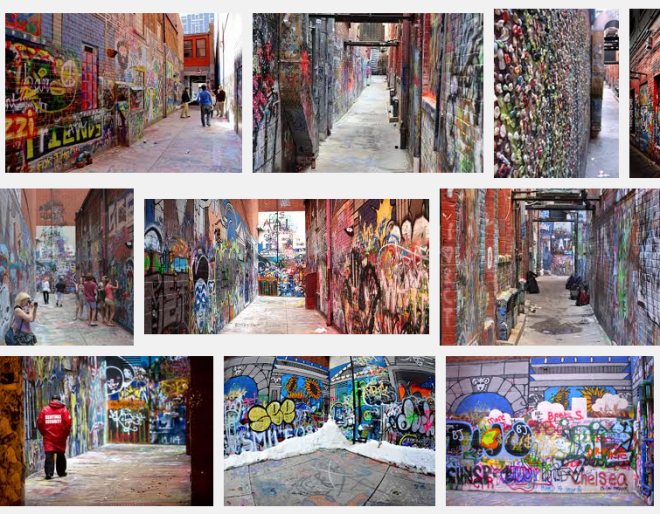
Oh well, so then I tried simple searches for anything involving graffiti in Ann Arbor and I found several references to a place the locals call “Graffiti Alley,” which apparently is a much bruited about local attraction (this video will give you the idea):Graffiti_alley_ann_arbor

It’s said to be next door to the Michigan Theater on Liberty Street, so that called for a quick peak at it on Streetview and Voila!  No more searching necessary.  We’ve arrived: there’s that brick-red monolith, the MEKAN tag, that pair of little white domes that are in the left of the view photo.

So it appears this week’s window is in the rear of the 202 South Thayer Building, on – you guessed it – South Thayer Street.  Six-stories, university property, it houses four departments and is one of the few VFYWs not shot from a hotel window.  I’m going to guess the Near Eastern Studies Dept., which seems to occupy the fourth floor.  Any higher or lower seems unlikely, and since I’ve won my copy of the book already, then what the hell, I’ll flip a coin.

Among the few dozen readers who went with 202 South Thayer:

vfywc-205-guess-collage

But the winner this week is the only correct guesser of a previous difficult contest who hasn’t yet won:

I haven’t entered one of these in a few years, but this one seemed doable, which of course means it will be the most correct responses ever and that my success will be meaningless, but here it is anyway. I started with googling “Mekan graffiti,” a pretty long shot strategy, I thought. But that led me to Ann Arbor, which fit with the general look of the picture, so I figured it was worth looking around for the red building with one window at the top center of the view. I finally found it in a nighttime view of the city, and then had to locate it on Google Maps based on that.

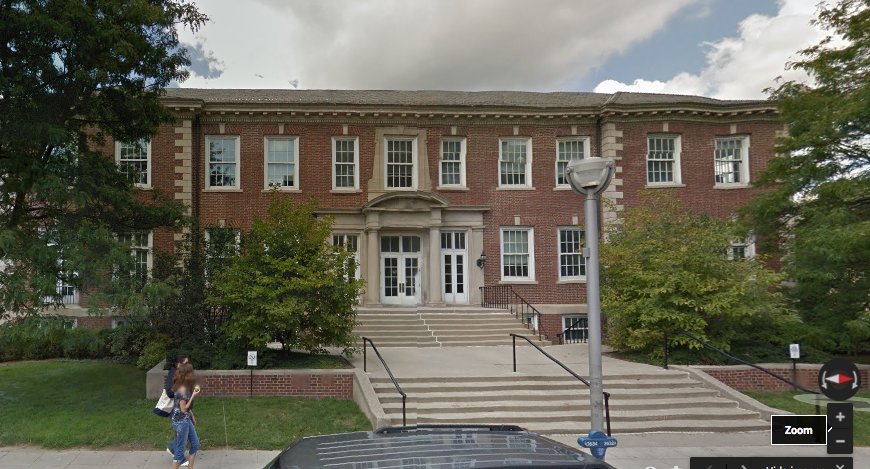
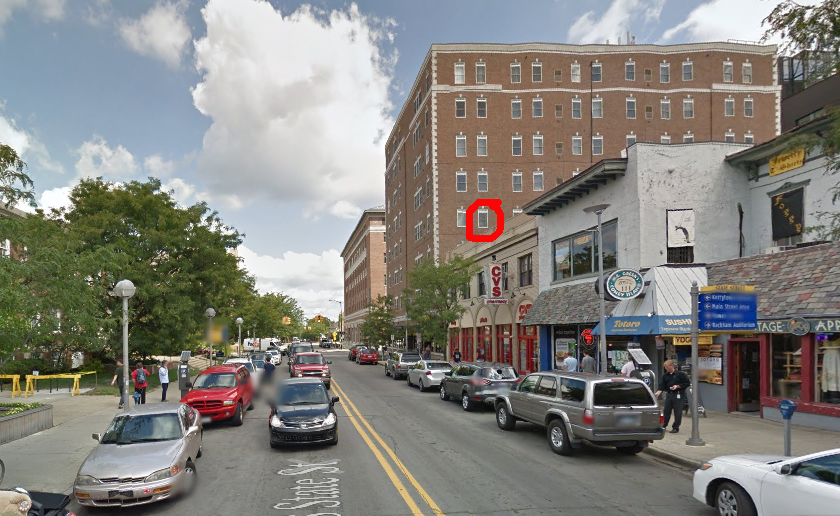
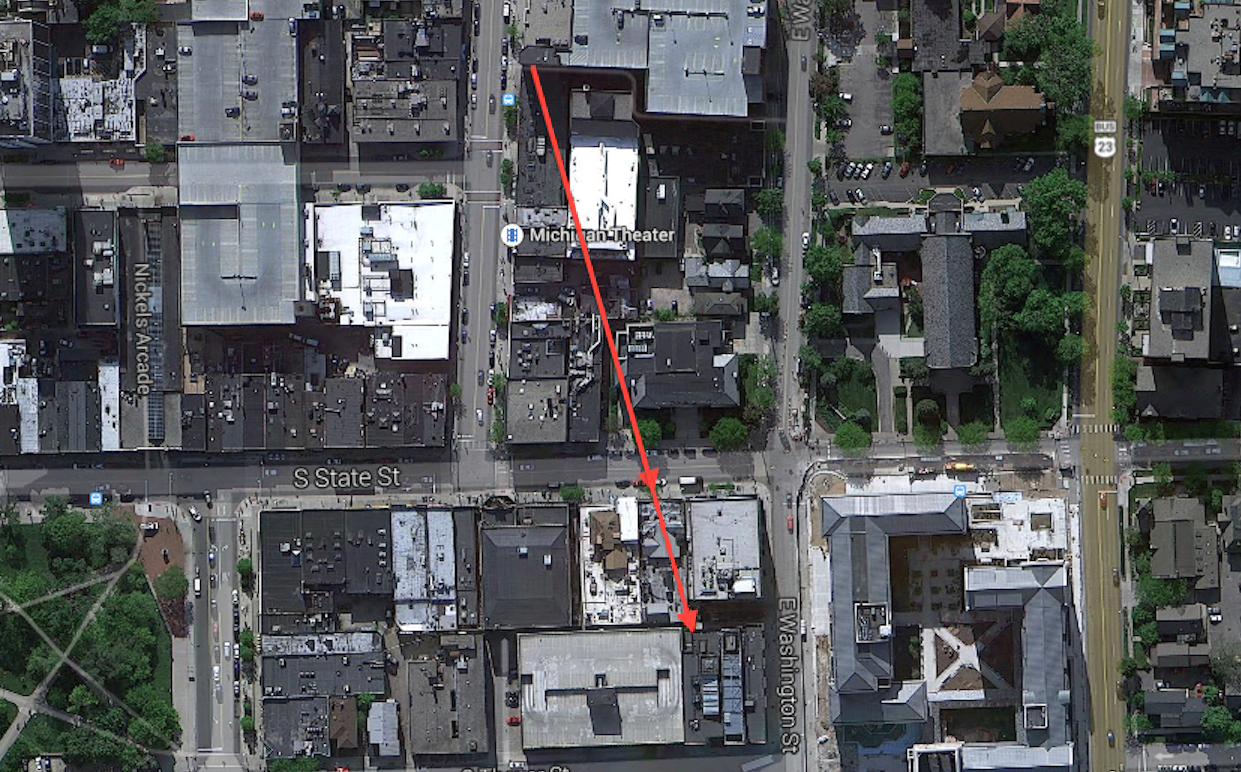
As depicted in the attached “Pic 1,” I drew a line from that window to the tree in front of the building with the distinctive doorway on the right hand side of the view, which confirmed that I was looking at a building above / behind / next to the CVS on S State Street:

Pic 1

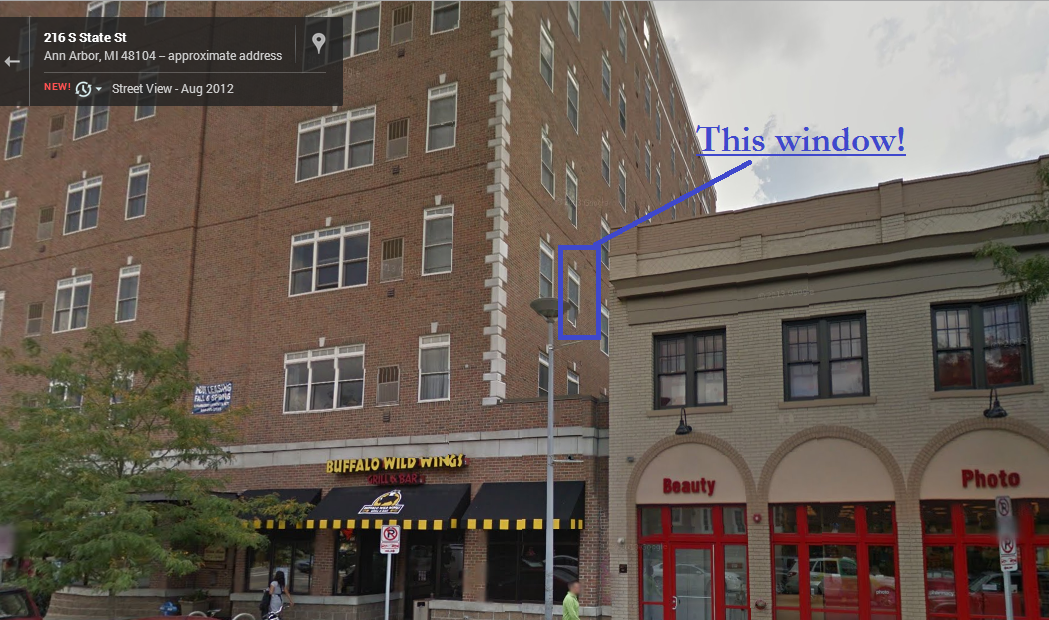
I then spent way too long looking at the apartment building above the Buffalo Wild Wings – pulling up the property management company’s website, foursquare, yelp, anything to get a sense of which window I was looking for. After thinking for a while that the window must be pretty far back in the apartment building, I went back to my Pic 1 arrow and extended it, seeing that obviously I should be looking at the building behind the apartments. Circling the block on street view got me the address, 202 South Thayer:

Pic 2

Unless this is somehow the first email you’re reading, I’m sure you’re familiar with the details already, but the street view is looking south from E Washington Street, with the apartment building on the right and 202 South Thayer on the Left. I’m going with the third story window on the SW corner of the building, since it’s got to be taller than the CVS, but not by much.

Thanks for a fun, if occasionally maddening Sunday morning.

Let’s see how the winner matched up with Chini this week:

chini-1

Back when I was figuring out where to go to law school I took a day trip to see U. Michigan. Unfortunately, I showed up on just about the rainiest, dreariest day of the year and chose to spend my three years in Ithaca instead; if I was gonna be cold, at least I’d be closer to NYC. If only the weather had been nicer …

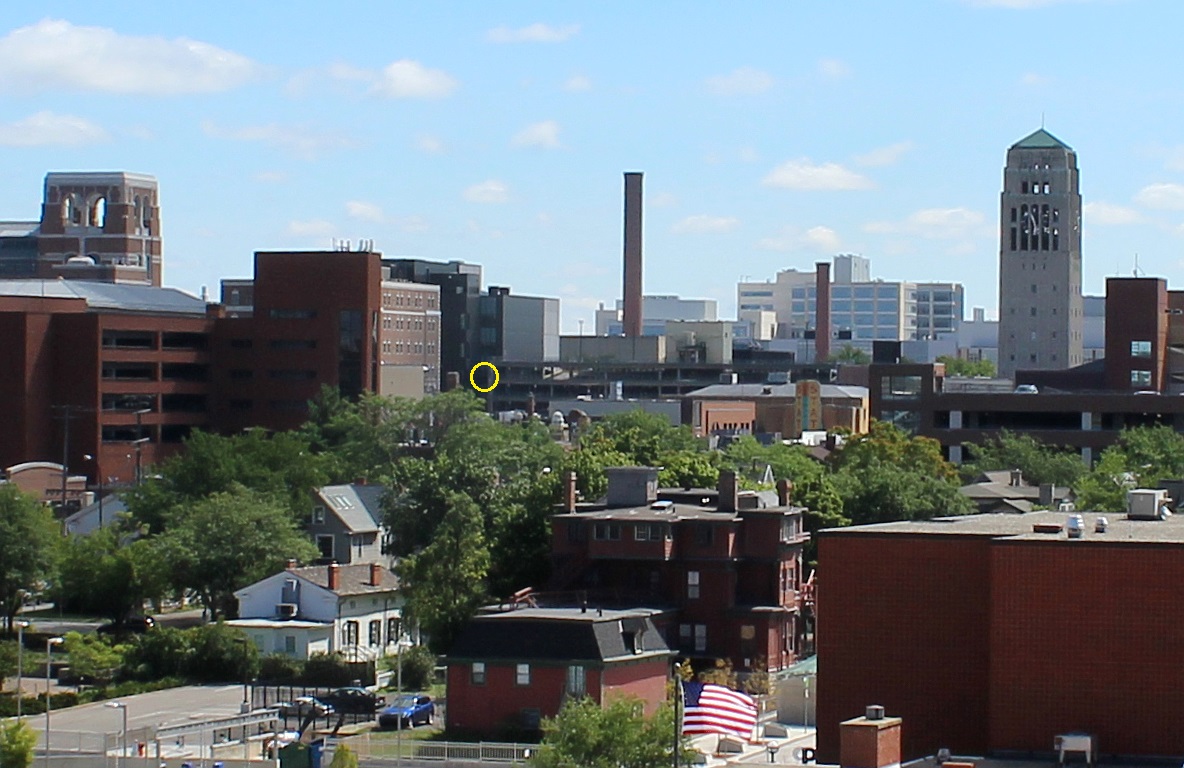
This week’s view comes from Ann Arbor, Michigan. The picture was taken from the fourth floor of the Near Eastern/Judaic Studies Centers at 202 South Thayer Street and looks west southwest along a heading of 256.65 degrees. The pic was snapped around 4:41 in the afternoon, on or around November 3rd of last year, from the hallway window between rooms 4080 and 4028.

chini-2

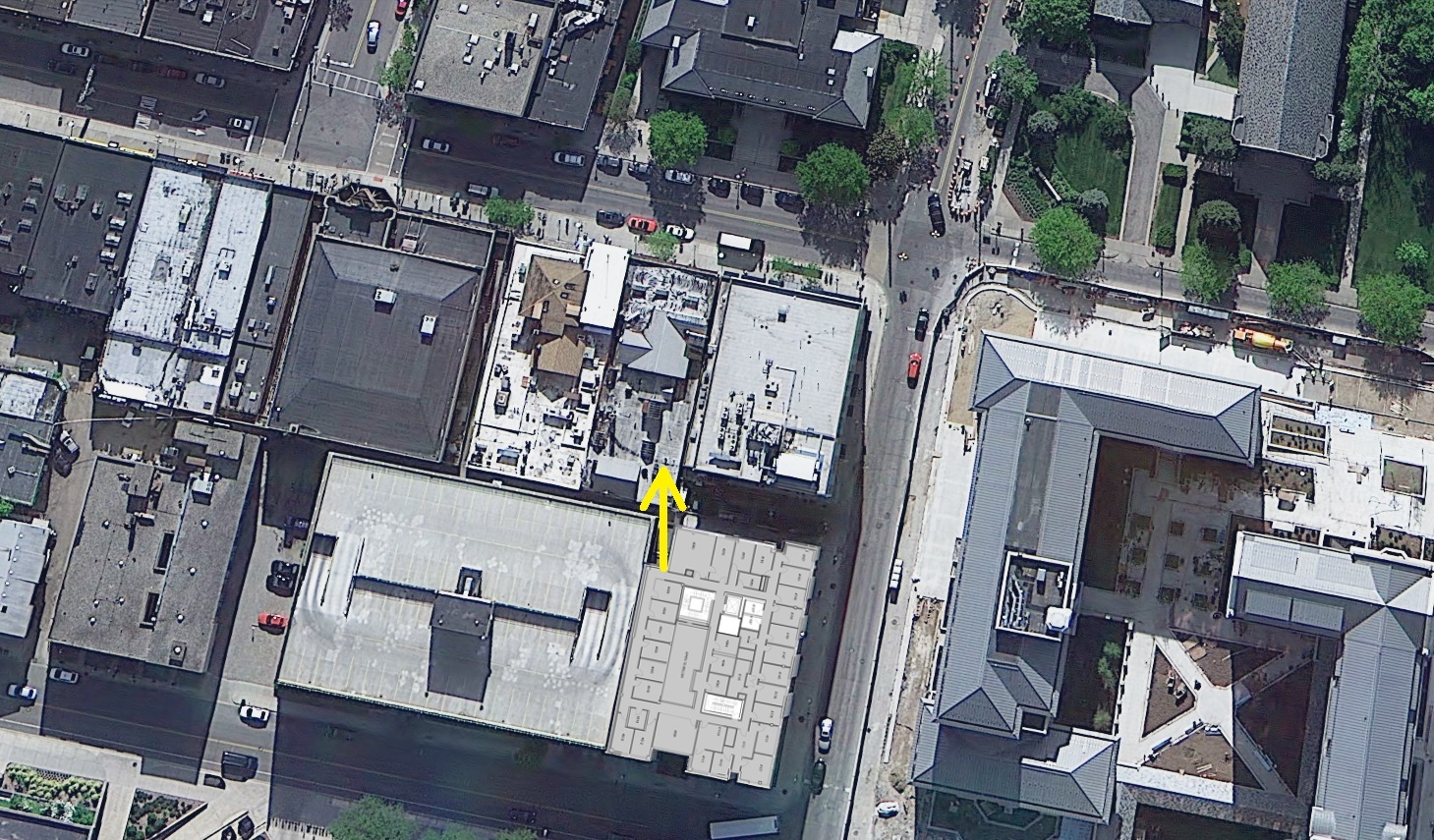
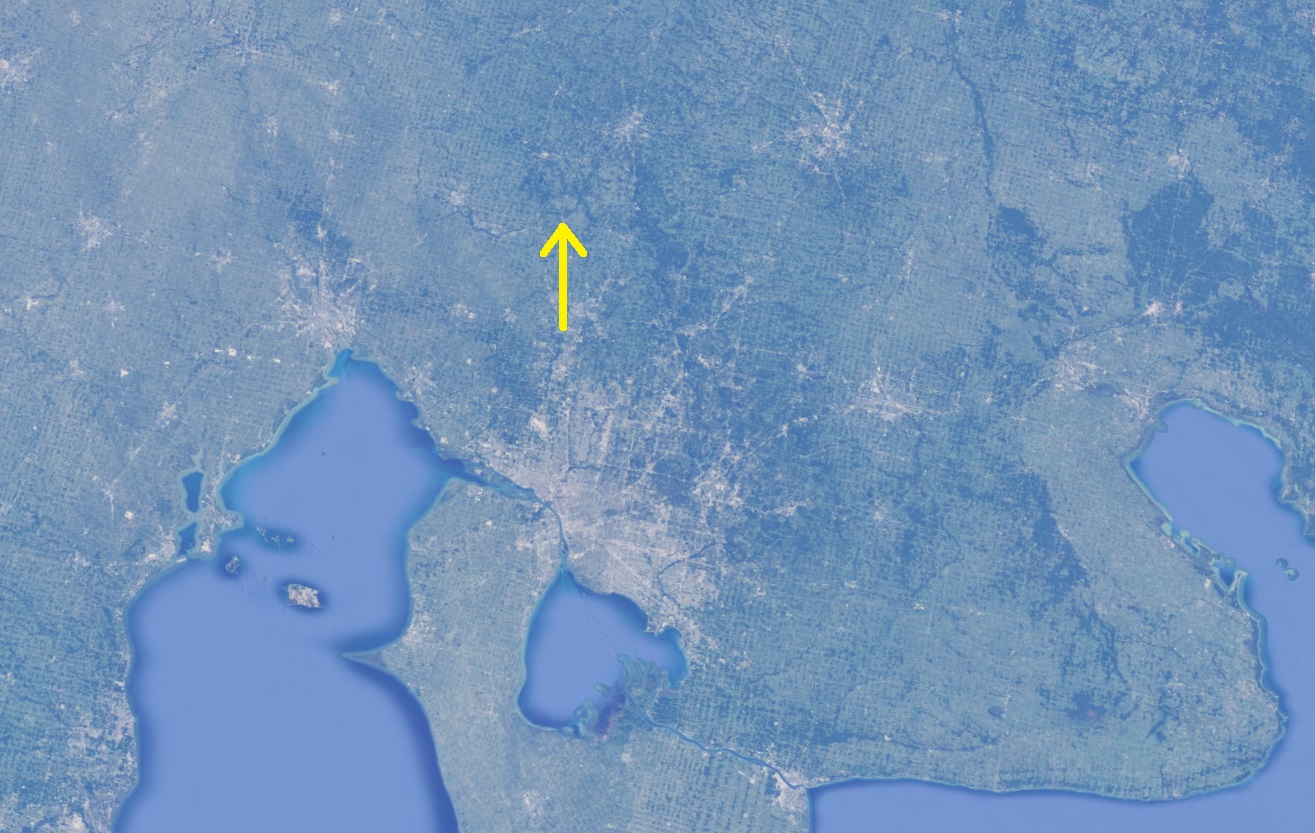
A marked view of the window is attached, as are an overhead view incorporating a blueprint of the interior and a view from the same height as the International Space Station, because why the heck not?

chini-3

The photo was actually taken at 1.07 pm, revealing that Doug Chini is, in fact, human. From the submitter:

I’m thrilled to see that chose my photo for this week’s contest. It was also a great relief, because I was traveling all weekend, and had time to look at the contest only late Sunday night, thinking oh God, if this looks like I might be able to solve it, it is going to keep me up for several more hours, and I need some sleep. But then, it looked really familiar, and I could go right to bed.

I don’t remember what level of detail I gave you when I sent it in, which must have been back in the fall. So this is 202 S. Thayer St., the so-called Thayer Academic Building, 4th floor, the hallway window at the southwestern corner, looking west. Those who get the window right will then also know which area of the world I teach …

Looking forward to many interesting guesses.

By far the most interesting one this week comes from a reader who went window-hunting on foot, armed with a camera. From the end of his photo series:

Once on the scene, it was obvious that the elevation was too high.  The view did not line up correctly with the building in the lower right hand corner on State Street. So, moving down one level, to the sixth floor of the structure, I came upon …

another-dishhead

Another Dishhead!

We had a laugh about running into each other and how we were both afraid of security.

From the other intrepid Dishhead:

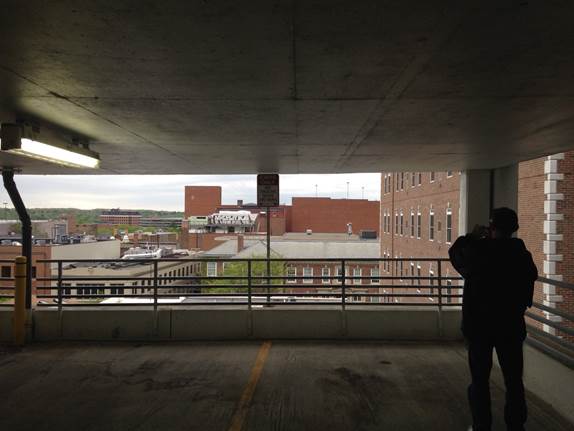
I’ve worked on this with my daughter – a past VFYW winner and multiple correct-guesser – and since I live in Ann Arbor it was easy for me to visit the adjacent parking structure to check out sight lines and architectural details. While I was checking things out this morning in the structure, a guy in a white shirt and tie approached me, and I figured it was parking management coming to find out just what in hell I was doing wandering around taking photos. It turns out he’s a fellow Dish reader and VFYW contestant who came to investigate the same location I was! I’ve attached a short video clip I shot of him:

(Archive: Text|Gallery)

Going After China’s Cyber-Spies

by Jonah Shepp

The Justice Department has indicted five Chinese military officers on charges of cyber-espionage, accusing them of stealing American companies’ trade secrets:

The five members of the People’s Liberation Army — Wang Dong, Sun Kailiang, Wen Xinyu, Huang Zhenyu and Gu Chunhui — belong to Unit 61398 of the 3rd Department of the People’s Liberation Army, based out of a building in Shanghai. All of them have been accused of conspiring to hack into the computers of six American entities. The companies identified as victims of the hacking are Westinghouse Electric; U.S. subsidiaries of SolarWorld; U.S. Steel; Allegheny Technologies; the United Steel, Paper and Forestry, Rubber, Manufacturing, Energy, Allied Industrial and Service Workers International Union; and Alcoa.

There’s no chance that they’ll ever appear in court, but the diplomatic consequences are obvious. Jacob Siegel and Josh Rogin note that the move comes at an awkward time in US-China relations:

The decision to expose Unit 61398 comes less than a week after a top Chinese general toured the U.S. on what many believed was a diplomatic trip intended to give U.S. officials the chance to deescalate tensions in China’s territorial disputes with its neighbors. But the visit failed to produce the hoped-for deescalation. Instead, Defense Secretary Chuck Hagel sparred publicly with Chinese Defense Minister Gen. Chang Wanquan over Chinese actions in the East China Sea, including China’s recent declaration of an air defense zone that spans disputed territories. Hagel was reportedly rebuffed in his plea to the Chinese military for greater transparency during a visit there last month.

Brian Merchant situates Unit 61398 within China’s massive cyber-spying operation:

Unit 61398 has in the past been tied to a hacking group the Comment Crew, most decisively by a 2013 Mandiant cyber security report. The New York Times explained that, according to the research, the Comment Crew “has drained terabytes of data from companies like Coca-Cola” but that “increasingly its focus is on companies involved in the critical infrastructure of the United States — its electrical power grid, gas lines and waterworks. According to the security researchers, one target was a company with remote access to more than 60 percent of oil and gas pipelines in North America.”

P.W. Singer explains what China’s cyber-spies are after:

[T]he targets of it range from across the spectrum: everything from jet fighter designs to oil company equipment designs to the designs of chairs made by small furniture makers. Or the theft of negotiating strategies: what everything from oil companies to soft drink companies were going to bid in competition with Chinese companies. Its been going after academic and scientific research; going even after personal cell phones. They’ve gone after journalists, [as in] the famous New York Times affair where a Chinese military-linked unit entered into the Times. It wasn’t after the secret recipe for New York Times newspaper ink, it wasn’t after readers’ credit card numbers, it was after who inside China was speaking to New York Times editors about corruption in China.

Adam Taylor notes that the Chinese are citing Snowden to dismiss the charges as hypocritical:

Monday’s statement [from the Chinese Foreign Ministry] appeared to make direct reference to Snowden’s revelation again. “It is a fact known to all that relevant US institutions have long been involved in large-scale and organized cyber theft as well as wiretapping and surveillance activities against foreign political leaders, companies and individuals,” the statement read. “China is a victim of severe US cyber theft, wiretapping and surveillance activities. Large amounts of publicly disclosed information show that relevant US institutions have been conducting cyber intrusion, wiretapping and surveillance activities against Chinese government departments, institutions, companies, universities and individuals.”

But Ambers distinguishes our espionage operations from what China has been doing:

The U.S. does not steal proprietary secrets to help U.S. corporations compete in the world. It does steal secrets to help the U.S., broadly, compete in the world. …

The U.S. does invade the internet servers and computers of foreign countries, looking to collect intelligence that will add value to American policy-makers’ decisions about trade deals, sanctions, counter-narcotics, counter-trafficking, and counter-terrorism. It does so with the help of American countries. It does not, at least explicitly, steal secrets from, say, Chinese companies in order to directly benefit American companies working with the same technology. But it does create backdoors into state-owned or operated companies in order to spy. Maybe it is a distinction without a difference, at least in terms of how the world perceives U.S. spying.

The editors at Bloomberg applaud the indictment:

Cybercrime targeting trade secrets and intellectual property is a booming business, one that costs U.S. companies billions each year. It’s been called the greatest transfer of wealth in human history. And China’s legions of cyberspies are, by general consensus, the world’s worst offenders. The U.S. has now signaled that it will protect companies against such intrusions after years of private warnings to the Chinese. And, more important, the indictment will hopefully remind China that curtailing this kind of abuse is in its own economic interest. On the first score, the indictment amounts to a defense of a long-established principle of espionage: While governments can spy to protect national security, as the U.S. does, they shouldn’t steal corporate secrets to benefit their own businesses. The Chinese government has been ostentatiously flouting this norm for years.

Color me unpersuaded on this point. Would we somehow be more OK with Chinese agents hacking the DoD because they could claim they were protecting their national security interests? I doubt it. Face it, guys: we’re a lot cooler with us spying on them than with them spying on us. That’s just national loyalty talking—don’t try and chalk it up to general principle. Gwynn Guilford also isn’t so sure this “long-established principle of espionage” argument will fly in other countries, especially since, y’know, we violate it too:

[T]he push to define the relative degrees of cyberspying nefariousness might not be all that persuasive abroad, says Adam Segal, a senior fellow at Council on Foreign Relations. “[US Attorney General Eric] Holder tried in his introductory statements to say ‘we’re going after economic espionage,’ and the US continually says we don’t engage in that,” Segal tells Quartz. “But Huawei and Petrobras [foreign companies the US government’s been caught spying on] are clearly economic targets. So I don’t see [this latest effort] gaining traction internationally.”

It certainly hasn’t convinced many in China:

On the Chinese web, users largely dismissed the U.S. accusations as a case of “a thief crying ‘stop the thief!’” and wondered whether China shouldn’t pursue charges of its own against U.S. officials for government-sponsored cyber spying.” So this means China can just charge U.S. military officers in the same way,” wrote one user on the Weibo microblogging platform. Another called the accusations “ridiculous; the United States has the whole world in its fist, but it’s not okay for others to want to listen in on what you’re doing.” Many also wondered aloud whether Beijing shouldn’t charge the U.S. National Security Agency for spying on Chinese telecommunications giant Huawei.

Meanwhile, Daniel Ikenson is unsympathetic to the affected companies:

[L]et’s not let the victims off the hook so easily.  Under the doctrine of “fool me once shame on you, fool me twice shame on me,” how is it possible for profit-maximizing U.S. companies to be so reckless and cavalier about protecting their assets, especially when these alleged losses accrued over a period of time? Theft – including intellectual property theft – is a fact of life, and it is the responsibility of property owners to do their parts to reduce the incidence of theft.  If that means incurring greater private costs to make illegal downloading or duplication more difficult, so be it.  If it means investing in extra cybersecurity measures to protect trade secrets, do it.  If it means taking executive communications off the main server and onto a dedicated, impenetrable network without access to the internet, c’est la vie.

Lazy, Happy Americans

by Jonah Shepp

exceptionalism-02

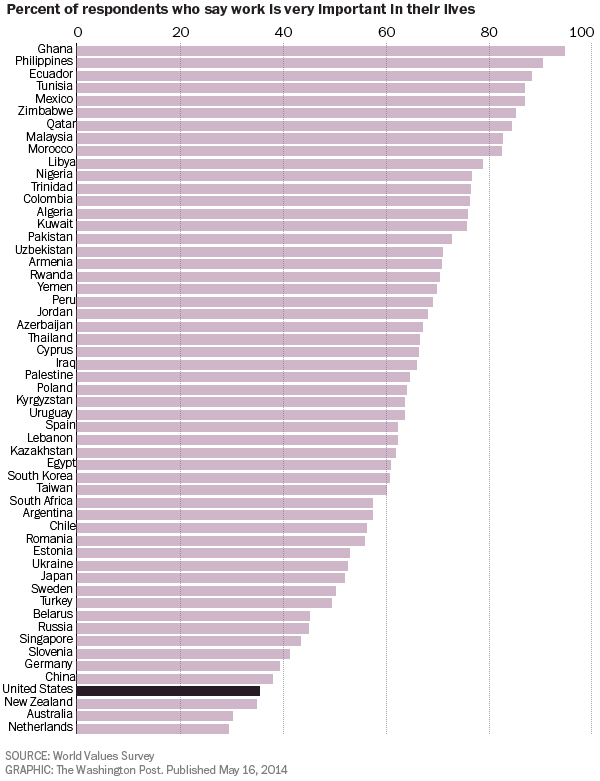
Perusing the latest World Values Survey, Christopher Ingraham highlights some of the findings about how Americans compare to the rest of the world. One shocker:

While we have a reputation for being a country of workaholics, we actually rank the importance of work quite low (36 percent) compared to other countries. Ghanians, Filipinos and Ecuadorians are the biggest workaholics, while again the Dutch are at the bottom of the list. The most important thing, according to Americans? Family. Sure, we may not fully trust that one sketchy uncle, but we love him anyway.

Charles Kenny points to another somewhat surprising finding: most Americans say they are happy:

Americans still report themselves happy, if not quite as much as in the past. The proportion reporting that they are either very happy or rather happy was 91 percent in 1981, climbed to 93 percent in 1999, and fell back to 89 percent in 2011.  In some ways, this suggests remarkable resilience in the face of stagnant incomes and an unemployment rate that almost doubled between the second and third surveys. Unemployment and the related uncertainty has a strong relationship with lower reported wellbeing across the rich world.

On the whole, the global average for people living in surveyed countries has risen. Among the global sample whose data goes back to the early 1980s, the proportion saying they are rather happy or very happy climbed from 71 percent to 84 percent. In the larger sample using data from the early 2000s, the global average reporting happiness climbed from 75 percent to 83 percent.

Zach Beauchamp notices that Germany, Japan, Ukraine, and Taiwan stand out for their citizens’ relative lack of pride, with fewer than 70 percent saying they were proud of their country and fewer than 30 percent saying they were very proud:

Each of those four countries where pride was unusually low has something interesting to it. For Germany and Japan, it suggests that the post-World War II hangups about nationalism may have not quite gone away. Since their defeats, both countries have developed a much more complicated relationship with national pride — in some ways, German and Japanese nationalism run amok were responsible for the whole thing. This sense of national guilt, or at least a wariness of too much national pride, might be making it harder for German and Japanese folk to feel immense amounts of national pride.

In Ukraine, the issue may be the country’s ethno-linguistic divides. … Then there’s Taiwan, whose results are almost certainly about tension with mainland China. 20 percent of Taiwanese outright favor reunification with China, and 43.5 percent of Taiwanese also identify as Chinese (“Zhongguo ren,” which could mean Taiwanese, mainland Chinese, or both). This complicated relationship with the People’s Republic probably explains why Taiwanese people aren’t quite as proud of their country as other peoples are.

Is Marriage Equality In Oregon Here To Stay?

by Patrick Appel

Mark Joseph Stern believes so:

Oregon’s attorney general has already refused to defend the law—and it’s unclear whether the state’s liberal governor, John Kitzhaber, is willing to spend state funds to defend a law he deems unconstitutional. If the state refuses to defend the ban in any capacity, McShane’s ruling might simply be unappealable: The Supreme Court has already stated that a group of private citizens (like NOM) has no standing to defend gay marriage bans in court.

Even if the state does hire private counsel to defend the ban, it’s in for some rough sledding. Marriage opponents will be keen to stay McShane’s order, thus halting any further gay marriages in the state. But they’ll be appealing McShane’s ruling to the Ninth Circuit, which recently elevated gays to a constitutionally protected class and will almost certainly refuse to suspend marriage. … That leaves the Supreme Court as marriage opponents’ last resort. And though the justices may well stay McShane’s ruling, thousands of gay couples will already have obtained their marriage licenses by that point—creating the kind of facts on the ground that Justice Anthony Kennedy won’t be able to ignore.

But Jim Burroway doesn’t see the Oregon ruling as having wider implications nationally:

[S]ince state and county officials have already said that they have no plans to appeal the decision, McShane’s ruling will remain strictly an Oregon matter, and will likely have little bearing on case law as the other cases move their way through the appeals process. So I guess one can argue that the Oregon decision is relatively unimportant in the greater scheme of things, [although] I have a feeling that many thousands of same-sex couples in Oregon today would be justified in strongly disagreeing with that.

Judge Michael McShane, who wrote the ruling, is one of just nine openly gay federal judges. Dale Carpenter sees that experience reflected in the opinion:

What really distinguishes the decision from many others is the personal terms in which Judge McShane, who has a son and is in a same-sex relationship, concluded it:

Generations of Americans, my own included, were raised in a world in which homosexuality was believed to be a moral perversion, a mental disorder, or a mortal sin. I remember that one of the more popular playground games of my childhood was called “smear the queer” [footnote omitted] and it was played with great zeal and without a moment’s thought to today’s political correctness. On a darker level, that same worldview led to an environment of cruelty, violence, and self-loathing. … I believe that if we can look for a moment past gender and sexuality, we can see in these plaintiffs nothing more or less than our own families. Families who we would expect our Constitution to protect, if not exalt, in equal measure. With discernment we see not shadows lurking in closets or the stereotypes of what was once believed; rather, we see families committed to the common purpose of love, devotion, and service to the greater community.

Yesterday’s tweets marking the news are here.

The Hole In The Safety Net

by Jonah Shepp

140516_$BOX_Transfers.png.CROP.promovar-mediumlarge

Weissmann looks at how welfare benefits for the very poor have shrunk over the past 30 years:

Looked at as a whole, the entire safety net has clearly gotten wider, even when you remove programs like Social Security retirement benefits, Medicare, and Medicaid from the equation. [Robert] Moffitt shows that per-capita spending on means-tested programs, such as food stamps, Supplemental Security Income, and the Earned Income Tax Credit, increased 89 percent between 1986 and 2007.

But Moffitt shows how that overall expansion masks key changes that have cut benefits for families with incomes that amount to less than 50 percent of the poverty line. Most important was the end of welfare as America knew it. In order to encourage more single mothers to enter the workforce, the Clinton administration eliminated the old Aid to Families With Dependent Children, which had served as an open-ended federal commitment to help poor parents. Its replacement, Temporary Assistance for Needy Families, includes work requirements, and only gives states annual grants that don’t grow with inflation. As a result, welfare spending, which traditionally reached the poorest of America’s poor, has plummeted, and has been redirected to mothers who are employed.

How College Divides Us

by Tracy R. Walsh

Paul Tough observes that an American student’s likelihood of graduating from college “seems to depend today almost entirely on just one factor – how much money his or her parents make”:

To put it in blunt terms: Rich kids graduate; poor and working-class kids don’t. Or to put it more statistically: About a quarter of college freshmen born into the bottom half of the income distribution will manage to collect a bachelor’s degree by age 24, while almost 90 percent of freshmen born into families in the top income quartile will go on to finish their degree. When you read about those gaps, you might assume that they mostly have to do with ability. Rich kids do better on the SAT, so of course they do better in college. But ability turns out to be a relatively minor factor behind this divide. If you compare college students with the same standardized-test scores who come from different family backgrounds, you find that their educational outcomes reflect their parents’ income, not their test scores.

Suzanne Mettler, author of Degrees of Inequality: How Higher Education Politics Sabotaged the American Dream, argues that current higher education policy only exacerbates the problem:

[A]t the federal level, we’re spending more than ever on student aid. But we also see that a lot of our new forms of spending help families in which the kids would be going to college anyway. Take the American Opportunity Tax Credit, a part of the tax code, which is a big piece of education policy. That tax credit actually goes mostly to families who are just below the income cap of $180,000 in household income. So that’s an extra perk for those families for sure, but it’s not going to expand who goes to college.

At the same time, [higher education] costs have grown dramatically over time, and the funds and programs that still exist don’t go as far as they once did. The purchasing power of Pell grants has dropped dramatically. In the 1970s when they were created, they covered nearly 80 percent of the cost of tuition and room and board for an average public, four-year university. Today they cover just over 30 percent.

She also raises concerns about for-profit schools:

[W]e’re now spending one quarter of federal student aid dollars on for-profit colleges (though only one in 10 students attend these schools). And these schools have a very poor record in serving students. And they serve predominantly low-income students. These are exactly the people we’d like to see succeeding in getting a college degree. Yet the graduation rates are 22 percent on average in these schools. Nearly all students who attend borrow large amounts in student loans and if they start and don’t finish, which is endemic in these schools, or they get a degree that’s not respected by employers and they can’t get a job, those students actually end up worse than if they never went to college in the first place.

Gay Geography

by Patrick Appel

Gays Settle Down

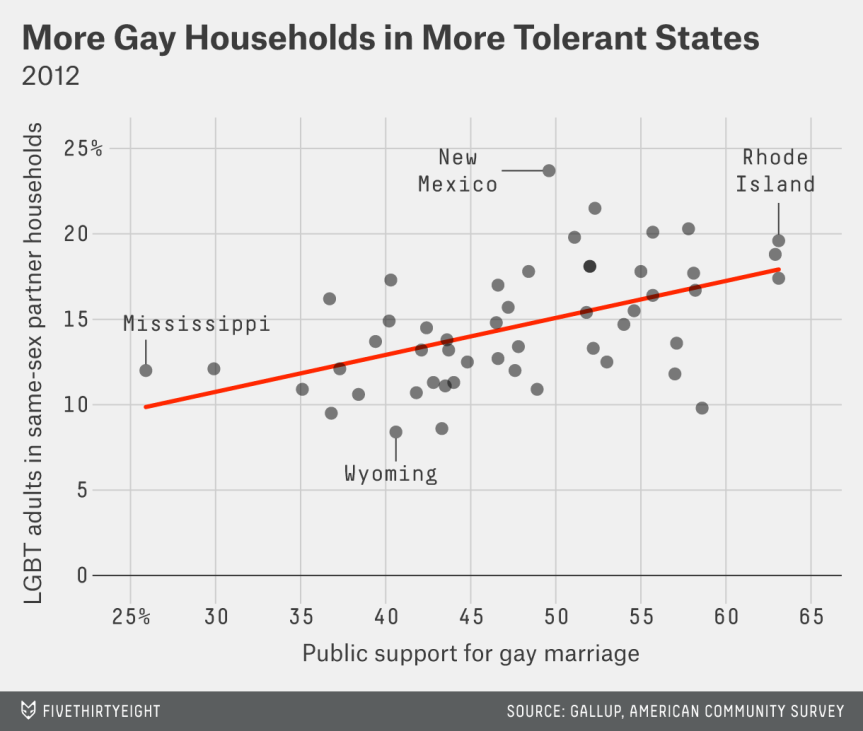
Silver finds that gays tend to settle down in more gay-friendly states:

The regression line in the chart implies that, in a state where 30 percent of the adult population supports gay marriage, about 11 percent of LGBT adults will live together as couples. By comparison, in a state where support for gay marriage is 60 percent, 17 percent will.

These results probably should not be surprising: forming a household with a same-sex partner is a fairly visible and public act, if not quite as public as marriage. By comparison, disclosing one’s LGBT identity to a pollster in an anonymous survey is more private and might depend less on perceived support from one’s community. There are also some LGBT Americans who are so closeted that they won’t tell pollsters about it.

Meanwhile, below is a GIF that shows the progress marriage equality has made over the past ten years (it’s already out of date because it was created before the Oregon news):

same-sex_marriage_gif

Lastly, for a perspective on the state of gay rights around the world, check out this interactive Guardian graphic.

A Push For Gender Equality In The Lab

by Jonah Shepp

No, not the scientists: the animals. Francie Diep explains:

The U.S. National Institutes of Health—one of the biggest funders of biomedical research in the U.S. and the world—will now require the studies it funds to have equal numbers of male and female lab animals. It’s even requiring gender balance in studies done in cells in petri dishes. Yep, that means female and male lab rats will now have equal opportunity to die for science.

All kidding aside, this is actually an important moment for the way medicines are developed in America. All new drugs and treatments are first tested in cells in a petri dish, as well as lab mice, rats, monkeys and other animals. If those studies go well, then they’re tested in people. Late-stage human studies of medicines in the U.S. are now required to recruit at least some women. (This wasn’t always true and, on the whole, it’s still not 50-50.) Gender parity in clinical trials is important because men and women are known to react differently to some medications. Just check out this example, or this one, or all these ones.

Marcotte adds:

That you shouldn’t exclude half a species in your testing seems obvious, but there are understandable, if not really defensible, reasons that scientists have typically stuck to male-only studies.

Roni Caryn Rabin at the New York Times explains: “Researchers avoided using female animals for fear that their reproductive cycles and hormone fluctuations would confound the results of delicately calibrated experiments.” But while this tradition makes it easier to come up with clean results, the long-term effect is that drugs are being released that women are going to take without researchers always knowing exactly how those drugs will work on them. (After all, human females have reproductive cycles and hormone fluctuations, too.)

Feminists in science have long been advocating for an end to the habit of male-only studies for just this reason. That’s part of why the University of Wisconsin started a feminist biology program to help critique and improve biology by targeting some of the unquestioned gender bias that sadly continues to flourish in the field.