A Serious House No Longer, Ctd

Jonathan Eig describes how Andrew Berlin, owner of minor league baseball team the South Bend Silver Hawks, converted a dilapidated synagogue on Coveleski Stadium grounds into a ballpark gift shop:

When Berlin bought the team, he held a meeting with members of the Jewish community and proposed moving the perimeter of the stadium to enclose the synagogue. The team needed a new gift shop, and it seemed a shame to waste such a beautiful old building. He had already pledged to spend $2.5 million of his own money on ballpark improvements. Now, he said, he would spend an additional million dollars on the synagogue’s restoration. The city of South Bend transferred ownership to Berlin.

“It wasn’t exactly what we had hoped for,” said David Piser, president of the Michiana Jewish Historical Society and one of the last Sons of Israel congregants. A Jewish museum would have been preferable, but Piser feared that the building might be knocked down if no use for it was found. Ultimately, everyone agreed that a gift-shop synagogue was better than no synagogue at all.

At one point in the discussions, Berlin proposed painting a target on the synagogue’s roof to encourage Silver Hawks batters to hit home runs. The idea was not received warmly by Piser or by some of the other Jewish community leaders. Today, the roof of the building is covered with an ad for Toyota.

Previous Dish on deconsecrated churches here. Update from a reader, who adds another anecdote to the thread:

There is a church in Grand Rapids, Michigan that became an abortion clinic. After years of protestors, it was bought by a nonprofit currently operating as Pregnancy Resource Center, a pro-life organization started by our church.
The Science Of Faking It

Petra Boynton looks at research on feigning orgasms:

In a two-stage study respondents (all heterosexual women college students majoring in psychology) were asked when, why and how they faked orgasm. The researchers then narrowed this into four categories:

Altruistic Deceit (e.g. faked orgasm to make a partner happy or prevent them feeling guilty)
Fear and Insecurity (e.g. faked orgasm because they felt ashamed they couldn’t experience orgasm)
Elevated Arousal (e.g. faked an orgasm to get more turned on or increase the intensity of the experience)
Sexual Adjournment (e.g. to end a sexual encounter because of tiredness, a lack of enjoyment etc)

We tend to view faking orgasm as manipulative, whereas this research suggested that it could well play a positive role in increasing arousal. I could see an additional measure of distress being useful here to identify whether the faking was something done pleasurably to enhance sex, or an indication of other sexual or relationships problems where perhaps education or therapy might be of benefit.

Starting With Sex

And other advice from Maïa Mazaurette, a French sex columnist:

[H]ow would you describe the French attitude toward sex?

I can only compare it to the countries I’ve lived in — Germany, and now Denmark, and I’ve made some trips to the U.S. I’d say the main difference is that in France we’re so straightforward. We don’t have these dating rituals; we just start with sex! And then, if the sex was good enough or we feel connected somehow, then we would try to build a relationship.

So you always have sex on the first date, then?

Absolutely! But it’s not even an issue because there is no date. There is just first sex. You think someone is attractive, you give it a try. I think it really makes sense. (Of course I say that, because I’m French, right?) But if you don’t have sex first, you build up too much pressure. You start thinking, I have seen this guy for four or five restaurants, or however you do it in the U.S., and what if it fails? If you get sex out the way first, then you can only have good surprises.

I never dated an American guy, but even with Danish and German guys, there were so many dates and it was taking so much time. At some point I just felt like, Ahhh! Stop it, are you going to kiss me? Are we going to your place? My place? Do something! I felt like I was investing a lot of time in something that might not be worth it anyway.

It’s interesting to me that France is a predominantly Catholic nation, and yet the culture is so sexually free.

Yes, but we don’t connect sex with ethics or morality or values in general, you know? There have been many studies about how French people don’t care about the sex life of our president, or if a person is unfaithful. It’s absolutely not a problem for me. Now, if my boyfriend and I have an agreement, that’s important. But I actually see a lot of my friends who are a bit older than me, maybe 40 or 45, who are always renegotiating the boundaries of their relationship. And a lot of them are okay with being unfaithful, as long as you don’t say it. It’s actually quite old-fashioned, as if we’re in the Victorian era, and your husband or your wife is the person you share children, a house, and money with, but for passion or a bit of adventure, you go elsewhere. The couple is not the place for adventure. It’s the place where you want to feel safe and watch Game of Thrones.

Update from a reader:

Maybe the French “start with sex,” but they are among the least sexually satisfied people on the planet, as regularly found in the annual Durex global sex survey. So maybe French advice on sex isn’t so good.

A Surreal Short

Colin Marshall spotlights the above old-and-improved version of Un Chien Andalou, the classic 1929 short by Luis Buñuel and Salvador Dalí. He insists Filmoteca Española’s restoration is “not quite like those you’ve seen before, whether in a film studies class, on late-night television, or in some corner or another of the internet”:

Video artist and blogging cinephile Blake Williams had that impression, finding what he calls “a markedly different version of this classic than what I came to know on Youtube.” The film “plays in ‘actual time’, slowing down the hyper, 16 minutes cut to a more deliberately paced 21+ minutes” with visuals “less contrast-blown than any version I have seen, not to mention that it is no longer heavily cropped. The score, too, is different, dropping the now iconic tango back-and-forth with Wagner.” If you’ve long since grown used to all the images in Un Chien Andalou‘s once-shocking procession — the dragging piano, the ants in the palm, the rotting donkeys, the immortal eyeball slice — prepare to feel at least surprised by them once again. Though they have become much cleaner, they’ve also become no less troubling for it.

Queering Cuisine

John Birdsall makes the case that today’s foodies owe a debt to three gay men – James Beard, Richard Olney, and Craig Claiborne – who propelled American dining past the “stale international haute cuisine of the 1950s.” Consider Beard:

Beard’s cookbooks have the whiff of sublimated desire: the open-air fantasies, stout flavors, abundant fats, and tons and tons of gorgeous meat. Beard’s public persona was the bow-tied bachelor gourmand with an unquenchable appetite, and he remade American food in his own triple-XL image. Even before McDonald’s mass-produced them, burgers had always been cheap lunch-counter food. Beard made them seem as monumental as an Abercrombie model’s torso: three-inch dripping slabs of sirloin you’d ground yourself, grilled over charcoal, and hoisted onto thickly buttered homemade buns—they’re the burgers on menus of serious restaurants across America. Beard convinced us that burgers had always been that way, a reinvention that made the pursuit of pleasure seem like some timeless American virtue. Beard made it okay for Americans to be hedonists at the table.

(Hat tip: Daniel Fromson)

Swipe Right For Love

Each episode of the web series Local Attraction depicts the first dates of couples who met on Tinder. Maggie Lange talks to series creator Connor Hines about the project:

Local Attraction seems to take the female side of the story — the men so far have been crazy obnoxious.

Well, I have three sisters, so there’s a lot of material there. The original intention behind these episodes was for my portfolio as an actor, since I wasn’t really anticipating anybody watching it; I thought I wanted to have as much fun as possible, so I want to make the characters big and outrageous. Now that we have a bit of a following, I’m going to feature the actresses more. For the fourth episode, we’ll have the actress as the perpetrator of the discomfort on the date. …

Are there any characters that you really want to play or have written into the script?

I was out at a bar in New York City — Brass Monkey — and this guy comes up to me in these ridiculous designer sunglasses with a ton of hair product and this ridiculous sweater on. He asked me for a cigarette and I said no. We started talking and the things that came out of his mouth were just so outrageous and so entertaining, I ended up trying to talk to him for 20 minutes and within that conversation, I had pretty much written an entire episode in my head. Wherever he is, I’m eternally grateful to that particular gentleman for episode three.

He was asking me about certain places that I’ve never attended — what’s hot, what’s not, and where can he and his boys go, and what’s a good place for this, and where do we find this kind of woman. And it was nighttime and he was still wearing his sunglasses, which made it all exponentially better.

Get Ready For McWeed

Annie Lowrey expects the big money in legal pot will come from mass-market products, noting that “thousands of people and millions of dollars are hard at work to make [marijuana] as predictable and dependable” as a fast-food hamburger:

In spite of marijuana’s significant popularity, there is still an element of roulette when it comes to smoking a legal joint or eating a legal brownie. Federal law does not require companies to test for and disclose levels of the drug’s active ingredients, like tetrahydrocannabinol. (Federal law does not hold that pot is legal, after all.) Many dispensaries and producers fail to test for potency, contaminants or mold. And different states have different disclosure laws with different levels of efficacy. As such, a gram of “AK-47” bought in an Oakland dispensary might affect you differently than a gram of the same purchased in Colorado. …

Sensing the opportunity for something more predictable, [Jon] Cooper and his partner at Ebbu, a Colorado pot start-up, are creating a variety of predosed products – like prerolled joints, or little Listerine-style strips. They have eschewed the silly strain names, instead labeling their products “high-energy,” “relaxed,” “bliss,” “create,” and “giggles.” Lauren Ely, a librarian from Erie, Colo., is working on a start-up called DisposaBowls – prepacked, disposable ceramic pipes. “I joke around and tell everyone I’m the old, fat Nancy Botwin,” she said, referring to the character from the HBO show Weeds. She said that she hoped the product would appeal to experienced smokers looking for a convenient way to bring the product with them while they go on a hike, for example. But she also saw it as a good way to introduce novices, seniors, and medicinal smokers to pot, with gentle, predictable results.

For Our Consideration

Citing a slew of recent novels told from the perspective of “we” or “us” – such as Joshua Ferris’s Then We Came to an End, Justin Torres’s We the Animals, and Chang-Rae Lee’s On Such a Full Sea – TaraShea Nesbit suggests that the rise of the first-person plural may be especially suited for our times:

Is life in the 21st-century social network less about the node and more about the links between nodes? In first-personal plural fiction, individuated characters can dissolve into the background, as our relationships and responsibilities to our fellow humans are foregrounded. This social awareness is not exactly new – it also exercised Victorian authors writing about town consciousness, as George Eliot did in Middlemarch. However, this new iteration is perhaps a move away from the character-driven plot of the individual “I”. How does one create one’s self in relation to the groups we are a part of? Where do our loyalties lie? What gets lost, and what is gained by group membership? This sense of social responsibility and selfhood, as well as uncertainty about how to act on such feelings, describes, in part, our contemporary moment.

In a similar vein, Art Edwards considers how an author’s method of narration helps him identify with a piece of fiction as a reader:

That’s where the power of fiction truly lies: Despite my wanting to know more about the novelists who write the novels I love, reading one isn’t the act of me learning about the writer’s life. It’s a metaphoric meeting place outside both writer and reader where the two come together. The novel can bridge further physical, cultural, emotional and experiential points, creating a connection that feels deeper. “Look at how different we are on the outside, how similar on the inside.”

Writers shouldn’t be looking for narrators to hide behind but to understand the effects their narrator choices have on the reader, and to make decisions accordingly. If the writer’s story is the whole point, and the writer doesn’t mind being front and center, then it’s best to employ memoir (or its longer sibling autobiography). … A first person point of view (The Name of the World [by Denis Johnson]) keeps the author in the fiction to the greatest degree with third person (Rabbit, Run [by John Updike]) the more distant mode, although even it doesn’t provide perfect cover. Having a detached third person narrator (most of Madame Bovary) leaves only the vaguest shadow of the author, but it’s still there, if only in its conspicuous absence. While fiction may always on some level be a disguise, its imaginative elements invite us to contemplate why the writer bothered to imagine them at all, and therefore, perhaps, to know him best.

Face Of The Day

Screen Shot 2014-05-15 at 4.01.07 PM

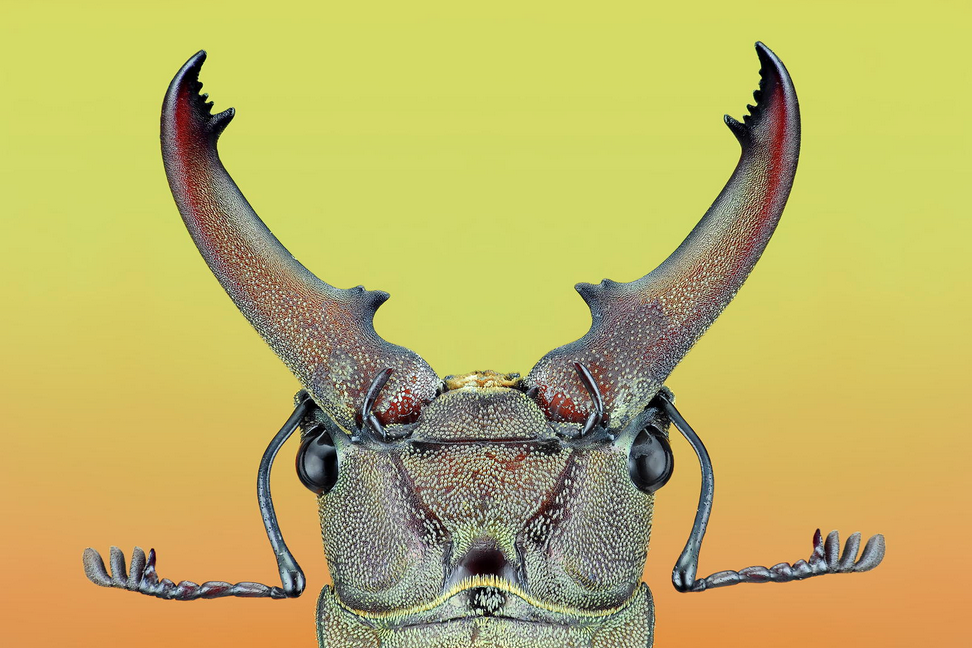
Photographer Donald Jusa brings us face-to-face with insects:

[W]ith his macro camera, the artist is able to capture the most minute details of the insect body. At times, the faces of these beings seem entirely foreign; as viewers, we search for marks of human feeling and features, but the multiple eyes and strange limbs transfix and confound our perceptive powers.

Unlike some macro photography cataloging the lives of insects, Jusa does not capture the  surrounding environment or even the entire body. Instead, his photographs read like strange portraits; against a colored backdrop, the miniature creatures seem absurdly to sit for the artist, proudly displaying their features.

See more of Jusa’s work here.