Say What?

Ross Perlin is intrigued by the Dictionary of Untranslatables, a compendium of words with no direct equivalent in other languages:

[T]he Dictionary is revealing for the way it sketches, lexically, a set of parallel but alternate intellectual traditions. What language teachers call “false friends” are everywhere, inspiring a constant alertness to nuance.

Did you know that French classicisme summons up Versailles (which we’d call baroque) but it was German Klassizismus that crystallized our idea of the “neoclassical”? Or that the vital feminist distinction between “sex” and “gender,” current in English since the 1970s, was “nearly impossible to translate into any Romance language,” not to mention the problems posed by the German Geschlecht, as Judith Butler writes in the Dictionary? Further probing may even make us wonder whether the nature/culture distinction so sharply drawn (and now promoted) by the English idea of “sex” vs. “gender” is the right distinction—the languages of the world offer many other possibilities.

This is the kind of “philosophizing through ­languages” that the Dictionary’s editors have in mind, and they’re right: philosophy has always been about bending (and coining) words to work in particular ways, about consciously harnessing and creating abstraction out of linguistic systems already engaged willy-nilly in much the same task. A century ago, analytic philosophers such as Bertrand Russell and Ludwig Wittgenstein saw the problems of philosophy as all boiling down to unclear language; contributors to the Dictionary lay a similar stress on words but revel in their contested indeterminacy.

Previous Dish on untranslatable words here, herehere, and here.

Your Friday Cry

It’s been a while since the Dish posted one of these beagle rescue videos that frequent the web – watch it and weep:

Via VideoSift:

There are about 75,000 Beagles used in labratories for their kind, forgiving nature. They live in cages their entire life subjected to test. Many never even get a glimpse of the outside world. The Beagle Freedom Project recently rescued nine Beagles from a laboratory in Nevada. These little ones had never known a kind touch, been loved or felt safe and now, they have loving, forever homes, a place to run and play.

They Wield More Than Hashtags

Nina Strochlic notes that Nigerians threatened by Boko Haram militants don’t count on the military or the police to protect them:

In northeastern Nigeria, where Boko Haram enjoys a stronghold, kills with impunity, and kidnapped more than 270 schoolgirls last month, young civilians have been taking protection and justice into their own hands. In June 2013, discontent with Nigeria’s official Joint Military Task Force (JTF) spawned an unofficial offshoot—widely dubbed the Civilian Joint Task Force—a loosely organized network of vigilantes facing down AK-47-wielding militants with axes, knives, and bows and arrows.

They’ve had, according to some accounts, remarkable success. On Tuesday morning a group of vigilante villagers from a town 150 miles from the capital reportedly fought off a major assault, killing 200 militants and arresting 10, with no villagers reported killed. Such claims are hard to confirm, but it may be true, as one local told the Associated Press, that “it is impossible” for Boko Haram to attack since the vigilante group was organized.

Laura Seay zooms in on the phenomenon:

Variation among vigilante groups operating in Nigeria is high on almost every metric. Some are officially registered with local police, with the tacit understanding that the vigilantes will respond to local crimes of a non-serious nature (like petty theft) while the police will be called in for more serious crimes like kidnapping or rape. Many vigilante groups operate under some form of accountability to local customary authorities, and as the membership in the vigilante groups are usually known to communities, they will be held accountable for any abuses by their fellow citizens as well. Other vigilantes operate osubscription-based models; if you have a problem with a crime committed against you and are a subscriber, you can call the vigilantes for help.

Vigilantism in Nigeria is an example of what scholars term hybrid forms of governance in weak states. These forms of governance are not fully undertaken by the state, but neither is the state completely uninvolved in regulating, overseeing or even partially providing the public services it cannot independently provide. The process of hybrid governance  is seen in widely varying sectors around the world, from public trash collection by community organizations to public education  systems run by religious actors.

End Scenes

suicidelocations

For her series entitled “Death Wooed Us,” photographer Donna J. Wan focused on suicide locations:

The beauty of Wan’s newest series belies the dark associations that drew her to these vistas. “I’ve always loved the California coast,” she says. But she struggles to say that these are locations where people have taken their own lives. Wan is no stranger to these emotional lands, having grappled with thoughts of suicide in the depths of postpartum depression. Her research into these sites started at her lowest point, and has continued since. The project has changed in meaning as she’s recovered.

While photographing one site for the project, Wan overheard someone, having been told the site was the scene of several suicides, say “I can understand why, it’s so beautiful here.” It raised Wan’s hackles, because she understands the contradiction between the beauty of these locations and the violence of the deaths that occurred there. She wants to correct the misconception that jumping from a bridge is quick and painless. On the contrary, it results in multiple internal injuries and fractures, and the cause of death is often drowning or hypothermia.

See more of Wan’s work here.

What’s The Greatest Threat Facing Mankind?

Anders Sandberg of Oxford’s Future of Humanity Institute took to Reddit earlier this week to explain what keeps him up at night. At the top of the list is nuclear war:

The typical mammalian species last for a few million years, which means that extinction risk (or turning-into-something-else-risk) is on the order of one in a million per year. Just looking at nuclear war, where we have had at least one close call in 69 years (the Cuban Missile Crisis, claimed by some of the participants to have had about one chance in three of having ended badly) gives a risk of 0.5 percent per year. Ouch. Of course, nuclear war might not be 100-percent extinction causing, but even if we agree it has just 10-percent or 1-percent chance, it is still way above the natural extinction rate.

What doesn’t worry him:

Overpopulation has actually dropped down the agenda since the ’70s. Back then it looked like there would literally be too many people to feed, and people would start starving soon. Then the green revolution happened, and crop yields went up. But birth rates also started declining, and have continued declining nearly everywhere (even if pretty backwards societies). The UN began to reassess their predictions, and things look much better. Or rather, we realized that the real problem is poverty rather than people. …

People actually seem to change the number of kids they have surprisingly easily (one would imagine evolution has predisposed us to have as many as we can, but human desires are stronger). A classic study showed that the introduction of TV soap operas – which generally show families with few kids – reduced birth rates in Indian and Brazilian villages. We might control our fertility more by what we see on the screen or how many playgrounds we have around us than we think.

(Hat tip: Mark Strauss)

Putin vs The Internet, Ctd

Anton Nossik is alarmed at Putin’s crackdown on Internet freedom, which culminated in draconian new legislation signed earlier this month:

Under the new laws, any social media platform that wishes to serve a Russian audience will be obliged to retain all user data for at least six months and to surrender this information to Russian security services upon request, without a court ruling or any other form of justification or explanation. Moreover, any foreign social media platform serving Russian users has to physically keep all sensible user data within the boundaries of the Russian Federation. And we’re not talking Russian user data, but rather all personal information of any user who happens to have some readers from Russia—like, say, Barack Obama, who has no less than 3,000 Russian nationals among the 40.5 million subscribers to his Facebook page. Twitter should also prepare to move all of Obama’s personal data to Russia and hand it over to the FSB, since both Putin and Medvedev are his followers on Twitter. Ditto for Google. If any of these companies don’t comply they would be subject to administrative fines, up to 500,000 roubles ($14,000), and Russian ISPs would have to block access to these platforms.

This Orwellian masterpiece of legislation was signed into law by Vladimir Putin on May 5, 2014, and it will be enforced from August 1, 2014. Will that be the last day of Russian Internet? Maybe. Unless a new law kills it even faster.

Previous Dish on Internet censorship in Russia here.

Face Of The Day

dourlen7-620x620

DL Cade finds a fun photo series:

French photographer Francois Dourlen gets creative using nothing more than his surroundings and an iPhone, but he’s not an iPhoneographer. No, his iPhone is a subject of every one of his images, a little window into the magical world of movies and television inserted creatively into drab scenes in the real world. A great set of forced perspective photographs that reminds us of the Newspaper and #mytoyplane series we’ve shared in the past, Dourlen’s images liven up the real world by turning a politician into Pinocchio or turning a green truck into a character from the Pixar movie Cars.

Check out more of Dourlen’s work on his Facebook page.

GMO Politics Go Down To The Root

In a lengthy exploration of the battle over GMO labeling, Molly Ball touches on how ideology injects itself into the debate:

The GMO debate has a frustrating quality, with one side decrying big corporations out to deceive us and the other pointing the finger at unscientific fearmongering. Both of these lines may be true as far as it goes; what the debate comes down to is politics. Though opposition to GMOs has its roots in the liberal environmental movement, an increasing number of environmental writers and thinkers have begun to take the industry’s side in the debate, pointing to an overwhelming scientific consensus—based on hundreds of independent, non-industry-funded, peer-reviewed, long-range studies—that GMOs are safe. …

And yet GMOs are the subject of widespread fear and antagonism.

University labs accused (not always accurately) of conducting GMO research funded by Monsanto have in the past been burned down by eco-terrorists. This type of sabotage has been rare in the past decade, but it may be making a comeback: Last year, a field of GMO sugar beets in Oregon was destroyed by vandals. Scientists and journalists who voice pro-GMO opinions are accustomed to being dismissed as industry shills, personally vilified, and even receiving death threats. Headlines on food blogs warn of“mutant GMO foods.” In the D.C. area, a car topped with a giant half-fish, half-tomato—the “fishy tomato”—roams the streets; the car’s hood reads “LABEL GMO FOOD.” In the popular imagination, GMOs are scary.

Freddie deBoer reads Ball’s article as an example of the culture war – not between left and right, but between the media’s elite readership and the masses:

Ball quotes an organizer, “I talk to Tea Party people, Occupy people, churches, everybody. Everywhere I go, people want labeling.” What unites the Tea Party, the Occupy movement, the religious? They are all groups that are typically treated with derision by media elites. They’re too grass roots, too passionate, too uneducated, too defined by cultural and social signifiers that are anathema to the bourgie, educated, arty-but-not-pretentious-about-it, smart-but-anti-academic types who write the internet. The anti-GMO movement ticks the right boxes: associated with both crazy Christian homeschool types and crunchy Whole Food liberal types, conveniently labelled as anti-science with all of the pretenses to objectivity and intelligence using that label brings, and generally not a threat to your professional or social standing if you criticize them. They’re an easy target and a risk-free one, if you’re a professional journalist or political writer.

If anything unites the presumed readership of our national newsmedia, it’s not ideology, but rather cultural and social positioning– the ideology of the elite. And the anti-GMO labeling position unites liberal journalists and writers, conservative journalists and writers, and libertarian journalists and writers in a shared distaste for the political machinations of those who they don’t deem up to their cultural standards.

Freddie prefaces this by saying that he doesn’t “really care about this issue” and is “perfectly willing to listen to an actual anti-labeling argument, rather than a pro-GMO argument, which is a separate thing.” Adam Ozimek attempts such an argument against labeling:

The information being conveyed to consumers is not simply the facts the government mandate says they must display, but THAT they say these facts must be displayed. In other words, when a consumer is confronted by what appears to be a mandated label they reasonably presume a few things:

1) direct content: a particular fact or set of facts about the product

2) implied content: the fact or facts are important for consumers to know for some reason

It can be the case that the direct content is absolutely true and implied content is absolutely false. For example, a food may be factually labeled as containing GMOs in a way that provides consumers truthful information. This is truthful direct content. However, the consumer is also likely to take from the existence of this label that “this food containing GMOs is important information that you should know”. This is the implied content, and from it consumers may reasonably conclude a few things.

One is that the GMO content of foods is something the government believes consumers may want to consider in their consumption decisions. This means that even if consumers had an accurate appraisal of the safety of GMOs coming in to the decision, this government message may change their beliefs. The GMO safety debate is in large part about whether or not a food containing GMOs is something consumers should consider. The label mandate sends the signal to consumers that the government believes the GMO critics are correct and have won this debate.

Reigniting The Net Neutrality Debate

netneutrality2

Timothy B. Lee explains the net neutrality proposal, announced yesterday, that the FCC is asking for public comment on:

When Chairman [Tom] Wheeler leaked a first draft of his network neutrality proposal to the press, it didn’t get a positive reception from network neutrality supporters. Wheeler’s rule would have allowed internet service providers to create “fast lanes” on the internet, provided that doing so was “commercially reasonable.”

Net neutrality supporters have been pressuring the agency to take a more aggressive approach, called reclassification. That means the FCC would declare broadband internet service a common-carrier telecommunications service, which would give the agency broader powers to regulate it. That could create some legal and political headaches, but it would likely put network neutrality regulations on a firmer legal footing in the long run.

The [notice of proposed rulemaking] leaves both options open, and asks the public for advice about which approach is better.

David Dayen notes that Wheeler’s preferred course of action isn’t as strong a safeguard of net neutrality as he claims:

Just listening to Wheeler today, you’d have thought he was the biggest Internet freedom activist in the country. “If telecoms try to divide haves and have-nots, we’ll use every power to stop it,” he said at the meeting. “Privileging some network users in a manner that squeezes out smaller voices is unacceptable.” Unfortunately, according to Craig Aaron of Free Press, Wheeler’s “rhetoric doesn’t match the reality of what’s in the rules.” They believe that Wheeler’s plan, which he says would prevent blocking or slowing of websites and prohibit “commercially unreasonable” fast-lane deals on a case-by-case basis, is impractical and legally dubious. “The only way to achieve his goals would be to reclassify broadband under Title II,” said Aaron.

Judis also spots a loophole:

Internet providers can violate net neutrality by setting up their own fast lane and charging content providers who want to use it, or they can charge content providers who want to connect directly with the internet provider without going through intermediate networks. That’s called “peering.” Comcast now charges Netflix an extra fee for connecting directly to its network. In exchange, Netflix gets faster and more dependable streaming on its videos. Wheeler’s proposals conspicuously ignore peering. It is, he said, “a different matter that is better addressed separately.” …

As a sop to the Democrats on the commission, and to Free Press, the Consumers’ Union, and other proponents of net neutrality, Wheeler included in his proposals the question of whether reclassifying the internet would provide “the most effective means of keeping the internet open.” He didn’t propose the FCC reclassify the internet, only that it consider doing that as one among several options. And it’s not going to happen.

Larry Downes opposes classifying the Internet as a public utility:

Internet access speeds and the range of useful applications have both improved by orders of magnitude over the last decade and a half, precisely because there were no federal or state agencies micromanaging their evolution, resulting in over a trillion dollars in private infrastructure investment. During that time, to pick a close comparison, the closely regulated public utility telephone network has fallen into decay and disuse. It will soon be absorbed into better and cheaper Internet-based alternatives.

Those who think that we should turn management of the Internet’s infrastructure over to the government had better dig out their 2400 baud modems. Not long ago, that was the “Internet as we know it.” Thank goodness it was allowed to evolve.

Suderman is on the same page:

Back in 1998, under President Bill Clinton, the agency submitted a report to Congress concluding that, for multiple reasons, Internet access was “appropriately classed” as an information service under Title I. One of the points the report made was that the Internet is more than just a dumb-pipe for carrying information. Yes, it involves data transport, “but the provision of Internet access service crucially involves information-processing elements as well; it offers end users information-service capabilities inextricably intertwined with data transport.” In other words, it simply doesn’t make sense to classify Internet access as a utility because the service involves than mindlessly moving packets of information from one place to another. And reclassification, the report warns, would result in “negative policy consequences”—specifically, it could have “significant consequences for the global development of the Internet.”

Over the last 16 years, that approach has given us the rapidly growing, innovative Internet we have today.

But Marvin Ammori argues that the FCC’s oversight facilitated innovation:

The past decade of tech innovation may not have been possible in an environment where the carriers could discriminate technically and could set and charge exorbitant and discriminatory prices for running internet applications. Without the FCC, established tech players could have paid for preferences, sharing their revenues with carriers in order to receive better service (or exclusive deals) and to crush new competitors and disruptive innovators. Venture investors would have moved their money elsewhere, away from tech startups who would be unable to compete with incumbents. Would-be entrepreneurs would have taken jobs at established companies or started companies in other nations. The FCC played an important role. The Chairman and this FCC shouldn’t break that.

Timothy B. Lee also addresses some of the arguments against reclassification, including that it would stifle investment:

Network neutrality supporters say this concern is overblown because of forbearance. That’s a legal procedure that allows the FCC to choose not to enforce provisions of the law that are deemed overly burdensome or counterproductive. But [legal scholar Gus] Hurwitz argues that the FCC has never tried to use forbearance on the scale that would be required to apply telecommunications regulations to the modern internet. It could become a legal quagmire and at a minimum it could become a distraction for FCC decision makers.

Reclassification opponents say broadband providers will be less willing to open their wallets when there’s a lot of uncertainty about when and how they’ll be allowed to profit from their networks. Of course, as Vox’s Matt Yglesias has noted, the [National Cable & Telecommunications Association’s] own statistics suggest that cable companies are investing less in their networks today than they did in the early 2000s, a time when there was a lot of uncertainty about the legal status of broadband networks.

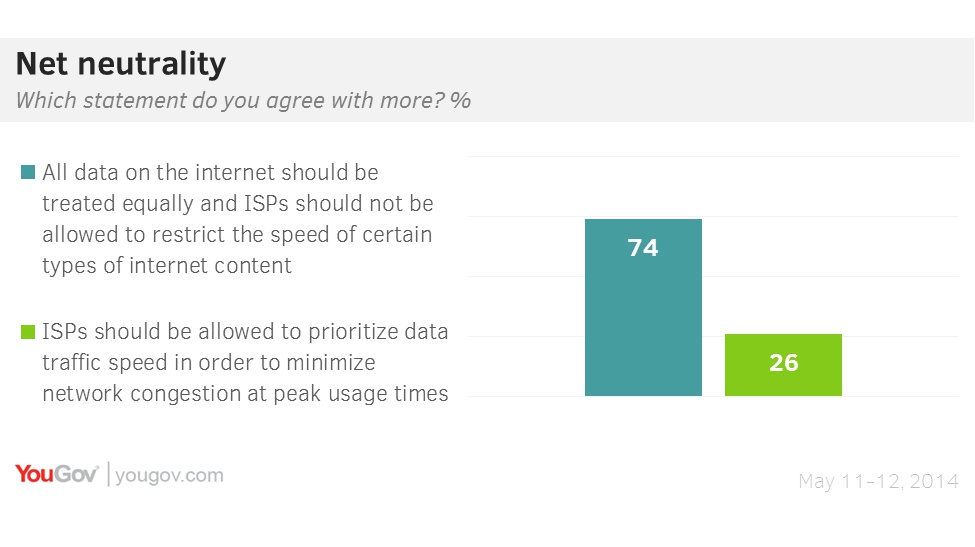
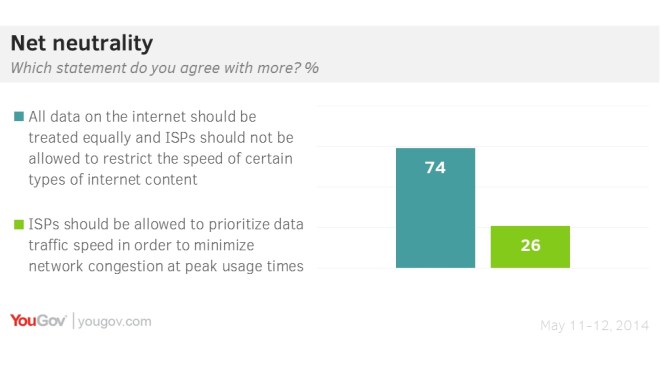
Meanwhile, net neutrality remains popular with the public, as the chart seen above illustrates. Steven A. Vaughan-Nichols points out that major Internet companies also support it:

You might think that today’s dominant Internet companies would favor this move [to allow “fast lanes”] as well. After all, while they’d end up paying more, this move would make sure they wouldn’t have competition in the future. Guess what? The top cloud company, Amazon; the top Web company, Google; and the top Internet video company, Netflix, all oppose this change. They, under the umbrella of the Ammori Group, a Washington DC-based public policy law-firm, all want the old-style net neutrality where companies can compete fairly with each other.

Heck, even the Internet providers, such as Level 3, which provides Internet service to the last mile ISPs want good, old net neutrality and not this new abomination. When the only ones supporting the FCC’s new position are the handful of companies that will directly benefit from it, is that really a fair position? I don’t think so.