Brown’s Limited Legacy

A study issued in the lead-up to the 60th anniversary of Brown v. Board of Education shows how our school system remains effectively segregated by race:

According to the UCLA Civil Rights Group, which conducted a similar study two years ago, minority students and white students attend demographically distinct institutions. On average, white students attend schools that are 72.5 percent white, Latino students attend schools that are 56.8 percent Latino, and black students attend schools that are 48.8 percent black. And minority students make up the vast majority of metropolitan public schools, whereas their white counterparts attend suburban institutions. In the suburbs of large, medium, and small cities, white students make up 50 percent, 60.3 percent, and 61.7 percent of public school populations, respectively.

Geographically, the highest rates of segregation occur in the West and South. Between 1991 and 2011, for instance, the percent of black students attending “racially isolated minority schools” in the South increased by more than 8 percent. The percent of black students enrolled in similarly segregated schools in the West rose by roughly 8 percent as well. In the same two decades, the percentage of Latino students in 90-100 percent minority schools jumped 16.2 percent in the West.

Emily Badger blames housing segregation:

Since the Civil Rights Era, residential racial segregation across the U.S. has steadily declined. But segregation among school-aged children has startlingly lagged behind this progress. In the communities where they live, black and white children — as well as the poor and non-poor — are more isolated from each other than adults in the U.S. population at large. …

How is it possible that school children would experience residential segregation at higher rates than the rest of us?

Think about who lives in the changing neighborhoods of Washington, Philadelphia or Brooklyn. Whites have begun to move back into urban neighborhoods – but, for the most part, they are not yet moving back with children. Young singles, childless professionals and empty-nesters are returning to cities that were abandoned by the white middle class decades ago in large part because of their struggling schools.

Bouie agrees:

School segregation doesn’t happen by accident; it flows inexorably from housing segregation. If most black Americans live near other blacks and in a level of neighborhood poverty unseen by the vast majority of white Americans, then in the same way, their children attend schools that are poorer and more segregated than anything experienced by their white peers.

We could fix this. If the only way to solve the problem of school segregation is to tackle housing, then we could commit to a national assault on concentrated poverty, entrenched segregation, and housing discrimination. We could mirror our decades of suburban investment with equal investment to our cities, with better transportation and more ways for families to find affordable housing. And we could do all of this with an eye toward racism—a recognition of our role in creating the conditions for hyper-segregation. To do this, however, requires a commitment to anti-racism in thought, word, and deed. And given our high national tolerance for racial inequality, I doubt we’ll rise to the challenge.

Well geez. Arit John adds that even in well-integrated schools, racial discrimination is pervasive:

A 2007 study from the Journal of Educational Psychology analyzed dozens of previous studies, spanning more than three decades, on how teachers interact with different kinds of students. Researchers found that, overall, teachers’ expectations and speech varied depending on the race of the student. Teachers directed the most positive behavior, like questions and encouragement, to white students.

A 2012 study from the American Sociological Association found, “Substantial scholarly evidence indicates that teachers—especially white teachers—evaluate black students’ behavior and academic potential more negatively than those of white students.” The study analyzed the results from the Education Longitudinal Study, a national survey of 15,362 high school sophomores, as well as their parents and teachers. Again, the evidence showed a bias among white teachers that favored white students.

With a more constructive take, Peg Tyre looks at some of the ways in which the Brown ruling backfired on black Americans:

[B]ecause the decision specified that black children would benefit from an education with white children, the grossly underfunded African-American run public education system, which for decades had been dedicated to serving children in black communities, was dismissed as inferior and dismantled. In the 1960s and 1970s, many more black schools than white schools were closed. African-American teachers and principals, who in many states held about the same level of professional certification as their white counterparts and who for decades had served as steadfast anchors in black communities, were fired en masse. African-Americans would never again have as great a role in educating our county’s youth. Sixty years later, at a time when nearly half of all public school children in the United States are black, Hispanic or Asian, 80 percent of public school teachers are white.

What’s Killing The Bees?

A new study out of Harvard appears to strengthen the case that neonicotinoid pesticides are behind the sharp decline in the honeybee population over the past six years:

According to lead author Chensheng (Alex) Lu, “We demonstrated again in this study that neonicotinoids are highly likely to be responsible for triggering [Colony Collapse Disorder] in honey bee hives that were healthy prior to the arrival of winter.” To perform the latest study, the researchers examined 18 bee colonies in three different locations in central Massachusetts. They split each colony into three groups — one treated with a neonicotinoid called imidacloprid, one with a neonicotinoid called clothianidin, and one left in pristine condition to serve as a control group. The scientists monitored the groups from October 2012 to April 2013 and found that, by the end of that period, half of the neonicotinoid colonies had been decimated, while only one of the control colonies was destroyed by a common intestinal parasite, Nosema cerenae.

But Lisa Beyer points out that the study fed the bees dosages of insecticides “far in excess of anything bees would encounter in agricultural fields”:

In any case, it should be noted that whatever results the researchers created in the lab, in trials in which bees have been placed in farm fields treated with neonicotinoids, the colonies have done fine.

Lu’s new study nonetheless is receiving significant — and largely uncritical — media attention and strengthening the call by some environmentalists to prohibit neonicotinoid use in the U.S. Such a ban would be a mistake. It would compel U.S. farmers to use older pesticides that haven’t been subjected to bee studies and may be more hazardous to cultivated bees, not to mention wildlife and humans.

What’s more, the focus on neonics draws attention away from more plausible causes of bee deaths. First is the Varroa mite, which spreads lethal infections and has developed resistance to miticides. More research is needed on strategies to defeat this parasite. Second is the decline in bee food sources. High corn and soybean prices have accelerated the conversion of open land to cropland, leaving bees little to eat outside of the few weeks when a crop blossoms. Maybe if the government limited the subsidies that encourage fence-to-fence single-crop planting, more marginal land would be left fallow and could feed bees.

Bryan Walsh weighs both sides of the debate:

The chemical companies that make neonicotinoids are, unsurprisingly, skeptical that their products are behind the plight of the honeybee. “Extensive research has shown that these products do not represent a long-term threat to bee colonies,” David Fischer, the director of pollinator safety at Bayer, said in recent Congressional testimony. But the very purpose of pesticides is to kill insects, and no one would deny that such chemicals are almost certainly one of many factors hurting honeybees today. (It’s notable that a recent study found that the diversity of pollinators like bees was 50% higher on organic farms than on conventional farms.)

Many independent experts, however, doubt that neonicotinoids should get all the blame. Australia still uses neonicotinoid pesticides, but honeybee populations there are not in decline—something that may be due to the fact that varroahave yet to infest the country’s hives.

Recent Dish on the beepocalypse here and here.

How The Senate Is Shaping Up

Tom Cotton

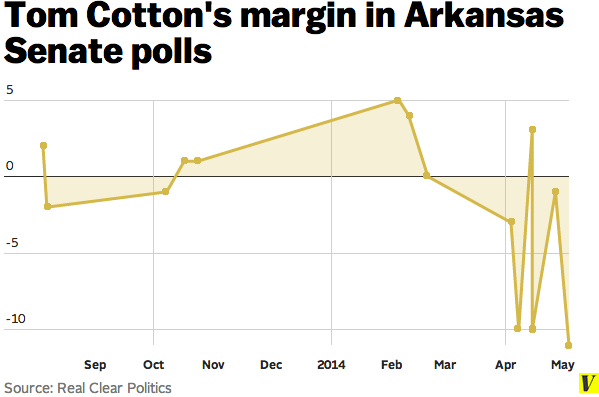
Arkansas Senator Mark Pryor is defending his seat against Republican Congressman Tom Cotton. Pryor has been doing surprisingly well as of late:

It’s impossible to say for sure why the race has turned around, or whether the trend will last. But it’s noteworthy that recently, the Pryor campaign has been aggressively advertising on just two issues: Medicare and Social Security.

Cotton “voted to raise the age to Medicare for 70,” one narrator intones. “Cotton would raise Medicare and Social Security to 70. Look it up! He’s a real threat to your retirement,” says an older woman named Linda. In another ad, Pryor himself says he wrote a bill to “stop politicians from destroying Medicare,” and helpfully adds, “My opponent voted to withhold benefits until age 70. And I’m trying to stop that.” The Pryor campaign has spent hundreds of thousands of dollars airing these ads in the past month.

Attacks against Republicans for supporting Paul Ryan’s budget are nothing new. Yet the most damaging claim here is that Cotton supports raising the beneficiary age to 70 — something Ryan’s budget specifically avoided doing. (It raises the Medicare age only to 67, and doesn’t even touch Social Security.)

But Charlie Cook sees Cotton’s farm bill vote as more signifiant:

My hunch is that a lot of people got a little ahead of their skis in pronouncing Pryor dead, but I also suspect that Cotton’s Jan. 29 vote against the farm bill—he was one of 63 House Republicans, mostly very conservative members, who voted against it, while 162 Republicans voted for it—had something to do with this. Among House Democrats, 89 voted for passage of the farm bill, 103—mostly pretty liberal members from urban districts and unhappy over food-stamp cuts—voted against it. No Republicans in Alabama, Iowa, Mississippi, or Missouri voted against the bill, and some of those folks are pretty conservative.

Although Cotton unquestionably has deeply held conservative principles that persuaded him to vote against the farm bill, it sure wasn’t politically expedient for the Senate candidate to vote in opposition. My hunch is that there is a lot of head-scratching over that vote among farmers and folks in rural and small-town Arkansas.

Nevertheless, The Monkey Cage’s model still gives the GOP a 77% chance of a Senate takeover:

Our earliest forecast showed that Republicans were already heavily favored due to the national landscape and the partisan complexion of the states holding Senate elections this year. We then showed that incorporating a measure of the “quality” of the candidates — prior experience in elective office — made things even more favorable to Republicans. Chris Cillizza and I discussed that forecast here. As we would expect, Republicans are recruiting and nominating relatively experienced and therefore more electable candidates.

Now, with fundraising in the model, the results are marginally more favorable to Democrats, but not by much.  This means that Democrats are mustering some advantages in fundraising, but not particularly large ones.

Fired For Being Pushy? Ctd

Ken Auletta talked to the NYT about Abramson’s firing:

Abramson’s attempt to raise the salary issue at a time when tempers were already frayed seemed wrongheaded to [publisher Arthur O.] Sulzberger and [CEO Mark] Thompson, both on its merits and in terms of her approach. Bringing in a lawyer, in particular, seems to have struck them as especially combative. Eileen Murphy, a spokeswoman for the Times, argued that there was no real compensation gap, but conceded to me that “this incident was a contributing factor” to the firing of Abramson, because “it was part of a pattern.” (Update: Murphy wrote to me after this post went up to dispute this. Her quote is accurate and in context, as I’ve confirmed in my notes. However, she now e-mails: “I said to you that the issue of bringing a lawyer in was part of a pattern that caused frustration. I NEVER said that it was part of a pattern that led to her firing because that is just not true.”)

Josh Marshall explains why this piece of reporting matters:

As you see, since I started writing this post, Murphy tried to get Auletta to issue a correction. And for good reason. If someone alleges employment discrimination and then retains a lawyer and you fire them for doing so, that’s big, big trouble. Basically wrongful termination on its face. And compounded if the initial claim is judged valid.

Either Murphy or the Times lawyers must have realized this as soon as they saw the piece. And how big a problem it was. Thus the failed attempt to secure a retraction.

Marcotte reflects on Abramson’s ouster:

This story, particularly in its current state of more-guessing-than-knowing, speaks to the deep, immoveable, and totally realistic fear many women have that there’s nothing they can do to overcome sexism in the workplace.

They worry that they can lean in, do the dance, do the work, calibrate themselves, obsess over reading a room and figuring out the exact dosage of femininity required to work it, and it still won’t matter. Women worry that the single word “pushy” can destroy everything they’ve worked for. Abramson’s story suggests that they may not be paranoid to think it.

Ann Friedman makes related points:

In real time, it’s hard to be sure what’s sexism and what’s you. Abramson exhibited this tension: She was unapologetic about her power and firm about her decisions, but she was also working with a coach to improve her management skills — presumably in response to complaints, such as those aired anonymously in Politico last year, that she was unpopular, unapproachable, condescending, brusque. Even though she and many outsiders recognized the double standards in the article, she later told Newsweek it made her cry.

I’m sure those quotes stung on a personal level, but they were also a grave professional threat. Some of the most successful people in the world profess not to care what others think of them. But for most women, and anyone else who faces scrutiny as the “only one” in the room, not caring is not an option. This is not because all women necessarily have a deep personal need to be liked by their colleagues; it’s because those colleagues’ gut-level opinions matter greatly when it comes to evaluating a woman’s job performance. Women are sometimes advised to keep a low profile and let their work “speak for itself.” But in Abramson’s case, eight Pulitzers did not speak loudly enough. Revenue growth did not speak loudly enough. Successful new digital products did not speak loudly enough.

Hanna Rosin weighs in:

Reports about her from the newsroom have always been mixed, as I reported in an earlier Slate storyMany women were inspired by her. I’ve heard people describe her as honest, exacting, funny, loyal, and very generous. More lately, a word I heard was “depleted,” as if the more harsh, negative sides of her personality were casting a gloom on the newsroom, as if she could not quite carry the stress of the job.

Maybe that’s a good enough reason to fire someone. It would be odd if politics dictated that you weren’t allowed to fire a woman, even if she were the most powerful woman in journalism. But the way it happened makes it hard to read the newspaper’s own front-page story and not see Baquet, Sulzberger, Keller, and all the powerful men in the history of the Times on the inside and one loyal, tattooed soldier now out.

Amanda Hess claims that, “to many women at the New York Times, Jill Abramson was everything”:

The New York Times is a newspaper where mostly male reporters cover industries—politics, media, sports, the military, the courts, the arts—that are also overwhelmingly run by men. With Abramson’s appointment, the Times cemented a female perspective at the top of the masthead for the very first time, and young women on the staff responded instantly.

“Among the women here, there was a deep appreciation that another woman was high up at the Times. It symbolically had an impact,” one young female staffer told me. “We felt possessive and proud of Jill, and [appreciated] her stories about [New Yorker reporter] Jane Mayer and her other female friends in journalism,” said another. “We loved that she had all those tattoos,” she continued, referring to the Times’ T on Abramson’s back. “We were curious about her and how she got to where she was in a way that [we weren’t] about senior male editors. This might have been just my imagination, but I felt like I related to and empathized with her in a way I hadn’t with male editors.” A third put it this way: “Jill leaned in before everyone else, ever. Before Lean In. She’s pre-Sheryl Sheryl, but with more style and more class.”

McArdle joins the conversation:

Most notable of all is the way she was fired. She seems to have been given no opportunity to address the newsroom, no fig leaf to resign, no sinecure consultancy to a department no one cares about. Indeed, management seems to be going out of its way not to say nice things about her. That’s less than Howell Raines got after he presided over the Jayson Blair and Rick Bragg disasters. Which of her offenses was so grave that higher-ups are going to such extraordinary lengths to humiliate her? It’s very hard for me not to suspect an element of masculine umbrage to this, a determination that Abramson should not merely be let go, but also put in her place.

And yet, we’ll never really know, will we? This is what troubles every ambitious woman: You’ll never really know how big a role sexism plays in your setbacks.

Kilgore observes how very often organizations will “go to great lengths to sugar-coat the justified sacking of a senior employee to avoid speculation about the incident”:

Give ‘em a going-away party, let ‘em pretend they left “to pursue other opportunities,” gild that parachute—you probably know the drill. I’ve also seen organizations deal with firings by asking for the employee’s keys in the termination meeting and then making sure a security guard met them at their desk with a box to collect personal items. That generally occurs with poor schmoes whose fate will not generate Twitter wars or consume the national commentariat.

I don’t know if Jill Abramson’s firing was justified or not, but she’s a global celebrity in her profession, and nobody at the Times should be surprised that giving her the bum’s rush would blow up in their faces.

Not In My 后院

China’s so-called “NIMBY” environmental protest movement appears to be gaining steam:

On Saturday, protestors held public demonstrations against the planned construction of a waste CHINA-ENVIRONMENT-POLITICS-PROTESTincineration plant near the city of Hangzhou in Zhejiang province. The Financial Times reported that the planned waste incineration plant would be the largest such plant in Asia, expected to process 3,000 tons of waste each day in its first phase. Protestors reportedly numbering in the thousands joined the march against the incinerator plant, citing environmental and health concerns. Smaller protests had been occurring for weeks before Saturday’s major demonstration, which led to the protestors blocking a major highway. …

Environmental protests such as the one in Hangzhou are not uncommon in China. Earlier this year, protests against a paraxylene (PX) plant in Maoming, Guangzhou also turned violent, with protestors reportedly throwing rocks and even setting police cars on fire. As with the protests near Hangzhou, photos of the protests (including images of bloody protestors clashing with police) were quickly circulated on China’s social media sites. In both Maoming and Hangzhou, local authorities announced that they would not continue the controversial construction projects without public support.

Alexa Olesen has more on the movement:

The Chinese word for NIMBY is “linbi,” a pairing of the characters for “neighbor” and “avoid” that is meant to allude to the original English phrase in both sound and meaning. The word doesn’t show up in most Chinese dictionaries, a sign of just how young the phenomenon is there (though the definition can be found online). Most trace the beginning of the movement to the peaceful strolling protests and banner-waving that happened in the summer of 2007 in the coastal city of Xiamen that brought to a halt plans for a chemical plant in that city. The tenor of those demonstrations, which were largely organized via SMS, was cooperative and upbeat, not antagonistic.

Not all Chinese NIMBY actions have been so tranquil in the years since. It’s not clear whether this reflects a more aggressive response from police in cities where the protests are happening, or if the protestors are instigating the violence, or some combination of both.

(Photo: A damaged police vehicle lies on a road after residents clashed with police during a protest in Hangzhou, east China’s Zhejiang province, on Sunday. At least 39 people were injured on May 10 during a protest against plans to build a waste incinerator in eastern China, state media reported. By STR/AFP/Getty Images.)

Ladylike Electability

A Dartmouth study suggests that women politicians with more feminine features are more likely to win elections than their more butch peers:

In fact, “a female politician’s success was related to how feminine or masculine her face was perceived less than one half-second after its initial exposure, suggesting that the way a face’s gender is rapidly processed may translate into real-world political outcomes,” Jon Freeman, author and assistant professor at Dartmouth, said in the study’s release.

The results got even more interesting when they were broken down by region.

“In conservative areas in particular, the difference in votes between women with more masculine faces and more feminine faces becomes larger and larger as conservatism increases,” says Eric Hehman, lead author and postdoctoral researcher at Dartmouth. In other words, conservatives want their female politicians to look like ladies.

Andrew Prokop points out the study’s limitations:

The study only uses pictures of 80 female politicians, between 1998 and 2010. So the number of politicians who ran in conservative states that we’re looking at is really rather small.

Furthermore, it’s possible that female candidates who are more likely to win will pay more attention to managing their image, and will therefore release more flattering official photos (though this was apparently not the case in liberal states). The study’s authors also write that, though they did try to control for this, the experiment’s participants could have had some vague familiarity with the the images of successful female politicians — which would lead to them more easily recognizing their faces as female.

But Elizabeth Nolan Brown notes that the study squares with previous research:

There have been a bevy of studies looking at how looks play a role in the politicians’s success (see hereherehereherehere, and here). Freeman’s study—published in the journal Social Psychological and Personality Science—echoes a UCLA study published in 2012. In that study, researchers (including two who also collaborators on this recent study) looked at the facial features of women in the U.S. House of Representatives. Those with more stereotypically feminine features were more likely to be Republican, and the correlation increased the more conservative the lawmaker’s voting record. Lady legislators with less traditionally feminine facial features were more likely to be Democrats, fitting with the Dartmouth study finding that feminine faces offer a greater electoral advantage in conservative states.

Tom Jacobs asks what the study implies for male pols:

So why weren’t subtly ambiguous male candidates similarly penalized? While the researchers aren’t sure, they note that, given then the fact that American political leaders have historically been men, “leader-like characteristics may be automatically conferred upon male politicians.” It’s particularly striking that this effect was found “above and beyond the numerous other influences on electoral outcomes,” in the researchers’ words. One might think that voters would grow accustomed to a candidate’s face over the course of a campaign, but this research suggests otherwise.

“Although whether a politician is male or female is certainly established quite quickly, how relatively masculine or feminine his or her face appears persists,” Freeman explained. “Each time an individual encounters that politician’s face, our results suggest a state of subtle uncertainty is triggered.”

Cillizza makes the obvious connection:

It’s hard to avoid viewing this study in light of the potential (likely) candidacy of Hillary Clinton for president in 2016. As we have previously written, Clinton played down her gender — and the historic nature of her candidacy — during the 2008 candidacy, a move that we believe hurt her. She’s not likely to repeat that mistake in 2016 — if her earlier rhetoric is any indication — but the Dartmouth study suggests that what she says may matter less to voters than how she looks, all of which reaffirms that life really is just like high school.

But Jay Newton-Small cautions against reading too much into the study:

Before you start to imagine that every woman elected to higher office is a supermodel, keep in mind that the study doesn’t take into account a lot of factors such as intelligence, party affiliation, incumbency, messaging, pedigree, money, etc. “Although it may be the case that, absent other information, voters consider facial features when selecting candidates, the reality is that the experimental conditions are quite artificial,” says Jennifer Lawless, a professor at American University who studies gender in American politics. “In the contemporary electoral environment in which we see a high degree of party polarization, many scholars have found that even when candidate sex and physical appearance do matter to voters, their influence pales in comparison to incumbency, partisanship, and ideology as principal drivers of election outcomes.”

The New Leader Of The World’s Largest Democracy

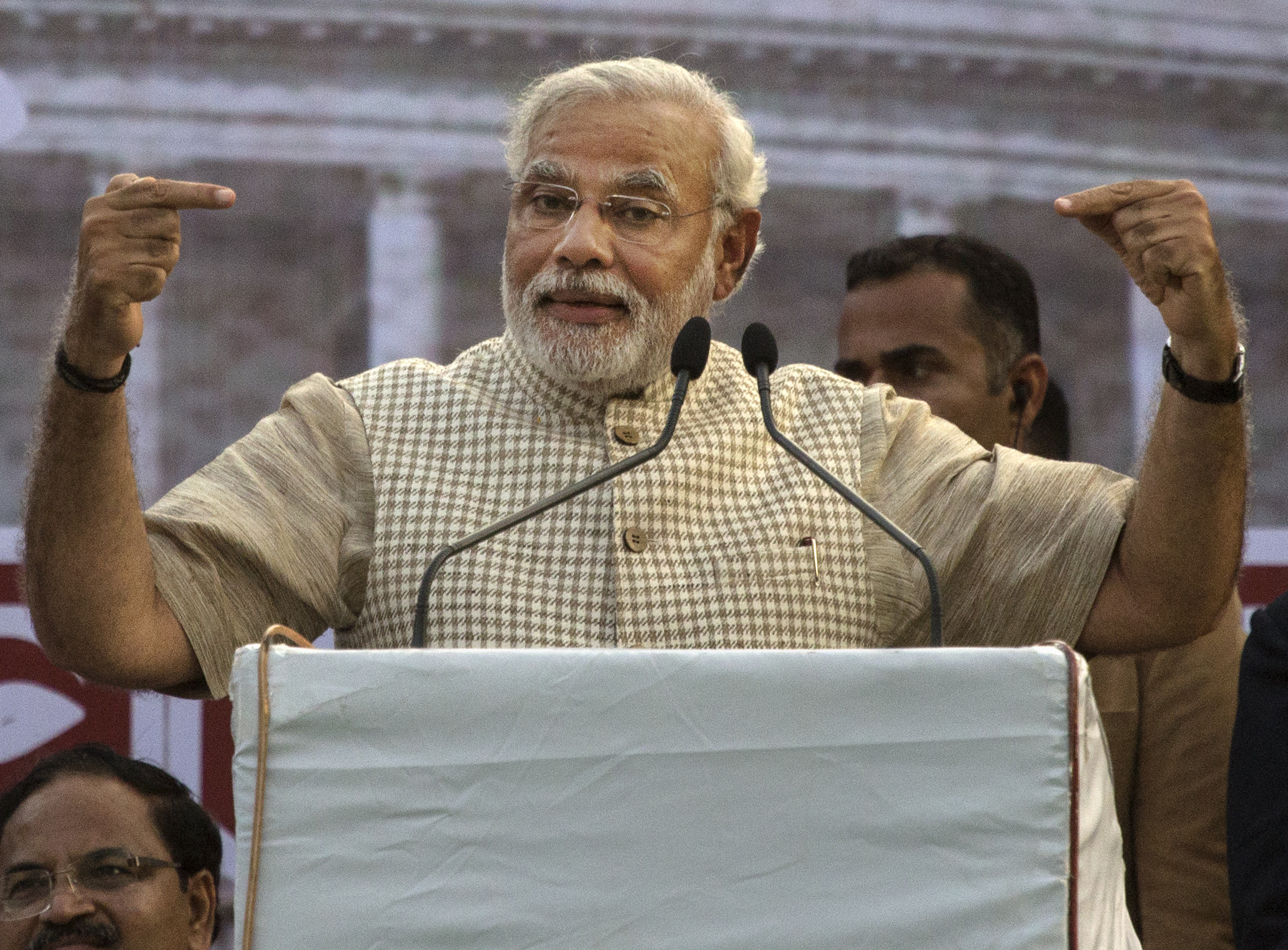
BJP's Narendra Modi Becomes India's Prime Minister With Landslide Victory

Narendra Modi, as expected:

According to Reuters, Modi’s Hindu nationalist Bharatiya Janata Party and allies (altogether as the National Democratic Alliance) are leading in races for 337 of 543 available parliamentary seats, more than six times the number of their next [closest] rival. It looks to be the most lopsided election victory in India in more than 30 years.

Meanwhile, Rahul Gandhi, leader of the Congress Party campaign, was leading his race by a slim margin, and a loss there would be particularly embarrassing considering that the seat he is running for has been held by his uncle, father, and mother before him — all former titans of Indian politics. The Economist notes that, “Newspapers report that Rahul Gandhi left the country earlier this week, which looked not only like an admission of defeat but an abdication of responsibility (he has since returned).”

Daniel Berman thinks Modi represents a sea change in Indian politics:

Almost everyone over 45 who I spoke with opposed him; every single person I spoke with under 40 was voting for him. Why? Because Modi this year offered a different narrative, one that is far more attuned to Indian aspirations than the one it has been cast in.

Rather than seeing India as a leader of the developing world and a peer of Brazil, Modi and the BJP portray it as a sleeping developed country, a peer of European and Chinese civilization as one of the three great cultures of world history, condemned by invasion, Arab in the 9th century, not British in the 19th, to weakness and underdevelopment. For Modi and the BJP, Congress by embracing non-alignment and its sequel in the BRIC concept had condemned India to underdevelopment, using its affirmative action programs to turn one of the most effective civil services in the world into one of the world’s least efficient and corrupt.

Chandrahas Choudhury looks back at how India’s democracy has evolved in recent years:

Even five years ago, Indian democracy had hot spots — mainly urban centers and more developed states — as well as black holes, where information from the world did not penetrate and even democracy took on a largely feudal cast. Newspapers and television controlled public discourse, and what they chose to ignore, the country did not debate. Today, a single tweeted picture or YouTube video spreads like wildfire on the Internet, meaning that many more people can participate in the national conversation. Television has flattened the differences between city and village, rich and poor, raising expectations across the board.

It’s a new environment ideal for a presidential-style election in which a party invests all its energies in one candidate: in this case, the Bharatiya Janata Party’s Narendra Modi. Modi himself (Twitter followers: 4 million) is probably the Indian politician who best understands the power of social media and the Internet, and his election machine includes a large Internet force, including, some reports say, a 2 million-strong volunteer squad that fights battles for him online.

But Jayati Ghosh worries about what Modi’s win means for India’s Muslims:

The “communal peace” that has supposedly prevailed in Gujarat since [the pogrom against Muslims during Modi’s time as chief minister] has been achieved at a tremendous cost to the minorities, essentially by terrorising them into submission. Muslim families and individuals are increasingly ghettoised, finding it impossible to buy or rent accommodation in dominantly Hindu areas. Muslim youths are not only discriminated in employment but much more exposed to being picked up, interrogated and even imprisoned on mere suspicion of being terrorists. Bank loans are hard to come by for people from minorities, and intercommunity social mingling, particularly between young men and women, is frowned upon.

That this “peace of the graveyard” may be extended across India is a frightening prospect. … In a speech in West Bengal, Modi declared that only Hindu migrants from Bangladesh were welcome; the others would be repatriated. His henchmen declared in Uttar Pradesh that anyone who did not support Modi should go back to Pakistan, where they belonged. That all this belligerence only seems to have helped them at the polls is alarming.

Max Fisher focuses on Modi’s foreign policy ideas, which are also troubling:

His anti-Muslim rhetoric, and his past accusations that political opponents are “Pakistani spies,” suggests he would worsen rather than improve relations with Pakistan. The two countries are armed with nuclear weapons, have frequent and ongoing disputes, and have fought several wars, most recently a 1999 conflict that got dangerously close to open nuclear warfare.

Modi’s party has already suggested it may revise the country’s “no first use” policy, by which India promises not to launch nuclear weapons except to defend against a nuclear attack. In other words, a Modi-run India would lower its standards for nuking another country.

Adam Taylor points to the other big story of the day, which is the Congress Party’s unprecedented crushing defeat:

Congress Party has long been a mainstay of Indian politics. It was the party that won India its independence, led by men like Mahatma Gandhi and Jawaharlal Nehru, India’s first prime minister. Since 1947, the center-left party has remained the dominant party, and for the last 10 years it had led India under Prime Minister Manmohan Singh.

So what explains this historic defeat? The “WhyCongressLost.In” thinks it knows why: Rahul Gandhi. The Web site is one of those delightful single serving Web sites that has popped up over the past few years. All it does is serve you up random quotes from Gandhi, including such gems as:

People call us an elephant.. We are not an elephant.. we are a beehive.. it’s funny but think about it. Which is more powerful? an elephant or a beehive?

The Bloomberg editors give Modi some free advice on how he should govern:

A good place to start would be to keep an election promise to introduce a combined goods and services tax — something his own party has long opposed because it would force revenue losses on state governments. (Modi should offset some of the losses using central revenues.) He should move to phase out petroleum subsidies. He should give state and local governments much greater flexibility in regulating labor markets, land sales and more. Economic competition among the states — a model that Modi has long advocated — is the best way to push the national economy forward.

True, several of those state governments will be run by political rivals. So much the better. Like any leader claiming a clear mandate, Modi will be tempted to ride roughshod over his weakened opponents. His record in Gujarat is not reassuring in this regard. From Russia’s Vladimir Putin to Turkey’s Recep Tayyip Erdogan, such charismatic figures tend to overreach, weakening their nations in the end. Modi would do better to find common ground. On economic policy, that shouldn’t be impossible.

Michael Schuman considers the monumental task Modi faces in fixing the Indian economy:

What Modi will have to do is no secret. More than two decades after Manmohan Singh (now the outgoing prime minister) began dismantling the web of controls on private enterprise known as the License Raj, the bureaucracy has struck back. The deregulation never went far enough, and that has allowed India’s meddlesome civil servants to impede the progress of critical investments. Many large-scale projects have stalled, while new ones have almost evaporated. Businessmen struggle to acquire land and get environmental approvals and other permits.

The World Bank ranks India a miserable 134th out of 189 countries on its ease of doing business index, which measures the difficulties faced starting a company, dealing with construction permits and other factors ­behind competitors like China or Indonesia. Without a boost to investment, the economy will continue to stagger. That means Modi will have to strip out red tape and streamline bureaucratic procedures to make it less burdensome for companies to invest and create jobs. On top of that, Modi will have to speed along improvements in the country’s strained infrastructure — from roads to ports to power — ­to bring down the costs and enhancing the efficiency of doing business.

(Photo: BJP leader Narendra Modi gestures as he speaks to supporters after his landslide victory on May 16, 2014 in Vadodara, India. By Kevin Frayer/Getty Images)

What’s A Bisexual Anyway? Ctd

A reader resurrects the thread once again:

I’ve been reading your blog for a long time, but never really felt compelled to write. I’m doing so now to thank you for the ongoing series on bisexuality. Recently our teenage son told us he is bisexual. It was a complete surprise to my husband and me. I knew he was interested in girls, so I just put him in the hetero category and never thought twice about it. We have lots of gay friends, several of whom are like extended family. There has never been any question in our house that a person’s sexuality is no big deal. And it’s not.

But even so, this knowledge rocked my world in ways I didn’t expect, including confronting my own ideas about bisexuality. And I gotta tell ya that my close gay friends were NO HELP when I tried to talk to them about it. Every single one of them has responded to some degree with the same comment: Oh, he’s too young to know what he is yet. My reaction: WTF? That does not jive with the “born this way” message I’ve been hearing like a steady drumbeat.

So, that’s where The Dish has helped tremendously. It’s the only place I’ve been able to hear directly from people who identify as bisexual about their journeys, frustrations and needs. I have read every single post in the series, and I hope you keep it going.

Another keeps it going:

I’m one of those bisexuals you have identified as bisexual and heteroamorous. But I’ve come to believe that my truncated sexual attraction to men, i.e., lacking the emotional dimension, is a result of my internalized homophobia.

I was an intellectually and emotionally precocious child, and at the age of 11, had my first huge crush on a girl in my school.  In the next year, I was sent to an all boys’ boarding school, where I promptly developed a huge crush on a boy a couple of years older than me. Sadly, the crush was discovered by a classmate, who suggested that I was a “fairy”.  In terror, I ruthlessly repressed my homosexual desires into adulthood.

Only in my twenties, did I begin to confront my attraction to men, and even that was for years a deeply confused attraction.  As I told a therapist, I’m bi, but I don’t even like the smell of men.  As for my heterosexuality, I allowed myself the full experience of it, and I am unquestionably both heterosexual and heteroamorous – I’m very happily married to a woman.

But over the years, I’ve worked to overcome my homophobic resistance to my attraction to men, and have reasonably succeeded – I even like the smell of men now, and can engage in homosexual sex without the tyrannizing Masters and Johnson-named observer on the shoulder who destroys all passionate sexual activity.  But I strongly suspect that emotional attachment is the remaining prohibition imposed by my internalized homophobia.  I often wondered who I would have grown up to be, had I not learned a terror of my homosexual attractions at an early age – I might even have grown up to be someone deeply attracted, both sexually and emotionally, to both sexes.  I am saddened that the world allows so little room for that.

Update from a reader, who responds to the mother’s email:

If a gay tells her it’s too soon for your son to know his entire sexual mind, it’s not necessarily insensitive or against the “born this way” message. Many of her close friends may have taken years or decades to fully know themselves. I am gay, so I am going by what I’ve read, and bisexuality can be as you have noted – sexual or amorous – but can also be simultaneous or consecutive, meaning the attraction for both sexes is both at the same time or takes turns. I doubt a young man can know so much about what the rest of his life will be, and surely a woman’s more fluid sexuality should inform her that one’s first self-realizations aren’t forever. It also sounds like the mother will only accept from gays what she wants to hear.

Book Club #2: “On Looking,” Hosted By Maria Popova

[Updated and re-posted from earlier this week]

When I asked Maria Popova of Brain Pickings which book she’d like to pick for our second book, her eyes widened a little. They do that a lot. It didn’t take long for her to settle on Alexandra Horowitz’s On Looking: Eleven Walks with Expert Eyes (alternatively subtitled “A Walker’s Guide to the Art of Observation”). In her work as a professor of cognitive science at Barnard, Horowitz is “currently testing the olfactory acuity of the domestic dog, through experiments in natural settings, and examining dog-human dyadic play behavior.” From the publisher’s description of the book Maria chose:

From the author of the giant #1 New York Times bestseller Inside Of A Dog comes an equally smart, delightful, and startling exploration of how we perceive and discover our world. Alexandra horowitz-onlookingHorowitz’s On Looking: Eleven Walks with Expert Eyes shows us how to see the spectacle of the ordinary—to practice, as Sir Arthur Conan Doyle put it, “the observation of trifles.”

On Looking is structured around a series of eleven walks the author takes, mostly in her Manhattan neighborhood, with experts on a diverse range of subjects, including an urban sociologist, the artist Maira Kalman, a geologist, a physician, and a sound designer. She also walks with a child and a dog to see the world as they perceive it. What they see, how they see it, and why most of us do not see the same things reveal the startling power of human attention and the cognitive aspects of what it means to be an expert observer.

On Looking is nutrition for the considered life, serving as a provocative response to our relentlessly virtual consciousness. So turn off the phone and other electronic devices and be in the real world—where strangers communicate by geometry as they walk toward one another, where sounds reveal shadows, where posture can display humility, and the underside of a leaf unveils a Lilliputian universe—where, indeed, there are worlds within worlds within worlds.

From Maria’s extensively excerpted review:

[Horowitz’s] approach is based on two osmotic human tendencies: our shared capacity to truly see what is in front of us, despite our conditioned concentration that obscures it, and the power of individual bias in perception — or what we call “expertise,” acquired by passion or training or both — in bringing orwell-2attention to elements that elude the rest of us. What follows is a whirlwind of endlessly captivating exercises in attentive bias as Horowitz, with her archetypal New Yorker’s “special fascination with the humming life-form that is an urban street,” and her diverse companions take to the city. …

It is undoubtedly one of the most stimulating books of the year, if not the decade, and the most enchanting thing I’ve read in ages.  In a way, it’s the opposite but equally delightful mirror image of Christoph Niemann’s Abstract City — a concrete, immersive examination of urbanity — blending the mindfulness of Sherlock Holmes with the expansive sensitivity of Thoreau.

It struck all of us as a great book to enter summer with, as we get outside more and try to turn down the digital noise in our heads. Less dense than the Ehrman book, it also covers a whole variety of ways of looking at the world – geology, physics, and the genius of dogs – ways many readers might be interested in or knowledgeable about. And, yes, it’s not about religion. I know that’s a niche topic. This one is literally everything on your block.

We’ll do the second Book Club exactly as we did the first – beginning the reader discussion, guided by Maria, after Memorial Day weekend. As with the Erhman book on early Christianity, the author will also show up at the end of the discussion, like Marshall MacLuhan, to tell us that we know nothing of her work. So buy the book through this link and get cracking. (The public library link is here.) We’ll start the conversation as summer begins.

Update from a reader:

I was very eager to join in the first book club because I adore the Dish community and knew that the discussion would be lively entertaining and I would definitely learn a thing or two. I have to admit I was disappointed by the first choice, How Jesus Became God. As a working mom I have limited time for reading not related to my profession so I couldn’t justify taking the time to read a book that didn’t spark my interest when I have so many waiting in my Kindle queue.

So I am one happy happy girl today because you have picked a book I was planning to read this summer! Thanks, and as a demonstration of my commitment, I am going to start today during recess.