A Majestic Creature Or Pest?

Adriaen_van_Nieulandt_(II)_-_Kitchen_Scene_-_WGA16570 2

Monica Kim wonders if roast swan will ever make a comeback – particularly in Michigan, where the birds are nearly three times as common as they were a decade ago:

Often served at feasts, roast swan was a favored dish in the courts of Henry VIII and Elizabeth I, particularly when skinned and redressed in its feathers and served with a yellow pepper sauce; others preferred to stuff the bird with a series of increasingly smaller birds, in the style of a turducken. … Great Britain’s royals are still allowed to eat swan, as are the fellows of St. John’s College of Cambridge, but to the best of our knowledge, they no longer do. Thanks to stories like Leda and the Swan and Lohengrin, the birds appear almost mythical; a restaurant on the Baltic island of Ruegen had swan on their menu for a short time, before protests began and it was swiftly removed.

In Michigan, however, which has the highest population of mute swans in North America, the creatures are considered pests.

According to the Michigan Department of Natural Resources, the statewide breeding population increased from about 5,700 to more than 15,000 in just 10 years. The birds attack people in the water and on shore, particularly children that wander too close to their nests. …  The cultural reluctance to hunt swan (let alone eat it) is powerful, but the government’s desire to control overpopulation is equally strong.

Update from a reader, who makes a distinction:

Mute Swans do not do anything to “other” native species in the US, as Ms. Kim suggests, because Mute Swans are not native to the US. They were deliberately introduced from the Old World to “grace the ponds of parks and estates” and are an invasive species here (like Starlings and English Sparrows). Our native swans include Tundra and Trumpeter Swans, and Mute Swans are not kind to them either. Mute Swans should be considered highly edible in the New World.

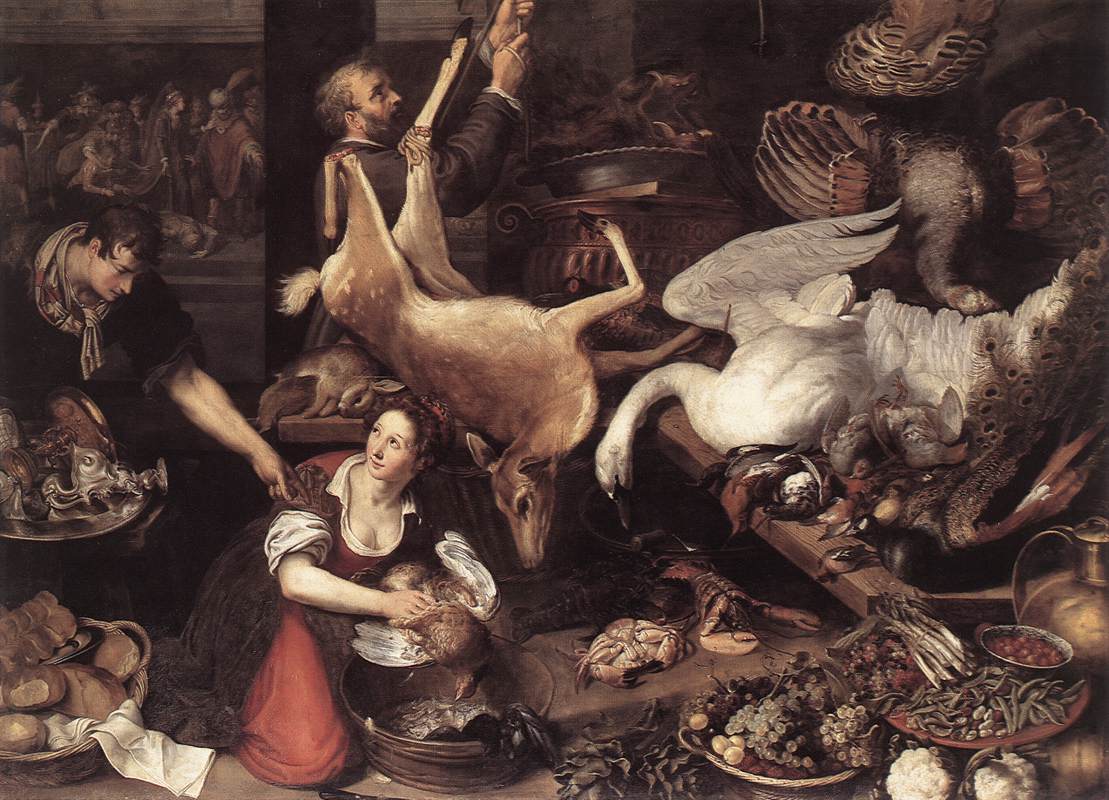
(Image: Adriaen van Nieulandt the Younger’s Kitchen Scene (1616) via Wikimedia Commons)

What Good Is A Minimum Wage?

Jamelle Bouie asks Republicans: “If raising the minimum wage destroys jobs and prevents employment, then lowering it would do the opposite. And if you gain from lowering the minimum wage, then why have one at all?” Ramesh Ponnuru answers:

For one thing, it’s not just opponents of a higher minimum wage who think it would destroy jobs while a lower one would create some. Almost everyone who has thought about this question believes these claims are true. Most proponents of a higher minimum wage think the trade-off is worth it because the job loss will be small and the benefits to people who will receive the higher wage large.

Opponents of an increase sometimes say to the proponents, “If $10.10 is such a good idea, why not $25?” This is not a great argument, because the proponents can reasonably say that the trade-off in that case would be much worse. But if it’s logically possible to favor a $10.10 minimum wage but not a $25 one, then it’s also possible to favor a $7.25 one and not a $10.10 one. (Tim Pawlenty, one of the Republicans Bouie mentions, wants one somewhere in between $7.25 and $10.10.) So an opponent of raising the minimum wage to $10.10 could answer Bouie’s question as follows: Yes, raising the minimum wage destroys jobs, as nearly everyone understands. I think it is an especially bad idea when the increase is nearly of 40 percent and it’s in the middle of a persistently weak labor market.

But Jordan Weissmann points out that abolishing the minimum wage wouldn’t necessarily lead to full employment:

It’s easy to think up reasons why nixing the minimum wage might not lead to a flood of new career opportunities for the unskilled. Because we have minimum wages today, businesses are required to work at a certain level of efficiency. Unless a business is understaffed, adding a new worker, even a cheaper one, might not be particularly profitable.

Or take technology.

Minimum-wage skeptics often point out that when employing a real live human being becomes too expensive, companies start buying computers and machinery instead. In a post-minimum-wage world, it seems unlikely that businesses would suddenly throw their profitable business models into reverse, and start scooping up cheap workers to handle tasks they had already purchased fancy new equipment to accomplish. Your local McDonald’s, for instance, wouldn’t suddenly return the fancy new soda machine that lets customers fill their own cups with umpteen variations on Diet Coke, just so that it could hire another person to work behind the counter for $4 an hour.

Of course, there’s another big question to answer: If we ripped up the wage floor, would pay for low-skill workers actually fall all that much? It’s hard to say. First, many low-wage businesses still offer their workers more than the absolute minimum. Second, wages tend to be “sticky,” meaning that once they go up, they tend not to come down. The reason why is still a bit of a mystery, but it likely has a lot to do with the fact that making your employees take a pay cut is a) emotionally unpleasant for both parties and b) a good way to sap their motivation on the job.

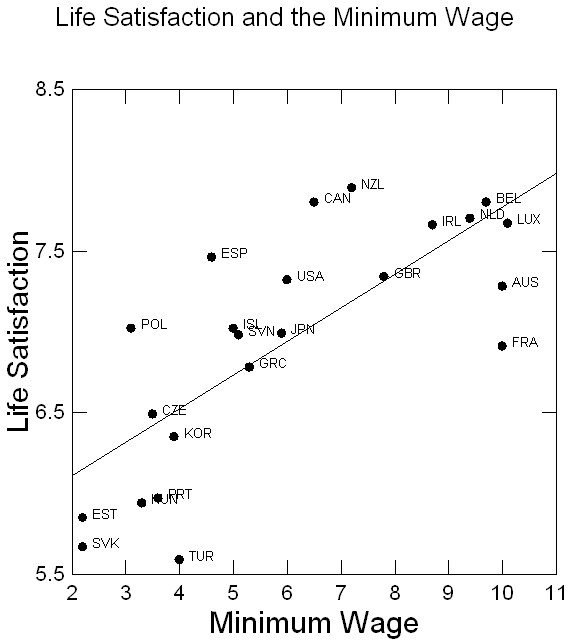
The minimum wage also has non-economic benefits, such as a clear correlation with happiness:

krassa_radcliff_TMC_graph-e1399998952468Can one approach be empirically demonstrated to contribute to greater levels of human well-being? The following graph is at least highly suggestive of an answer. It plots the mean level of life satisfaction in a nation against its minimum wage (for those industrial democracies that have a minimum wage). As is apparent, the slope relating wages to satisfaction is positive (and statistically significant at the .01 level), meaning that average levels of life satisfaction increase as minimum wage increases. …

The relationship is dramatic and clear: As the minimum wage increases, people are in general more satisfied with their lives. To be sure that this result is not an artifact of failing to consider alternative explanations, we note that the same positive relationship continues to obtain if we add statistical controls for other factors, including as a country’s level of economic development (GDP per capita, again in purchasing power parity), which may affect both its level of happiness and the level of its minimum wage, and (simultaneously) short-term economic performance (the unemployment rate).
Global Guzzling

Screen Shot 2014-05-14 at 2.19.23 PM

The average adult drinks 1.64 gallons of pure alcohol each year, according to a new World Health Organization report (pdf) covering more than 190 countries. But as Kate Kelland points out, that may be understating the case:

Less than half the population – 38.3 percent – drinks, so those who do drink on average 17 liters (4.49 gallons) of pure alcohol a year. “We found that worldwide about 16 percent of drinkers engage in heavy episodic drinking – often referred to as ‘binge-drinking’ – which is the most harmful to health,” said Shekhar Saxena, director for mental health and substance abuse at WHO.

Globally, Europe consumes the most alcohol per person, with some countries there having particularly high rates of harmful drinking. A study published earlier this year found that a quarter of all Russian men die before they reach their mid-fifties, largely from drinking to excess. Some men in that study reported drinking three or more bottles of vodka a week. WHO said global trend analyses showed that drinking has been stable over the last five years in Europe, Africa and the Americas – but is growing in Southeast Asia and the Western Pacific.

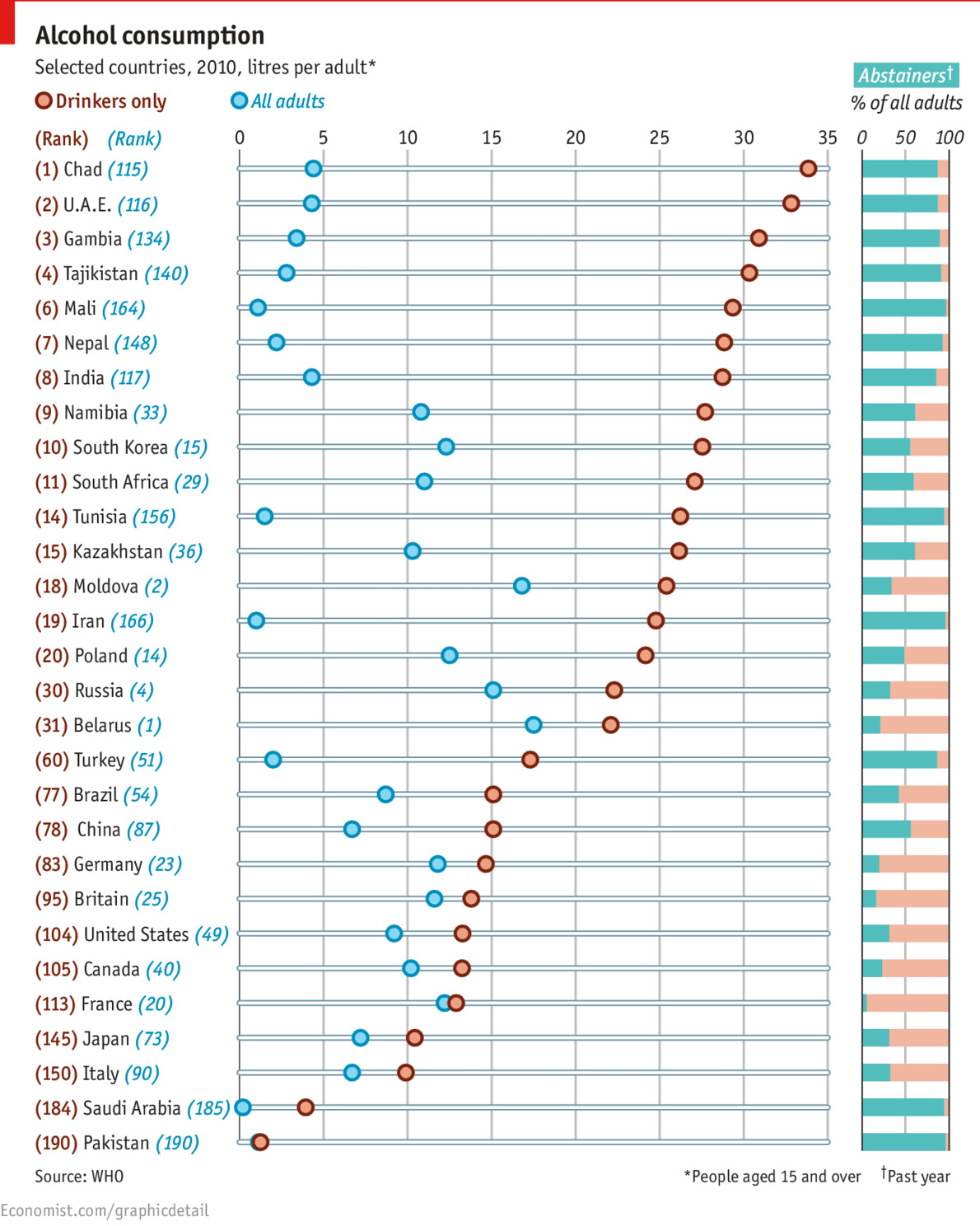
And as The Economist notes, “when abstainers are excluded, the national averages look extremely different”:

By this measure, it is in Africa, Asia and even the Middle East where actual drinkers quaff the most. In Chad almost nine in ten adults abstain, yet its 780,000 drinkers put away almost 34 liters of alcohol each. On the usual ranking, it would come 115th out of 190 countries. France drinks a lot, but because it has one of the lowest rate of abstainers at just 5 percent, it ranks 113th compared with 20th.

20140517_gdc884

Meanwhile, Ria Misra looks to the future:

Globally, the WHO expects the average to continue to rise, though they’ll be some regional differences here as well. The biggest increase, say researchers, will be found in the Western Pacific region and China. The biggest decrease will most likely be seen in Europe, though even with that decrease, they are still expected to keep the highest average overall.

It’s Not Just Concussions

Joseph Stromberg observes that one “reason many doctors are especially concerned about the risks of playing football is the mounting evidence that mild, routine hits — which present no immediate symptoms and are generally categorized as sub-­concussions, rather than concussions — might lead to [chronic traumatic encephalopathy (CTE)] as well.” He highlights a new study that supports this theory:

In it, doctors studied 25 college football players who’d previously suffered concussions, 25 who’d never been diagnosed with concussions, and 25 non-football participants of similar ages. Using MRI scans, they looked at the sizes of each person’s hippocampus — a brain region heavily involved in memory. This is important because people with CTE often have dramatically shrunken hippocampi by the time they’re diagnosed.

They found that previously concussed players had smaller hippocampi than non-concussed players — but, disturbingly, both groups had smaller hippocampi than the non-players. Within both groups, the more years of playing time a player had, the smaller his hippocampus.

Piketty Saw This One Coming

David Katz takes stock of the boom in the butler industry:

Thirty-five years ago, there were only a few hundred butlers left in Britain; today there are roughly 10,000, plus thousands more abroad, including the fastest-growing butler market of them all, China.

“For the Chinese, it’s a status thing,” says Sara Vestin Rahmini, who founded Bespoke Bureau. “They’re like, ‘Just send us somebody who looks British, who looks European.’” … Gary Williams, a London-based staffing agent who himself was a butler for 15 years, credits much of China’s butler demand to Downton Abbey. Watched by millions of Chinese, it’s one of the biggest British TV imports ever. The show is more than just a soapy diversion, he says; it’s a guidebook for living in a stratified society. “The Chinese aren’t even really sure what a British butler should do,” says Williams. “It will take them 10 to 15 years to really understand that.”

But they’ll pay – and pay well – to find out. A new butler willing to go east, to Shanghai or Dubai or anywhere else suffering an Anglo-servant shortage, can start at $60,000 a year and run his employer’s estate from the start. In the West, where standards are higher and the competition more fierce, a rookie typically apprentices for a few years and earns a starting salary of maybe $40,000. A butler in either market should hit six figures within five to six years – sooner if he learns a few dirty secrets or gets poached by one of his boss’s billionaire friends.

Russian Jews Know Fear

Ioffe tracks a rising tide of anti-Semitic incidents in Russia:

The Russian Jewish Congress, for instance, issued a report saying that there has been a marked increase in anti-Semitism in Russia in the first four months of 2014. Though there were no physical attacks on Jews, there were some minor incidents—everything from cemetery attacks to Russian nationalist thugs chanting anti-Semitic slogans. But most of this rise, the Congress reports, “was manifested first and foremost in public anti-Semitic statements, the number of which has increased dramatically.”

The report notes public statements from politicians, like the member of Putin’s United Russia party in Kaliningrad who accused his opponents of being “Jews, hiding among the opposition” and destroying the country. Dmitry Kiselev, who has threatened to turn the U.S. “into radioactive ash,” was called out for pointedly pointing out the Jewish names of some opposition writers and saying that they should be wary of comparing the Sochi and 1936 Berlin Olympics because, in Germany, they wouldn’t have been allowed to write, let alone live. The columnist of one state-friendly Russian newsletter listed Jewish members of the Russian opposition, saying that “they have no homeland because of their political beliefs.”

Yet at the same time, Putin is claiming that his intervention in Ukraine is saving the country from fascists and anti-Semites. Josh Cohen looks into how Ukrainian Jews feel about that:

Despite the substantial presence of right wing nationalists on the Maidan during the revolution, many in Ukraine’s Jewish community resent being used by Putin in his propaganda war. …

On March 5, 21 leaders of Ukraine’s Jewish community signed an open letter to Putin excoriating the Russian president for using Ukraine’s Jewish community to bash the interim government — and insisting that the real threat to Ukraine’s Jews emanated from Russia: “We know that the political opposition consists of various groups, including some that are nationalistic. But even the most marginal of them do not demonstrate anti-Semitism or other forms of xenophobia. And we certainly know that our very few nationalists are well-controlled by civil society and the new Ukrainian government — which is more than can be said for the Russian neo-Nazis, who are encouraged by your security services.”

This letter to Putin brought forth an important point: namely, that much of the real anti-Semitism directed at Ukrainian Jews is actually coming from Russia.

Previous Dish on Jews in Ukraine here.

Losing The Ring

Well, the procedure went well yesterday and I’m a little sore but fine. What’s not so fine is that they lost my wedding ring. I’d already changed into my OR clothes when a nurse noticed my ring was still on my finger. She asked to take it with my cellphone and said she’d put it in the bag in my locker. In the understandably woozy aftermath, as I prepared to leave, I found my phone in the bag but not the ring. I’ve been told they weddingaislewould have been together in a plastic ziplock bag inside the bigger clothes bag, but I only remember finding my phone loose among my clothes. I wasn’t fully altogether so forgive myself for not checking for the ring before I left. But last night, halfway through the Daily Show, I got that panicked feeling as I reached almost instinctively for my ring and it wasn’t there. Today, after searches and several phone calls, the ring has not been found. It was probably thrown out in the empty big bag I left behind.

I truly feel ill about this. I’m not at all a possessions-freak; in fact, I am wildly indifferent to things in general. But that little band of gold? After a lifetime of struggle for the right to marry and the blessing of finding my other half? I’m genuinely bereft. Yes, I’ll try and replicate it and get a new one. But knowing that that piece of metal had been on my finger continuously since the day I got married was, well, priceless. And every few minutes, I get this sudden sinking lurch in my gut when I remember what I’ve just lost.

It’s just a thing, Aaron reassures me. But this time, that ‘just’ seems inadequate. It keeps stinging.

A Poem For Thursday

in-bed-the-kiss-1892.jpg!Large

“The Ledger” by J.D. McClatchy:

Love is injustice, said Camus.
We want to be loved. What’s still more true?
Each wants most to be preferred,
And listens for those redeeming words
Better than X, more than Y—
Enough to quiet the child’s cry,
The bridegroom’s nerves, the patient’s
Reluctant belief in providence.
Break what you can, hurt whom you will,
Humiliate the others until
Someone takes a long, hard look.
Oh Love, put down your balance book.

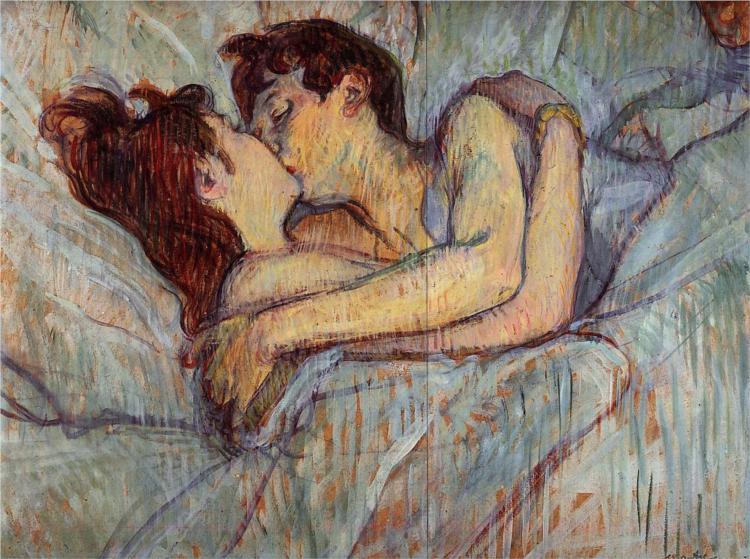
(From Plundered Hearts: New and Selected Poems © 2014 by J.D. McClatchy. Used by permission of Alfred A. Knopf, Inc. Henri de Toulouse-Lautrec’s In Bed: The Kiss, 1892, via WikiPaintings)

Hard Times For The Ego

Ben Richmond flags a study on how coming of age during an economic recession lowers narcissism:

Published in the journal Psychological Science , the team from Emory University examined survey data from over 1,500 American adults, and found that participants who entered adulthood during a worse economic climate—when average unemployment was at 7.7 percent—scored 2.35 points lower on a 40-point narcissism scale than those who graduated in more prosperous times, when average unemployment was 4.3 percent. Better economic conditions later in life didn’t put the narcissism back on, either. It’s those formative “Best Top Ramen-Eating” years of your life that really do a number on you.

Recessions also impact CEOs’ narcissism:

A separate study in the paper analyzed the salaries of CEOs from more than 2,000 publicly traded companies. The researchers discovered that the CEOs who were 18 to 25 during sunnier economic climates paid themselves 2.26 times as much as the next most well-paid executive; compare that to CEOs who came of age during bleaker economic times, who paid themselves just 1.69 times as much (recent research has suggested that CEOs who pay themselves considerably more than colleagues immediately below them show higher rates of narcissism).

Julie Beck ponders what this all means:

It seems that the humbling experience of struggling through a recession shapes people, leaving them less narcissistic than they might have been had they found success in a thriving economy. However, the study notes that this could be both good and bad for the humbler children of recessions. “Narcissists are often well-liked in initial interactions and are effective at claiming resources for themselves,” Bianchi writes. “In this regard, the present results could help explain why entering the workforce in an economic boom continues to confer advantages even decades into people’s careers.”