The Earth We Hold In Our Hands

Edward_Hicks_-_Peaceable_Kingdom 2

Justin E.H. Smith considers the theology underlying a certain strain of environmentalism:

Ironically, much conservationist thinking involves an implicitly mythological conception of species diversity that agrees in its essentials with the creation account offered in Genesis. In the scriptural tradition, God looked upon his work and deemed it good, and what ensued was a stable order of fixed, discrete, and well-bounded kinds, with no relations of descent among them. The best metaphor for conceptualizing biodiversity in this view is Noah’s ark, where each kind can be neatly separated from the others in its own compartment. The conservationist view generally leaves the creator out of the picture, yet the creatures are still deemed good, intrinsically good, and if they do not remain fixed and unchanging, then we may conclude that something is out of order – or “unnatural,” to use [Elizabeth] Kolbert’s term.

Darwinism, properly understood, is the opposite of this mythological outlook. It tells us that no particular arrangement of biodiversity is good in itself, and that no species has any absolute reason to exist. … The point here is not to relativize the current ecological crisis, or to call for an approach to mass extinction that simply says, que será, será. Rather, it is to suggest that conservationism might do well to acknowledge the endurance and the strength of the mythopoetical conception of nature, the one that sees our fellow creatures not only as more or less well adapted, but also as good, truly good.

The indifference to specific species is indeed one of Darwin’s great revelations. The whole planet is a teeming mass of DNA attempting to advance itself through various environmental challenges and changes. The death of one species is as integral as the birth of another. And so it will surely be with climate change. And at some point, I’ll wager, as the reality seeps through our consciousness, I’m sure we’ll begin rationalizing it. Species are always dying out, we’ll say to ourselves; weather has always changed, hasn’t it?; climate is never fixed, etc. The difference this time, of course, is that we humans have managed to change the climate in unprecedented ways. We have never reached this abyss before in all 200,000 years of struggle and survival. We are gods in that respect in planetary terms. And like the Greek gods, we are fickle, unpredictable and occasionally catastrophic.

A different theological account of environmentalism would not seek to set in stone every single species on the planet or resist any changes that occur because of some pristine present.

It would not construct a religion of Gaia, or be actively hostile to technology and science. But it would understand that we are but one species on this earth, even though we are easily the most powerful, and that our self-awareness bestows on us a responsibility unknown to other species. My view is that nature changes all the time and there’s nothing sacrosanct about this era in the millions of years that the earth has existed. But equally, one species’ knowing decision to destroy countless others, to shift the patterns of climate in potentially dramatic ways, and to up-end the ways of life of so much else on earth is an unprecedented global crime. To have dominion over the earth means a responsibility to be a worthy steward. We can use and exploit its resources – but only to the extent that we do not irreversibly alter its diversity.

You do not have to worship earth above humans to be an environmentalist. You merely have to respect the earth and better understand how all its inhabitants are connected through evolution. When you do that, the kind of wanton vandalism humanity is now wreaking is horrifying to any objective eyes. What a tragedy that the smartest species began as a territorial, murderous primate. And what spiritual revolution will be necessary to prevent this ongoing assault on nature?

(Detail of Edward Hicks’ Peaceable Kingdom, ca. 1834, via Wikimedia Commons)
Why Was Geithner So Easy On Wall Street?

Neil Irwin mulls the question:

Mr. Geithner spent his youth largely abroad and his early adulthood working on international trade and economics in the United States Treasury Department. Only starting in 2003 did he have much of anything to do with the financial industry, and that was as its overseer at the helm of the Federal Reserve Bank of New York. He is now the president of Warburg Pincus, a private equity firm, but he has held that job for all of 10 weeks. He was never an investment banker like his predecessors Hank Paulson and Robert Rubin, or even a hedge fund consultant like Larry Summers.

As far back as college, as he puts it in his new memoir, “I had never thought of finance as a particularly special or prestigious profession.” All of which makes the fact that he earned a reputation as a tool of big financial interests that much more intriguing. After covering Mr. Geithner for the better part of a decade and reading the memoir, I think here’s the best way to make sense of him: Timothy Geithner isn’t captured by Wall Street. He’s captured by working within systems as they exist.

Sheiber puts forward a different theory:

What always bothered me about Geithner, and which Sorkin’s piece draws out, is that he often seemed more dedicated to the banks than the bankers were to their own cause. While reporting my book about Obama’s economic team, plenty of bankers confided to me that the bailouts were shockingly generous. Many of them tended to take a “these f—king guys” view of their colleagues and puzzled over how Geithner could be so deferential. It made me suspect Geithner would have been much more of a hard-ass had he spent a few years toiling on Wall Street before joining government.

Instead, as Geithner tells Sorkin, “My jobs mostly exposed me to talented senior bankers, and selection bias probably gave me an impression that the U.S. financial sector was more capable and ethical than it really was.” Bummer for the rest us. But I guess that means at least one good thing may come out of Geithner’s recent move to Wall Street: He’ll actually get to know the place this time.

Andrew Huszar wishes that Geithner had more strongly reformed the financial services industry:

[L]ooking out at the U.S. economy little more than five years after Mr. Geithner’s becoming U.S. Treasury Secretary, what do we see? The more things are said to have changed, the more they’ve stayed the same. Nursed back to health by massive government support, the U.S. financial sector is once again America’s largest enterprise, accounting for more than 30 percent of the nation’s corporate profits. Moreover, Wall Street’s six biggest banks—the so-called “too big to fail” ones—have gotten 37 percent bigger.

More Than A Billion Holocaust Deniers?

a7437851c

Digging into the Anti-Defamation League’s global survey, which identified a quarter of the world’s population as anti-Semites, Emma Green notices another troubling finding, that “two-thirds of the world’s population don’t know the Holocaust happened—or they deny it”:

These beliefs follow some unexpected patterns, too. The Middle East and North Africa had the largest percentage of doubters, with only 8 percent of respondents reporting that they had heard of the genocide and believed descriptions of it were accurate. But only 12 percent of respondents in sub-Saharan Africa said the same, and only 23 percent in Asia. People in these groups were likely to say they believed the number of deaths has been exaggerated—just over half of Middle Easterners and a third of Asians and Africans think the body count has been distorted over time.

When the data is sliced by religious groups, the results are even more surprising: Hindus were most likely to believe that the number of Holocaust deaths has been exaggerated. Muslims followed closely, and those two groups were distantly trailed by Christians, Buddhists, and those with no religion. In no coincidence, Hindus and Muslims were also significantly less likely to have heard of the Holocaust.

In almost every religious group, people younger than 65 were much more likely to say they believe that facts about the Holocaust have been distorted, and they were less likely to know what the Holocaust is.

A Gene For Intelligence?

Previews Ahead Of London 2012 Olympic Games

It looks as if they have found a gene called KL-VS, whose critical protein is called klotho. They thought it could help prevent aging. But they discovered something different. The gene boosts

cognitive faculties regardless of a person’s age by the equivalent of about six IQ points. If this result, just published in Cell Reports, is confirmed, KL-VS will be the most important genetic agent of non-pathological variation in intelligence yet discovered.

This requires you to believe in IQ as a measure of general intelligence, and to believe in genes as powerful influencers of human intelligence. These assumptions could complicate your career in most universities, but for some unaccountable reason, the scientists do not regard either theory as problematic. Then this:

The six-point IQ gap is an extrapolation, since the cognitive tests did not measure general intelligence directly. But if it is correct, variation in the KL gene could account for as much as 3% of the variation of IQ in the general population (or, rather, in the population from which the researchers’ samples were drawn, namely white Americans).

That’s a lot for a little protein. Could this new discovery help create a pill to combat Alzheimers or one that could generally make us smarter? A PreP for the SAT? Probably not fast enough to stay ahead of the machines, I’d wager. But it’s a start. And it’s a leading indicator of what we’ll soon be finding out about genetics – with all the troubling, exciting, uplifting and dangerous consequences we are oh-so-unwilling to confront ahead of time.

Update from a reader:

Just a note about your post on the KL-VS gene variant. I’m quite familiar with this research, and the scientists behind it never tested IQ, nor did they claim to. That idea, and the notion that the KL-VS variant somehow confers a 6 IQ point advantage, was introduced in The Economist‘s coverage of the work, and how they arrived at that number is quite unclear. The tests the researchers actually did were all on different types of cognitive function, such as learning, memory and attention, because the focus of the work is on preventing cognitive decline in the elderly. Your commentary implies that IQ claims were part of the original research paper, which isn’t the case. The original paper is fascinating and worth a read!

(Photo: Ryan Lochte of the USA looks on during a USA team training session at the Aquatics Centre at Olympic Park on July 23, 2012 in London, England. By Michael Regan/Getty Images.)

From Their Cold, Blackened Hands

Yesterday, the worst mining disaster in Turkey’s history claimed the lives of at least 282 coal miners (the death toll expected to rise). In his initial statement on the incident, which happened in the western town of Soma, Prime Minister Erdogan sparked outrage by claiming that explosions in mines happen all the time and that there wasn’t much the government could do about it. Michael Koplow explains why this “don’t blame us” attitude is getting Erdogan in such hot water:

As Erdoğan said in opening his press conference today, accidents happen. In this case, however, there is the extremely inconvenient fact that only two weeks ago, the AKP rejected a motion in the Grand National Assembly brought by the opposition CHP – and supported by the MHP and BDP – calling for an investigation into the legion of mine accidents in Soma.

In 2013, for instance, 4500 workplace accidents were reported in Soma mines alone. There is also this picture making the rounds of two AKP ministers chatting away two weeks ago during an opposition parliamentary speech about safety concerns in Soma coal mines. In other words, serious concerns were raised within the last month about this particular mine, the government chose to ignore them, and now has a terrible public relations disaster on its hands on top of the fact that 238 Turkish citizens are dead after an accident that might have been avoided had the government taken the warnings about Soma more seriously.

A serious and responsible government would only have one logical response under these circumstances. It would acknowledge a terrible mistake, apologize, vow to get to the bottom of what went wrong, and generally act in a contrite fashion. But as we all know by now, the AKP under Erdoğan neither acknowledges mistakes nor apologizes, and is never contrite about anything.

The Bloomberg editors don’t make much of Erdogan’s excuse:

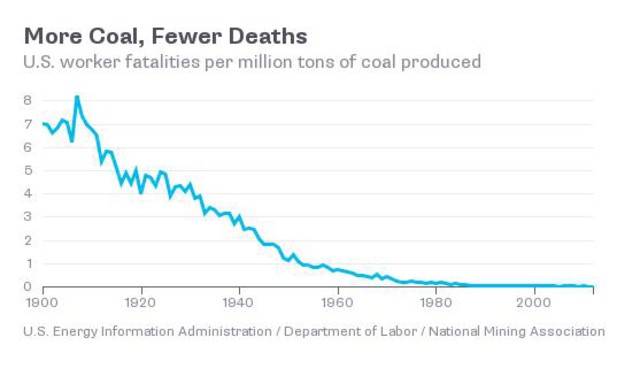
The history of coal mining in the U.S. shows what can be done. Mining disasters were once far more common in the U.S., as Erdogan noted, as well as in the U.K. No longer:

iZsiC6BXW6BU

And it’s not just developed countries that have improved their mine-safety record and reduced the human cost of extracting coal. China’s coal industry averaged 6,151 deaths a year from 2000 to 2005, falling to a still-horrendous 1,049 last year. Much of that was due to reduced production and the closure of illegal mines as demand has fallen since the financial crisis; China remains in a far worse position than Turkey. Still, the Chinese government has acknowledged the problem and has been shutting down unsafe mines in response.

Karen Graham highlights some of Wednesday’s protests against Erdogan’s government:

Taksim Square’s Gezi Park, the site of anti-government protests a year ago, was shut down on Wednesday. The number of law enforcement officers in Istanbul’s historic square was increased as thousands of protesters were met with water cannons and pepper spray wielding police.

In the Turkish capital of Ankara, several protests were staged, including one where students from the Middle East Technical University (ODTU) tried to march on the Energy and Natural Resources Ministry to protest the deaths of the miners and unsafe work conditions. They too, were met with water cannons and tear gas. Other people staged sit-ins in neighborhoods housing diplomatic buildings.

When Prime Minister Recep Tayyip Erdogan visited Soma, rocks were thrown at police protecting the leader’s car as he passed through the crowds. The Prime Minister was booed after speaking about the mine, with the crowd chanting “Resign! Resign!” Reuters reported that at least 10 protesters were taken away by the police.

Checking In On The Iran Talks

It’s getting down to the number of centrifuges allowed for Iran:

“We need at least 100,000 IR-1 (first generation) centrifuges to produce enough fuel for each of our (civilian) nuclear (power) plants. We have informed the International Atomic Energy Agency about our plans to build 20 plants,” a senior Iranian official said on condition of anonymity. U.S. officials, however, have made clear for months that the number of centrifuges they are willing to tolerate operating in Iran over the medium term is in the low thousands to ensure that Tehran’s ability to produce a usable amount of bomb-grade uranium, should it go down that road, is severely limited.

Iran, which has demonstrated a readiness to curb higher-level enrichment, says such draconian limitations would be a violation of its right to enrich – an issue Supreme Leader Ayatollah Ali Khamenei has said is a “red line” for Tehran.

Obama: A Christian Of Doubt

The historian James Kloppenberg, author of Reading Obama, explains why there’s no contradiction in the president embracing both Christianity and skepticism:

I think of the tradition of Christian skepticism as a very old tradition, a tradition of people who are as aware of and concerned with their doubt as they are committed to their faith. I think that’s the kind of Christianity that Obama found at Jeremiah Wright’s Trinity Church of Christ, and I think that’s what appealed to him.

[Recently] I quoted a comment that Jeremiah Wright made to Obama’s biographer, David Remnick. Wright said to him, “He came to Trinity not just looking for a social gospel but looking for a church that didn’t put other people down.” That sense of Christians as people on a quest, and that quest taking them in different directions, and different people choosing different worlds for themselves is something that I think appealed to Obama and is consistent with the way you would expect from the son of cultural anthropologist to think. He understands that the different cultures in human history have had different orientations toward values.

He finally found in Jeremiah Wright’s church a way of thinking that made sense to him, and he uses that phrase, “I felt the spirit of God beckoning to me” with reference to his experience in Trinity Church. I think it’s pretty powerful. It’s the sort of conversion story that you get in William James’s Varieties of Religious Experience, and I think it’s similar to the experience that Obama himself had.

Partly because of the Muslim canard, very few have taken the president’s profession of Christianity very seriously. I’d argue it’s critical to his record and to his politics, but Christianist Republicans and secular Democrats have largely missed it because of ideological blinders. Back in 2007, I wrote:

He was brought up in a nonreligious home and converted to Christianity as an adult. But—critically—he is not born-again. His faith—at once real and measured, hot and cool—lives at the center of the American religious experience. It is a modern, intellectual Christianity. “I didn’t have an epiphany,” he explained to me.

“What I really did was to take a set of values and ideals that were first instilled in me from my mother, who was, as I have called her in my book, the last of the secular humanists—you know, belief in kindness and empathy and discipline, responsibility—those kinds of values. And I found in the Church a vessel or a repository for those values and a way to connect those values to a larger community and a belief in God and a belief in redemption and mercy and justice … I guess the point is, it continues to be both a spiritual, but also intellectual, journey for me, this issue of faith.”

At some point, a historian may take a look at Obama’s record and see in it the contours of this very modern Christianity: His Niebuhrian foreign policy, with a few moments of compassionate weakness (Libya) and his dogged resilience on expanding access to basic healthcare for millions come to mind. But it’s a theme way under-covered and a paradigm rich for interpretation. Obama’s religiosity is of a type that seems occluded in a culture riven between fundamentalism and scientism. But I suspect it is the religiosity of the American future.

Fired For Being Pushy?

Ken Auletta reports on one reason Jill Abramson may have been fired as NYT editor:

Several weeks ago, I’m told, Abramson discovered that her pay and her pension benefits as both executive editor and, before that, as managing editor were considerably less than the pay and pension benefits of Bill Keller, the male editor whom she replaced in both jobs. “She confronted the top brass,” one close associate said, and this may have fed into the management’s narrative that she was “pushy,” a characterization that, for many, has an inescapably gendered aspect … Eileen Murphy, a spokeswoman for the Times, said that Jill Abramson’s total compensation as executive editor “was directly comparable to Bill Keller’s”—though it was not actually the same.

I was also told by another friend of Abramson’s that the pay gap with Keller was only closed after she complained. But, to women at an institution that was once sued by its female employees for discriminatory practices, the question brings up ugly memories. Whether Abramson was right or wrong, both sides were left unhappy. A third associate told me, “She found out that a former deputy managing editor”—a man—“made more money than she did” while she was managing editor. “She had a lawyer make polite inquiries about the pay and pension disparities, which set them off.”

Bryce Covert points out that such executive pay disparities are common:

Many women who reach the top are still paid less than their male peers. The highest paid female executives at S&P 500 companies still make 18 percent less than the men in these roles, on average. For example, Heather Bresch, CEO of pharmaceutical company Mylan, makes about a third less than average CEO pay in her sector, and Campbell Soup CEO Denise Morrison makes about a quarter less.

Olga Khazan comments:

Economists have suggested that one factor driving the gender wage gap is that women “don’t ask” for as much money in negotiations. The implication is, then, that women should ask, since they supposedly have nothing to lose. But both social-science research and real-life job sagas have shown that women sometimes do pay a price for self-advocating. A few months ago, the story of one female job candidate went viral when her offer to teach at Nazareth College was allegedly retracted when she asked for better compensation.

Times national editor Alison Mitchell suggested to Capital New York Tuesday that Abramson’s firing “wouldn’t sit well with a broad swath of female Times journalists who saw her as a role model.” But what would be even more demoralizing is if it turns out to be true that a woman as powerful as Abramson was punished for being “pushy”—and, worse yet, if the pay gap between the two editors was real.

Chadwick Matlin observes the sizable pay gap in journalism:

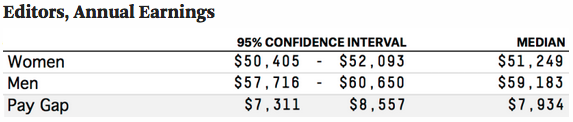
If the pay gap did exist, Abramson wouldn’t have been the only woman in journalism paid less than her male peers. According to the Census Bureau’s 2008-2012 American Community Survey, the median annual earnings for a male editor was $59,183 (+/- $1,467). Female editors made $51,249 (+/- $844).

Pay gap

Hadas Gold notes that Abramson wasn’t always the easiest person to work with:

[S]ome who worked with her said she fostered an atmosphere of insecurity by seeming to regard disagreement as a personal challenge or even betrayal. In contrast to her careful and fastidious style as a reporter, her opinions as editor, some believed, were prone to snap judgments that hardly braked for conflicting evidence or points of view. She struck a note of disdain for people who considered job offers elsewhere, as though the Times were the only worthy place to practice one’s craft, and even had a tattoo with the “T” of the Times — an institutional loyalty that did not protect her from the whims and changing moods of her own boss when the going got tough.

I can imagine a man with that rep being lionized as an old-school character. A woman? Not too much. Weissmann believes “whatever the reasons for her abrupt departure, by pretty much any meaningful measure, Abramson seemed to be doing an excellent job piloting the Times into a bright digital future”:

Consider: Bill Keller led the paper from 2003 until mid 2011. During that time, its finances degenerated so thoroughly that the company was forced to borrow a glorified payday loan from Mexican oligarch Carlos Slim. Near the very end of Keller’s tenure, however, the Times finally began implementing the online paywall that’s resurrecting its business. It has almost 800,000 digital-only subscribers—the vast majority of whom have been acquired on Abramson’s watch—and is now turning a decent operating profit.

Yglesias also defends the business side of Abramson’s NYT tenure:

You often see companies change management amidst business crises. But one thing that is clear is that amidst a generalized crisis for the American newspaper industry the Times is doing quite well as a business. In the first quarter of the year, the Times scored a $22 million operating profit on $390 million in revenue. That revenue figure represented a 2.6 percent increase from the year-ago quarter, including a 3.4 percent increase in ad revenue.

The overall newspaper industry, meanwhile, is a disaster area.

Rebecca Traister calls Abramson’s firing “among the most harsh and humiliating I’ve ever seen play out in the media’s recent history”:

Within minutes of the editorial meeting at which the turnover was announced, Abramson’s name had been scrubbed from the masthead of the paper she’s run for the past two and a half years. A Times spokeswoman told Buzzfeed that Abramson would not be remaining with the paper in any professional capacity and would have no involvement in the transition of power. Sulzberger made no pretense that this was anything other than an unceremonious dump. When staffers reportedly expressed concern that Abramson’s firing would be a blow to women, he helpfully explained that that women in top management positions are just as likely to be fired as men in top management positions.

Ezra cautions:

“As part of a settlement agreement between her and the paper, neither side would go into detail about her firing,” reports the New York Times. Perhaps that’s not true. With anonymous sources you never really know who’s talking and who isn’t. But at this juncture it’s probably mostly true. The Sulzbergers are likely trying to ride this out. It sounds like Abramson is legally barred from discussing the break. Friends and allies might step into the breach, but so too will hanger-ons, troublemakers, and earnest observers who think they know a lot more than they do. Moreover, this seems to have been an incredibly well-kept secret in the Times newsroom. The universe of people who know the real story is, for now, quite small — and they’re only in the know because one side or the other is sure they won’t talk.

Which isn’t to say the reporting coming out now is wrong. It’s just not quite right, either. There’s some truth in it, a lot of truth missing, a few lies mixed in for good measure, and it’ll be a long time till we can tell which is which.

She Fought Against Sponsored Content

WIRED Business Conference: Think Bigger

We’re rounding up as many assessments of Jill Abramson’s abrupt exit from the NYT as we can, so stay tuned. But one thing is worth recalling:

Although both have denied it in public, Thompson and Abramson’s relationship spiraled down over the past year, as Thompson pressed ahead with plans to move the Times into native advertising. “She was morally opposed to that,” an executive said. “She told me it would not happen on her watch.”

But it did, of course, as the philistine from the UK pushed it through. If one factor in Abramson’s firing was her resistance to this unethical and desperate gambit, then it’s all the more depressing. And yes, I thought and think the world of Abramson. And what always struck me about her – apart from her sardonic humor, relentless drawl and revulsion at bullshit – was her transcendence of gender. She leant in at every opportunity. She never accepted a gender double standard for a second – which is why she was a real role model for other women in journalism. I sure hope these virtues – and yes, they’re virtues weren’t behind her demise at the NYT:

As I’ve written before, female leaders are liked best when they lead their organizations not unlike one would lead a casual weekend drum circle—cheerily deferring to others and giving everyone a chance. Meanwhile, they’re resented to a greater degree than their male counterparts when behaving authoritatively. And Abramson, by all accounts, was nothing if not authoritative … Times national editor Alison Mitchell suggested to Capital New York Tuesday that Abramson’s firing “wouldn’t sit well with a broad swath of female Times journalists who saw her as a role model.” But what would be even more demoralizing is if it turns out to be true that a woman as powerful as Abramson was punished for being “pushy”—and, worse yet, if the pay gap between the two editors was real.

And this is troubling to me:

In a controversial 2013 piece in Politico, Dylan Byers wrote: “At times, [staffers] say, her attitude toward editors and reporters leaves everyone feeling demoralized; on other occasions, she can seem disengaged or uncaring.”

But a look at the examples he gave shows just how gendered these discussions can get. In one instance, Abramson reportedly ordered an editor to leave a meeting to change a stale photo on the newspaper’s homepage. That was played in the article as proof of Abramson’s brusque, demoralizing style. But compare that to this anecdote about how Tim Cook, head of Apple, dealt with a manufacturing problem in China.

Cook forced an executive to leave the meeting to get on a plane to China, without the dude even changing his clothes. I doubt if that was regarded as “pushy”. Look: no woman has a right to keep a job she’s doing poorly in because she’s a woman. But Abramson’s management of the NYT coincided with relative success in an extremely troubled time in media – and certainly seemed to me, as a loyal subscriber, to be producing an excellent paper. The combination of that record and yesterday’s brutal, near-vindictive public firing suggests something awry. I’d say that at the very least, we need to find out exactly what the pay disparity may have been between Abramson and her predecessor, Keller. And I’d also say that this story may get some more legs if the tiny few who know all about it start to leak.

(Photo: Executive Editor of The New York Times Jill Abramson attends the WIRED Business Conference: Think Bigger at Museum of Jewish Heritage on May 7, 2013 in New York City. By Brad Barket/Getty Images for WIRED.)