Could The Senior Vote Break Left?

David Frum warns the GOP against taking the over-65s for granted. An important point:

Among all voters 65-plus, women outnumber men only slightly: In 2010, for every 100 women older than 65, the Census counted 95.5 men. The political result? The mild preference in favor of President Obama among older women voters was swamped by the intense hostility of older men.

As we advance from age cohort to age cohort, however, the men dwindle away. At 75, the Census counts 80.2 men for every 100 women; at 85, 58.3 men for every 100 women. The good news for men: Our survival prospects are rising! In 1990, the Census counted only 45.6 men for every 100 women older than 85. The bad news for the Republicans: The disparity in sex-survival rates has huge political effects on the way the old vote.

But Trende continues to downplay the GOP’s demographic challenges:

Obama’s vote share in 2012 was less than it was in 2008; the Republican coalition expanded, which is actually unusual when taking on an incumbent — along with Andrew Jackson and Franklin D. Roosevelt (twice), Obama is the only other incumbent president to not win a larger raw share of the popular vote in a reelection win. Republicans are at, or near, all-time highs in their performances in the House, among governors, and in the state legislatures. While it is true that the midterm electorates are different than presidential electorates, they’re subject to the same long-term trends and should demonstrate a gradual GOP decline.

For decades, political scientists have argued that elections are largely about a few fundamental factors, and that other factors come out in the proverbial wash. Both parties tend to elect competent candidates who raise a lot of money, commit gaffes and play within the 40-yard lines of American politics. Attempts to add one group to a party’s coalition inevitably pushes some other group out, resulting in a regression-to-mean. We might have to abandon this model in the future, but so far the “old” model hasn’t had sufficient failures to justify looking elsewhere for explanations of elections.

The CDC Backs The Gay Pill

This is terrific news for combating the resilient transmission of HIV among gay men:

“HIV infection is preventable, yet every year we see some 50,000 new HIV infections in the United States,” stated CDC Director Dr. truvadaTom Frieden. “PrEP, used along with other prevention strategies, has the potential to help at-risk individuals protect themselves and reduce new HIV infections in the United States.” The new guidelines also stress that patients be tested for HIV prior to starting PreP and be tested again at three-month intervals so if someone on PrEP does become infected with HIV they discontinue taking the drugs and begin HIV treatment.

Soon to follow: a serious public health education campaign. The CDC report is here (pdf). The Dish’s extensive recent coverage of this issue can be read here.

Where Does Polarization Come From?

Hans Noel tries to answer the question:

Members of Congress are not polarized because voters are now better sorted. And voters are not polarized simply because legislators now are. The missing piece is ideological activists, who now dominate the political parties. In short, policy demanders. These politically engaged activists are the base that legislators are increasingly playing to, because they are the ones who provide campaign resources and who threaten primary challenges. Their polarization also filters to voters, through elected officials but also through the media and informal networks. (And ultimately, these activists themselves may be polarized because elite political thinkers are polarized, but you don’t have to buy that story to believe that activists are important.) Of course, studying legislative and mass polarization is very important, but its far from the center of the story.

Seth Masket adds that almost no one “gets into politics with the goal of driving the parties further apart.” Instead, he argues, individuals “get involved in politics usually because they want the government to do something different from what it’s currently doing”:

Activists have become better at this over time. They’re increasingly organizing over a broader range of issues and they’ve become adept at getting political parties to adopt their stances, making it even harder for politicians to resist them. This isn’t necessarily a bad thing. Indeed, this is how governing ideas are generated and translated into law. But it’s important to remember that the parties aren’t far apart because people hate each other; they’re far apart because people want the government to do things. This is why exhortations for common ground tend to fall on deaf ears. People favor compromise in principle, except on the one thing that drove them into politics in the first place.

Julia Azari partially blames growing polarization on growing distrust of government:

[P]artisanship and declining trust in government have become mutually reinforcing. In my research, I find that mistrust of governing institutions (I focus on the presidency, although I think we can all agree that Congress has not been immune to this) emerged around the same time that the parties began to sort ideologically in response to the collapse of the New Deal coalition and the rise of cultural issues on the agenda. These began – in the late 1960s – as distinct phenomena. But as time went on, they became intertwined. A general lack of reverence and respect for the office of the presidency – not without good reason after Watergate and Vietnam – have merged with party polarization to create an environment in which presidents tend to be divisive, rather than uniting figures. They also tend, as I argue in the book, to rely more on language that appeals to their supporters and their campaign promises, which does little to alleviate the problem. In turn, these developments shape the incentives of individual members of Congress, who have increasingly little reason to collaborate across party lines.

Europe’s Anti-Roma Racism, Ctd

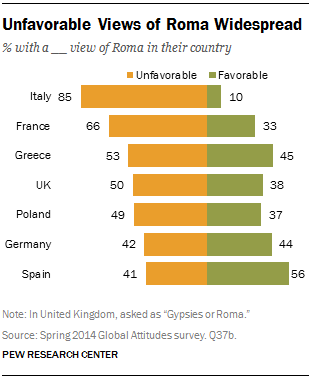
Perusing the latest Pew survey data from seven European countries, Adam Taylor notices an interesting finding about attitudes toward ethnic and religious minorities:

The most negative views in Europe aren’t directed toward Muslims or Jews. Rather, it’s Roma. This chart is really quite remarkable, showing that RomaSpain is the only nation where more people hold positive views of Roma than negative. In Italy, just 10 percent have positive views about Roma, while 85 percent have negative views.

Unfortunately, it’s not entirely surprising. Roma, often dismissively referred to as “gypsies” in Europe, have suffered discrimination in Europe for centuries, and some estimates suggest that 70 percent of their European population was killed during the Holocaust. Last year, Europe’s tabloid media got into a frenzy over allegations that Roma families in Greece and Ireland had stolen “blond girls.” (In both cases, it was later confirmed that the children were actually Roma).

The Dish looked at attitudes toward the Roma in Europe at the time of the “blond girls” allegations here.

Risky Business

James Surowiecki finds that entrepreneurs have a hard time identifying a bad bet:

The 18th-century Irish-French economist Richard Cantillon, who coined the term “entrepreneur,” defined it as a “bearer of risk.” And in 1921 the economist Frank Knight argued that the function of entrepreneurs was to “specialize in risk-taking.” Yet studies of entrepreneurs find that, in general, they’re as risk-averse as everyone else. Only when it comes to starting a business are they daring.

And that’s because the fundamental characteristic of entrepreneurs isn’t risk-seeking; it’s self-confidence. A 1997 study in the Journal of Business Venturing found that entrepreneurs are overconfident about their ability to prevent bad outcomes. They’re also overconfident about the prospects of their business. A 1988 study in the same journal of some 3,000 entrepreneurs found that 81 percent thought their businesses had at least a 70-percent chance of success, and a third thought there was no chance they would fail – numbers that bear no relation to reality. A recent paper called “Living Forever” notes that entrepreneurs are more likely than other people to overestimate their life spans.

A Tree Grows In Africa

But really, just one tree. Or so it would seem from this roundup of book covers from Africa Is A Country:

Book Covers

Michael Silverberg explains:

The texts of the books were as diverse as the geography they covered: Nigeria, Zimbabwe, South Africa, Botswana, Zambia, Mozambique. They were written in wildly divergent styles, by writers that included several Nobel Prize winners. Yet all of books’ covers featured an acacia tree, an orange sunset over the veld, or both. …

I asked Peter Mendelsund—who is an associate art director of Knopf, a gifted cover designer, and the author of a forthcoming book on the complex alliances between image and text—to help me understand how the publishing industry got to a place where these crude visual stereotypes are recycled ad nauseam. (Again and again, that acacia tree!)

He points first to “laziness, both individual or institutionalized.” Like most Americans, book designers tend not to know all that much about the rest of the world, and since they don’t always have the time to respond to a book on its own terms, they resort to visual cliches. Meanwhile, editors sometimes forget what made a manuscript unique to begin with. In the case of non-Western novels, they often fall back on framing it with “a vague, Orientalist sense of place,” Mendelsund says, and they’re enabled by risk-averse marketing departments.

The Gender Divide On Elder Care

Kathleen Geier addresses it:

[W]omen are the majority of those who provide unpaid care for ill, disabled, or elderly friends and relatives. The burden of unpaid care work that women continue to shoulder plays a major role in women’s persistent economic inequality. Directly, there is the opportunity cost that comes when women cut back hours or drop out of the paid labor force to provide care; economist Nancy Folbre has referred to this cost as the “care penalty.” Indirectly, unpaid care work affects women’s compensation in the paid labor market. Research has shown that a portion of the gender pay gap is attributable to the fact that women with children are, on average, paid less than their otherwise identical counterparts. Another study found that working in a caregiving occupation is associated with a 5- to 10-percent wage penalty, even when skill levels, education, industry, and other observable factors are controlled for.

She calls the push for paid family leave occurring in several states “grossly underreported, even in the feminist media that you’d think would be most interested in them”:

Feminist issues around the body, reproductive rights, rape culture, and so on are always going to be sexier, and easier to sell to mainstream media outlets, than feminist issues around work. The carnivalesque appeal of a feminist demonstration like “Slutwalk” is obvious – but a “Shitwork Walk,” if one were to be organized, not so much. … Even within the spectrum of feminist care issues, care for the elderly tends to be neglected. Child care tends to be a happier burden; you’re nurturing someone at the beginning of life and seeing them grow and develop. But care for an elderly person occurs at the end of that person’s life. Instead of seeing them develop their abilities, you often witness them losing those abilities – a difficult and lonely process.

Previous Dish on the wage gap hereherehere, and here.

Reality Check

The sky still hasn’t fallen in Colorado:

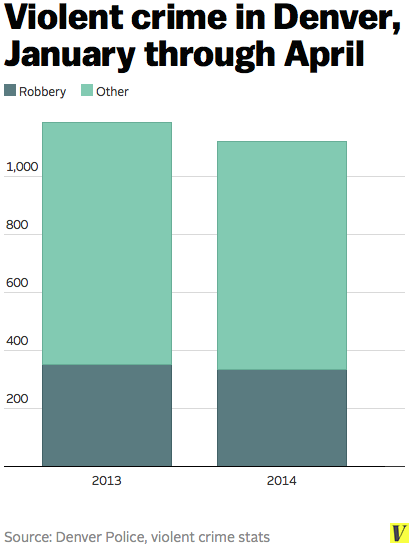
The Denver Police Department’s crime data shows that violent crime from January through April dropped by 5.6 percent compared to the violent_crimesame time period last year, and robberies in particular fell by 4.8 percent. Major property crimes also dropped by 11.4 percent, with burglaries falling by 4.7 percent, compared to the same time last year. …

All of that is despite warnings from law enforcement officials that crime, particularly robberies and burglaries, would rise following legalization. Two months back, Denver District Attorney Mitch Morrissey told me that legal marijuana was already causing more crimes. But if that’s the case, it’s not showing up in the city’s crime statistics.

History Isn’t A Straight Line

That’s one lesson drawn from Steven Hahn’s review of David Brion Davis’ The Problem of Slavery in the Age of Emancipation:

Rather than portraying the age of emancipation as an inevitable process once it commenced, Davis suggests that the Haitian Revolution and the British emancipation may have steeled the resistance of American slaveholders, who came to regard abolition as a fatal blow to the world they knew. That resistance, in turn, worsened tensions in national politics over the future of slavery, and led slaveholders to demand greater protection for their property and greater power in the federal government. They had been especially exercised by abolitionists aiding fugitives from slavery and driving off slave-catchers who came to retrieve them. As a consequence, slaveholders pushed a new Fugitive Slave Law through Congress in 1850 that both strengthened their hands and increased the vulnerabilities of all people of African descent, whether or not they were enslaved. Growing numbers of white Northerners – not just abolitionists – saw in this a fundamental attack on religious principles and civil rights.

How To Woo A Spider

Bring her a gift:

The scientists collected 53 male spiders from the wild who were found to be carrying gifts for females. Amazingly, 70% of these males were holding worthless gifts such as prey leftovers, presumably after having eaten the prey themselves. … The researchers then brought all of these spiders (both the ones holding worthless gifts and what I like to think of as the more earnest males carrying genuine gifts) into the lab. The male spiders were then given either a real gift to give to a female spider (a big juicy housefly), a worthless gift (an insect skeleton), or no gift at all.

So how did the females react?

Females were equally likely to mate with males who carried real gifts as those who carried leftovers from their dinners. This is not surprising, given that since the gift was cleverly wrapped by the male, the female may not have been able to tell what the package contained before ‘agreeing’ to mate with her male suitor. Instead, females much preferred to mate with males in good body condition rather than skinny, underfed males. Therefore, those males that ate their gifts were actually the ‘smart’ ones (whether they knew this or not) as it was better to be in good shape having had a full meal, but courting the female with the equivalent of an empty box of chocolates than to court her looking wan but holding the equivalent of a roast dinner. The well-fed males not only had a higher chance of mating a female, but females also let them mate with them sooner and for a longer period of time.

More surprisingly, females also didn’t seem to care about whether males even carried a gift at all. They were actually as likely to mate with males without a gift as males with a gift (as long as their bodies were in good condition).